The Real Cost of Mobile Hydraulic Repair in DFW (2026 Guide)
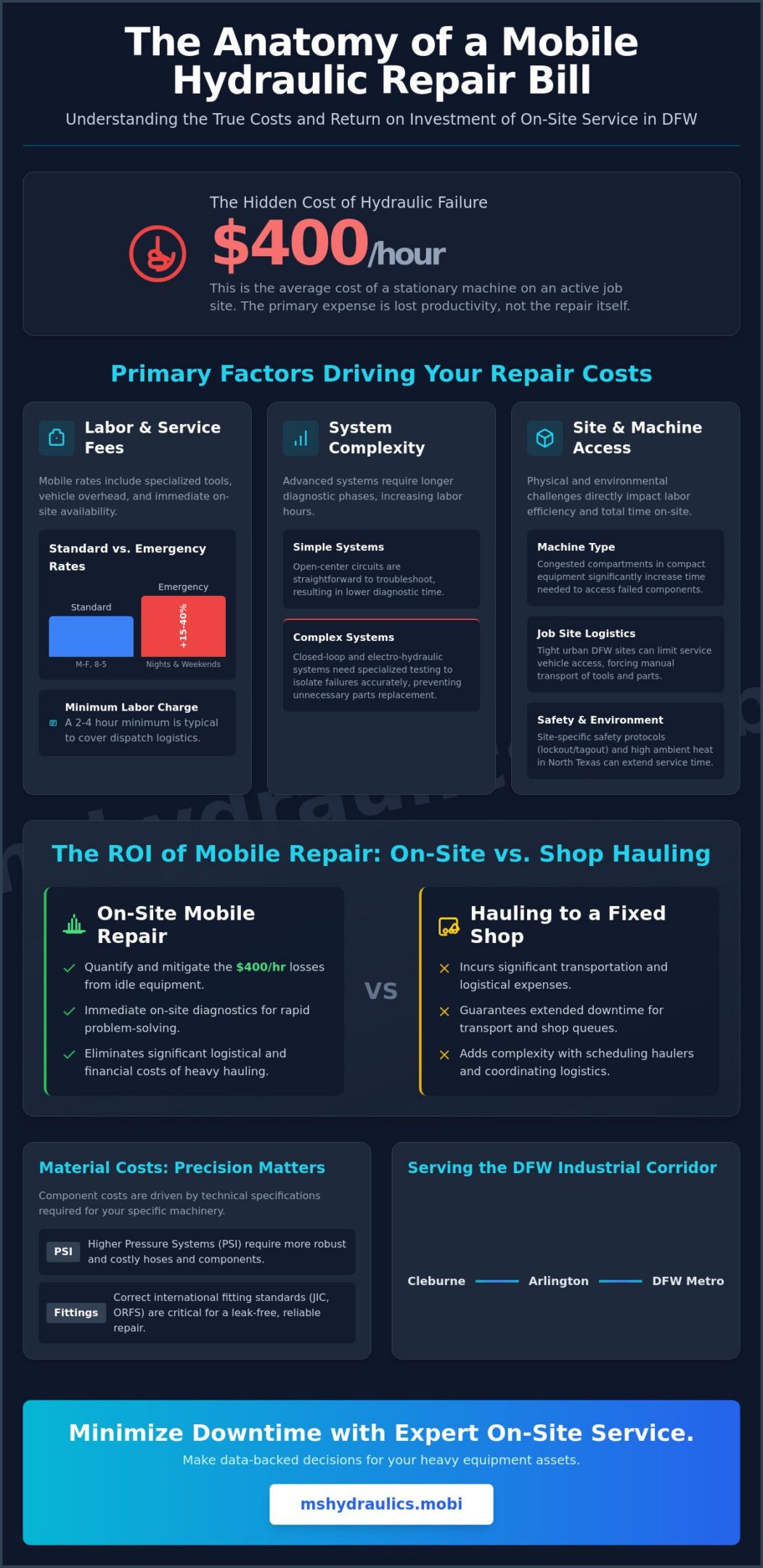
The most significant expense of a hydraulic failure isn’t the technical repair itself; it’s the $400-per-hour cost of a stationary machine on an active job site. For project managers, these mounting losses often outweigh the initial mechanical issue. It’s difficult to maintain a stable maintenance budget when you’re faced with the unpredictable cost of mobile hydraulic repair in DFW. You’ve likely felt the frustration of deciphering travel fees versus labor rates while your project timeline slips away.
This guide provides the technical clarity required to manage your heavy equipment assets with professional precision. You’ll gain a clear understanding of how mobile service fees are calculated and how to differentiate between standard and emergency service requirements. Our analysis previews the primary cost drivers and provides a framework for evaluating the return on investment for on-site services, ensuring your operational decisions are backed by rigorous data and engineering logic.
Key Takeaways
- Identify how mechanical complexity and component accessibility dictate specific labor requirements and final project billing.
- Evaluate the total cost of mobile hydraulic repair in DFW by comparing field service premiums against the significant logistical expenses of heavy hauling.
- Understand the impact of technical specifications, including PSI ratings and international fitting standards like JIC and ORFS, on material expenditures.
- Quantify the financial advantages of on-site diagnostics in mitigating the high hourly losses associated with idle heavy equipment.
- Review the specialized service capabilities available throughout the DFW industrial corridor, specifically targeting regions from Cleburne to Arlington.
Factors Influencing Mobile Hydraulic Repair Costs in DFW
The total cost of mobile hydraulic repair in DFW is determined by a confluence of technical variables rather than a simple flat-fee structure. Industrial maintenance requires a methodical approach to diagnostics and physical repair. Understanding these variables allows equipment managers to project maintenance expenditures with greater accuracy and minimize budgetary surprises. Several primary factors dictate the final invoice for on-site services.
System Complexity and Diagnostic Time
Technical complexity is a primary driver of labor hours. Simple open-center circuits found on basic utility equipment are relatively straightforward to troubleshoot. However, modern hydraulic machinery often utilizes advanced closed-loop systems with load-sensing pumps and electro-hydraulic proportional valves. These systems require extensive diagnostic phases. Technicians must use specialized pressure testing equipment to isolate failures within the circuit. Intermittent pressure drops or thermal-related performance issues often extend the initial assessment period. The failure must be replicated under specific load conditions to ensure an accurate repair plan. This diagnostic precision prevents the unnecessary replacement of functional components.
Machine Type and Accessibility Challenges
Physical accessibility significantly impacts labor efficiency. A repair on a compact skid steer often involves working within a highly congested engine compartment. Technicians might spend several hours removing unrelated components just to access a single leaking hydraulic hose or valve bank. In contrast, large-scale excavators offer more internal volume but require heavier tooling and more rigorous safety protocols for component handling. Specialized industrial machinery, such as drill rigs or pile drivers, presents unique challenges due to customized hydraulic circuits that deviate from standard OEM configurations.
The job site environment in urban Dallas or the Fort Worth industrial corridor also influences the cost of mobile hydraulic repair in DFW. Tight footprints on downtown construction sites limit the placement of service vehicles. This logistical constraint often forces technicians to transport tools and parts over longer distances manually. It increases the total billable hours for the operation. Efficient on-site diagnostic services depend on the technician’s ability to reach the machine quickly and set up a safe work perimeter.
Environmental variables in North Texas also play a role. High ambient temperatures during summer months affect fluid viscosity and can complicate thermal diagnostics. Additionally, stringent safety requirements on active municipal or industrial sites necessitate additional setup time for site-specific hazard assessments and lockout/tagout procedures. These essential steps ensure operational safety and compliance with international industry standards. They also contribute to the overall time spent on-site during a heavy equipment maintenance call.
Breakdown of Hourly Labor and Field Service Fees
Labor rates for mobile services are higher than fixed-shop rates because of the specialized inventory and high-pressure diagnostic tools required for on-site execution. When calculating the cost of mobile hydraulic repair in DFW, stakeholders must account for the technician’s technical expertise and the logistical burden of bringing a fully equipped fabrication shop directly to the machine. While the median annual wage for mobile equipment technicians serves as a baseline for industry compensation, the billable hourly rate includes insurance, specialized vehicle maintenance, and complex overhead. In the DFW industrial corridor, the billed labor rate reflects the premium for immediate technical availability.
Standard vs. Emergency Response Rates
Standard business hours in North Texas typically align with a Monday through Friday, 8:00 AM to 5:00 PM schedule. Service requests outside these parameters, including weekends or night shifts, generally incur premium rates. These premiums often reflect a 15% to 40% increase over standard labor charges. This adjustment compensates for the immediate mobilization of resources and the disruption of scheduled maintenance cycles. Most providers also enforce a minimum labor hour requirement, typically ranging from two to four hours, to ensure the logistical feasibility of dispatching a technician to a remote site. This minimum ensures that even minor adjustments are economically viable for the service provider to perform on-site.
Travel and Dispatch Logistics in North Texas
The geographic scale of the Dallas-Fort Worth metroplex necessitates structured travel billing. Providers often utilize either a flat-rate service call fee or a tiered mileage-based charge originating from primary hubs like Cleburne or Dallas. DFW traffic congestion significantly impacts technician arrival times, which is why many firms favor a transparent travel fee over hourly billing for transit time. For projects requiring on-site diagnostic services, understanding these logistical surcharges is critical for accurate budget forecasting. Distance from industrial hubs like Mansfield or Arlington directly correlates with travel expenses, making localized dispatch a key factor in cost containment.
Effective cost management depends on distinguishing between the labor performed and the field service fee. The latter covers the “rolling shop” expenses, including high-capacity hydraulic hose crimpers and diagnostic gauges housed within the service truck. By consolidating these fees into a single maintenance plan, fleet managers can better predict the overall cost of mobile hydraulic repair in DFW while ensuring their equipment receives professional-grade technical attention without the delay of hauling to a central shop. This structured approach to billing provides the transparency needed for high-level asset management.
Material Costs: Hoses, Fittings, and Cylinder Components
Material expenditures represent a substantial variable in the total cost of mobile hydraulic repair in DFW. While labor is billed by the hour, component pricing is dictated by technical specifications such as pressure ratings and metallurgical requirements. High-pressure systems operating at 5,000 PSI or above require reinforced hoses and specialized fittings to maintain structural integrity under load. Selecting the correct hose diameter and PSI rating is not merely a matter of fitment; it’s a critical engineering decision that impacts the longevity of the entire hydraulic circuit.
Custom Hydraulic Hose Fabrication Pricing
The choice between 2-wire braided and 4-spiral wire hoses is a primary cost driver. High-cycle applications often necessitate the increased durability of spiral reinforcement, which commands a higher price point than standard braided alternatives. Utilizing custom hydraulic hose fabrication on-site eliminates the lead times associated with OEM procurement. This is particularly valuable when dealing with a variety of fittings, including JIC, NPT, and ORFS. Specialized international standards, such as DIN or BSPP, often require specific adapters that may not be readily available in standard retail inventories. Stainless steel or high-corrosion fittings also add to the material total but are necessary for equipment exposed to harsh North Texas environmental conditions.
Cylinder Rebuild vs. Replacement Analysis
For large-scale infrastructure projects, heavy equipment cylinder rebuilds in Texas often prove more economical than total unit replacement. A standard reseal operation is cost-effective if the barrel and rod remain within original engineering tolerances. However, labor-intensive processes such as honing damaged barrels or polishing rods to remove scoring will increase the technical scope. If a rod requires re-chroming or the barrel is severely pitted, the material and machining costs might approach the price of a new component. Technicians must perform a rigorous physical assessment to determine the most viable path forward for the equipment owner.
Safe handling of these materials is mandatory. Technicians must adhere to OSHA’s standard for The Control of Hazardous Energy when depressurizing circuits and replacing components. Beyond the physical parts, hydraulic fluid replacement and environmental disposal fees are standard inclusions in a professional quote. Because hydraulic fluid is a petroleum-based product, its price fluctuates with market conditions. Proper disposal on industrial sites ensures compliance with local regulations and prevents soil contamination. These combined factors create a comprehensive picture of the material investment required for high-performance mobile repairs.
Accurately forecasting the cost of mobile hydraulic repair in DFW requires a granular look at these material variables. By prioritizing high-quality fittings and hoses that meet or exceed SAE standards, fleet managers can reduce the frequency of component failure. This technical foresight ensures that the investment in materials translates into long-term mechanical reliability and peak operational performance.
The Hidden Cost of Downtime: Why Mobile Repair Saves Money
Calculating the real cost of mobile hydraulic repair in DFW requires an analysis of the machine’s revenue-generating capacity versus its idle overhead. When an excavator or drill rig fails, the financial impact extends far beyond the mechanical repair bill. Industry data confirms that the cost of downtime for hydraulic equipment ranges from $150 to $400 per hour. This figure accounts for lost productivity, operator wages, and fixed project overhead that continues to accrue regardless of machine status. Mobile intervention directly addresses these losses by performing technical repairs at the point of failure.
Choosing on-site service eliminates the logistical burden of heavy hauling. Transporting a non-functional machine requires specialized trailers, permits, and significant man-hours for loading and unloading. These logistical steps often add 48 to 72 hours to the repair timeline. By performing the repair on-site, the equipment owner bypasses these expenses and prevents the secondary damage that can occur when moving a machine with a compromised hydraulic circuit. Immediate on-site repair also serves as a critical risk mitigation step, preventing environmental contamination from uncontrolled fluid leaks. This standard of rapid intervention is equally vital in facility maintenance, where providers like Miami 305 Plumbing offer 24/7 emergency services to mitigate damage and restore operations quickly.
Opportunity Loss on North Texas Job Sites
Common machines like skid steers and backhoes are the primary drivers of project momentum in the North Texas industrial sector. A four-hour on-site fix allows for same-day production recovery, whereas a three-day shop turnaround can trigger steep contract penalties. These penalties are common in Dallas-area municipal and commercial projects. When a machine is stationary, the operator’s wages continue to accrue, further inflating the total loss. The ability to resume operations within a single shift provides a measurable competitive advantage and protects the project’s bottom line.
Preventative Maintenance as a Cost-Saving Strategy
Implementing a rigorous heavy equipment maintenance program offers a high return on investment. Regular on-site diagnostic services identify micro-leaks and pressure variances before they result in a total system blowout. This proactive approach extends the operational life of hydraulic pumps and motors, which are significantly more expensive to replace than hoses or seals. Data-driven maintenance ensures that components are replaced based on wear parameters rather than after a catastrophic failure occurs.
For precision diagnostics that protect your bottom line, consider the technical advantages of Mobile Hydraulic Repair to keep your fleet operational and efficient.
Professional Mobile Hydraulic Services in Cleburne and DFW
Ms. Hydraulics LLC maintains a disciplined approach to field service, prioritizing technical integrity and transparent reporting for every dispatch. Our operations focus on the critical industrial corridors of North Texas, providing specialized support where heavy machinery is most active. By utilizing a methodical diagnostic process, we ensure that the cost of mobile hydraulic repair in DFW remains predictable and aligned with the actual mechanical requirements of the equipment. Our technicians possess the specialized expertise required for complex hydraulic pump, motor, and valve repair, ensuring that every component meets original engineering specifications before the machine returns to service.
Our specialized service area encompasses the regions from Cleburne and Alvarado to Mansfield and Arlington. This localized focus allows for efficient mobilization and a deep understanding of the specific industrial demands within these zones. We operate as a serious partner for major players in construction and infrastructure, offering a level of professional decorum and technical accuracy that aligns with international industry standards.
Ms. Hydraulics LLC Technical Standards
Precision is the cornerstone of our service model. We utilize high-quality hydraulic parts and fabrication techniques to ensure that every repair is a long-term solution rather than a temporary fix. As locally owned industrial veterans, we understand the stability required for large-scale operations in North Texas. Our technicians prioritize the verification of all physical and mechanical parameters during the repair process. This commitment to excellence ensures that the hydraulic circuit maintains its performance under peak load conditions, reducing the likelihood of recurring failures and secondary system damage.
Getting an Accurate Quote for Your Repair
To receive a precise estimate and minimize the initial diagnostic phase, equipment managers should have specific data ready for our intake team. Providing the machine model, a detailed description of symptoms, and the exact job site location allows us to prepare the necessary specialized tooling and inventory for the service call. This preparation is essential for managing the cost of mobile hydraulic repair in DFW effectively.
- Machine Model and Serial Number: Enables accurate identification of OEM hydraulic specifications and fitting standards.
- Detailed Symptom Reporting: Helps technicians isolate whether the failure is in the pump, valve bank, or a specific cylinder.
- Site Accessibility Details: Assists in logistical planning for the service vehicle to ensure a rapid and safe setup.
Our diagnostic-first approach ensures that you only pay for the necessary technical interventions. We provide 24/7 mobile support across the DFW Metroplex for emergency requirements, maintaining a steady and structured communication rhythm from the initial call to the final technical report. This methodical flow provides the order and predictability that stakeholders require when managing high-value heavy equipment assets.
Optimizing Operational Efficiency and Maintenance Budgets
Managing the total cost of mobile hydraulic repair in DFW requires a shift from reactive troubleshooting to strategic asset management. By accounting for the technical variables of system complexity and the high cost of machine downtime, project managers can protect their operational margins. Professional on-site diagnostics and precision hose fabrication eliminate the logistical delays and hauling expenses that often inflate maintenance budgets. Technical accuracy in component selection ensures that repairs meet international standards for long-term reliability.
Founded in 2021 with deep roots in Cleburne and North Texas, Ms. Hydraulics LLC provides specialized 24/7 mobile hydraulic hose fabrication and cylinder rebuilds. We serve the construction, agriculture, and industrial sectors with technical integrity and a focus on mechanical verification. Our methodical approach to field service provides the order and predictability your operations require to stay on schedule. Request an On-Site Diagnostic Quote from Ms. Hydraulics LLC today to secure professional-grade support for your heavy equipment assets. We look forward to partnering with you to ensure your machinery remains at peak performance.
Frequently Asked Questions
What is the average hourly rate for mobile hydraulic repair in DFW?
The billing structure for the cost of mobile hydraulic repair in DFW is determined by technical expertise and the overhead of maintaining a rolling fabrication shop. While salary data indicates an average mobile technician in the metroplex earns $36.62 per hour, the billed labor rate is higher to cover specialized diagnostic equipment, insurance, and vehicle maintenance. Technical complexity and the type of machinery being serviced also influence the final hourly rate.
Is there a separate fee for the technician to travel to my job site in Arlington or Mansfield?
A separate travel or service call fee is standard for dispatches to Arlington, Mansfield, or other regional hubs. This fee covers the logistical costs of transit and the availability of on-site fabrication tools. Providers often use flat-rate fees for specific industrial corridors to provide cost predictability for equipment managers. This ensures that the technician arrives with a full inventory of high-pressure components.
How much more does emergency after-hours hydraulic service cost?
Emergency after-hours services typically incur a premium rate that is 15% to 40% higher than standard business hour charges. This surcharge accounts for the immediate mobilization of technical resources and the logistical challenges of night or weekend repairs. These fees are necessary to maintain 24/7 availability for critical infrastructure projects and to minimize the high cost of machine downtime.
Can you fabricate hydraulic hoses on-site, or do I need to bring the old one to a shop?
Technicians perform hydraulic hose fabrication on-site using mobile crimping equipment and a comprehensive inventory of fittings. You don’t need to transport old hoses to a shop, as the mobile unit can replicate the original specifications exactly. This on-site service includes pressure testing to ensure the new assembly meets or exceeds the required PSI ratings for your specific machine.
Is it cheaper to rebuild a hydraulic cylinder or buy a new one?
Rebuilding a cylinder is often the most economical path if the internal components are within engineering tolerances. A professional reseal and rod polishing can restore a cylinder to peak performance for significantly less than the price of a new OEM component. However, the technical assessment must confirm that the barrel doesn’t require extensive honing or the rod doesn’t need re-chroming before a rebuild is approved.
What information do I need to provide to get an accurate cost estimate over the phone?
Accurate cost estimates require the machine’s make, model, and serial number, as well as a description of the mechanical symptoms. Identifying whether the issue involves a pump, valve, or cylinder helps the service provider prepare the correct diagnostic gauges and parts. Providing the exact location and site accessibility details also ensures that the travel and labor components of the quote are precise.
Do you charge a minimum number of hours for a mobile service call in Johnson County?
A minimum labor hour requirement, often between two and four hours, is standard for mobile service dispatches in Johnson County. This policy ensures the economic viability of sending a specialized technician and a fully equipped service truck to your site. It covers the initial diagnostic phase and the setup of a safe work perimeter according to industrial safety standards.
Does the type of hydraulic fluid used affect the total cost of the repair?
The total cost of mobile hydraulic repair in DFW is affected by the volume and technical grade of the hydraulic fluid replaced. Synthetic fluids or specialized oils required for high-cycle industrial applications cost more than standard mineral-based oils. Environmental compliance also requires professional disposal of used fluid. This is typically billed as a separate environmental fee to ensure proper petroleum waste management and site safety.