Heavy Equipment Maintenance in Cleburne & North Texas: A Technical Guide
Unplanned downtime in the North Texas industrial sector carries a quantifiable burden, often exceeding $2,500 per hour for high-capacity excavators and drilling rigs. You recognize that the sustained 105-degree temperatures in Cleburne during July and August represent more than just operator discomfort; they’re a direct threat to hydraulic viscosity and component longevity. Maintaining peak performance requires more than basic oil changes. It demands a disciplined approach to Heavy Equipment Maintenance that prioritizes the engineering specifications of your fleet.
We’ll provide the technical protocols necessary to maximize machine uptime and stabilize hydraulic performance under extreme thermal loads. You’ll learn how to implement engineering-grade maintenance that extends machine lifespan and converts unpredictable repair spikes into manageable, predictable operational costs. This guide details specific fluid analysis intervals, seal compatibility for high-pressure systems, and the critical role of ISO-certified field technicians in maintaining system integrity. We’ve structured this analysis to address the unique mechanical stressors found in the North Texas climate, from particulate contamination to heat-induced seal failure.
Key Takeaways
- Transition from reactive “run-to-failure” models to a rigorous preventive maintenance strategy to significantly reduce long-term operational costs.
- Establish a structured service hierarchy based strictly on machine operating hours to ensure critical 250-hour and 1000-hour overhauls are executed with precision.
- Protect hydraulic system integrity by implementing technical protocols to mitigate thermal stress and fluid oxidation risks unique to the North Texas climate.
- Execute a professional Heavy Equipment Maintenance checklist that prioritizes region-appropriate lubrication and the early detection of structural fatigue.
- Leverage mobile repair and expert on-site diagnostics to eliminate the logistical overhead and downtime associated with hauling machinery to off-site facilities.
The Economics of Heavy Equipment Maintenance in North Texas
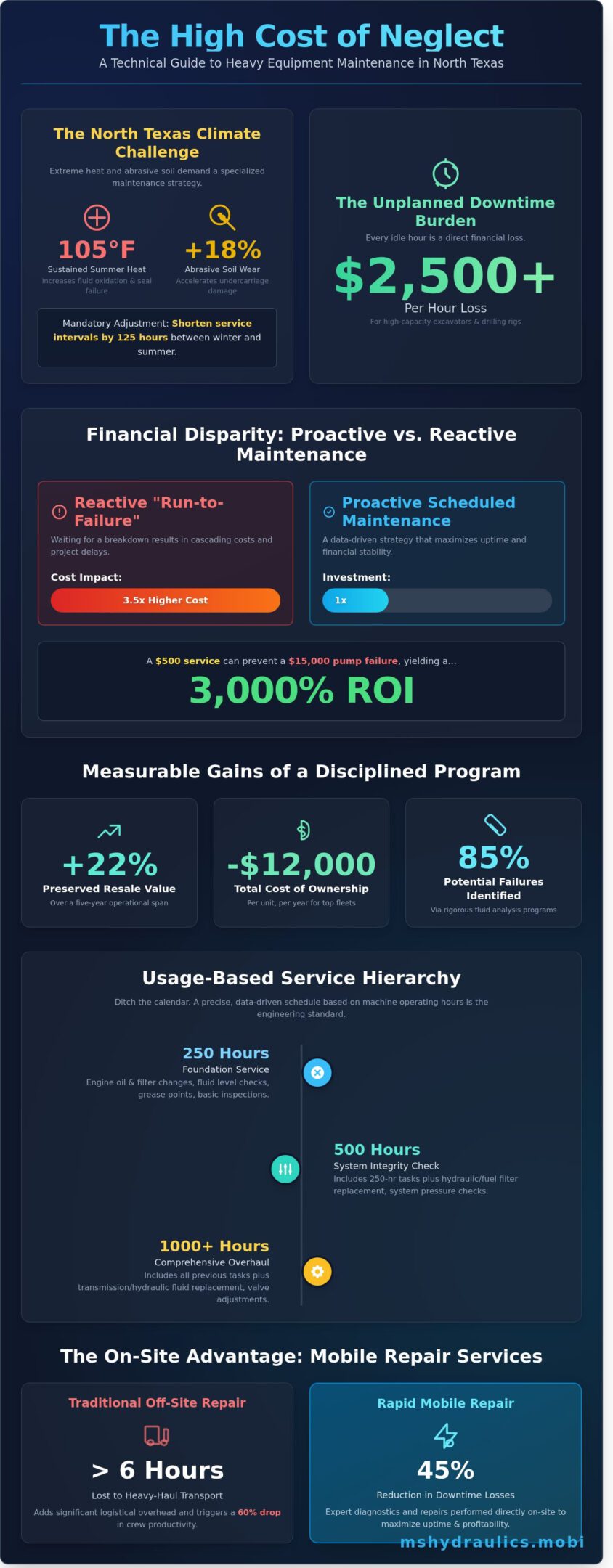
Heavy Equipment Maintenance is defined as a systematic protocol for inspecting, servicing, and repairing industrial machinery to ensure peak operational reliability and safety. In the Cleburne construction sector, the financial disparity between “run-to-failure” strategies and scheduled preventive maintenance (PM) is documented and severe. Reactive repairs typically cost 3.5 times more than proactive servicing because of emergency shipping for parts and collateral component damage. Managing the heavy equipment life cycle effectively requires a data-driven approach that prioritizes technical uptime over short-term cost-cutting. For Tier 1 assets like 20-ton excavators or high-flow skid steers, consistent maintenance records preserve approximately 22% more of the machine’s resale value over a five-year operational span. In the 2023 fiscal year, 74% of high-performing North Texas fleets reported that structured PM schedules reduced their total cost of ownership by $12,000 per unit annually.
The decision to defer maintenance often stems from a misunderstanding of the long-term capital requirements of heavy machinery. A single hydraulic pump failure on a D6 dozer can cost $15,000 in parts alone. If that failure occurs because of contaminated fluid that should’ve been replaced during a $500 service interval, the return on investment for that maintenance task is 3,000%. This logic applies across all mechanical systems, including engines, transmissions, and final drives. Operators in Johnson County who implement rigorous fluid analysis programs identify 85% of potential failures before they result in a catastrophic work stoppage.
Calculating Downtime Costs for DFW Job Sites
An idle machine on a DFW job site generates immediate financial loss that extends beyond the repair bill. For a standard mid-sized excavator, hourly losses average $325 when you account for operator wages, idle support equipment, and project delays. The Downtime Multiplier for North Texas commercial projects is the total hourly project burn rate divided by the machine’s individual rental rate. Rapid mobile repair services mitigate these losses by 45% by eliminating the 6 hours usually required for heavy-haul transport to a repair facility. When a machine stops, the entire crew’s productivity often drops by 60%, creating a ripple effect that can push project completion dates past liquidated damage deadlines.
Environmental Stressors in the Cleburne Region
Johnson County’s climate presents mechanical challenges that demand specific technical responses. When ambient temperatures exceed 100°F, hydraulic fluid oxidation rates increase significantly, causing a loss in lubrication efficiency and the formation of varnish. North Texas soil contains abrasive particulates that accelerate wear on undercarriages and pivot pins by 18% compared to standard conditions. Fleet managers must adjust service intervals by 125 operating hours when transitioning from 35°F wet winters to 105°F dusty summers. This adjustment prevents the premature failure of seals and filters caused by high particulate counts in the air. Proper Heavy Equipment Maintenance in this region requires a focus on cooling system integrity and air filtration efficiency to combat these localized stressors.
Effective maintenance isn’t just a mechanical necessity; it’s a financial strategy. By tracking the mean time between failures (MTBF) and the cost of parts, Cleburne businesses can predict their annual maintenance spend with 90% accuracy. This predictability allows for better bidding on competitive North Texas contracts, as the risk of unplanned expenses is minimized. Maintaining a disciplined service schedule ensures that the equipment remains a revenue-generating asset rather than a liability on the balance sheet.
Core Components of a Professional Maintenance Program
A high-performance maintenance strategy transitions from a calendar-based approach to a usage-based methodology. Relying on monthly intervals often results in either over-servicing underutilized machines or neglecting high-cycle units. A professional Heavy Equipment Maintenance program utilizes precise operating hours to dictate service intervals. This data-driven approach ensures that components like hydraulic pumps and seals are serviced exactly when their wear profiles demand it, rather than according to an arbitrary date on a wall calendar.
The hierarchy of service follows a structured 250, 500, and 1,000-hour progression. While the 250-hour service typically focuses on engine oil and primary filtration, the 1,000-hour overhaul involves comprehensive system flushes and the inspection of internal tolerances. Adhering to these benchmarks is essential for maintaining compliance with OSHA equipment safety standards; which mandate that all machinery remains in a safe operating condition. Standardizing this documentation according to ISO 9001 protocols protects manufacturer warranties and maintains the resale value of the fleet.
Fluid analysis serves as the diagnostic “blood test” for any machine. By analyzing microscopic metal particles and chemical shifts in hydraulic oil, technicians can identify failing components before a catastrophic blowout occurs. A 5% increase in copper content in an oil sample might indicate premature wear on a brass piston shoe; allowing for a scheduled repair instead of an emergency shutdown. For specialized assistance with system health, fleet managers can consult with engineering experts to interpret these complex data sets and avoid costly downtime.
The Daily Walk-Around Protocol
Operators must perform a visual inspection before every shift to identify immediate risks. This includes verifying engine oil, coolant, and hydraulic reservoir levels to prevent cavitation or thermal runaway. Technicians should inspect cylinder rods for scoring and hose fittings for “weeping” seals. Identifying a hairline fracture in a steel bracket today prevents a structural failure tomorrow. These 10-minute checks reduce unscheduled downtime by approximately 15% across a standard construction season.
Advanced Diagnostics and Pressure Testing
Visual inspections reach their limit when assessing internal component health. Professional Heavy Equipment Maintenance requires the use of flow meters and pressure gauges to verify hydraulic system performance. Technicians monitor displacement and torque parameters to ensure pumps meet their 3,500 PSI specifications. If a pump shows a 10% drop in flow at peak pressure, it indicates internal bypass leakage. Utilizing specialized diagnostic tools allows for precision adjustments that restore factory-spec efficiency and prevent collateral damage to the rest of the circuit.
Just as professional maintenance programs streamline mechanical operations, many businesses find similar efficiencies by outsourcing other essential, non-core tasks. This can range from specialized diagnostics to ensuring crews have professionally cleaned uniforms, which improves safety and team professionalism. To see how a dedicated service handles industrial-grade laundry, you can visit Hustle Laundry.
Hydraulic System Integrity: Mitigating Thermal Stress and Contamination
Hydraulic systems serve as the lifeblood of industrial machinery, yet they represent the most frequent failure point for Heavy Equipment Maintenance in North Texas. The Cleburne climate, where ambient temperatures frequently exceed 100°F during summer months, places extreme thermal stress on hydraulic circuits. When fluid temperatures surpass the 140°F threshold, the chemical stability of the oil begins to degrade through oxidation. This process creates insoluble thickeners, varnishes, and sludges that coat internal components. For every 18°F increase in temperature above 140°F, the service life of the oil is effectively reduced by 50%.
Beyond chemical breakdown, microscopic particulate contamination acts as a silent killer within the system. Approximately 75% of all hydraulic component failures are the direct result of contaminated fluid. Particles as small as 2 to 5 microns, which are invisible to the naked eye, cause erosive wear on precision valves and pump rotating groups. This “sandblasting” effect increases internal leakage, reducing overall system efficiency by as much as 20% before an operator even detects a performance drop. Adhering to heavy equipment maintenance best practices requires a rigorous fluid analysis program to identify these contaminants before they cause catastrophic pump seizure.
Operators must implement active cooling strategies to combat high-ambient-heat environments. This includes cleaning oil cooler fins every 250 hours of operation and ensuring that thermal bypass valves are functioning correctly. Maintaining the correct viscosity index is also vital; using a fluid that’s too thin at high temperatures leads to boundary lubrication failure, while fluid that’s too thick increases friction and heat generation.
The Critical Role of Hydraulic Hose Maintenance
Hydraulic lines in Cleburne fleets face dual threats: external abrasion from limestone dust and internal “heat checking.” Heat checking occurs when high-temperature cycles cause the inner tube of the hose to harden and crack, eventually leading to a burst. For North Texas operators, custom hose fabrication is significantly more reliable than “one-size-fits-all” retail replacements. Custom assemblies ensure the correct pressure ratings and precise lengths to prevent rubbing. Ms. Hydraulics LLC provides specialized custom hose services for Cleburne and Alvarado operators, ensuring that every replacement meets or exceeds OEM specifications for flow and pressure tolerance.
Cylinder Health and Rebuild Cycles
Cylinder failure often begins with subtle signs like rod pitting or seal hardening. A single pit on a chrome rod acts like a knife, slicing through polyurethane seals in fewer than 100 cycles. Once the seal integrity is compromised, external contaminants enter the system. A professional cylinder rebuild is a technical process involving barrel honing, rod polishing to a 16-32 micro-inch finish, and the installation of high-spec seals. Choosing to rebuild an OEM cylinder typically costs 40% to 60% less than purchasing a new unit. Furthermore, a rebuilt OEM cylinder often outperforms generic replacements, which frequently utilize inferior alloys that lack the structural rigidity required for Heavy Equipment Maintenance in demanding excavation environments. When sourcing replacement components for cylinder rebuilds, understanding the specific hydraulic parts specifications for North Texas applications ensures compatibility with local operating conditions and extends component lifespan.
The Cleburne Operator’s Preventive Maintenance Checklist
Effective Heavy Equipment Maintenance requires a disciplined approach to technical inspection and mechanical upkeep. Adhering to a standardized protocol ensures that components operate within their engineered tolerances, reducing the risk of catastrophic hydraulic failure. This checklist serves as the baseline for operations in the demanding North Texas environment.
- Step 1: Decontamination and Inspection. Clean the machine thoroughly using high-pressure steam. Removing accumulated North Texas clay and limestone dust is essential to reveal hairline structural cracks and weeping hydraulic seals. A clean surface allows technicians to identify 0.5mm fissures in weld points before they result in boom failure.
- Step 2: Thermal-Resistant Lubrication. Apply NLGI Grade 2 lithium-complex grease to all pivot points and bearings. Cleburne summers often exceed 100°F, which causes standard lubricants to lose viscosity. Use grease with a minimum dropping point of 500°F to ensure the lubricant remains in the pin-and-bushing interface during high-cycle operations.
- Step 3: Filtration Management. Replace air, fuel, and hydraulic filters every 500 engine hours or according to the OEM schedule. Maintaining ISO 4406 cleanliness standards is vital. A single 10-micron particle can cause significant scoring in a hydraulic cylinder wall, leading to internal bypass and loss of lift capacity.
- Step 4: Hydraulic System Verification. Perform a full pressure test using calibrated gauges. Verify that the primary relief valve settings match the factory specifications, typically ranging between 3,000 and 4,500 PSI depending on the model. Pressure spikes or sluggish cycle times often indicate an auxiliary valve out of adjustment.
- Step 5: Centralized Documentation. Record all fluid levels, pressure readings, and component wear measurements in a digital fleet log. Systematic data entry allows for predictive analysis, identifying a 15% increase in fuel consumption or a 10-degree rise in operating temperature before a breakdown occurs.
Specific Guidance for Excavators and Skid Steers
Excavator operators must monitor undercarriage tensioning daily. In the abrasive soil of Johnson County, maintaining 10mm to 15mm of track sag prevents premature sprocket wear. Inspect final drives and swing motors for oil clarity; cloudy oil indicates water ingress or metallic shedding. Check all attachment couplings for hydraulic line integrity, as a 2% drop in flow can decrease attachment torque by 10% during heavy grading.
While this guidance focuses on industrial applications, the core principles of precise excavation and equipment management apply across the construction sector. Even in residential projects like swimming pool installations, understanding the equipment and local geology is key to success. As an example of how specialized contractors approach these challenges in a different context, the team at Marlin Exteriors, Inc. outlines their process for quality installation, which can be an interesting read for anyone involved in complex construction projects.
Managing Fleet Maintenance in Granbury and Mansfield
Coordinating maintenance windows across Granbury and Mansfield requires a 72-hour lead time to prevent site disruption. Mobile service units handle the logistics of remote sites in Waxahachie and Cedar Hill, bringing 2,000-liter oil recovery systems directly to the machine. Our Service Radius for mobile hydraulic support extends 50 miles from our Cleburne facility to ensure 60-minute response times for all Johnson County job sites. Consistent Heavy Equipment Maintenance across these locations reduces the need for emergency hauling by 30% annually.
If your system pressures are falling below OEM specifications, our technicians provide precision diagnostics to restore your machine’s performance. Schedule professional hydraulic testing today to protect your fleet investment.
Scaling Efficiency with Mobile Repair and Expert Diagnostics
On-site repair services represent a critical strategic pivot for fleet managers across the DFW metroplex. Transporting heavy machinery to a central facility often incurs logistical costs ranging from $1,500 to $5,000 per transport cycle, depending on the load’s weight and dimensions. Ms. Hydraulics LLC eliminates these overheads by deploying technical expertise directly to the job site. This model integrates precise mechanical engineering with rapid mobile response. By analyzing system pressure and torque specifications in the field, technicians ensure that machine performance remains within strict operational parameters. Professional partnerships built on this mobile framework prioritize long-term reliability over temporary fixes.
Mobile technicians arrive equipped with flow meters and pressure transducers capable of measuring hydraulic output in real-time. This allows for the identification of internal leakage or pump cavitation before these issues lead to catastrophic component failure. By addressing these variables on-site, we bypass the 48-hour delay typically associated with scheduling third-party transport and shop intake. Our field service reports provide documented data on system performance, allowing for a 15 percent improvement in asset availability across most Cleburne-based fleets. This technical approach ensures that Heavy Equipment Maintenance is handled with the same precision as a factory-floor overhaul.
24/7 Support for Critical Infrastructure Projects
Drill rigs and industrial machinery operating on high-stakes infrastructure projects require immediate technical intervention when failures occur. A single hour of downtime on a Cleburne drilling site can cost an operator upwards of $3,200 in lost productivity according to 2023 regional industry benchmarks. Our mobile units utilize advanced on-board diagnostic equipment to interface with electronic control modules and hydraulic circuits. This capability allows for rapid troubleshooting of complex system faults. By maintaining localized service hubs in Cleburne, we reduce the Mean Time to Repair (MTTR) by as much as 42 percent compared to traditional shop-based models. Rapid response isn’t just about speed; it’s about having the specific diagnostic tools to solve the problem on the first visit. For a comprehensive analysis of how these engineering protocols translate to measurable results across North Texas industrial sites, see our detailed Texas hydraulics case study on industrial reliability.
Customized Maintenance Plans for Industrial Partners
Effective service schedules are not universal. A machine utilized in high-impact demolition requires more frequent hydraulic fluid analysis than one used for light grading. We develop customized maintenance plans that adjust service intervals based on specific duty cycles and environmental stressors. This precision prevents the premature wear of critical components like pumps and actuators. Our approach emphasizes integrity; we only recommend repairs necessary for sustained operational performance. This technical discipline ensures that Heavy Equipment Maintenance remains a value-add rather than a recurring drain on capital. Fleet owners who transition to these data-driven schedules typically see a 22 percent increase in asset lifespan. We focus on the engineering facts to deliver predictable results for every partner.
Establishing a consistent service protocol is the most effective way to protect your capital investments. Our team provides the technical data and mechanical support needed to keep your fleet operational in the most demanding North Texas environments. It’s about maintaining the exact specifications your equipment requires for peak efficiency.
CTA: Contact Ms. Hydraulics LLC for a comprehensive maintenance evaluation in North Texas.
Securing Industrial Uptime with Technical Maintenance Protocols
Effective Heavy Equipment Maintenance in North Texas relies on managing thermal stress and eliminating particulate contamination. Industry data indicates that 80% of hydraulic system failures are caused by fluid impurities. Adhering to the ISO 4406 cleanliness standards ensures that high-pressure components remain functional under extreme thermal loads. Ms. Hydraulics LLC provides the specialized mobile hydraulic repair and on-site hose fabrication necessary to maintain these rigorous engineering benchmarks. Our Cleburne-based technicians utilize advanced diagnostics to identify potential points of failure before they result in costly downtime. It’s essential to integrate these technical audits into your daily operational workflow to preserve asset longevity. We’re ready to deploy our mobile service units to your location, providing the precision your machinery requires. By focusing on system integrity and proactive component replacement, operators can significantly extend the service life of their fleets. Trust our disciplined approach to keep your projects moving forward without interruption.
Schedule On-Site Heavy Equipment Maintenance with Ms. Hydraulics LLC
Frequently Asked Questions
How often should I change hydraulic fluid in the Texas heat?
You should change hydraulic fluid every 1,500 operating hours, but North Texas temperatures exceeding 100°F require a 25% reduction in this interval. High ambient heat accelerates oil oxidation and reduces viscosity, which leads to premature component wear. Operators should conduct fluid analysis every 500 hours to monitor the total acid number and ensure the lubricant maintains its protective properties.
What are the first signs of hydraulic pump failure on heavy equipment?
A 15% increase in cycle times and audible noise levels exceeding 85 decibels are the primary indicators of pump degradation. If your heavy equipment maintenance logs show hydraulic fluid temperatures consistently rising above 180°F, the pump’s internal volumetric efficiency is likely dropping. These symptoms suggest internal leakage or aeration that will eventually lead to total system failure if you don’t address them immediately.
Is it better to rebuild or replace a leaking hydraulic cylinder?
You should rebuild the cylinder if the internal barrel and piston rod remain within the manufacturer’s specified tolerance of 0.002 inches. A professional reseal and hone typically costs 45% to 60% of the price of a new unit. If the rod is bent or the chrome plating shows pitting deeper than 0.005 inches, a full replacement is the only way to ensure long-term reliability.
How does dust in the Dallas-Fort Worth area affect my engine’s air intake system?
Fine particulate matter in the DFW region, often measuring between 2 and 10 microns, can clog air filters 30% faster than the national average. This dust acts as an abrasive that wears down cylinder liners and piston rings if it bypasses compromised seals. Maintaining a filter efficiency of 99.9% is critical to prevent engine “dusting,” which can reduce your engine’s service life by 5,000 hours.
What is the difference between preventive and predictive maintenance?
Preventive maintenance follows a fixed schedule based on operating hours, while predictive maintenance uses real-time data to identify when a component will fail. Predictive techniques, such as vibration analysis or infrared thermography, follow ISO 13372 standards to detect faults before they occur. Integrating predictive sensors into your heavy equipment maintenance program can reduce unscheduled downtime by 15% compared to strictly schedule-based intervals.
Can a mobile technician perform a full hydraulic hose replacement on-site?
A mobile technician can complete a full hydraulic hose replacement on-site within 60 to 90 minutes for most standard industrial machines. Service vehicles are equipped with specialized crimping tools and SAE 100R15 high-pressure hoses capable of handling 6,000 psi. This onsite service eliminates the 4-hour average transport time required to move heavy machinery to a fixed repair facility.
What grease is best for heavy equipment operating in North Texas summers?
You should use an NLGI Grade 2 lithium complex grease with a minimum of 3% molybdenum disulfide for summer operations in Texas. This grease must have a dropping point exceeding 500°F to remain stable when ambient temperatures reach 105°F and pin temperatures climb higher. High-viscosity base oils provide the necessary film strength to protect heavily loaded joints during 12-hour work shifts.
How much can a proactive maintenance program save me in annual repair costs?
A proactive maintenance program typically reduces annual repair costs by 25% by preventing catastrophic component failures. For every $1,000 spent on scheduled inspections and fluid analysis, fleet owners avoid approximately $4,000 in emergency repair expenses and lost productivity. These savings result from extending the life of major components and eliminating the $500-per-hour downtime costs common in heavy industrial applications.