Comprehensive Guide to Hydraulic Parts in Cleburne & North Texas (2026)
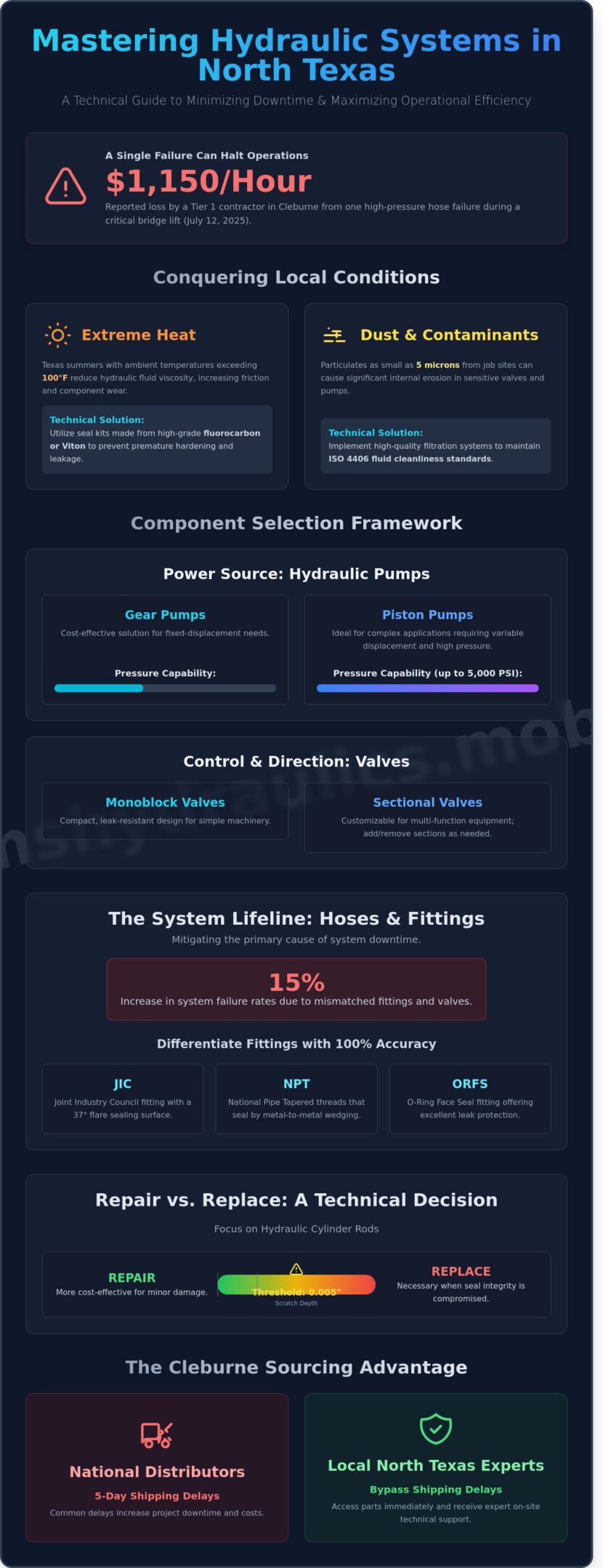
On July 12, 2025, a Tier 1 contractor in Cleburne reported a loss of $1,150 per hour when a single high-pressure hose assembly failed during a critical bridge lift. You understand that in the North Texas industrial sector, mechanical failure isn’t just an inconvenience; it’s a direct threat to your project’s bottom line. Finding the correct hydraulic parts shouldn’t feel like a guessing game involving thread pitches and pressure ratings. You need components that meet exact engineering specifications to ensure system integrity and operator safety.
Our 2026 guide provides the technical data you need to master component selection and minimize unplanned maintenance. You’ll learn how to differentiate between JIC, NPT, and ORFS fittings with 100% accuracy and determine if a hydraulic pump requires a full replacement or a simple seal kit rebuild. We’ll also highlight how local North Texas experts can help you maintain ISO 4406 fluid cleanliness standards while bypassing the typical five-day shipping delays common with national distributors.
Key Takeaways
- Understand the critical role of ISO standards in high-pressure systems to ensure part certification and operational safety.
- Learn how North Texas environmental factors, specifically extreme heat, impact fluid viscosity and the functional lifespan of seal kits.
- Master technical specifications for hoses and fittings, including dash sizes and pressure ratings, to mitigate the primary cause of system downtime.
- Apply a technical decision framework to evaluate the cost-benefit ratio of rebuilding versus purchasing new hydraulic parts based on structural fatigue.
- Discover the logistical advantages of sourcing components locally in Cleburne to minimize expensive shipping delays and access expert technical support.
The Anatomy of High-Pressure Systems: Essential Hydraulic Parts
Hydraulic parts are precision-engineered, interconnected components designed to facilitate fluid power transfer within a closed-loop system. These systems operate under extreme conditions. For instance, heavy machinery used in the Cleburne area often runs at pressures exceeding 3,000 PSI. Adherence to ISO 4413 standards ensures that every component meets rigorous safety and performance benchmarks. Manufacturers must prioritize these certifications to guarantee reliability in high-stress environments. Component compatibility remains a non-negotiable requirement for any operator. Mixing mismatched fittings or valves leads to a 15% increase in system failure rates; it also poses significant safety risks to personnel. The system’s architecture typically divides into three primary categories: fluid storage, power generation, and control mechanisms.
The Power Source: Hydraulic Pumps and Motors
Machinery in North Texas requires specific displacement and torque profiles to handle heavy clay soils and construction loads. Gear pumps offer a cost-effective solution for fixed-displacement needs. Conversely, piston pumps provide the variable displacement and high-pressure capability required for complex 5,000 PSI applications. These components must withstand ambient temperature fluctuations that can impact fluid viscosity and seal integrity. Hydraulic pump efficiency is defined as the ratio of actual fluid volume delivered to the theoretical volume displacement per revolution. Selecting the correct hydraulic parts for power generation ensures the system maintains its 90% volumetric efficiency rating throughout its service life.
Control and Direction: Valves and Actuators
Monoblock valves provide a compact, leak-resistant design for simple machinery. Sectional control valves allow for greater customization in multi-function equipment; they enable operators to add or remove sections based on specific task requirements. Relief valves serve as the primary safety mechanism by venting fluid when pressure exceeds the 100% threshold of the system’s design limit. This prevents catastrophic component rupture during sudden load spikes. Actuators complete the mechanical cycle by converting high-pressure fluid power into precise linear or rotary motion. Modern actuators utilized in industrial settings are rated for millions of cycles, provided the hydraulic parts within the control circuit are maintained to ISO 4406 cleanliness standards.
Core Components Powering North Texas Industries
Cleburne’s industrial output relies on the mechanical efficiency of hydraulic parts within the construction and agricultural sectors. In Johnson County, equipment like excavators and harvesters operate under thermal stress that exceeds standard engineering benchmarks. Texas summers, where ambient temperatures frequently surpass 100°F for extended periods, directly impact fluid viscosity. This thinning of the hydraulic oil reduces lubrication, leading to increased friction and potential component scoring. Operators must select seal kits composed of high-grade fluorocarbon or viton to prevent premature hardening and leakage caused by these extreme heat cycles.
Dust management is another critical variable for local job sites. High-quality filtration systems are essential to capture particulates before they reach sensitive valves; contaminants as small as 5 microns can cause significant internal erosion. For specialized machinery like skid steers, the choice between OEM and aftermarket hydraulic parts often hinges on precision. While aftermarket options offer cost savings, OEM components ensure compliance with ISO 4406 cleanliness levels. This is vital for maintaining the 3,000 PSI operating pressures common in modern Tier 4 engine integrated systems.
Hydraulic Cylinders: The Muscle of the Machine
The cylinder assembly consists of the barrel, piston rod, and internal seals. In heavy-duty North Texas applications, side loading and rod scoring represent the most frequent failure modes. When a rod sustains a scratch deeper than 0.005 inches, seal integrity is compromised, leading to fluid bypass. Professional restoration is often more cost-effective than replacement. You can learn more about the technical specifications of a heavy equipment cylinder rebuild in Texas to understand these restoration parameters.
Accumulators and Reservoirs
Accumulators serve as energy storage units, using compressed nitrogen to maintain system pressure. Bladder accumulators are preferred for high-frequency shock absorption, while piston designs excel in high-volume energy storage. Reservoir design is equally vital; it must facilitate heat dissipation during peak summer months. Large surface area tanks with integrated baffles help cool the fluid and allow air to escape. Maintaining fluid integrity requires high-specification tank accessories, including breathers and magnetic plugs. For those seeking technical support on system optimization, consulting with a specialized hydraulic manufacturer ensures your machinery meets its rated performance benchmarks.
The Lifeline: Hydraulic Hoses and Fittings in the Field
Hoses represent the most frequent point of failure in any industrial hydraulic system, accounting for approximately 80% of unscheduled maintenance events. This vulnerability stems from their role as flexible conduits subjected to continuous pressure spikes, extreme temperature fluctuations, and external abrasion. To ensure operational reliability, technicians must specify hydraulic parts based on precise engineering parameters. This includes dash sizes, which denote the internal diameter in sixteenths of an inch, and specific reinforcement layers. High-pressure applications in heavy equipment often require four-wire or six-wire spiral reinforcement to safely manage working pressures that exceed 5,000 PSI.
Mismatched fittings are a primary cause of catastrophic failure and fluid loss. Whether the system utilizes JIC 37-degree flare, NPT pipe threads, or SAE O-ring boss connections, the seal must be absolute to prevent cavitation and environmental contamination. Custom fabrication provides a solution for non-standard machinery where off-the-shelf components fail to meet specific length or bend requirements. A bespoke assembly ensures the hose maintains its structural integrity without being subjected to unnecessary torsional stress during operation. It’s a standard that prevents the premature fatigue often seen in “one-size-fits-all” replacements.
Identifying Hydraulic Hose Fittings
Field technicians on North Texas job sites frequently encounter a mix of American and international thread standards. Identifying these requires more than a visual check; it demands the use of thread gauges and calipers to distinguish between NPT and BSPT threads. These look nearly identical but possess different thread pitches. Mixing different standards leads to thread stripping and high-pressure leaks. Technicians shouldn’t guess when identifying hydraulic parts in the field. They must verify the seat angle and thread pitch before installation to maintain system safety and performance. For comprehensive guidance on proper identification techniques, our detailed reference on hydraulic fittings near me provides the technical specifications needed to prevent costly mismatches.
Hose Protection and Routing
Operating in the rocky terrain around Cleburne requires additional layers of defense for exposed lines. Installing nylon or steel protective sleeves prevents external abrasion from wearing through the hose cover. Proper routing is equally critical for longevity. Hoses must have enough slack to accommodate expansion under pressure, which typically ranges from 2% to 4% of the total length. Technicians should avoid tight bends that exceed the manufacturer’s minimum bend radius, as this restricts flow and generates excessive heat. If you need immediate assistance with replacements, finding high-quality hydraulic parts near me ensures your equipment returns to service with components that meet or exceed ISO 4406 cleanliness standards.
Repair vs. Replacement: A Technical Decision Framework
Deciding whether to salvage a component or invest in a new unit requires a data-driven approach. Most Cleburne fleet managers follow the 60% rule; if the restoration cost exceeds 60% of the price of a new assembly, replacement is the logical choice. Technicians must inspect for terminal signs like scoring deeper than 0.005 inches on cylinder walls or structural fatigue in the casting. These defects often compromise the safety of the entire system, making it’s impossible to guarantee performance under high-pressure loads.
Diagnostic testing is the only way to prevent repeat failures. Flow testing and pressure monitoring identify the root cause, such as a clogged heat exchanger or a failing relief valve. Without this data, new hydraulic parts are at risk of premature failure within the first 500 hours of operation. Implementing a strict 2,000-hour preventative maintenance schedule can increase the service life of pumps and motors by 35% compared to reactive repair cycles.
When to Rebuild Your Components
Rebuilding is often the most efficient path for specialized cylinders and high-value pumps. This technical process includes rod polishing to a 12 micro-inch finish and installing high-performance fluorocarbon seals. All rebuilt units are tested at 1.25 times their rated pressure to verify they meet OEM specifications. Maintaining a consistent heavy equipment maintenance program ensures these components perform reliably once they’re back in service.
Identifying Critical Failure Modes
Operators shouldn’t ignore the physical signs of internal damage. Contamination is responsible for 82% of component wear, introducing abrasive particles that score valve spools and ruin tolerances. Cavitation occurs when air enters the fluid stream, creating an audible “marbles in a can” noise that signals internal pump erosion. Thermal degradation happens when fluid temperatures exceed 185°F, leaving a dark varnish on internal hydraulic parts and reducing lubrication efficiency.
If your equipment is showing signs of reduced cycle times or excessive heat, it’s time to request a technical diagnostic from our engineering team to determine the most cost-effective path forward.
Sourcing Hydraulic Parts in Cleburne: The Local Advantage
Waiting for shipping is the most expensive way to buy hydraulic parts. In 2023, industrial data indicated that unplanned downtime costs heavy equipment operators an average of $5,000 to $10,000 per hour depending on the scale of the project. For businesses in Alvarado and Granbury, relying on 3-day ground shipping often results in five-figure losses that far exceed the cost of the component itself. Local procurement eliminates these delays while providing a critical layer of technical validation. When you source locally, you gain access to engineers who verify that pressure ratings, thread patterns, and displacement volumes match your specific machinery requirements before the part leaves the shelf.
Ms. Hydraulics integrates parts procurement with sophisticated mobile diagnostic services to ensure system integrity. Installing a new pump into a contaminated system is a recipe for immediate failure. Our technicians use digital flow meters and pressure transducers to analyze system health on-site. This objective, data-driven approach allows North Texas industries to identify the root cause of a component failure, such as cavitation or excessive heat, rather than simply replacing a symptom. We provide on-site solutions that stabilize operations for construction, agriculture, and municipal fleets across Johnson County.
Mobile Fabrication and Repair
On-site hose manufacturing effectively eliminates the 60-minute round trip to a traditional repair shop. Our mobile units are equipped with high-precision crimpers and a full inventory of hydraulic parts to service systems up to 5,000 PSI. We provide expert diagnostics for excavators, skid steers, and drill rigs directly at the job site. By utilizing mobile hydraulic repair Cleburne TX, operators can resume production in a fraction of the time. Every assembly we fabricate follows strict ISO 18752 standards to ensure long-term durability under peak load conditions.
Building a Long-Term Service Partnership
Reliability in industrial maintenance stems from technical authority and disciplined service schedules. We develop custom maintenance plans for Johnson County fleets with 10 or more assets, focusing on predictive component replacement and fluid analysis. This proactive strategy reduces catastrophic failures by 35 percent over a 12-month period. Our team prioritizes integrity, ensuring that every recommendation is backed by mechanical data and engineering logic. To secure your equipment’s performance, contact Ms. Hydraulics for expert parts and service and experience the precision of a dedicated industrial partner.
Securing Peak Performance for Your North Texas Fleet
Maintaining operational efficiency in 2026 requires a disciplined approach to component selection and system maintenance. We’ve analyzed how technical parameters like pressure ratings and torque requirements dictate the performance of your high-pressure systems. Deciding between a technical rebuild or a full replacement involves assessing the duty cycle of your equipment against the cost of downtime. Sourcing the correct hydraulic parts locally ensures your machinery remains within ISO certification standards while minimizing logistics delays.
Ms. Hydraulics LLC has served Johnson County and the broader North Texas region since 2021; we provide the technical precision necessary for heavy industrial operations. Our team delivers expert on-site diagnostics for excavators and drill rigs to identify failures at the source. If you require immediate repairs, we offer custom hose fabrication while you wait to restore system integrity. Don’t let a minor component failure compromise your project’s timeline or safety standards. Get Expert Mobile Hydraulic Support in Cleburne Now. Your equipment is the backbone of your business, and keeping it in top condition is a goal we’re ready to help you achieve.
Frequently Asked Questions
What are the most common hydraulic parts that fail on heavy equipment?
Seals, hoses, and filters represent the most frequent points of failure in heavy equipment systems. Statistics indicate that approximately 40% of all hydraulic downtime stems from seal degradation. These hydraulic parts lose elasticity over time due to heat cycles. High-pressure hoses typically require replacement every 2,000 to 3,000 operating hours to prevent catastrophic rupture.
How do I know if my hydraulic pump is failing or just has a bad valve?
You can differentiate between pump failure and valve malfunction by performing a flow test under load. A pump is failing if it shows a 15% or greater drop in flow rate as pressure increases to its rated PSI. If the system maintains flow but fails to hold pressure, the relief valve is likely stuck or worn. Precise diagnostic tools are necessary to confirm these parameters before ordering replacement hydraulic parts.
Can I replace a hydraulic hose myself in the field?
You can replace a hydraulic hose in the field provided you possess the correct length of hose and matched fittings. Technicians must follow SAE J517 standards to ensure the assembly handles the system’s maximum operating pressure. Field repairs are often temporary measures. It’s essential to use a calibrated crimper for permanent installations to avoid a 3,000 PSI leak that could cause injection injuries.
What is the difference between JIC and NPT hydraulic fittings?
JIC fittings utilize a 37-degree flare seating surface to create a mechanical seal, whereas NPT fittings rely on tapered threads and interference. NPT threads have a 1:16 taper that requires a sealant like PTFE tape to prevent leaks. JIC connections are rated for higher pressures and are more reliable in high-vibration environments. Most modern industrial equipment has transitioned to JIC or ORFS to minimize fluid loss.
How much does it cost to rebuild a hydraulic cylinder in Cleburne?
Rebuilding a standard hydraulic cylinder in Cleburne typically costs between $300 and $1,200. This price range covers the disassembly, honing of the barrel, and installation of a new seal kit. If the chrome rod requires replating or replacement, costs can increase by 50% or more. Most local shops provide a quote within 4 hours and complete the work in a 24 to 48 hour window.
What type of hydraulic fluid is best for the North Texas climate?
ISO VG 46 is the optimal hydraulic fluid for the North Texas climate because it maintains stable viscosity during 105 degree summer peaks. This oil grade provides the necessary film strength to protect internal components from friction. If your equipment operates exclusively in high-load summer conditions, an ISO VG 68 might be preferred. Always check your OEM manual to ensure the fluid meets specific anti-wear (AW) requirements.
Where can I find custom hydraulic hose fabrication near Granbury or Alvarado?
MS Hydraulics offers precision custom hydraulic hose fabrication for operators in the Granbury and Alvarado areas. Our Cleburne facility is located within a 15-minute drive of these locations, providing rapid turnaround on high-pressure assemblies. We stock a wide inventory of 2-wire and 4-wire hoses capable of handling up to 5,000 PSI. Our technicians utilize horizontal crimpers to ensure every assembly meets factory specifications.
Does Ms. Hydraulics provide 24/7 emergency repair for hydraulic parts?
MS Hydraulics provides 24/7 emergency repair services for critical hydraulic systems. We understand that downtime costs operators an average of $500 per hour, so our technicians remain on call for immediate assistance. Our team aims for a 60-minute response time to ensure your machinery returns to service quickly. We maintain a full inventory of seals and fittings to handle most onsite repairs without delay.