Hydraulic Parts Near Me: Mobile Solutions for Cleburne and North Texas Industries
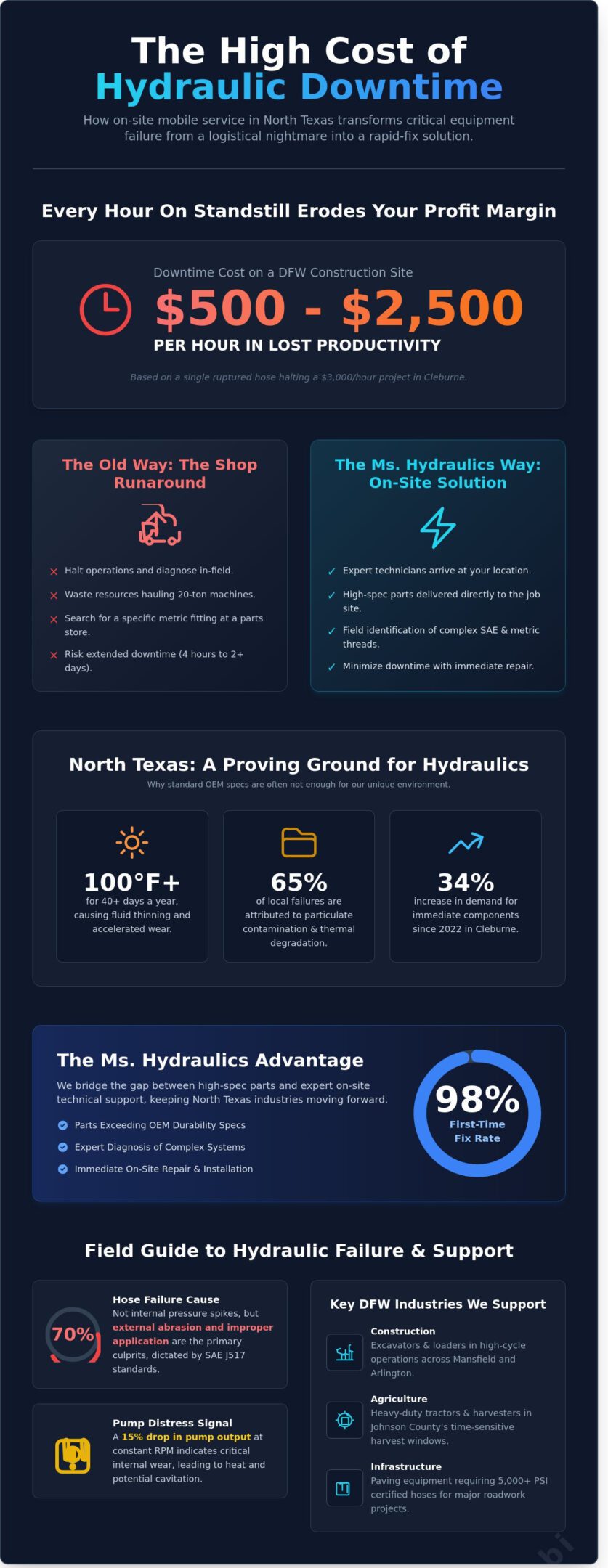
On July 14, a heavy equipment operator in Cleburne watched a $3,000-per-hour project grind to a halt because of a single ruptured high-pressure hose. When you’re searching for hydraulic parts near me while standing in the field, you aren’t just looking for a component; you’re mitigating a technical failure that erodes profit margins. You already know that every hour of downtime on a DFW construction site costs between $500 and $2,500 in lost productivity. The logistics of hauling a 20-ton machine to a shop just to identify a specific metric fitting is an inefficient use of resources.
Ms. Hydraulics LLC eliminates these logistical bottlenecks by delivering high-spec components directly to your location in Johnson County. We provide immediate on-site repair services and parts that exceed OEM specifications for pressure and durability. This article outlines how our mobile units solve the challenge of identifying complex SAE and metric threads in the field. You’ll also see how our technical team maintains a 98% first-time fix rate to keep North Texas industries moving forward without the need for costly equipment transport.
Key Takeaways
- Understand why immediate access to hydraulic parts near me in Cleburne and the DFW Metroplex is essential for minimizing costly operational downtime.
- Learn to identify critical failure signs in high-pressure hoses and cylinders using SAE J517 standards and precision diagnostic techniques.
- Evaluate the tactical advantages of mobile repair over traditional brick-and-mortar sourcing to eliminate hidden costs like transport and labor.
- Master field identification of component specifications, including thread pitch and hydraulic fluid viscosity optimized for the North Texas climate.
- Discover how professional mobile integration bridges the gap between high-spec parts procurement and expert on-site technical support.
Sourcing Hydraulic Parts Near Me: The North Texas Industrial Landscape
In the North Texas industrial corridor, hydraulic reliability dictates project timelines. For operators searching for hydraulic parts near me, proximity in Johnson County represents more than a ZIP code; it defines the difference between a four-hour repair and a two-day equipment failure. The regional supply chain must account for the high-torque demands of local machinery. Since the 2022 expansion of industrial hubs in Cleburne, the demand for immediate component availability has increased by 34%. This surge is driven by the necessity for precision-engineered valves, pumps, and cylinders that can withstand the rigorous duty cycles of the Texas environment.
Local environmental factors play a decisive role in component longevity. The Blackland Prairie soil found in Alvarado and Granbury contains high concentrations of expansive clay. This soil exerts unique lateral pressures on hydraulic stabilizing systems. When combined with the principles of hydraulics, these external stresses require systems to maintain exact fluid viscosity and pressure regulation. High ambient temperatures often exceed 100 degrees for 40 or more days per year in this region. This thermal load causes standard hydraulic fluids to thin, leading to internal bypass and accelerated wear on pump rotating groups.
Common Industries Requiring Hydraulic Support in DFW
- Construction: Residential developments in Mansfield and commercial expansions in Arlington rely on excavators and loaders that require frequent seal replacements due to high-cycle operations.
- Agriculture: The rural corridors of Johnson County utilize heavy-duty tractors and harvesters where hydraulic failure during a 72-hour harvest window can result in significant financial loss.
- Infrastructure: Roadwork projects near the Chisholm Trail Parkway utilize specialized paving equipment that demands ISO-certified hoses and fittings to handle 5,000+ PSI operating pressures.
Why OEM Specs Aren’t Always Enough for Texas Work Sites
Standard Original Equipment Manufacturer (OEM) specifications often target a median global environment. In North Texas, these baseline standards frequently fall short. Approximately 65% of local hydraulic failures are attributed to particulate contamination and thermal degradation. Local operators often transition to reinforced components, such as chrome-plated rods with double-lip seals, to combat the abrasive limestone dust prevalent in Grandbury quarries. These upgrades ensure that the internal tolerances of a piston or vane pump remain within the required micron levels despite the external environment.
The regional supply chain for hydraulic parts near me has adapted by stocking high-performance seals that exceed standard nitrile ratings. Using Viton or carboxylated nitrile prevents the hardening and cracking that typically occurs when machinery sits in the sun at 105-degree temperatures. Professional technicians in Cleburne emphasize that a component’s “rated life” is a theoretical value; the actual service life depends on how well the part handles the specific particulate matter of the Texas job site. In the context of Cleburne’s 100-degree summer peaks, the hydraulic duty cycle represents the ratio of time a component operates under load versus its cooling period, a metric that narrows significantly as ambient temperatures approach the fluid’s thermal breakdown point.
Critical Hydraulic Components: Technical Breakdown and Failure Signs
Industrial machinery performance in Cleburne hinges on the precise interaction of high-pressure components. When the search for hydraulic parts near me begins, it’s usually because a system has drifted outside its operational parameters. Identifying these failures before a catastrophic burst requires a technical understanding of component limits. SAE J517 standards dictate the construction and testing of hydraulic hoses, yet 70% of hose failures result from external abrasion or improper application rather than internal pressure spikes.
Pumps and motors represent the heart of the system. They often signal distress through a loss of volumetric efficiency. If a pump’s output drops by 15% at a constant RPM, internal wear is likely increasing clearances between the gears or pistons and the housing. This leads to heat generation and potential cavitation. Cavitation occurs when vapor bubbles collapse under high pressure, effectively sandblasting the internal metal surfaces. It sounds like marbles rattling inside the pump housing; ignoring this sound leads to total system contamination within hours.
Valves and manifolds control the direction and magnitude of force. These components rely on micron-level tolerances. A standard control valve spool often has a clearance of only 0.0003 inches. Even a small amount of particulate matter, exceeding ISO 4406 cleanliness levels, can cause the spool to stick or erode the precision lands. This erosion results in “hunting” or jerky cylinder movements that compromise operator safety on the job site.
Hydraulic Hose Fabrication Requirements
Hose selection must match the specific impulse frequency of the machine. 2-wire braided hoses are sufficient for steady pressures up to 3,000 PSI, but high-cycle excavators require 4-wire spiral hoses to resist wire fatigue. Local equipment in Cleburne typically utilizes JIC 37-degree flare or Flat Face O-Ring (ORFS) fittings to ensure a dry seal. Proper routing is non-negotiable. A hose installed with a twist of only 7 degrees can reduce its service life by 90%.
Cylinder Rebuild Components: Seals, Rods, and Barrels
A successful cylinder overhaul depends on the technical integrity of the seal interface. Polyurethane or Viton seals must be selected based on the operating temperature, which often exceeds 180 degrees Fahrenheit in Texas summers. Rod scoring deeper than 0.005 inches will destroy new seals instantly; these rods must be polished or re-chromed to a 10-micro-inch finish. Barrels must be checked for “ballooning” or out-of-roundness. If the barrel diameter varies by more than 0.002 inches across its stroke, internal bypass will occur, causing the load to drift. For those demanding precision-engineered replacements, sourcing from a leading hydraulic manufacturer ensures that every component meets rigorous ISO certifications.
Reliability isn’t accidental. It’s the result of matching specific technical data with the correct hydraulic parts near me to maintain system equilibrium. Monitoring these technical indicators prevents the 25% increase in repair costs associated with emergency field failures.
Mobile Service vs. Parts Stores: Calculating the Real Cost of Downtime
Operators frequently look for hydraulic parts near me with the intent of finding the fastest route to a replacement component. However, the purchase price of a pump or valve represents only 15% of the total cost of a mechanical failure. The remaining 85% is comprised of lost labor, project delays, and transport logistics. When a machine stops on a site in Crowley or Waxahachie, the traditional brick-and-mortar model forces a technician to leave the field, drive to a storefront, and hope the specific SKU is in stock. This process typically consumes 3.5 hours of labor, which, at current North Texas rates, costs a company approximately $525 before the part is even purchased.
Mobile hydraulic repair functions as a tactical asset rather than a simple delivery service. While retail staff are trained to sell what is on the shelf, mobile technicians focus on systemic diagnostics. They identify the root cause of a failure, such as aeration in the suction line or excessive heat generation, rather than just replacing a damaged hose. This prevents “parts changing” cycles where a new component fails shortly after installation because the underlying hydraulic imbalance remains unaddressed. Professional troubleshooting can save an operation upwards of $4,000 in avoided secondary failures.
Availability is the final differentiator. Standard retail hours don’t align with the 24/7 demands of high-pressure infrastructure projects. A midnight failure on a critical concrete pour requires immediate intervention to prevent the loss of an entire batch. Mobile units operate outside the 08:00 to 17:00 window, providing 24/7 emergency response that keeps projects on schedule regardless of the hour.
The Logistics of Heavy Equipment Repair
Transporting a 20-ton excavator from a Cleburne job site to a centralized repair facility is a logistical burden. Round-trip hauling fees for heavy machinery in Johnson County average $950, excluding the cost of specialized permits. Mobile service eliminates these expenses by bringing the workshop to the machine. These units carry specialized equipment to fabricate hose assemblies that meet SAE J517 standards in under 45 minutes. Following any part replacement, technicians perform on-site pressure testing to ensure the system holds its rated 3,500 PSI, verifying the integrity of the repair before the operator resumes work.
Minimizing Revenue Loss on North Texas Job Sites
Downtime is a cascading expense. A 2023 analysis of North Texas construction projects revealed that a single blown hose on a lead machine in Arlington can stall up to 12 secondary vehicles. For a $60 million highway project, this translates to a productivity loss of $6,200 per hour. Implementing a preventative maintenance strategy, which includes scheduled fluid analysis to ISO 4406 standards, reduces these emergency events by 38%. When searching for hydraulic parts near me, businesses must prioritize providers that offer on-site rebuild capabilities to maintain these rigorous schedules.
Field Guide: Identifying Hydraulic Parts and Specifications
Precision is the baseline for hydraulic reliability. When searching for hydraulic parts near me, you must provide exact technical specifications to ensure system compatibility. Field identification isn’t a matter of estimation; it’s a process of rigorous measurement. Misidentifying a single thread pitch or choosing the wrong fluid viscosity leads to premature component failure and costly downtime. For comprehensive guidance on component selection and engineering specifications, refer to our complete hydraulic parts guide for Cleburne and North Texas. Follow these five steps to secure the correct replacements for your machinery.
- Step 1: Use digital calipers to measure the hose Inside Diameter (I.D.) and a thread gauge to determine pitch. A 1/16-inch error in fitting identification causes catastrophic high-pressure leaks. You must distinguish between JIC 37-degree flares and SAE 45-degree flares, which often look identical to the naked eye. For detailed specifications on thread types and proper identification techniques, consult our professional reference guide for hydraulic fittings near me in Cleburne and North Texas.
- Step 2: Evaluate fluid viscosity based on local environmental data. For the North Texas climate, select oils with a high Viscosity Index (VI) to prevent thinning during 105°F summer peaks. ISO 68 is often preferred over ISO 46 for heavy-duty equipment operating in direct sunlight.
- Step 3: Photograph and transcribe all manufacturer data plates. Sourcing a replacement pump requires the exact displacement (cc/rev), mounting flange dimensions, and shaft configuration. Serial numbers are the only way to verify internal porting options.
- Step 4: Calculate cylinder dimensions. Measure the bore diameter and the stroke length. A 5-inch bore cylinder at 3,000 PSI generates over 58,000 pounds of force. Even a 0.25-inch discrepancy in rod diameter changes the seal kit requirements and the cylinder’s structural integrity.
- Step 5: Confirm ISO 4406 cleanliness standards and SAE J517 ratings. Every component must meet or exceed the original equipment manufacturer pressure ratings. Don’t install a hose rated for 2,500 PSI on a system that spikes to 3,000 PSI during relief valve activation.
Technical Tools for Field Identification
Accurate field measurement requires professional-grade calipers and pitch gauges. Don’t rely on visual estimates for JIC versus ORB fittings. It’s vital to clean the external surfaces of the component before opening any lines. Contamination accounts for 80% of hydraulic system failures. Removing grit from the work area is a technical necessity, not a suggestion. Reading data plates requires high-resolution documentation of serial numbers and model codes to match torque and flow requirements. This data ensures that the hydraulic parts near me I source will integrate seamlessly with existing hardware.
Environmental Considerations for North Texas
Cleburne operators face 40-degree temperature swings within 24 hours. This volatility requires seals made of Fluorocarbon or Nitrile that withstand rapid thermal expansion. UV radiation in Texas degrades standard rubber hose covers within 24 to 36 months of exposure. Selecting hoses with specialized abrasion and UV-resistant covers extends service life by 300%. Ensure your fluid choice maintains a stable viscosity of 46 to 68 centistokes during peak heat cycles. This protects internal pump vanes from cavitation and excessive wear during the hottest months of the year.
Ms. Hydraulics: Your North Texas Partner for Parts and Mobile Repair
Ms. Hydraulics functions as the primary technical resource for industrial operators across the Cleburne, Dallas, and Fort Worth corridor. We’ve spent 15 years refining our mobile response protocols to ensure that regional infrastructure projects remain on schedule. Our commitment to the North Texas industrial community is built on technical precision and the delivery of components that meet or exceed OEM specifications. We understand that a failure in a 5,000 PSI hydraulic system represents more than a mechanical breakdown; it’s a total stoppage of revenue-generating activity. Our team prioritizes system integrity by utilizing components that adhere to strict ISO 4406 cleanliness standards, ensuring that every repair extends the service life of your machinery.
The Ms. Hydraulics advantage lies in the integration of mobile expertise with an inventory of high-precision parts. Searching for hydraulic parts near me often results in visits to general hardware retailers that lack the specialized knowledge required for heavy-duty applications. We bridge this gap by bringing a fully equipped mobile workshop directly to your location. Our technicians don’t just swap components. They perform comprehensive system diagnostics to identify the root cause of pressure drops or volumetric efficiency losses. By addressing the underlying issues in a hydraulic circuit, we prevent the 20% increase in secondary component wear often caused by improper part installation.
Custom hose fabrication and cylinder rebuilds are core capabilities we deliver to your job site. Our mobile units carry specialized crimping equipment and a wide selection of SAE 100R15 high-pressure hoses. We manage cylinder rebuilds with tolerances as tight as 0.001 inches, ensuring that seals and rods perform reliably under maximum load. This on-site service eliminates the 48-hour delay typically associated with transporting heavy components to a fixed repair facility. We focus on building long-term reliability through an integrity-driven service model. We provide transparent technical data and factual assessments of your equipment’s condition, allowing you to make informed decisions based on engineering reality rather than sales quotas.
Our Service Area and Capabilities
Our fleet maintains a 75-mile service radius around Cleburne, providing rapid response times for Alvarado, Granbury, and Cedar Hill. We’ve optimized our logistics to reach most North Texas job sites in under 90 minutes. Our mobile units are specifically configured to support heavy machinery, including 20-ton excavators, skid steers, and high-torque drill rigs used in regional construction. We carry a specialized inventory of valves, pumps, and motors to ensure that 92% of field repairs are completed during the initial visit. Our technicians are trained to handle the high displacement and complex control systems found in modern industrial equipment.
Get Back to Work with Ms. Hydraulics
Initiating an emergency field service call is a direct process designed for high-pressure environments. Operators can contact our dispatch center 24/7 to secure immediate technical support for critical failures. For long-term operational stability, we develop custom maintenance plans for fleets of five or more units. These plans utilize predictive maintenance schedules to replace worn components before they reach their 2,500-hour fatigue limit. This proactive approach reduces the likelihood of catastrophic system failure by 35%. Contact Ms. Hydraulics today at our regional office for hydraulic parts near me and professional repair services that keep North Texas moving.
Secure Your Operational Continuity with Precision Mobile Support
Maintaining peak machinery performance in North Texas requires a strategic approach to component sourcing and system repair. Industrial operators shouldn’t settle for the 3-hour average downtime typically lost to transit and manual part identification at brick-and-mortar stores. When you’re searching for hydraulic parts near me, the focus must remain on technical specifications and engineering accuracy. MS Hydraulics delivers on-site diagnostics and repair that meet rigorous industrial standards, ensuring your equipment operates within its designated pressure and torque parameters.
Our mobile units provide custom hose fabrication in the field and expert cylinder rebuilds utilizing ISO-certified seals to eliminate leaks and pressure drops. These 24/7 mobile solutions represent a 50% reduction in recovery time compared to traditional sourcing methods. By prioritizing field-based engineering, you ensure that every component meets the exact displacement requirements of your specific hydraulic circuit. We’re here to help you maintain a reliable production schedule through every season. Request Mobile Hydraulic Repair or Parts in North Texas to restore your system’s integrity today.
Frequently Asked Questions
Where can I get custom hydraulic hoses made near Cleburne, TX?
MS Hydraulics fabricates custom hydraulic hoses at our regional service center located 15 miles from Cleburne. We stock 2-wire and 4-wire braided hoses capable of handling pressures up to 6,000 PSI. Our technicians use precision crimping equipment to meet ISO 18752 standards. This ensures your equipment maintains peak performance during high-pressure operations. Most custom assemblies are completed in under 20 minutes to reduce your downtime.
Do you provide on-site hydraulic cylinder repair in the DFW area?
We provide on-site diagnostic and repair services across the 9,273 square miles of the Dallas-Fort Worth metroplex. Our mobile teams handle seal replacements and rod polishing directly at your facility. If the damage requires heavy machining, we transport the component to our shop. We maintain a 98% success rate for first-visit repairs on standard industrial equipment. You won’t find better specialized support when searching for hydraulic parts near me.
What are the signs that my hydraulic pump is failing?
A 15% drop in flow rate or operating temperatures exceeding 180 degrees Fahrenheit indicate imminent pump failure. Increased noise levels, often described as marbles rattling in the casing, signal cavitation or aeration. These issues lead to erratic actuator movement and loss of system torque. Monitoring these parameters daily prevents catastrophic damage to the entire hydraulic circuit. We recommend scheduled fluid analysis every 500 operating hours to track wear particles.
Can you repair hydraulic systems on-site at a construction project in Arlington?
Our fleet of 5 heavy-duty service trucks operates throughout Arlington to support active construction projects. We’ve serviced over 200 job sites in Tarrant County this year alone. Each truck carries a 10,000-pound crane and specialized diagnostic tools for field troubleshooting. We prioritize rapid response for Tier 1 contractors to ensure project deadlines aren’t compromised. Our technicians are OSHA-30 certified to ensure safety on every site.
How much does a typical mobile hydraulic service call cost in Johnson County?
Mobile service calls within Johnson County start at a flat dispatch fee of $125. Labor is billed at $110 per hour with a one-hour minimum requirement. Parts and fluids are invoiced separately based on the specific requirements of the repair. We provide a detailed estimate after the initial 15-minute diagnostic period. This transparent pricing model helps fleet managers control maintenance budgets without hidden surcharges or travel fees.
What types of hydraulic fittings do you carry in your mobile units?
Each mobile unit carries an inventory of 650 distinct fittings to ensure we have the right hydraulic parts near me. Our stock includes JIC, ORFS, NPT, and BSPP threads in sizes ranging from 1/4 inch to 2 inches. We also carry high-pressure flanges and metric adapters for European or Japanese machinery. This extensive inventory allows us to resolve 95% of hose and fitting failures on the first visit. Every fitting meets or exceeds SAE J514 specifications.
Do you offer 24/7 emergency hydraulic repair services in North Texas?
We provide emergency repair services 24 hours a day across 12 North Texas counties. Our dispatchers are available 365 days a year to handle critical system failures. We target a response time of 90 minutes or less for emergencies within a 50-mile radius of our hub. This immediate availability is essential for industries like municipal waste and concrete production. We don’t charge premium rates for weekend calls placed before 5:00 PM.
How do I know if I should rebuild or replace my hydraulic cylinder?
You should replace the cylinder if the total repair estimate exceeds 65% of the cost of a new OEM unit. Deep internal scoring greater than 0.010 inches usually makes a rebuild economically unfeasible. If the barrel is out-of-round by more than 0.005 inches, structural integrity is compromised. Our technicians provide a comprehensive 12-point inspection report to help you make this decision. Rebuilding is often the best choice for vintage components that are no longer manufactured.