Financial impact of a catastrophic hydraulic failure and its costs
The financial impact of a catastrophic hydraulic failure goes beyond the damaged component. Assess it by combining repair and cleanup costs with lost output, business interruption, delayed orders, supply-chain effects, and emergency labor. The greatest exposure may come from how long production is disrupted, not from the replacement part alone.
A hydraulic breakdown can also create less visible costs, including rework, missed delivery commitments, temporary production arrangements, and damage to connected components. Separate these effects to give decision-makers a clearer picture of the operational and financial impact. This article explains how to assess downtime and lost output, trace supply-chain effects, compare repair approaches, and account for urgent technician labor. It also looks at how the failure’s cause and extent shape the response, helping you make informed decisions about restoring equipment and limiting disruption.
Key Takeaways
- Build a full interruption estimate by accounting for lost production, delayed orders, and supply-chain effects, not just the failed component.
- Separate downtime from lost output so the operational consequences of a shutdown are clear and measurable.
- Compare immediate component replacement with the wider work required when contamination spreads through a hydraulic system.
- Include emergency labor premiums and minimum call-out periods when evaluating the cost of an unplanned repair.
Business interruption and supply-chain disruption
The financial impact of a catastrophic hydraulic failure includes more than repair costs. Consider production interruption, affected orders, cleanup, and recovery expenses. For example, a Texas chemical processing facility’s hose failure led to production losses, cleanup costs, and regulatory fines.
Insurance for Equipment Failure and Interruption
Equipment-breakdown coverage may address insured physical damage, while business-interruption coverage may address qualifying income losses. Policy wording, covered causes, exclusions, deductibles, limits, and waiting periods determine how expenses are treated. Separate estimates for equipment damage, cleanup, and lost revenue can help clarify a claim. A dated incident timeline can show how the failure affected production and shipments.
OSHA and EPA reporting or cleanup requirements depend on the spill’s circumstances, location, and potential exposure. Applicable federal and state requirements in the United States also depend on these details. Cleanup costs vary with fluid volume, surface, containment, and the extent of contamination. Those costs describe that incident, not a standard rate.
A catastrophic failure is a major hydraulic-system breakdown that disables critical equipment or causes substantial operational disruption. A ruptured hose or failed pump may damage connected components, while a major leak can contaminate floors, machinery, or materials. Financial effects vary by industry and equipment: a production-line stoppage affects output, while a failed mobile machine can interrupt work at its operating site.
Cost Drivers and Real-World Cases
The financial impact of a catastrophic hydraulic failure depends on factors such as equipment age, maintenance history, damage extent, and fluid contamination. Contaminated fluid can circulate through the system and damage seals, valves, and actuators, expanding the repair scope.
Production downtime and lost output
Downtime turns a mechanical incident into lost production and recovery work. The financial impact of a catastrophic hydraulic failure partly depends on how long output stops and what the machine supports. Separate immediate production losses from delayed effects that continue after the equipment restarts.
This range shows why a single hourly estimate cannot represent every operation. Product value is not necessarily the same as lost revenue or profit.
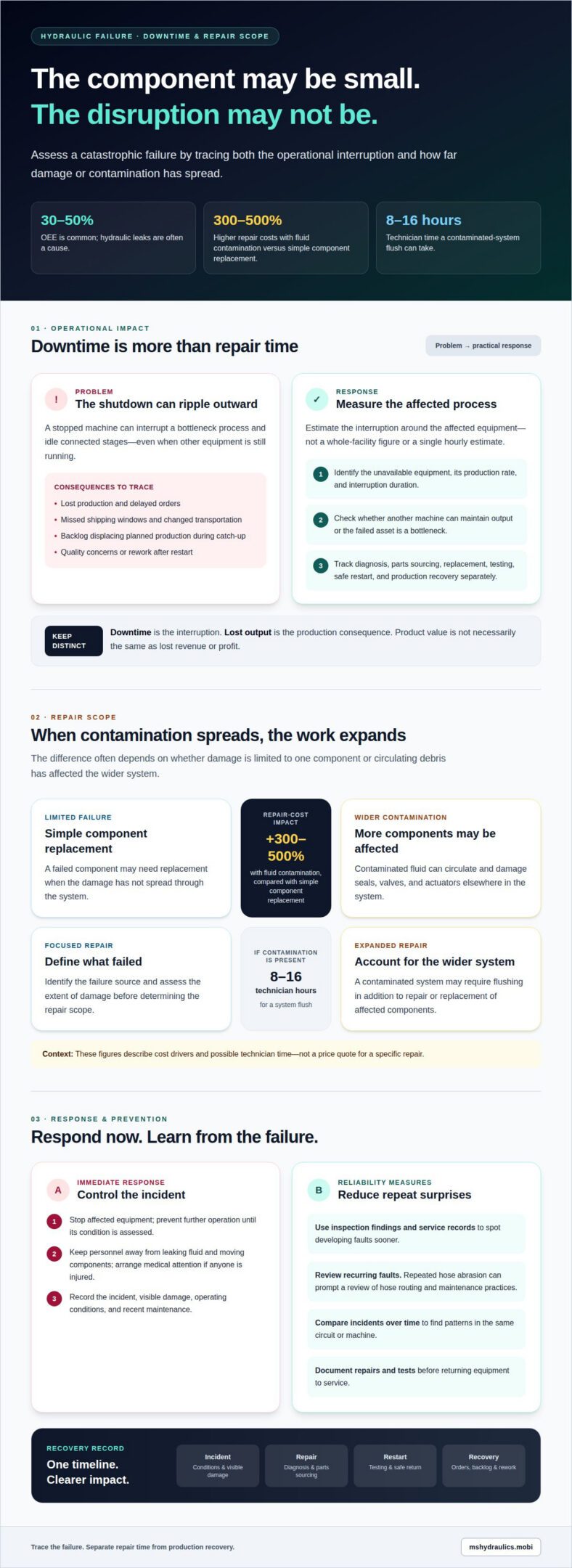
Estimate the impact on the affected process rather than applying a whole-facility figure. Identify the unavailable equipment, its production rate, and the interruption’s duration. Then determine whether another machine can maintain output or whether the failed asset is a bottleneck. A bottleneck can idle connected stages even when other equipment remains operational.
Downtime may extend beyond repair time. Diagnosis, parts sourcing, replacement, system testing, and safe restart can each lengthen the interruption. After restart, inspections may uncover quality concerns or work that needs redoing. Record each stage separately to distinguish repair duration from production recovery.
Lost output can affect schedules even after operations resume. Missed shipping windows may delay orders, while a backlog can displace planned production during catch-up. Track affected orders, transportation changes, and rescheduled work. This helps show how the financial impact of a catastrophic hydraulic failure can extend beyond the time a machine is stopped.
Overall equipment effectiveness (OEE) of 30-50% is common, and hydraulic leaks are often a cause. Compare production records with the failure timeline to understand the operational context. For equipment that remains down, hydraulic failure diagnostics can help identify the cause and inform the repair response.
Reactive repairs versus reliability measures
Reactive repair begins after a component fails; reliability measures aim to identify developing problems sooner. Comparing these approaches means considering repair scope, repeat failures, downtime, and maintenance records.
Repair and Replacement Costs
Repair or replacement costs depend on the failed component, the extent of damage, and contamination. Hydraulic fluid contamination can increase repair costs by 300-500% compared with simple component replacement. A contaminated system may also require flushing, which can take 8-16 hours of technician time. These figures describe cost drivers, not a price quote for a specific repair.
The difference often depends on how far the damage has spread. A failed component may need replacement, while circulating debris can affect seals, valves, and actuators elsewhere in the system. Identifying the failure source helps define the required work. Maintenance records can also show whether a recurring fault points to an unresolved cause or a new incident.
Immediate Response and Reliability Measures
After a catastrophic failure, stop the affected equipment and prevent further operation until its condition has been assessed. Keep personnel away from leaking fluid and moving components, and arrange medical attention if anyone is injured. Record the incident, visible damage, operating conditions, and recent maintenance. These details help establish the failure sequence and guide the repair scope.
Reactive work restores equipment after a breakdown; reliability measures use inspection findings and service records to address developing faults. For example, recurring hose abrasion can prompt a review of hose routing and maintenance practices. The aim is to identify sources of repeat failures before another shutdown, rather than treating each failed component as an isolated event.
After repairs, document replaced components, contamination findings, and tests completed before returning equipment to service. Compare these records with previous failures to identify patterns affecting the same circuit or machine. A recurring pump or valve problem may need investigation beyond component replacement. This provides a stronger basis for future maintenance decisions and reduces reliance on unplanned repairs.
Emergency technician labor premiums and call-out fees
Urgent hydraulic repairs can involve labor premiums because response timing, travel, diagnosis, and repair complexity affect the work required. Separate direct labor from parts, equipment downtime, and production recovery to understand the incident’s full cost.
Approximately 60-70% of hydraulic system failures occur at night, on weekends, or on holidays. Timing can affect technician availability and labor terms, while the failure’s location and severity shape the response. A minor hose issue may require different diagnostic work than a pump failure involving contamination or multiple damaged components.
Review an estimate by task, not just by total hours. Distinguish travel, fault diagnosis, component removal, repair or replacement, system flushing, and operational testing. Minimum call-out periods can mean billed time exceeds hands-on repair time. The applicable agreement and repair scope determine how those hours are treated.
For a clear cost record, document the incident time, machine status, operator observations, and work performed. Record labor hours by activity, along with parts used and testing results. This creates a traceable account for internal cost analysis and insurance documentation. Keep the production-restoration timeline separate from technician labor, since work may finish before the equipment returns to service.
Planning can reduce avoidable urgency. Maintenance records that identify recurring faults, known component issues, and equipment access requirements help technicians prepare for diagnosis. Keep relevant machine details and failure observations available when arranging a response. Do not restart equipment until its condition has been assessed and required testing is complete.
To discuss an urgent hydraulic repair, request repair support and share the equipment type, failure symptoms, and operating location.
Emergency hydraulic service providers typically charge minimum call-out fees of 4-8 hours, even for shorter repairs. Weekend and evening overtime labor rates can be 50-100% higher than standard labor rates. Use these figures when comparing quoted minimums, scheduled work, and after-hours response terms.
Ms. Hydraulics LLC
Ms. Hydraulics LLC helps businesses address hydraulic failures that disrupt equipment and operations. Its mobile hydraulic repair and on-site diagnostic services support assessment and repair at the equipment’s location, while hydraulic hose fabrication and cylinder rebuilds address specific repair needs. Heavy equipment maintenance can also support ongoing equipment care.
Turn to Ms. Hydraulics LLC when a hydraulic fault requires technical diagnosis, component repair, or heavy equipment maintenance. Details about the machine, symptoms, and operating conditions help establish the context for the work. The appropriate response depends on the failure and equipment involved.
Contact Ms. Hydraulics LLC to discuss hydraulic repair or equipment maintenance.
Make the Next Repair Decision Deliberate
The financial impact of a catastrophic hydraulic failure can inform more than the immediate repair decision. Use the incident record to identify recurring equipment issues, determine which assets need closer attention, and set future maintenance priorities. This turns disruption into useful information for operating and maintenance teams.
When hydraulic equipment needs repair or ongoing attention, Ms. Hydraulics LLC offers Hydraulic Hose Fabrication, Hydraulic Cylinder Rebuilds, and Heavy Equipment Maintenance. The appropriate work depends on the affected equipment and the failure’s condition. Clear details about symptoms and operating context help guide the discussion.
A considered next step can help your team move from failure assessment to a defined repair plan. Contact Ms. Hydraulics LLC for support to discuss the equipment issue and determine a practical path forward.
Frequently Asked Questions
How should downtime and knock-on impacts be assessed?
Assess direct production loss separately from delayed work that can be recovered later. Map which orders, processes, and internal teams rely on the failed machine, then note where production can be rescheduled and where commitments may shift. This distinguishes a temporary backlog from output that cannot be made up. Include added coordination, storage, or transportation requirements only when they result from the incident.
How should you compare reactive recovery with reliability measures?
Compare both approaches using the same equipment and operating period. For reactive recovery, record repair work, repeat faults, and operational disruption. For reliability measures, track inspection findings, maintenance activity, and whether recurring problems become less frequent. Work-order records can reveal whether a measure addresses a failure source or merely treats its symptoms. This comparison supports maintenance decisions grounded in observed equipment performance.
How much production downtime and lost revenue can hydraulic failure cause?
Estimate the effect by multiplying the affected production rate by the hours unavailable, then distinguish delayed output from sales that cannot be recovered. Revenue is not the same as profit: materials, labor, and other variable expenses affect the financial result. For example, a machine may stop one production stage while others continue, so calculate its actual contribution rather than applying a whole-facility rate.
How can preventive maintenance and condition monitoring reduce hydraulic failure costs?
Preventive maintenance can identify wear, leaks, or changes in system behavior before a component failure causes wider disruption. Comparing condition-monitoring observations over time can help teams spot changes instead of treating each reading in isolation. Ms. Hydraulics provides Heavy Equipment Maintenance for businesses in Cleburne and the Dallas-Fort Worth region, supporting maintenance planning for local equipment operations.