Hydraulic Fittings Near Me: A Professional Reference Guide for Cleburne and North Texas
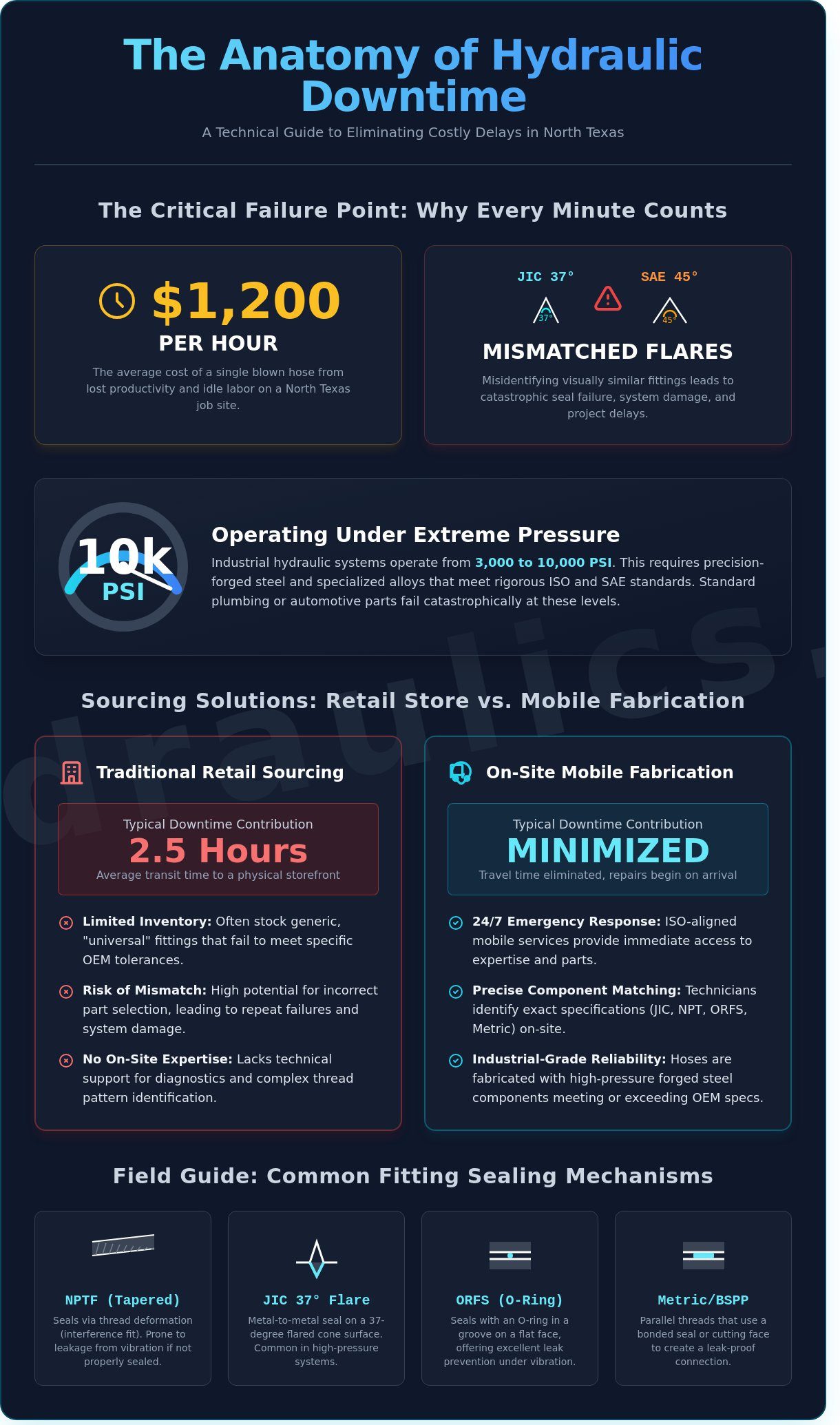
A single blown hose on a North Texas job site often costs a fleet operator $1,200 per hour in lost productivity and idle labor. When searching for hydraulic fittings near me, you aren’t just looking for a replacement part; you’re looking for a precision engineered solution that restores system integrity. You recognize that misidentifying a 37 degree JIC flare for an SAE 45 degree flare can lead to catastrophic seal failure and extended project delays. It’s a risk that professional operators in Cleburne can’t afford when high pressure systems are at stake.
This reference guide clarifies the technical distinctions between common thread types and demonstrates why on-site mobile fabrication is the most efficient method to eliminate downtime. You’ll learn to identify the exact specifications your equipment demands, whether you’re dealing with ISO 6149 metric ports or standard NPTF connections. We will examine the critical role of local mobile services in reducing the typical 2.5 hour transit time to a physical storefront, ensuring your machinery returns to service with industrial grade reliability.
Key Takeaways
- Learn the technical methodology for identifying thread diameters, pitch, and seat angles to ensure precise component matching in high-pressure environments.
- Discover why searching for “hydraulic fittings near me” often reveals the limitations of retail inventory and why mobile fabrication is essential for meeting specific equipment tolerances.
- Identify how North Texas environmental stressors impact seal longevity and learn to recognize the common installation errors that compromise system integrity.
- Understand the critical role of precision-engineered connectors in maintaining system pressure and preventing fluid contamination within industrial circuits.
- Explore how ISO-aligned mobile services and 24/7 emergency response protocols provide a technical solution for eliminating costly operational downtime.
Understanding Hydraulic Fittings: The Vital Links in Your High-Pressure Systems
Hydraulic fittings are precision-engineered connectors designed to integrate hoses, pipes, and tubes within a high-pressure circuit. While a standard piping and plumbing fitting serves general fluid transport, hydraulic variants must maintain structural integrity under extreme mechanical stress. These components serve as the critical interface that prevents fluid contamination and ensures the system maintains consistent operating pressure. In the demanding environments of Cleburne’s construction and agricultural sectors, these fittings are the primary defense against catastrophic system failure.
These components differ significantly from standard automotive connectors. Industrial-grade fittings are manufactured to withstand pressures ranging from 3,000 to 10,000 PSI, whereas light-duty connectors often fail at a fraction of those levels. Utilizing subpar hardware in a high-torque environment leads to fluid aeration and overheating. MS Hydraulics prioritizes heavy-duty specifications to ensure that every connection point supports the full displacement capacity of the pump without leakage.
The Engineering Behind High-Pressure Connections
Precision is mandatory when managing the extreme PSI levels found in excavators, dozers, and drill rigs. MS Hydraulics utilizes forged steel and specialized alloys to ensure material integrity, as these metals resist the fatigue caused by constant pressure cycling. Most industrial applications in North Texas adhere to rigorous ISO 12151 and SAE J514 standards. These certifications guarantee that thread dimensions and seat angles provide a leak-proof seal. High-performance fittings utilize specific geometries, such as JIC 37-degree flares or O-Ring Face Seals (ORFS), to eliminate the risk of vibration-induced loosening during heavy operation.
Why Local Availability in Cleburne Matters for Operations
Managing the true cost of downtime is a priority for any Johnson County industrial project. When a hose bursts on a job site, the financial loss often exceeds $600 per hour in lost labor and machine productivity. Searching for hydraulic fittings near me is about more than proximity; it’s about accessing technical expertise that prevents repeat failures. Retail outlets often stock “universal” fittings that don’t meet the specific tolerance requirements of specialized machinery.
Local specialized inventory ensures faster diagnostics and correct part matching for complex thread patterns. Using the wrong fitting—such as forcing a Metric thread into a BSPP port—damages expensive manifolds and leads to environmental contamination. Professional local sourcing provides:
- Immediate access to high-pressure forged steel components.
- Verification of thread compatibility (JIC, NPT, Metric, ORFS).
- Reduced transport time for emergency repairs in North Texas.
Reliability in the field depends on the quality of these connections. Finding professional hydraulic fittings near me ensures that your equipment returns to service with components that meet or exceed original equipment manufacturer (OEM) specifications.
A Technical Field Guide to Identifying Hydraulic Fitting Types and Threads
Precision in component identification is the primary factor that separates a 30-minute repair from a 24-hour operational delay. When technicians search for hydraulic fittings near me in Cleburne or the surrounding North Texas industrial hubs, they’re often dealing with machinery that utilizes multiple, non-interchangeable thread standards. Correct identification requires more than a cursory glance; it demands a systematic measurement of the thread diameter, pitch, and sealing surface geometry.
Field identification starts with distinguishing between tapered and parallel threads. Tapered threads, such as NPT, seal through an interference fit where the threads themselves crush together to form a barrier. Parallel threads, including JIC and ORFS, serve only as a mechanical fastener to pull two sealing surfaces together. Mixing these types leads to cross-threading or catastrophic seal failure under pressure. For those requiring a foundational Introduction to Hydraulic Hose and Fittings, it’s vital to recognize that pressure ratings and vibration resistance vary significantly between these mechanical designs.
Common Thread Types: JIC, NPT, and ORFS
- JIC (Joint Industry Council) 37-degree flare: This is the workhorse of North Texas heavy equipment. It uses a 37-degree seating surface to create a metal-to-metal seal. It’s highly reliable but susceptible to over-torque damage.
- NPT (National Pipe Tapered): These threads are common in older domestic machinery. They require a sealant, such as PTFE tape or pipe dope, because the seal occurs on the thread flanks.
- ORFS (O-Ring Face Seal): This is the modern standard for high-pressure systems. It features a flat face with an embedded elastomeric O-ring, providing superior leak protection in systems operating above 6,000 PSI.
Identifying Sealing Surfaces and Seat Angles
Visual inspection often fails when distinguishing between a 37-degree JIC flare and a 45-degree SAE flare. The 8-degree difference is nearly impossible to detect without a seat gauge. Technicians must use calipers to measure the outside diameter (OD) of male threads and a pitch gauge to confirm the threads per inch (TPI). A single mismatched thread pitch can strip the housing of a $5,000 hydraulic pump in seconds.
Detecting worn or damaged surfaces is equally critical. Look for “wire drawing,” which appears as small grooves on the seating surface, or pitting caused by cavitation. These defects prevent a 100% seal regardless of how much torque you apply. Ensuring you have the correct hydraulic system components on hand before disassembly prevents environmental contamination and extended downtime. When sourcing hydraulic fittings near me, always verify that the replacement matches the ISO or SAE specifications of the original equipment manufacturer to maintain system integrity.
Sourcing Hydraulic Fittings Near Me: Retail vs. Mobile Fabrication
Selecting the correct source for hydraulic fittings near me determines the total lifecycle and safety of your pressurized systems. While general hardware stores or big-box retailers offer geographical convenience, they rarely provide the engineering precision required for industrial-grade applications. Professional operations in Cleburne and North Texas require components that adhere to strict mechanical tolerances, a requirement that off-the-shelf retail products often fail to meet.
The Retail Gap: Why General Stores Fall Short
Retail-grade fittings are designed for low-pressure, consumer-level equipment. These components often lack the metallurgy and thread precision defined by the SAE J516 industry standard for hydraulic hose fittings. Using a retail-sourced fitting on a system rated for 5,000 PSI or higher introduces a significant risk of catastrophic failure. Data from field audits suggests that non-specialized retail fittings experience a 35% higher failure rate under peak torque conditions compared to certified industrial components.
- Technical Deficit: Retail staff generally lack the training to troubleshoot complex hydraulic circuits or identify obscure metric thread pitches.
- Pressure Limitations: Most retail inventory is capped at 2,500 PSI, which is insufficient for 85% of modern construction and manufacturing machinery.
- Availability Risks: The time lost driving to a store only to find a specific JIC or ORFS fitting is out of stock can cost an operation upwards of $500 per hour in idle labor.
By 2026, the proliferation of European and Asian machinery in the North Texas corridor has increased the demand for DIN and JIS metric standards by 22%. Retailers have not scaled their inventory to match this shift, leaving local operators with limited options for specialized repairs.
The Ms. Hydraulics Advantage: Mobile Fabrication and Repair
Finding hydraulic fittings near me that meet exact OEM specifications requires a mobile fabrication approach. MS Hydraulics eliminates the logistical burden of transporting disabled machinery, which can incur hauling fees exceeding $1,200 for heavy equipment. Our mobile units function as decentralized machine shops, arriving at your job site with a comprehensive inventory of high-pressure fittings and specialized adapters.
This service model integrates directly with our custom hydraulic hose fabrication capabilities. On-site assembly ensures that every connection is measured and crimped to the precise displacement and torque requirements of your specific cylinder or pump. We maintain a deep stock of 2026-standard metric and specialized fittings, ensuring that even the most modern Tier 4 and Tier 5 equipment remains operational. Our technicians prioritize factual accuracy and technical performance, providing a disciplined alternative to the guesswork of retail sourcing.
Why Fittings Fail: Addressing Challenges in the North Texas Environment
Failure in hydraulic systems often stems from environmental stressors that exceed the design parameters of standard components. In North Texas, where ambient temperatures fluctuate by as much as 40 degrees within a single 24-hour cycle, the search for hydraulic fittings near me is frequently driven by preventable component fatigue. Industrial sites in Cleburne operate under heavy loads that demand precision-engineered connections capable of withstanding both high internal pressure and aggressive external atmospheric conditions. Reliability isn’t a luxury; it’s a technical requirement for maintaining operational uptime.
Thermal Expansion and Seal Degradation in Texas Heat
Summer temperatures in Johnson County often exceed 105°F, causing hydraulic fluid temperatures to climb toward 180°F. This thermal load reduces the elasticity of standard Nitrile (Buna-N) O-rings by approximately 50% over a single peak season. As seals harden, they lose their ability to compensate for micro-movements of the fitting under pressure. “Sweating” at the connection point isn’t just a minor leak. It’s a diagnostic indicator that internal pressure spikes have compromised the seal’s integrity. High-performance Viton seals, rated for 400°F, provide the necessary thermal resistance for these extreme North Texas conditions.
Installation Pitfalls: Over-Torquing and Misalignment
Data from field failures suggests that 60% of fitting leaks result from improper installation rather than component defect. Technicians often follow the “more is better” philosophy, but over-tightening a JIC 37-degree flare fitting beyond its specified 30 foot-pounds of torque for a -8 size leads to flared end deformation. This causes the nut to crack or the seat to collapse entirely. Alignment is equally critical. A misalignment of just 2 degrees creates side-loading that accelerates thread galling and uneven seal wear.
- Contamination Control: In the dusty environments of North Texas, a single 10-micron grain of silica can bypass a compromised seal and score a valve spool.
- Corrosion Resistance: High salinity and chemical runoff in regional oilfield operations accelerate galvanic corrosion.
- Torque Accuracy: Using calibrated wrenches ensures the 1,000-hour salt spray resistance of zinc-nickel coatings remains intact.
The high-pressure demands of local industrial sectors require components that meet or exceed ISO 12151 standards. Implementing a proactive maintenance schedule that includes ultrasonic leak detection can reduce unplanned downtime by 22% annually. Precision matters in every thread and every seal. When you require components that withstand the rigors of the Texas climate, it’s vital to source high-performance hydraulic fittings that are engineered for durability.
Protecting your equipment involves more than just selecting the right part. It requires an understanding of how local environmental variables impact the metallurgical and polymer properties of your hydraulic fittings near me. By addressing thermal expansion and installation precision, operators can extend the service life of their hydraulic connections by up to 35%.
Professional Hydraulic Fitting Services in Cleburne and Johnson County
Ms. Hydraulics maintains a commitment to technical excellence through ISO 9001:2015 aligned service protocols. We provide the specialized engineering support required for high-pressure systems across North Texas. If you’re searching for hydraulic fittings near me during a critical equipment failure, our 24/7 emergency response team delivers immediate technical intervention. We recognize that heavy equipment downtime in Johnson County often costs operators upwards of $2,500 per hour in lost productivity. Our service model prioritizes rapid diagnostics and on-site recovery to mitigate these financial losses.
We develop custom maintenance schedules for North Texas construction and agriculture fleets. These plans utilize data-driven replacement cycles to prevent unexpected blowouts. Our technicians evaluate system parameters like operating temperature and pressure spikes to ensure every fitting remains within safe tolerance levels. We support various machinery types, including:
- Tier 4 Final compliant construction equipment
- High-flow agricultural irrigation systems
- Industrial manufacturing presses and CNC machinery
- Waste management and recycling fleet hydraulics
Our on-site diagnostics involve more than just visual inspections. We use calibrated flow meters and pressure gauges to identify internal bypass issues or pump inefficiencies. This methodical approach ensures that when we replace a fitting, the entire circuit is restored to its original equipment manufacturer (OEM) specifications.
Serving the North Texas Industrial Corridor
Logistics and location define our service efficiency. We guarantee rapid response times for Cleburne, Alvarado, Granbury, and Crowley. Our fleet maintenance reach extends into Arlington, Mansfield, and Waxahachie to support regional logistics hubs. By providing expert mobile hydraulic repair in Cleburne, we reduce the distance between failure and resolution. Our mobile service units are stocked with 600 unique fitting configurations to handle diverse machinery requirements on the first visit, preventing the need for secondary trips to a parts warehouse.
Partnering for Long-Term Reliability
A simple repair often ignores the underlying hydraulic imbalances that cause repeated failures. We focus on comprehensive system health monitoring to identify root causes like fluid aeration or excessive vibration. This integrity-driven approach is essential in a high-stakes industrial environment where safety is paramount. We help operators search for hydraulic fittings near me with the confidence that they’ll receive engineering-grade solutions rather than temporary patches. Our goal is to extend the mean time between failures (MTBF) for every client we serve. Contact Ms. Hydraulics for immediate on-site fitting and hose service to restore your equipment’s reliability and operational safety.
Optimize Your Equipment Reliability with Precision Engineering
Maintaining peak performance in heavy machinery requires more than a quick fix; it demands technical precision and the correct identification of thread specifications. Selecting high-quality components ensures your high-pressure systems withstand the specific environmental demands of Cleburne and the broader North Texas region. Since 2021, MS Hydraulics has delivered engineering-grade solutions to minimize operational lag. Our expert technicians specialize in mobile diagnostics for excavators, skid steers, and drill rigs, ensuring every connection meets rigorous industrial standards.
When you’re searching for hydraulic fittings near me, reliability and technical expertise must be your primary metrics. We provide on-site fabrication and diagnostic support throughout Johnson County to keep your projects on schedule. Don’t let a minor seal failure lead to a major system blowout. Secure your equipment’s longevity with professional field service designed for the modern industrial landscape.
Request Immediate Mobile Hydraulic Service in Cleburne & North Texas
We look forward to keeping your fleet in motion with the highest standards of technical excellence.
Frequently Asked Questions
How do I know if I have a JIC or an NPT fitting?
You identify a JIC fitting by its 37-degree flare seat and parallel threads, whereas NPT fittings use tapered threads to achieve a seal. Use a caliper to measure the thread pitch and a seat gauge to verify the angle according to SAE J514 standards. NPT fittings rely on thread deformation, which often requires sealant for high-pressure applications exceeding 5,000 PSI. Precise measurement prevents 90% of installation errors.
Can I reuse hydraulic fittings if they look undamaged?
You shouldn’t reuse hydraulic fittings because the metal-to-metal seal deforms permanently during the initial torqueing process. Reusing a fitting increases the statistical risk of a leak by 40% due to work hardening of the steel or brass components. Even if the threads look intact, the seating surface won’t maintain a gas-tight seal under 3,000 PSI of operating pressure. Always replace fittings during hose assembly maintenance to ensure system integrity.
What are the most common causes of hydraulic fitting leaks?
The primary causes of leaks include improper torque, vibration fatigue, and seal degradation. Over-tightening accounts for 60% of fitting failures in North Texas industrial environments. When searching for hydraulic fittings near me, it’s vital to select components that meet ISO 12151 specifications. This ensures they withstand the specific vibration frequencies of heavy machinery. Proper installation reduces the 15% annual fluid loss typical in poorly maintained systems.
Do you provide mobile hydraulic fitting replacement in Fort Worth?
We provide 24/7 mobile hydraulic services throughout Fort Worth and the surrounding Tarrant County area. Our service trucks carry crimping technology capable of handling up to 2-inch diameter 6-wire spiral hoses. This onsite capability reduces equipment downtime by an average of 180 minutes compared to traditional shop-based repairs. We service all major brands, ensuring your machinery returns to 100% operational capacity without leaving the job site.
What information do I need to provide for a custom hose and fitting assembly?
You must provide the STAMPED data, which stands for Size, Temperature, Application, Material, Pressure, Ends, and Delivery. We require the internal diameter in 1/16th inch increments and the maximum system pressure, such as 5,000 PSI. Identifying the correct hydraulic fittings near me requires knowing if your system uses metric, JIC, or ORFS connections. Providing these 7 data points ensures a 100% leak-free assembly for your specific industrial application.
Is there a difference between hydraulic fittings for excavators vs. tractors?
Excavators typically utilize high-pressure DIN or flange fittings to handle 5,000 to 7,000 PSI, while tractors often use ISO 7241-1 Series A quick-connect couplings. Excavator systems require 4-wire or 6-wire reinforcement to manage extreme pressure spikes during heavy lifting. In contrast, standard agricultural tractors operate at lower pressures, usually between 2,000 and 2,900 PSI. These differences mean components aren’t interchangeable without risking a 50% reduction in system safety.
How quickly can a mobile technician arrive at my job site in Cleburne?
Our technicians typically arrive at Cleburne job sites within 45 to 90 minutes of a service call. We maintain a fleet of 5 dedicated service vehicles stationed near major North Texas corridors like US-67 and I-35W. This rapid response ensures that critical operations, such as municipal utility repairs or construction projects, resume within a 120-minute window. We prioritize emergency calls to minimize the $500 per hour cost of idle machinery.
Why is it dangerous to use mismatched threads even if they seem to fit?
Mismatched threads create a high risk of catastrophic failure because the thread engagement is insufficient to hold rated pressure. For example, a BSPP male fitting might thread into an NPT female port, but the pitch difference leads to a 75% reduction in burst strength. This results in a fitting blowing off at 3,000 PSI, which can cause severe injury. Always verify thread compatibility using ISO 228 or SAE J514 standards to maintain safety.