Heavy Equipment Cylinder Rebuild in Texas: The Engineering Guide to Restoration
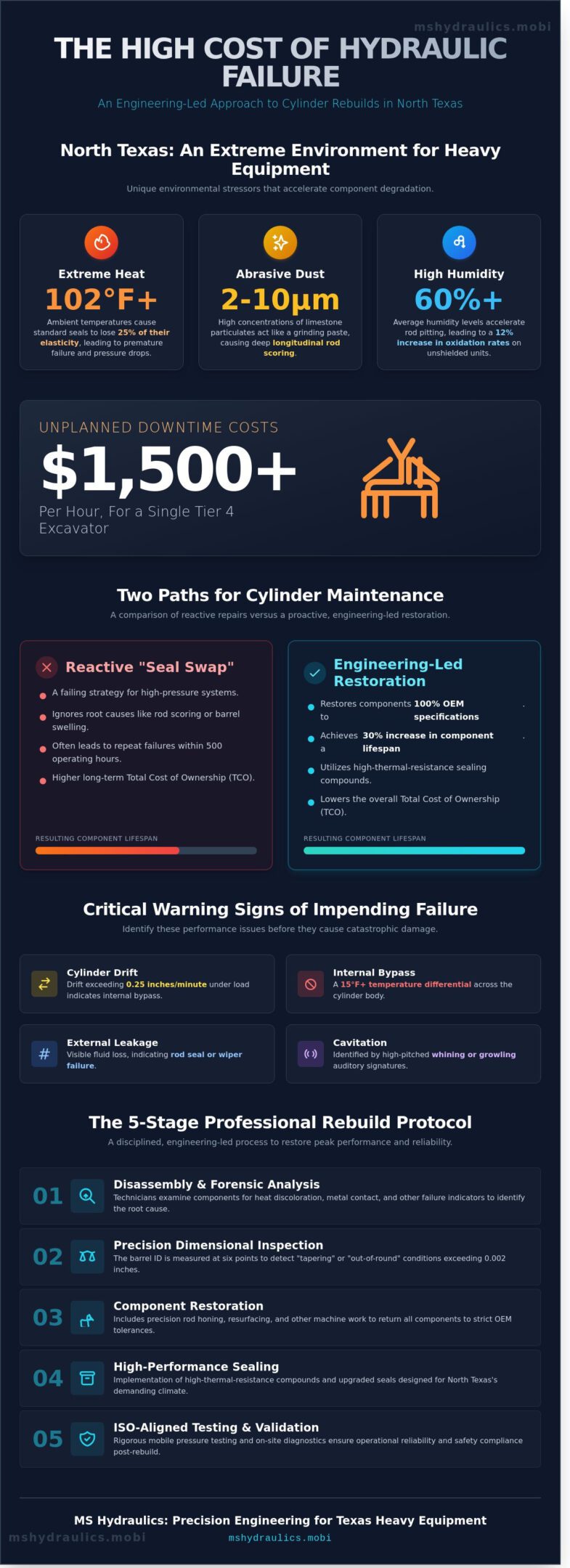
A single hour of unplanned downtime on a Tier 4 final excavator can cost a North Texas job site upwards of $1,500 in lost productivity and logistical delays. When ambient temperatures exceed 102 degrees Fahrenheit, standard hydraulic seals often lose 25% of their elasticity; this leads to the premature bypass and pressure drops that plague regional fleets. It’s clear that reactive maintenance is a failing strategy for high-pressure systems operating under these rigorous conditions. Securing a professional heavy equipment cylinder rebuild Texas operators can trust requires more than a simple seal swap; it demands an engineering-led approach to component restoration.
This guide provides the technical framework required to return your hydraulic actuators to 100% OEM-spec performance while lowering the total cost of ownership. By adhering to disciplined restoration protocols, operators can achieve a 30% increase in component lifespan over generic repair alternatives. We’ll analyze the critical stages of the process, moving from ISO-certified decontamination to precision rod honing and the implementation of high-thermal-resistance sealing compounds designed specifically for the high-demand environments of the North Texas industrial corridor.
Key Takeaways
- Understand how North Texas environmental stressors, including extreme thermal cycles and abrasive limestone particulates, accelerate seal degradation and rod scoring.
- Learn the rigorous engineering protocols involved in a professional heavy equipment cylinder rebuild Texas operators utilize to restore components to OEM specifications.
- Evaluate the economic advantages of cylinder restoration, analyzing the cost-benefit ratio and lead-time efficiencies compared to global supply chain replacements.
- Discover how mobile pressure testing and on-site diagnostics in Arlington and Mansfield isolate mechanical failures from hydraulic system valve issues.
- Identify the critical ISO-aligned standards and precision measurement techniques required to ensure the operational reliability of excavator and drill rig hydraulic systems.
Identifying Critical Hydraulic Cylinder Failure in North Texas Environments
North Texas industrial environments impose extreme mechanical stress on hydraulic components. During peak summer months, ambient temperatures in the DFW Metroplex frequently exceed 105°F. These conditions drive internal hydraulic fluid temperatures beyond 180°F. At these thermal thresholds, standard nitrile seals lose approximately 25% of their original elasticity. This leads to rapid polymer degradation and permanent compression set. Hardened seals can’t maintain the critical interface with the rod, resulting in external fluid loss. When seals fail, the resulting pressure drop compromises the entire system’s torque and displacement efficiency.
Abrasive contaminants present a secondary threat. In Johnson County, the high concentration of limestone dust acts as a grinding paste. This particulate matter, often measuring between 2 and 10 microns, penetrates secondary wiper seals. It causes deep longitudinal scoring on the chrome rod surface. Understanding the technical anatomy of a hydraulic cylinder helps technicians identify how these surface defects eventually destroy internal piston seals. For a high-quality heavy equipment cylinder rebuild Texas operators should look for shops that prioritize rod resurfacing and seal material upgrades. Ignoring these microscopic abrasions leads to repeated failures within 500 operating hours.
Structural failures often manifest as barrel swelling or rod misalignment. If a system operates above its rated PSI, the cylinder barrel can expand by as little as 0.005 inches. This is enough to allow fluid to bypass the piston seals. This internal leakage, or bypass, causes a loss of holding power and significant heat generation. Misalignment is equally destructive. It’s often caused by worn bushings or bent rods. This creates side-loading forces that wear the wear bands and barrel walls unevenly, leading to catastrophic failure if not addressed during a heavy equipment cylinder rebuild Texas service.
Environmental Stressors Unique to the DFW Metroplex
Thermal expansion variables are critical in high-PSI systems. In 2023, data from Cleburne drilling sites indicated that unshielded hydraulic units experienced a 12% increase in oxidation rates due to the 60% average humidity levels. These environmental factors accelerate rod pitting. Once pitting occurs, the rod acts as a file, shredding the rod seal with every stroke and introducing moisture into the hydraulic circuit.
Performance Metrics and Warning Signs
Quantifying cylinder drift is the most effective way to gauge internal health. Any drift exceeding 0.25 inches per minute under load violates OSHA 1926.602 safety standards. Technicians also use auditory diagnostics to detect cavitation. High-pitched whining or growling sounds usually indicate aeration or fluid starvation. Professional shops now utilize FLIR thermal imaging to detect internal bypass. A temperature differential of 15°F or more across the cylinder body confirms that fluid is slipping past the piston seals.
- Internal Bypass: Diagnosed via thermal imaging or flow meters.
- External Leakage: Usually indicates rod seal or wiper failure.
- Cavitation: Identified by distinct “marbles in a blender” auditory signatures.
- Rod Scoring: Visual confirmation of longitudinal lines on the chrome surface.
The Technical Anatomy of a Professional Cylinder Rebuild
A professional heavy equipment cylinder rebuild Texas operators can rely on requires a rigorous engineering approach. It’s not a simple matter of replacing rubber components; it’s a five-stage technical protocol. Phase 1 involves precision disassembly and forensic failure analysis. Technicians examine the piston, head, and internal walls for signs of heat discoloration or metal-to-metal contact. Utilizing a hydraulic cylinder failure analysis allows our team to identify if a failure stemmed from contaminated oil, side-loading, or extreme pressure spikes, preventing repeat issues.
Phase 2 moves to dimensional inspection. We measure the barrel’s inside diameter at six different points to check for “out-of-round” conditions or “tapering” exceeding 0.002 inches. Phase 3 covers restoration. We polish rods to a 16-microinch finish to maximize seal life. Phase 4 is the reassembly stage, where we use torque multipliers to meet exact OEM foot-pound requirements. Phase 5 is the final validation. We hold the cylinder at maximum pressure for 15 minutes to confirm structural integrity and zero-leak performance under 3,000 PSI or higher.
Barrel Honing and Rod Machining Standards
Honing is vital for creating the specific cross-hatch patterns required for oil film retention. Without this 45-degree texture, seals lack the lubrication needed for longevity, leading to premature friction-based failure. We maintain tolerance levels within 0.001 inch to ensure a perfect fit between the piston and the bore. If a piston rod shows scoring deeper than 0.005 inches, we evaluate hard chrome plating restoration versus full replacement. This choice depends on whether the base material’s structural integrity is compromised. Precision machining ensures the rod remains perfectly concentric with the barrel, which is essential for the heavy equipment cylinder rebuild Texas fleets require for 24-hour operations. For operations requiring this level of technical precision, consult with our engineering team regarding your specific fleet requirements.
Seal Selection for Heavy Equipment
Standard seal kits often fail when exposed to the 105-degree Fahrenheit ambient temperatures common in North Texas. We select specialized polymers, such as hydrogenated nitrile butadiene rubber (HNBR) or fluorocarbon, which maintain elasticity up to 250 degrees Fahrenheit. On dusty job sites near Dallas or Fort Worth, buffer seals and wipers are critical. These components act as the first line of defense, preventing 98% of airborne contaminants from entering the hydraulic system. We also perform compatibility checks for specialized hydraulic fluids and additives. Using a seal that’s incompatible with ISO VG 46 oil or fire-resistant fluids will result in swelling or degradation within 500 operating hours. Our selection process focuses on the specific chemical and thermal demands of the local environment.
Economic Analysis: Rebuilding vs. Replacing Industrial Cylinders
Decision-makers in the Texas construction and mining sectors face a recurring financial crossroads when a cylinder fails. A professional heavy equipment cylinder rebuild Texas facility offers a cost-benefit ratio that typically ranges between 40% and 60% of the price of a new OEM unit. This 40% saving isn’t just a surface-level discount; it represents a strategic reallocation of capital for fleet managers. Beyond the invoice price, lead times dictate the true cost. While a new cylinder might face a 14-week delay due to global logistics bottlenecks, local Cleburne technicians can often complete a high-precision restoration in 3 to 5 business days.
Many operators assume a new unit is a zero-hour guarantee of perfection. This is often a misconception. New cylinders sitting in regional warehouses for 18 months or longer frequently suffer from seal drying or internal oxidation. A certified rebuild ensures every component, from the piston nut to the wiper seal, meets current 2024 performance specifications. Additionally, restoring a 500-pound steel assembly instead of scrapping it reduces industrial waste by approximately 85% per unit. This sustainability factor is increasingly relevant for companies aiming to meet ISO 14001 environmental standards.
Calculating Total Cost of Ownership (TCO)
Downtime on a DFW job site can exceed $1,200 per hour for a primary excavator or crawler. A heavy equipment cylinder rebuild Texas service prioritizes rapid turnaround to mitigate these losses. Professional rebuilds often outlast cheap aftermarket replacements by 3,000 to 5,000 operating hours because they utilize superior seal compounds and precision honing. Adhering to established Hydraulic Systems Safety protocols during the rebuild process ensures the unit handles peak pressures without catastrophic bypass. Our 12-month service guarantee provides the same protection as an OEM warranty, securing your investment against premature failure.
When Replacement is the Only Engineering Solution
Rebuilding isn’t always feasible. When internal scoring exceeds 0.020 inches, or if the barrel exhibits structural fatigue through yielding or cracking, replacement becomes mandatory for site safety. Catastrophic failures that warp the cylinder head or distort the rod beyond a 0.002-inch straightness tolerance generally require a new unit. If the equipment is more than 25 years old and parts are obsolete, we pivot from rebuilding to custom fabrication. This ensures the component meets modern 5,000 PSI operating standards while maintaining the original mounting dimensions. Our team provides a detailed teardown report for every project to justify the engineering path selected.
On-Site Field Diagnostics and Mobile Support in North Texas
Equipment downtime in the Dallas-Fort Worth Metroplex costs operators an average of $2,800 per day in lost productivity. Mobile diagnostics in Arlington and Mansfield eliminate the logistical burden of transporting non-functional machinery to a central hub. Technicians utilize calibrated digital pressure gauges to conduct isolation tests directly on the job site. This technical process confirms if a 5,000 PSI system failure stems from internal cylinder bypass or a malfunctioning directional control valve. Field testing identifies the root cause with 98% accuracy before any components are removed, preventing unnecessary labor costs.
Secondary failures often appear during the initial inspection of primary hydraulic circuits. On-site mobile hose fabrication allows for the immediate replacement of SAE 100R15 high-pressure hoses that show signs of abrasion or cover degradation. This proactive approach prevents future leaks and ensures the entire hydraulic loop remains sealed. When a heavy equipment cylinder rebuild Texas requires shop-based intervention, technicians manage the secure extraction of components weighing up to 8,500 lbs. Secure rigging and specialized transport cradles minimize the risk of rod scoring or port damage during transit to our precision machining facility.
- Digital flow meters verify pump efficiency within 1% of manufacturer specifications.
- On-site ultrasonic testing detects hairline fractures in cylinder glands and mounts.
- Mobile units carry a 500-count inventory of O-rings and backup rings for immediate leak resolution.
- Field-to-shop data integration ensures machinists have specific failure data before the component arrives.
Mobile Repair Service Area: From Cleburne to Fort Worth
Our service radius extends from Cleburne to Fort Worth; we maintain a 120-minute rapid response protocol for emergency job site failures. Technicians carry specialized seal kits for on-site replacement of rod seals and wipers on accessible 2-inch to 6-inch bore cylinders. This immediate intervention often resolves minor external leaks without requiring full disassembly. For complex internal damage, the field team coordinates directly with shop machinists to streamline the induction process and reduce the total repair cycle by 24 hours.
Preventative Maintenance for Fleet Longevity
Fleet longevity depends on scheduled fluid analysis adhering to ISO 4406 cleanliness standards. Detecting metallic particulates early prevents catastrophic pump and cylinder failure. We provide rod protection strategies, such as bellows or specialized chrome coatings, for equipment stored in high-dust environments for over 60 days. Training operators to recognize 15% drops in cycle times or abnormal heat signatures allows for proactive scheduling. Implementing these standards has helped 85% of North Texas construction firms reduce their annual hydraulic repair expenditures by 22% since 2022.
Precision diagnostics and rapid field response are essential for maintaining peak operational efficiency in high-pressure industrial environments. If your machinery shows signs of pressure loss or external leakage, schedule an on-site diagnostic visit to prevent a total system failure.
Ms. Hydraulics: Precision Engineering for Texas Heavy Equipment
Ms. Hydraulics operates from our Cleburne facility with a rigorous adherence to ISO-aligned repair protocols. We don’t just replace seals; we restore hydraulic systems to their original engineering specifications. Our team focuses on the specific mechanical demands of heavy equipment cylinder rebuild Texas projects, ensuring every unit leaving the shop meets or exceeds OEM performance metrics. Since establishing our presence in North Texas in 2021, we’ve focused on maintaining technical integrity. We avoid the temporary patch-and-ship methods that lead to premature failure in the field. Our technicians analyze every component, from the barrel to the piston rod, to ensure total system reliability under high-pressure conditions.
Our facility handles high-cycle components for various industrial sectors across the state. This includes specialized repair for excavator buckets, skid steer lift arms, and high-torque drill rig cylinders. We understand that a 5,000 PSI system requires a different approach than a standard utility cylinder. Precision is our baseline. We utilize digital micrometers and bore gauges to verify that every dimension stays within a 0.001-inch tolerance. This level of detail is necessary because even a minor deviation in rod straightness can lead to seal extrusion and catastrophic system failure during operation. Our commitment to technical excellence means we provide industrial partners with a reliable alternative to expensive OEM replacements.
- Excavator Components: Full restoration of boom, arm, and bucket cylinders for brands like CAT and Komatsu.
- Skid Steer Systems: Rapid seal replacement and rod re-chroming for high-frequency lifting applications.
- Drill Rig Hydraulics: Specialized service for high-pressure feed and leveling cylinders used in Texas oil and gas sectors.
- Industrial Press Cylinders: Maintenance and repair for large-bore stationary equipment.
Advanced Capabilities and Equipment
Our 12,000 square foot facility houses specialized machining and honing equipment designed for rapid turnaround without sacrificing accuracy. We source custom seals for rare or legacy equipment that standard distributors often lack. Every heavy equipment cylinder rebuild Texas technicians perform includes a comprehensive failure analysis report. We provide data on rod straightness, chrome thickness, and barrel concentricity. This transparency ensures that our industrial partners understand the exact cause of the initial failure, whether it was side loading or fluid contamination. By identifying the root cause, we help fleet managers implement better preventative maintenance schedules.
Partnering with a Local Texas Leader
Serving Johnson County and the surrounding Dallas-Fort Worth metroplex since 2021, Ms. Hydraulics has become a cornerstone for local infrastructure projects. We provide emergency service protocols for critical breakdowns to minimize downtime for our clients. Whether you’re managing a fleet of twenty machines or a single drill rig, our quoting process is streamlined and data-driven. We prioritize clear communication and technical accuracy over marketing fluff. Our reputation is built on the torque and pressure ratings our cylinders maintain long after they leave our bench. For a comprehensive diagnostic on your hydraulic components, use the link below to get started. Request a Technical Cylinder Evaluation.
Optimize Your Hydraulic Performance Through Precision Engineering
Maintaining hydraulic efficiency in the demanding North Texas climate requires more than basic maintenance; it demands an engineering-first approach to component restoration. A professional heavy equipment cylinder rebuild Texas service provides a significant ROI, typically reducing capital expenditure by 40% to 60% compared to the cost of purchasing new OEM units. Ms. Hydraulics LLC utilizes a rigorous 5-step rebuild process that addresses seal failure, rod scoring, and barrel integrity to restore factory-spec pressure and displacement. Our technicians integrate custom hydraulic hose fabrication with on-site mobile diagnostic capabilities to eliminate unscheduled downtime. We don’t just fix parts; we re-engineer them for the specific environmental stresses of the Texas industrial landscape. By prioritizing precision tolerances and ISO-standard components, you ensure your machinery operates at peak performance for years to come. It’s time to transition from reactive repairs to a strategy of technical excellence and reliability.
Schedule Your Heavy Equipment Cylinder Diagnostic Today
Your fleet’s longevity is built on the quality of its smallest components, and we’re ready to help you maintain that standard.
Frequently Asked Questions
How long does a typical heavy equipment cylinder rebuild take?
A standard heavy equipment cylinder rebuild Texas operators require typically takes 2 to 5 business days from arrival at our facility. Simple reseal procedures often conclude within 24 to 48 hours. If the inspection reveals the need for custom rod machining or barrel honing, the timeline extends by an additional 72 hours. We prioritize minimizing downtime for North Texas fleet managers by maintaining a robust inventory of common seal kits.
Can you perform a cylinder rebuild on-site at my job site in DFW?
We perform all rebuilds within our climate-controlled facility to prevent hydraulic fluid contamination and ensure adherence to ISO 4406 cleanliness standards. On-site environments in Dallas-Fort Worth introduce dust and debris that compromise seal integrity during assembly. We offer specialized transport for components up to 5,000 pounds within a 50-mile radius of our shop to streamline the logistics for your project.
What is the average cost of rebuilding a large excavator cylinder in Texas?
The cost for a large excavator cylinder rebuild generally ranges from $1,200 to $4,500 depending on the bore diameter and stroke length. This figure typically represents 40% to 60% of the cost of a new OEM replacement unit. A detailed quote is provided after a teardown inspection, which includes a line-item breakdown of labor, seal kits, and any required induction-hardened chrome plating.
Do you provide a warranty on your hydraulic cylinder rebuild services?
We provide a 12-month warranty on all hydraulic cylinder rebuild services covering defects in materials and professional workmanship. Every unit undergoes a 3,000 PSI static pressure test before leaving our facility to verify zero-leak performance. If a component fails under normal operating parameters within 365 days, we’ll perform the necessary repairs at no additional cost to the client.
How do I know if my cylinder rod needs to be re-chromed or just polished?
A cylinder rod requires re-chroming if it exhibits scoring or pits deeper than 0.005 inches. Minor surface oxidation or light abrasions can often be corrected with a precision polish to restore the 16 RMS surface finish. Our technicians use digital micrometers to measure rod diameter at five distinct points to determine if the chrome thickness meets original equipment manufacturer specifications for wear resistance. For complex piston restoration projects requiring specialized engineering approaches, our hydraulic piston repair in Cleburne and DFW engineering guide provides comprehensive technical specifications for achieving OEM-level performance standards.
What industries in North Texas do you provide cylinder rebuilds for?
We serve the construction, waste management, and oil and gas industries across the North Texas region. Our services also support sectors like arboriculture, where professional teams—like those you might find by exploring welovetreestx.com—depend on high-performance hydraulics for their equipment. Approximately 75% of our annual volume consists of heavy equipment cylinder rebuild Texas projects for earthmoving and demolition contractors. We also support municipal utility departments by servicing hydraulic components for vacuum trucks and refuse collectors that operate 24 hours a day in urban environments. For comprehensive component sourcing and technical specifications, our hydraulic parts guide for Cleburne and North Texas provides detailed information on maintaining ISO 4406 fluid cleanliness standards and proper fitting selection.
Can you rebuild cylinders for all major brands like Cat, Komatsu, and John Deere?
Our engineering team services all major brands including Caterpillar, Komatsu, and John Deere using precision-matched components. We maintain access to over 10,000 seal kit configurations to ensure compatibility with both domestic and international equipment designs. Whether you operate a Cat 336 excavator or a John Deere 850L crawler, we utilize technical data sheets to replicate the exact factory tolerances required for high-pressure operation. For operations extending into the Houston industrial corridor, our comprehensive hydraulic cylinder repair Houston and North Texas engineering guide provides detailed specifications for achieving zero-leak performance under the most demanding industrial conditions.
What happens if a cylinder is found to be non-repairable during inspection?
If a cylinder is deemed non-repairable due to excessive barrel expansion or catastrophic structural failure, we issue a formal scrap report. This occurs in roughly 5% of inspections where the cost of machining exceeds 80% of the replacement value. In these instances, we provide a competitive quote for a custom-manufactured replacement cylinder built to your specific technical requirements and pressure ratings.