Hydraulic Piston Repair in Cleburne & DFW: The Engineering Guide to Restoration
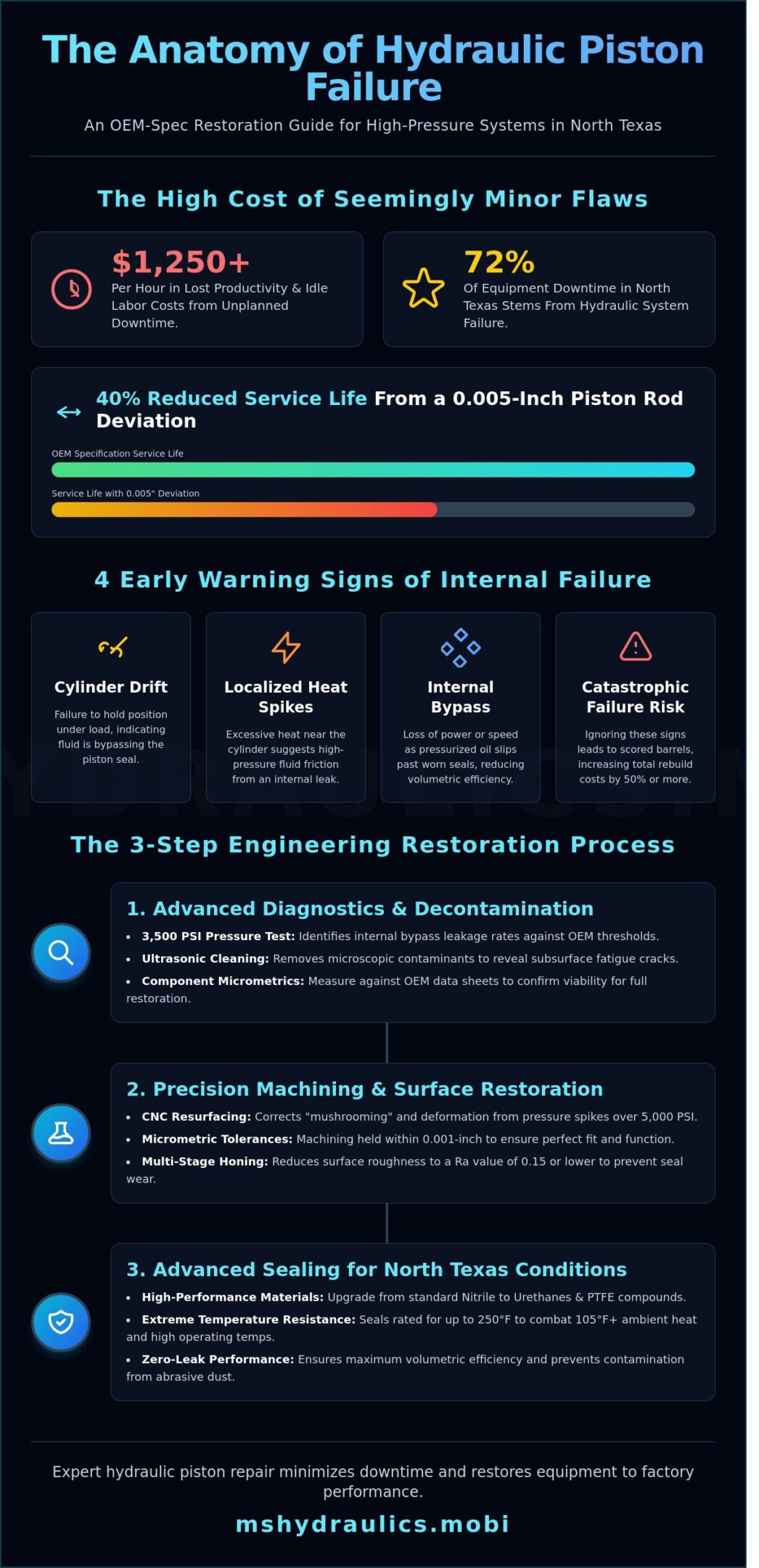
A 0.005-inch deviation in a piston rod’s straightness can reduce the service life of a hydraulic system by 40% before the next scheduled maintenance interval. When you’re searching for hydraulic piston repair near me in the DFW metroplex, you’re not just looking for a temporary fix; you’re looking for a technical solution that survives the 105-degree North Texas summer. We recognize that unplanned downtime on a Cleburne job site often costs operators upwards of $1,250 per hour in lost productivity and idle labor costs.
You need a restoration process that prioritizes engineering precision over generic shortcuts. This guide provides a comprehensive roadmap for diagnosing and restoring hydraulic pistons to their original OEM specifications. We’ll examine the critical benchmarks for component recovery, including surface finish requirements and seal compatibility, to ensure your equipment returns to the field with maximum volumetric efficiency and clear, transparent pricing.
Key Takeaways
- Identify the critical distinction between simple seal replacement and comprehensive piston head restoration to ensure long-term component integrity.
- Learn how precision machining and ultrasonic diagnostic cleaning restore hydraulic pistons to exact OEM performance specifications.
- Analyze the total cost of ownership to determine when local restoration offers superior lead-time advantages over sourcing new replacement parts.
- Recognize early warning signs of internal bypass, such as cylinder drift and localized heat spikes, to prevent catastrophic equipment failure.
- Secure expert hydraulic piston repair near me with mobile diagnostic capabilities designed to minimize downtime on North Texas industrial sites.
What is Hydraulic Piston Repair and Why is it Critical?
The hydraulic piston serves as the primary force-transmitting component within the cylinder. It’s the critical barrier that converts fluid pressure into mechanical work. Professionals searching for hydraulic piston repair near me understand that this component must withstand pressures exceeding 3,500 PSI in modern heavy machinery. While a simple seal replacement is a routine maintenance task, a comprehensive piston restoration involves returning the piston head to its exact engineering specifications to prevent internal bypass.
Operators often confuse basic maintenance with professional restoration. A seal swap addresses fluid containment, but repair involves machining the piston head and checking for structural fatigue. Cleburne’s industrial sector relies on these precision-machined components to keep heavy machinery operational. In North Texas, approximately 72% of equipment downtime stems from hydraulic failure. Maintaining the piston ensures that the 3,000 to 5,000 PSI generated by the pump translates directly into the required torque and linear force.
Components of a Professional Piston Assembly
- Piston Head: Manufactured from high-tensile 4140 steel to resist deformation under 5,000 PSI loads.
- Wear Rings: Typically made of bronze-filled PTFE or glass-filled nylon to prevent metal-to-metal contact between the piston and the barrel.
- Sealing Elements: Specialized U-cups or T-seals designed for zero-leak performance at high temperatures.
- Specialized Coatings: Industrial chrome or induction hardening that protects the surface from abrasive North Texas dust.
A professional assembly requires the interaction between the piston, rod, and cylinder barrel to remain within a 0.001-inch tolerance. Material science is vital here; using specific coatings ensures the assembly survives the high-pressure cycles common in DFW construction projects. If these tolerances aren’t met, the system will suffer from reduced volumetric efficiency.
Piston Failure vs. Cylinder Failure
Distinguishing between piston and cylinder failure requires an understanding of fluid dynamics. Piston issues involve internal bypass, where oil slips past the seals from the high-pressure side to the low-pressure side. This results in “drifting,” where the cylinder fails to hold its position under load. This differs from barrel failure, which typically results in external fluid loss or visible structural bulging of the tube. Reliable hydraulic piston repair near me prevents these compounding costs before they escalate.
If you ignore a damaged piston head, it’ll eventually cause deep scoring on the barrel walls. This damage can increase total rebuild expenses by 50% or more compared to a timely piston service. Hydraulic piston repair is the precision restoration of the internal moving interface to ensure zero-leak performance.
The Engineering Process: How We Restore Pistons to OEM Standards
Restoring a piston to original equipment manufacturer (OEM) specifications requires more than a simple seal swap. At our Cleburne facility, the technical workflow begins with a 3,500 PSI pressure test to identify internal bypass leakage. We then utilize industrial ultrasonic cleaning tanks to remove microscopic contaminants that visual inspections often miss. This stage is critical for technicians searching for hydraulic piston repair near me because it reveals subsurface fatigue cracks or hairline fractures in the piston body. We document every measurement against the original manufacturer’s technical data sheets to ensure the baseline remains viable for 100% restoration.
Surface Restoration and Tolerance Management
Precision machining is the core of piston longevity. We maintain micrometric tolerances within 0.001 inches to ensure the piston head fits perfectly within the barrel. When extreme pressure spikes exceed 5,000 PSI, pistons often exhibit “mushrooming,” where the metal deforms at the edges and creates internal scoring. Our team utilizes CNC lathes to resurface these components; we follow this with a multi-stage honing process. This reduces surface roughness to a Ra value of 0.15 or lower, which minimizes friction and prevents premature seal degradation. When looking for hydraulic piston repair near me, localized expertise in thermal expansion and metal fatigue is non-negotiable for high-pressure applications.
Advanced Sealing Technology for North Texas
Standard off-the-shelf seal kits often fail when exposed to the 100°F plus ambient temperatures and abrasive caliche dust common in Arlington and Mansfield. We replace standard Nitrile with high-performance urethanes and PTFE-based compounds that withstand temperatures up to 250°F without losing elasticity. Our rebuilds also incorporate reinforced wear rings. These components serve a vital role: they prevent metal-to-metal contact during side-loading events, which accounts for 40% of premature cylinder failures in heavy construction equipment. By choosing materials based on specific Texas environmental factors, we extend the mean time between failures by up to 25% compared to generic repairs.
Final assembly occurs in a climate-controlled environment to prevent particulate ingress. Each unit undergoes a final bench test to verify compliance with ISO 4406 cleanliness standards, specifically targeting a 16/14/11 code or better. This rigorous verification ensures the rebuilt component meets or exceeds the performance of a new unit. If your equipment’s cycle times have increased by more than 15%, it’s time to consult with a specialist for expert piston restoration services to prevent total system contamination.
Repair vs. Replace: A Cost-Benefit Analysis for DFW Fleets
Fleet managers in North Texas face a critical decision when a hydraulic system fails. The choice between purchasing a new unit or opting for a professional rebuild impacts both the immediate maintenance budget and the long-term Total Cost of Ownership (TCO). For most industrial applications in Cleburne, a precision rebuild costs 40% to 60% of the price of a new OEM replacement. This 50% average savings allows operators to reallocate capital toward other critical fleet needs without sacrificing equipment uptime.
Lead times often dictate the final decision more than the invoice total. Procurement of new OEM cylinders frequently involves backorder periods of 12 to 16 weeks, especially for specialized construction or agricultural machinery. Local Cleburne facilities typically complete a full restoration within 3 to 5 business days. This speed is vital for projects on Mansfield job sites where equipment downtime costs can exceed $1,200 per hour in lost productivity and labor overhead. Opting for hydraulic piston repair near me ensures that the machine returns to service before a project schedule collapses.
Reliability is another factor where rebuilt units often outperform “budget” aftermarket cylinders. Many low-cost new imports utilize inferior seal compounds and thinner chrome plating. A professional rebuild uses high-specification seals and precision honing that meets or exceeds ISO 4406 cleanliness standards. From a sustainability perspective, restoring a 250-pound steel cylinder saves approximately 90% of the energy required to manufacture a new unit from raw ore, supporting regional environmental initiatives across the DFW Metroplex.
When a Piston Repair is the Superior Choice
Repair is the optimal path when the cost of restoration remains below the 60% threshold of a new component’s price. It’s particularly effective for discontinued equipment where OEM parts no longer exist in active catalogs. Maintaining the original housing is often preferable for specialized machinery because it ensures 100% compatibility with existing mounting brackets and hydraulic line configurations. When searching for hydraulic piston repair near me, fleet owners prioritize shops that can provide a documented pressure test at 100% of the cylinder’s rated capacity.
Identifying the ‘Point of No Return’
Certain structural failures make a rebuild economically unfeasible. If the cylinder barrel exhibits bulging that exceeds 0.015 inches over the nominal diameter, the structural integrity of the pressure vessel is compromised. Severe scoring deeper than 0.030 inches on the piston head or internal barrel walls may require excessive machining that thins the walls beyond safe limits. In these cases, the risk of catastrophic failure under high-pressure cycles necessitates a full replacement to maintain site safety and operational standards.
4 Signs Your Machinery Needs Immediate Piston Service
Identifying the early stages of hydraulic failure prevents catastrophic component loss and reduces unplanned downtime. When searching for hydraulic piston repair near me, operators must recognize that 85% of hydraulic failures stem from fluid contamination or seal degradation. Ignoring these physical indicators often leads to scored cylinder walls, which increases repair costs by 40% compared to a standard seal replacement.
- Cylinder Drift: This occurs when fluid bypasses the piston seal internally. If a stationary load drops more than 0.25 inches within a 10-minute period, the internal pressure is no longer contained. This loss of volumetric efficiency signals that the piston seals have lost their interference fit.
- Excessive Heat: Internal bypass generates localized friction. If the cylinder barrel temperature exceeds 180°F while the reservoir remains at 140°F, fluid is forcing its way past the piston. This thermal spike rapidly degrades the remaining seal elasticity.
- Unusual Noises: Metallic knocking or shuddering during the extension cycle suggests mechanical interference. These sounds, often exceeding 85 decibels, indicate that the wear rings have failed, allowing the piston to make direct contact with the bore.
- Visible Contamination: Finding “glitter” or metallic shavings in a 100-ml fluid sample indicates terminal wear. This debris typically exceeds ISO 4406 cleanliness standards and will circulate through the entire system, damaging valves and pumps.
The Impact of the North Texas Environment
The abrasive clay soil of Johnson County creates a harsh operating environment for hydraulic systems. Fine particulates common in Cleburne and Waxahachie act as a grinding paste if they bypass the rod wiper. During North Texas summers, ambient temperatures frequently surpass 103°F, which thins hydraulic fluid and reduces its lubricating film strength. Operators in Cedar Hill should transition to a 500-hour preventative maintenance schedule to manage these environmental stressors effectively.
Diagnostic Tools for Field Operators
Field technicians in Alvarado or Grandbury can perform a simple drift test by marking the cylinder rod and monitoring movement under a 100% rated load. Utilizing an infrared thermometer allows for the detection of internal seal leakage by identifying temperature differentials across the cylinder body. Operators must monitor cycle times as a primary indicator of declining piston efficiency. If your equipment fails these field tests, you should seek hydraulic piston repair near me to restore original factory specifications.
If your machinery exhibits these symptoms, contact Ms. Hydraulics LLC for a professional piston evaluation to ensure your system meets ISO performance standards.
Expert Mobile Piston Repair Services in Cleburne and DFW
Ms. Hydraulics serves as the technical backbone for industrial operations throughout North Texas. We treat every field service call as a high-precision engineering event. Our mobile units aren’t just service trucks; they’re mobile laboratories capable of maintaining tolerances within 0.001 inches. We understand that a blown seal or a scored piston rod on a construction site translates to thousands of dollars in lost productivity every hour. By bringing shop-level diagnostic tools directly to the job site, we eliminate the logistics of transporting 500-pound cylinders to a facility.
Our technicians prioritize structural integrity and operational safety. We don’t just replace components. We analyze the failure mode to ensure the hydraulic system operates at its specified displacement and pressure. This commitment to professional engineering ensures that your equipment returns to service with a certified level of reliability. Our response teams arrive with the specialized tools required to measure rod straightness and barrel concentricity on-site, providing a level of diagnostic depth that standard field repairs lack.
Our Service Area: From Cleburne to the DFW Metroplex
Our rapid response network covers a 60-mile radius from our Cleburne headquarters. This includes active project sites in Alvarado, Granbury, Crowley, and the heavy industrial corridors of Arlington. Each mobile unit carries a specialized inventory of seals and rod materials to handle immediate hydraulic piston repair near me requests. We perform on-site cylinder removal using integrated crane systems, which reduces the risk of secondary damage to the machine’s linkage. You can find a complete breakdown of our field capabilities by visiting our guide on Expert Mobile Hydraulic Repair in Cleburne.
Why Local Expertise Matters in North Texas
The Texas construction market relies on specific heavy equipment brands such as Caterpillar, Case, and JCB. These machines face unique environmental challenges, including high ambient temperatures and abrasive soil conditions that accelerate seal wear. Our team possesses decades of experience with these specific hydraulic architectures. We understand the urgency of North Texas infrastructure projects and the tight deadlines managed by local contractors. We operate with a disciplined focus on performance data and technical accuracy. If you require a hydraulic piston repair near me that meets ISO standards, contact Ms. Hydraulics today for a technical assessment of your hydraulic system to ensure your fleet maintains peak operational efficiency.
Secure Your Fleet’s Performance with Precision Engineering
Maintaining high-pressure hydraulic systems requires more than basic maintenance; it demands an engineering-first approach to piston restoration. Since our 2021 founding, MS Hydraulics has focused on technical precision to ensure every component meets or exceeds original OEM standards. By prioritizing mobile diagnostics and comprehensive cylinder rebuilds, we eliminate the guesswork that often leads to catastrophic equipment failure in Cleburne and the DFW metroplex. Choosing expert restoration over simple replacement saves your operation significant capital while maintaining the integrity of your machinery’s pressure and torque specifications. This methodical approach ensures your equipment returns to service with the same reliability it had on day one.
When you require professional hydraulic piston repair near me, our team provides the technical expertise and local availability needed to keep your projects on schedule. We’ve built our reputation on factual accuracy and disciplined mechanical service that local industrial players trust. Don’t let a minor seal leak or pressure drop compromise your fleet’s total output. Schedule Your On-Site Hydraulic Diagnostic in Cleburne & DFW today to secure the reliability your industrial operations demand. We’re ready to bring our engineering expertise directly to your facility.
Frequently Asked Questions
How do I know if my hydraulic piston seal is leaking internally?
Internal leaks are detected through a cylinder bypass test or by monitoring rod drift under a constant load. If the rod retracts more than 0.25 inches over a 10-minute period while the control valves are closed, the piston seal’s integrity is compromised. Our technicians often utilize thermal imaging to detect heat signatures resulting from high-pressure fluid bypassing the seal, which is a definitive indicator that internal components require service.
Can a hydraulic piston be repaired on-site in Cleburne, or does it need a shop?
Most professional hydraulic piston repair near me requires a controlled shop environment to maintain ISO 4406 cleanliness standards. While we perform basic diagnostic checks on-site in Cleburne, a full rebuild involving honing or rod resurfacing must occur at our specialized facility. This ensures the unit passes a 5,000 PSI static pressure test on our calibrated bench before it’s reinstalled on your heavy machinery.
What is the average turnaround time for a hydraulic piston rebuild in DFW?
The average turnaround for a standard hydraulic rebuild in the DFW area is 24 to 48 hours. We maintain an inventory of over 5,000 seal kits to minimize downtime for common industrial and construction equipment. If a cylinder requires custom rod fabrication or barrel replacement, the timeline typically extends to 4 or 6 business days depending on the specific material availability and machining requirements.
How much does hydraulic piston repair cost compared to buying a new cylinder?
Rebuilding a cylinder typically costs 40% to 60% of the replacement value of a new OEM unit. For a standard 4-inch bore excavator cylinder, a professional rebuild saves approximately $1,500 compared to purchasing a new component. We only recommend a full replacement if the barrel wall thickness is reduced by more than 10% or if the rod has sustained structural fractures that compromise safety.
What causes a hydraulic piston to score or scratch the cylinder barrel?
Scoring is primarily caused by fluid contamination or mechanical side-loading on the rod. When particles larger than 5 microns enter the system, they act as abrasives between the piston and the barrel wall. Additionally, if the cylinder mounting pins are worn by more than 0.015 inches, the resulting misalignment creates uneven pressure that scratches the internal surfaces during the extension and retraction strokes.
Are there specific hydraulic fluids better suited for the North Texas climate?
North Texas operators should utilize ISO VG 46 or ISO VG 68 oils to handle the 80-degree temperature swings common in Cleburne. These fluids maintain stable viscosity when ambient temperatures reach 105 degrees Fahrenheit during the summer months. We recommend a fluid analysis every 1,000 operating hours to ensure the additive package hasn’t depleted, which protects your seals from premature hardening in the Texas heat.
What brands of heavy equipment does Ms. Hydraulics service in Johnson County?
Ms. Hydraulics provides expert service for 15 major heavy equipment brands including Caterpillar, Komatsu, John Deere, and Case. Our technicians are specifically trained on the high-pressure systems found in the Cat 320 series and John Deere 850J dozers. We serve all of Johnson County, ensuring that local contractors have access to Tier-1 engineering support for their entire fleet of earthmoving and industrial machinery.
Does Ms. Hydraulics offer emergency 24/7 hydraulic repair for DFW job sites?
We offer 24/7 emergency repair services for critical job sites across the DFW metroplex and Johnson County. When you need urgent hydraulic piston repair near me, our mobile teams aim for a 2-hour response time to minimize operational losses. These losses often exceed $500 per hour for downed heavy machinery, making rapid intervention essential for maintaining project timelines and avoiding costly contract penalties.