On-Site Diagnostic Services for Heavy Equipment in Cleburne & North Texas
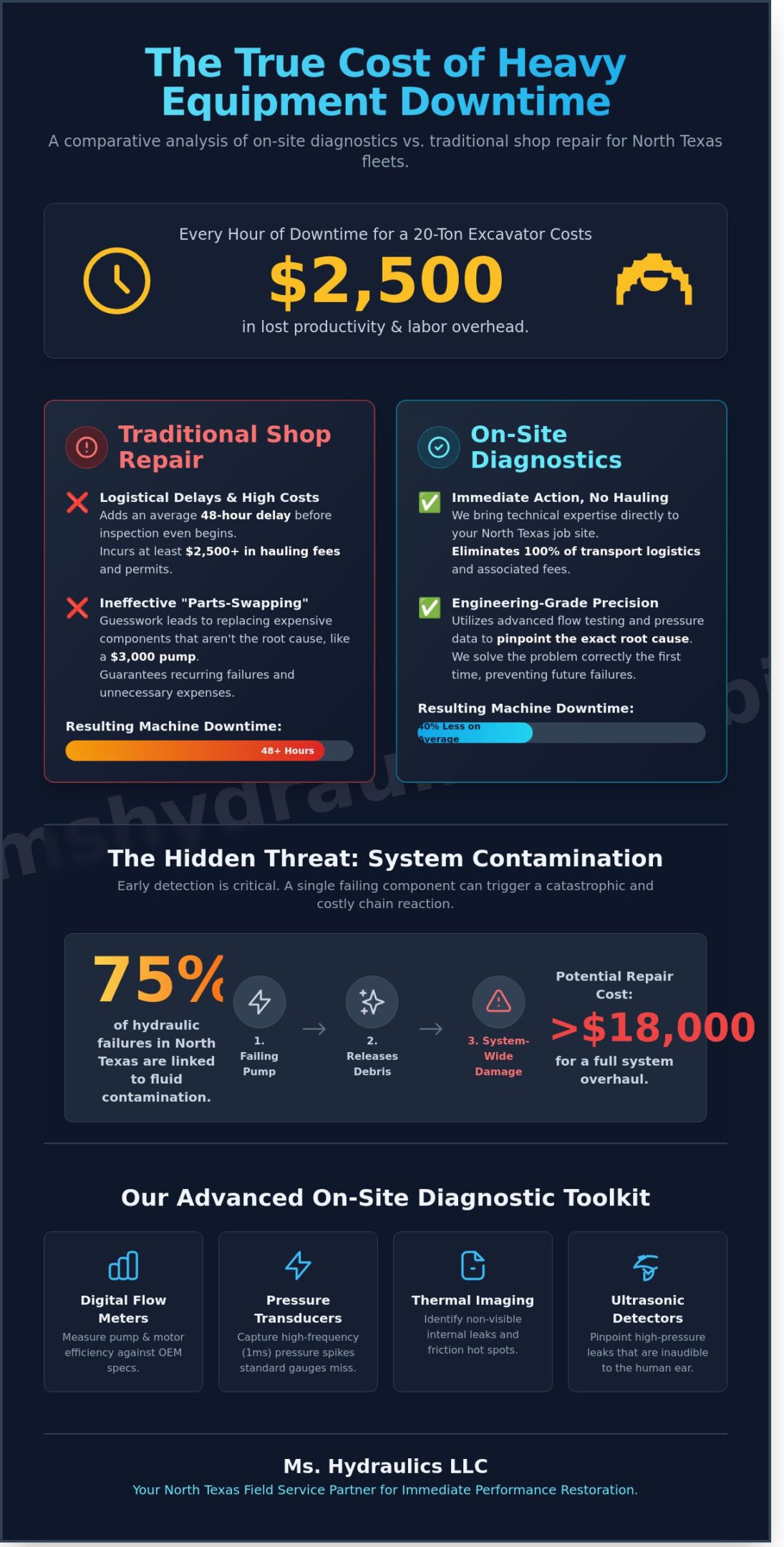
Every hour a 20-ton excavator sits idle on a Cleburne job site represents a direct loss of approximately $2,500 in operational productivity and labor overhead. You know that transporting heavy machinery to a service center often adds a 48-hour logistical delay before a technician even begins an inspection. It’s a common frustration when inexperienced mechanics resort to “parts-swapping” instead of identifying the actual mechanical failure, leading to unnecessary expenses and extended downtime. Our On-Site Diagnostic Services are designed to bypass these bottlenecks by delivering technical expertise directly to your fleet.
Ms. Hydraulics LLC utilizes precise flow testing and high-accuracy pressure transducer data to pinpoint the root cause of hydraulic failure immediately. We eliminate the guesswork and high hauling fees by bringing engineering-grade troubleshooting to your North Texas location. This article outlines how our field technicians resolve complex pressure and flow issues to restore your equipment’s performance specifications. You’ll learn how our structured approach to field diagnostics ensures a clear path to repair that minimizes operational delays and maximizes your machine’s uptime.
Key Takeaways
- Identify technical failures early through advanced field instrumentation to prevent catastrophic system-wide contamination and hardware damage.
- Learn how precision flow testing and pressure transducer analysis determine whether hydraulic pumps and motors are operating within manufacturer displacement specifications.
- Evaluate the cost-benefit advantages of utilizing On-Site Diagnostic Services to bypass the logistical expenses and downtime of hauling equipment to a shop.
- Understand the systematic mobile diagnostic workflow, ensuring safety and accuracy from the initial symptom assessment to final field resolution.
- Explore how specialized mobile service units deliver shop-level technical expertise directly to Cleburne and North Texas job sites for immediate performance restoration.
What Are On-Site Diagnostic Services for Heavy Equipment?
On-Site Diagnostic Services represent a specialized engineering discipline focused on real-time field testing and performance evaluation. Technicians utilize advanced instrumentation, including digital flow meters, ultrasonic leak detectors, and high-frequency pressure transducers, to identify failures across hydraulic, mechanical, and electrical systems. This technical approach allows for the measurement of internal leakage and pressure drops that aren’t visible during a standard walk-around inspection. By analyzing these parameters against OEM performance curves and monitoring pressure ratings up to 10,000 PSI, we pinpoint the exact source of inefficiency before a total breakdown occurs.
Preventing catastrophic system-wide contamination is the primary objective of these diagnostics. When a hydraulic pump begins to fail, it often releases microscopic metallic debris into the fluid stream. If these particles aren’t identified through immediate field testing in accordance with ISO 4406 cleanliness standards, they migrate through the entire circuit. This migration destroys valves, cylinders, and motors, turning a single component repair into a complete system overhaul. In North Texas, 75% of hydraulic failures are linked to fluid contamination. Identifying a failing component early saves fleet owners from a full system flush and component replacement cycle that can exceed $18,000 on complex heavy equipment units.
Cleburne fleet managers prioritize On-Site Diagnostic Services over traditional shop-based intake to maintain aggressive project timelines. Transporting a 50-ton excavator to a repair facility involves expensive permits, specialized trailers, and at least $2,500 in logistics costs before any repair work begins. Field analysis eliminates these hurdles entirely. We’ve found that performing diagnostics at the job site reduces total machine downtime by 40% on average. This efficiency has a direct impact on operational ROI by keeping machines in production and eliminating the non-productive hours spent in transit.
The Difference Between Troubleshooting and Guessing
“Parts-swapping” is a costly and ineffective strategy for modern, high-pressure hydraulics. Replacing a $3,000 pump without identifying the underlying cavitation issue only guarantees a second failure within weeks. Our technicians operate as system detectives, using forensic mechanical analysis to trace symptoms back to their technical origin. Diagnostic precision is the intersection of technical data and field experience. This methodical approach ensures we solve the problem correctly the first time, preventing the cycle of recurring failures that plagues unscientific repair methods.
Equipment We Service in North Texas
We provide comprehensive on-site support for a wide range of machinery, including excavators, skid steers, drill rigs, and telehandlers. Our mobile units frequently service specialized agricultural machinery in Alvarado and Grandbury, where hydraulic reliability is critical for seasonal harvests. The Texas climate presents unique challenges, as summer ambient temperatures often surpass 100°F. This extreme heat causes hydraulic fluid to thin and seals to undergo thermal degradation. We specifically analyze seal durometer and fluid viscosity to ensure your equipment survives the thermal stressors of the local environment, preventing leaks caused by heat-induced hardening.
The Technical Process of Hydraulic System Analysis
Effective diagnosis requires a rigorous engineering approach rather than simple visual inspection. Our On-Site Diagnostic Services utilize high-accuracy pressure transducers to monitor system spikes and drops in real-time. These sensors capture data at intervals of 1 millisecond, allowing technicians to identify pressure surges that standard mechanical gauges cannot register. Such surges often signal faulty accumulators or sticking relief valves that lead to catastrophic component failure if left unaddressed. Safety remains the primary concern during these procedures. The dangers of hydraulic systems involve high-pressure skin penetration and mechanical bursts, making professional-grade testing equipment essential for risk mitigation.
Thermal imaging cameras provide a non-invasive look at internal system health. By scanning valve banks and cylinders, we identify internal bypass and friction heat that isn’t visible to the eye. A localized hot spot on a control valve, for example, often indicates a worn seal or a cracked internal housing. On modern machinery, we also perform electronic control diagnostics. Reading fault codes on CAN bus systems allows us to calibrate proportional valves and adjust electronic pump controllers to original factory defaults. This ensures the digital and mechanical components of the machine are in perfect synchronization.
Pressure and Flow Testing Protocols
We establish baseline PSI measurements against factory specifications to verify that the system operates within its design envelope. A pump rated for 4,000 PSI must achieve that pressure without excessive case drain flow. We utilize flow meters to determine if pumps and motors meet at least 92% of their manufacturer displacement specs. This process identifies “drifting” cylinders and internal valve leakage through empirical flow analysis. It’s vital to test under “working load” conditions. Replicating field failures requires pushing the system to its operational limits, as many leaks only manifest when the oil reaches 140°F and viscosity thins.
Hydraulic Fluid and Contamination Analysis
Contamination causes approximately 75% of all hydraulic failures. Our on-site fluid sampling detects metallic shavings, water ingress, or aeration before they cause a total system seizure. We interpret these results using ISO 4406 cleanliness codes to provide a clear picture of fluid health. A reading of 21/19/16 indicates a high risk of pump shoe wear, whereas a 16/14/11 rating suggests a healthy, well-filtered system. Regular fluid “health checks” for high-hour machines provide a 30% increase in component life expectancy on average. This data-driven approach allows for planned maintenance rather than reactive repairs.
Maintaining these technical standards ensures your equipment remains reliable under heavy industrial use. If your machinery shows signs of power loss or erratic movement, a On-Site Diagnostic Services visit can prevent extensive downtime. For complex system issues, you can consult our engineering team to schedule a comprehensive performance evaluation.
Field Diagnostics vs. Shop Repair: A Cost-Benefit Analysis
Deciding between mobile intervention and shop-based overhaul requires a rigorous assessment of logistical overhead. Transporting heavy machinery from a Cleburne job site to a centralized facility involves more than just fuel costs. Oversize load permits in Johnson County can range from $30 to $100 per trip, while specialized hauling fees often exceed $1,500 for a single 50-mile radius. Utilizing On-Site Diagnostic Services eliminates these preliminary expenses and reduces the risk of structural damage during loading. Field technicians utilize calibrated flow meters and pressure transducers to analyze system performance under actual load conditions. This method provides immediate data on pump efficiency and valve response. It allows operators to observe the diagnostic process firsthand. This transparency ensures that the identified failure point, such as a 15% drop in volumetric efficiency, is verified before components are removed.
Safety remains a critical factor during these evaluations. Technicians must adhere to strict safety procedures for high-pressure hydraulic systems to prevent fluid injection injuries and mechanical collapses. Diagnosing a failure in its operational environment allows the technician to identify external variables like ambient heat or contaminated fluid reservoirs that a shop environment might mask. By utilizing digital pressure gauges with data-logging capabilities, our team identifies transient pressure spikes that occur only during specific duty cycles. This provides a level of precision that static shop testing often misses.
Calculating the Real Cost of Downtime
Financial impact isn’t limited to the repair invoice. A mid-sized excavator generates approximately $450 in hourly project revenue. When a machine sits idle, the owner loses $3,600 per eight-hour shift. Adding a $2,200 weekly rental fee for a replacement unit quickly compounds the deficit. Accurate On-Site Diagnostic Services prevent “comebacks” by identifying secondary issues, such as metallic debris in the return line, before they cause a second catastrophic failure. In a 2023 project near Chisholm Trail Parkway, a local contractor saved 72 hours of transit and staging time by opting for mobile diagnostics. This 3-day window allowed them to complete a foundation pour ahead of a scheduled weather event, avoiding a $12,000 delay penalty.
When Field Service is the Only Viable Option
Certain scenarios render shop repairs impossible. A “stuck” machine with a locked final drive or a collapsed boom cannot be safely winched onto a lowboy trailer without causing further mechanical destruction. In these instances, field intervention is the primary recovery method. This necessity extends to stationary industrial equipment within Cleburne’s manufacturing sector. Large-scale hydraulic presses and injection molding machines are integrated into facility foundations; they cannot be moved. For critical infrastructure projects across North Texas, including those in Dallas and Fort Worth, emergency response teams provide the technical expertise required to restore system pressure and torque on-site. This capability is vital for maintaining the 98% uptime standards required in high-volume production environments. Our technicians focus on specific parameters like displacement and torque to ensure the machinery meets original equipment manufacturer (OEM) specifications before the service call is closed.
What to Expect During a Mobile Diagnostic Call
The mobilization of On-Site Diagnostic Services begins with a technical intake process. We don’t just send a truck; we dispatch a specialized technician equipped with the machine’s specific service history and reported failure symptoms. During the initial dispatch, we verify critical parameters such as the 5,000 PSI operating limit or the 250-hour service interval status. This data allows for a targeted tool selection, ensuring the diagnostic suite includes the correct pressure transducers and flow meters for your specific ISO 4406 cleanliness requirements.
Upon arrival at the Cleburne job site, the priority is establishing a 15-foot safety perimeter. Hydraulic systems under pressure represent a significant kinetic energy risk. Technicians verify that the machine is in a zero-energy state before connecting diagnostic hardware. We then perform systematic testing of both the hydraulic circuits and the integrated electrical interfaces. This involves measuring volumetric efficiency at the pump and checking relief valve settings against the manufacturer’s 3,500 PSI specification. We also utilize digital multimeters to verify 24V DC solenoid response times, ensuring the electrical signals match the mechanical output.
Preparing Your Site for the Technician
Efficiency depends on access. Ensure the machine is positioned on level ground with a 3-meter clearance zone free of debris. An operator must be present to demonstrate the specific failure mode, as intermittent pressure drops often only occur under 85% load conditions. Provide hard copies of the last 12 months of maintenance logs. Having this documentation ready can reduce the diagnostic window by 45 minutes, allowing for a faster transition to the repair phase. Our technicians require a clear path to the main pump stack and control valves to minimize setup time.
Reviewing the Diagnostic Report
The final report provides a data-driven breakdown of the system’s health. You’ll see precise measurements for volumetric efficiency; a pump operating at 70% efficiency typically requires an immediate overhaul to prevent catastrophic failure. We also document relief valve settings and electrical solenoid response times in milliseconds. Repairs are categorized by urgency. Critical safety issues, such as a compromised 4-wire spiral hose, take precedence over 500-hour preventative maintenance tasks. Every report includes a 48-hour estimate for parts lead times and a fixed labor quote based on current Cleburne market rates.
Our diagnostic process eliminates guesswork by relying on calibrated instrumentation rather than visual inspection alone. This methodical approach ensures that the root cause of the failure is addressed, preventing the recurrence of the same issue 30 days later. For immediate technical support and to schedule your inspection, request our On-Site Diagnostic Services today.
Ms. Hydraulics: Your North Texas Field Service Partner
Ms. Hydraulics delivers engineering-grade solutions to Cleburne without the distractions of corporate fluff. We focus on technical integrity and mechanical performance. Our field technicians approach every call with over 15 years of collective experience in fluid power systems. We understand that a stalled excavator or a failing industrial press costs your operation approximately $500 to $2,000 per hour in lost productivity. Our goal is to minimize that window through precise On-Site Diagnostic Services that pinpoint the exact failure point, whether it’s a worn piston seal or a cavitating pump.
Our mobile service trucks are fully-equipped technical hubs. They aren’t just transport vehicles; they’re mobile fabrication shops. Each unit carries a comprehensive inventory of ISO-certified fittings and high-pressure hoses capable of withstanding 5,000 PSI working pressures. When our diagnostics reveal a ruptured line or a compromised cylinder, we don’t send you to a third-party shop. We handle custom hose fabrication and initial cylinder assessments right there on your job site. This vertical integration ensures that repairs meet 100% of OEM specifications before the technician leaves your property. We utilize digital flow meters to verify that your system reaches its rated output after every intervention.
We serve the entire North Texas corridor with a focus on reliability. Our service area extends from Alvarado to Mansfield and into the heart of Johnson County. By maintaining a localized fleet, we ensure that our technicians arrive with the specific tools required for regional equipment, such as the heavy-duty rigs used in local gas well servicing and infrastructure projects. We track system parameters like operating temperature and fluid viscosity to ensure your machinery performs within its designed torque and displacement limits. This regional focus allows us to reach sites in Cleburne within 60 minutes of a confirmed dispatch.
Local Expertise for Texas Job Sites
Operating in Johnson County presents unique challenges. During the 45 days of 100-degree heat typical of a Texas summer, hydraulic fluids often exceed 180 degrees Fahrenheit, leading to rapid seal degradation. Our technicians specialize in identifying heat-related failures and dust contamination issues common in local construction. We build trust through data-driven service reports that provide a clear audit trail for your maintenance records. Our field evaluations include:
- Monitoring fluid oxidation levels caused by high ambient temperatures.
- Inspecting rod seals for abrasive wear from limestone dust.
- Checking cooling system efficiency to prevent pump cavitation.
Contact Us for Emergency On-Site Support
When your fleet stops moving, immediate action is required. You can request a field technician by contacting Ms. Hydraulics LLC directly. Our dispatch team coordinates On-Site Diagnostic Services across the North Texas region to ensure your equipment returns to service quickly. We provide transparent pricing and technical breakdowns for every repair. Schedule your diagnostic today to maintain your fleet’s operational efficiency and prevent costly mechanical downtime.
Optimize Your Fleet Performance with Precision Field Data
Reducing heavy equipment downtime starts with accurate data acquisition. Mobile field diagnostics eliminate the $500 to $2,000 transport costs typically associated with hauling machinery to a repair facility for initial inspection. By utilizing On-Site Diagnostic Services, operators maintain strict project timelines while our technicians analyze critical parameters like hydraulic pressure and flow rates directly at the job site. MS Hydraulics provides Cleburne and North Texas with 24/7 emergency response, ensuring that mechanical failures don’t stall 12-hour work shifts. Our mobile service trucks carry a full suite of digital diagnostic tools capable of measuring system performance with 99% accuracy. This technical approach identifies the root cause of hydraulic instability before it leads to catastrophic component failure. When diagnostics reveal the need for specific components, having access to quality hydraulic parts in Cleburne and North Texas ensures rapid repairs with OEM-grade components. Trust our Cleburne-based team to restore your equipment’s ISO-rated performance levels without the logistical delays of traditional shop repairs. It’s the most efficient way to keep your operations running at peak capacity.
Schedule Your On-Site Diagnostic Service Now
We look forward to helping you maintain your competitive edge in the field.
Frequently Asked Questions
How quickly can a technician arrive for on-site diagnostics in Cleburne?
Our technicians typically arrive at Cleburne job sites within 2 to 4 hours of your initial service request. We prioritize emergency calls for critical infrastructure where downtime costs exceed $600 per hour. Our dispatch center monitors 15 mobile units across Johnson County to ensure the closest specialist is routed to your location immediately. This rapid response is a core part of our commitment to local industrial reliability.
Can you diagnose electrical issues on hydraulic systems?
We diagnose electrical faults within hydraulic systems using calibrated multimeters and digital diagnostic scanners. Modern machinery relies on 24V DC systems for solenoid actuation and pressure sensing. Our team tests wiring harnesses, relays, and controllers to isolate electrical failures from mechanical ones. We verify 100% of the system’s control architecture before we recommend any mechanical teardowns or component replacements.
What information do I need to provide before the technician arrives?
You should provide the machine model number, serial number, and a description of the failure symptoms. Mentioning if the system shows a 15% drop in pressure or a 20 degree Celsius rise in operating temperature helps our preparation. This data allows us to bring the correct schematics for your On-Site Diagnostic Services. Knowing the specific fluid type also prevents cross-contamination during testing.
Is on-site diagnostic service more expensive than bringing it to a shop?
On-site diagnostics include a flat-rate service call fee starting at $150, which is significantly less than the $500 to $1,500 cost of transporting heavy machinery. You save on rigging and hauling expenses while keeping the equipment in its actual operating environment. Our field rates are competitive with shop labor; 85% of diagnostic tasks are completed successfully without requiring equipment relocation to a fixed facility.
What happens if the diagnostic reveals a major component failure like a pump?
If we identify a failure in a component like a Rexroth A10V pump, we provide a technical report detailing the volumetric efficiency loss. We offer on-site removal or field repair depending on the contamination levels found in the 10-micron filters. Our 12-month warranty covers major component replacements. If the pump requires a clean-room rebuild, we facilitate transport to our ISO 9001 certified facility for precision machining.
Do you offer diagnostic services for agricultural equipment in rural Johnson County?
We provide On-Site Diagnostic Services for agricultural machinery throughout the 730 square miles of Johnson County. Our technicians service tractors, harvesters, and irrigation systems in rural areas like Grandview and Godley. We understand that a 24-hour delay during harvest can result in a 5% total crop loss. Our mobile labs carry the specialized metric and JIC fittings required for John Deere and Case IH platforms.
Can you perform on-site diagnostics during inclement Texas weather?
We perform diagnostics during inclement weather unless wind speeds exceed 35 mph or lightning is detected within a 10-mile radius. Our service vehicles carry portable shelters to protect open hydraulic circuits from moisture and wind-blown debris. Maintaining a clean environment is critical; even 0.5% water contamination can degrade hydraulic fluid performance. We follow strict OSHA safety guidelines to ensure field operations continue safely during storms.
Are your technicians certified to work on major brands like Cat, Deere, or Komatsu?
Our technicians hold certifications from the International Fluid Power Society and have completed manufacturer-specific training for Caterpillar, John Deere, and Komatsu systems. We maintain a database of over 5,000 technical manuals to ensure every adjustment meets OEM specifications exactly. We use calibrated gauges to verify that system pressures align with the factory-set 3,000 PSI or 5,000 PSI requirements. Accuracy remains our primary metric for success.