Precision Drill Rig Hydraulic Cylinder Repair in North Texas (2026)
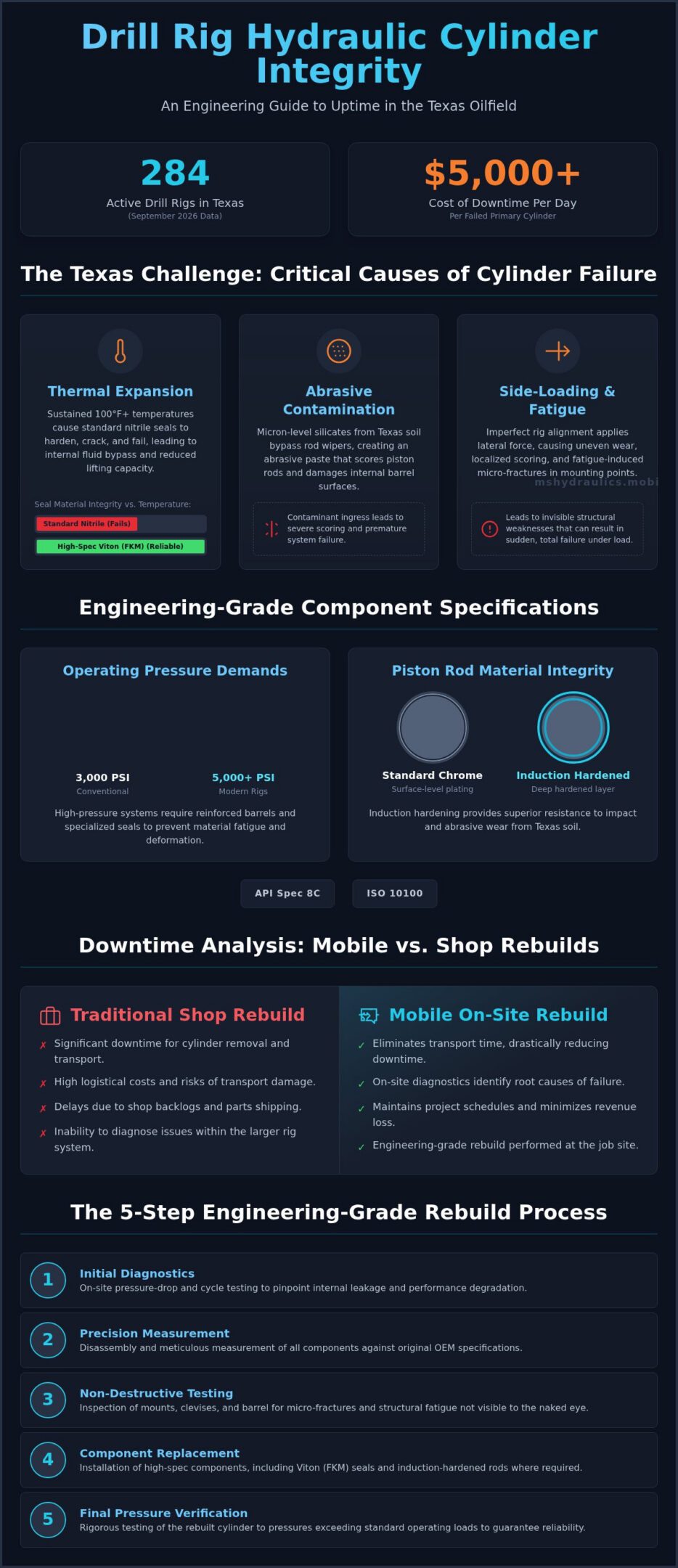
With the active Texas rig count reaching 284 in September 2026, the demand for operational uptime has reached a critical peak. You understand that when a primary lift or pull-down cylinder fails, the resulting downtime costs often exceed $5,000 per day. For many operators, the logistical burden of transporting large-bore cylinders to a remote shop only compounds these losses. This article details the technical standards required for professional drill rig hydraulic cylinder repair Texas projects demand to ensure long-term reliability. You’ll discover how mobile diagnostics and engineering-grade rebuilds eliminate transport delays while maintaining strict adherence to API Spec 8C and ISO 10100 standards.
We provide a comprehensive look at the mechanical parameters of high-pressure systems operating above 350 bar. Our analysis covers the necessity of verified pressure testing and the selection of seal materials capable of withstanding the extreme thermal expansion cycles common in North Texas. By the end of this guide, you’ll have a clear framework for evaluating repair services based on technical verification and modern efficiency rather than just a quick fix.
Key Takeaways
- Identify how extreme Texas temperatures and abrasive contaminants degrade hydraulic fluid viscosity and seal integrity.
- Distinguish between high-pressure feed cylinders and stability-focused leveling jacks to determine specific material requirements for piston rods.
- Analyze the logistical advantages of on-site diagnostics to eliminate the significant costs associated with transporting large-bore components.
- Understand the rigorous steps of a drill rig hydraulic cylinder repair Texas project, from initial pressure-drop testing to precision measurement against OEM specifications.
- Leverage mobile hydraulic services in the North Texas region to maintain project schedules through engineering-grade rebuilds performed directly at the job site.
Critical Causes of Drill Rig Hydraulic Cylinder Failure in Texas
Drill rig operations in North Texas face unique environmental challenges that accelerate mechanical degradation. The intersection of extreme climate conditions and high-cycle industrial use creates a high-risk environment for hydraulic failure. Understanding these failure modes is essential for scheduling timely drill rig hydraulic cylinder repair Texas services before a catastrophic breach occurs. When these systems fail, it’s rarely due to a single event; rather, it’s the cumulative effect of thermal stress and abrasive wear.
Thermal Expansion and Seal Integrity
Texas summer temperatures frequently exceed 100°F. These sustained high-ambient conditions directly impact the physical properties of hydraulic seals. Standard nitrile elastomers often lose elasticity and become brittle when operating temperatures consistently remain at the upper end of their design limits. This degradation leads to hardening, which prevents the seal from maintaining the necessary contact pressure against the rod or barrel. Thermal bypass refers to the internal leakage of hydraulic fluid across a piston seal as heat causes the cylinder barrel to expand at a different rate than the internal components.
Industrial oilfield applications require high-spec Viton (FKM) seals to mitigate these risks. Viton maintains its mechanical properties at significantly higher temperatures compared to standard materials, ensuring a reliable seal even during intensive drilling cycles. Without these specialized materials, internal bypass becomes inevitable, reducing the rig’s lifting capacity and precision.
Contamination Management in the Field
North Texas soil and dust contain high concentrations of abrasive silicates. These micron-level particles often bypass standard rod wipers during high-cycle operations. Once these contaminants enter the system, they act as an abrasive paste, leading to significant rod scoring and internal barrel damage. Proactive Heavy Equipment Maintenance serves as the primary defense against this particle ingress. Regular inspection of the rod wiper integrity and fluid filtration levels is necessary to prevent internal component wear. Understanding the Hydraulic cylinder design and function allows operators to identify early signs of contamination, such as “milky” fluid or unusual heat signatures on the barrel surface.
Side-Loading and Fatigue
Drill rig cylinders are frequently subjected to side-loading stresses when the mast or leveling jacks aren’t perfectly aligned. This lateral force causes the piston to press unevenly against the barrel wall, resulting in localized scoring and premature seal failure. Over time, these stresses contribute to fatigue-induced cracking in the cylinder clevises and mounting points. These structural failures aren’t always visible to the naked eye but can lead to sudden, total system failure under load. Professional drill rig hydraulic cylinder repair Texas providers use non-destructive testing to identify these micro-fractures during the rebuild process, ensuring the structural integrity of the mount matches the performance of the internal seals.
Technical Specifications of Industrial Drill Rig Cylinders
Industrial drilling equipment relies on a sophisticated hydraulic architecture where components are engineered for specific mechanical roles. Precision in drill rig hydraulic cylinder repair Texas projects requires a deep understanding of these distinct specifications. While a standard utility cylinder might suffice for light duty, drill rigs demand components capable of managing extreme axial loads and high-frequency cycles. Most conventional systems operate within a 3,000 PSI parameter, but modern high-intensity rigs frequently utilize 5,000+ PSI systems. These higher pressure ratings necessitate reinforced barrel walls and specialized seal geometries to prevent material fatigue or catastrophic deformation.
Material selection for piston rods is another critical specification. Induction hardened chrome is the preferred standard for North Texas drilling operations. Unlike standard chrome plating, the induction hardening process creates a deep, hardened layer beneath the surface. This provides superior resistance to the physical impacts and abrasive silicates common in local soil profiles. When evaluating a cylinder for rebuild, verifying the surface hardness and geometric integrity of the rod is a mandatory step in our engineering-grade process. If your equipment shows signs of pressure loss, scheduling on-site diagnostic services can identify whether the issue lies in the material specification or a component failure.
Feed Cylinders: Precision and Constant Load
Feed cylinders are the primary drivers of the rate-of-penetration (ROP). They must maintain a constant, vibration-free load to ensure drilling efficiency and bit longevity. Internal bypass is a common failure mode here, often manifesting as “drift,” where the cylinder fails to hold its position under a static load. Precision rod polishing is essential during the rebuild of feed cylinders. A surface finish that is too rough will shred seals, while a surface that is too smooth won’t hold the microscopic oil film required for lubrication. We aim for a specific Ra (Roughness Average) value to balance these requirements.
Leveling Jacks and Outriggers
Stability-focused cylinders, such as leveling jacks and outriggers, prioritize static load-holding over high-speed cycling. These units rely heavily on integrated load-holding valves to ensure the rig remains level and safe during operation. Failure in telescoping stabilizer designs often occurs at the transition points between stages, where seals are subjected to complex pressure differentials. Identifying whether a leak is external or internal is vital. External leaks are visible indicators of seal failure, whereas internal leaks often result in the cylinder “settling” under the weight of the rig, creating a significant safety hazard on the job site.
Mobile vs. Shop Rebuilds: A Strategic Downtime Analysis
Selecting the appropriate repair environment for a 500lb+ hydraulic component is a critical operational decision. The “True Cost of Transport” often exceeds the actual repair invoice when you factor in crane rentals, specialized freight, and the extended downtime required for logistical coordination. Strategic drill rig hydraulic cylinder repair Texas operators prioritize on-site solutions to bypass these overheads. By integrating On-Site Diagnostic Services into the initial workflow, technicians can determine the precise failure mode without removing the cylinder from the machine. This prevents unnecessary teardowns and allows for targeted component replacement directly in the field.
Shop-based machining becomes unavoidable only when the mechanical integrity of the barrel or rod is compromised beyond field-serviceable limits. If a cylinder requires deep-hole boring or precision honing to correct internal barrel scoring, transport to a controlled facility is necessary. However, for the majority of seal failures and minor rod damage, the mobile approach offers superior efficiency. Field technicians utilize specialized tooling to perform precision disassembly while maintaining the rigorous cleanliness standards required to prevent hydraulic system contamination.
The Logistics of On-Site Repair
Mobile repair units are engineered to function as self-contained service centers. These units include equipment for mobile hydraulic hose fabrication, allowing for the immediate replacement of associated lines that may have been damaged during the cylinder’s failure. Field testing protocols are equally rigorous; technicians perform verified pressure-holding tests using portable diagnostic equipment to ensure the rebuild meets OEM specifications. To manage environmental exposure, we utilize portable clean-work zones and containment systems that protect sensitive internal components from the abrasive silicates common in the North Texas wind.
Cost-Benefit Framework for Texas Operators
Analyzing the ROI of expert mobile hydraulic repair in Cleburne, TX requires a comparison of hourly field labor against the total lifecycle cost of a shop rebuild. While shop environments may offer flat-rate fees for certain services, they rarely account for the $5,000+ daily loss in rig productivity during transport. In the Cleburne and DFW corridor, emergency response times are optimized to restore rig functionality within hours rather than days. This rapid deployment model ensures that drill rig hydraulic cylinder repair Texas projects remain on schedule, maximizing the utilization of high-value drilling assets in a competitive market.
The Engineering-Grade Rebuild Process for Drill Rigs
A standard reseal is insufficient for high-intensity drilling assets. Precision drill rig hydraulic cylinder repair Texas requires a methodical, engineering-grade workflow that restores the component to original manufacturer specifications. The process begins with an external inspection and a pressure-drop test. This initial phase quantifies the extent of internal bypass before the unit is opened, providing a baseline for the restoration. Once disassembled, every component undergoes a rigorous cleaning process to remove the abrasive silicates common in North Texas drilling sites.
Honing the cylinder barrel is a mandatory step in our restoration protocol. This isn’t merely for aesthetic clarity; it’s a mechanical requirement to restore the specific cross-hatch pattern required for hydraulic oil retention. This pattern ensures that the piston seals remain lubricated throughout the entire stroke, preventing the friction-induced hardening that leads to premature failure. Without proper honing, new seals will often fail within months of deployment. Our approach to drill rig hydraulic cylinder repair Texas ensures that every component meets or exceeds original field performance expectations.
Component Inspection and Measurement
Technicians use precision micrometers to detect rod out-of-round conditions, where even a few thousandths of an inch of wear can compromise seal performance. We verify the piston nut torque and thread integrity against OEM data to prevent catastrophic internal loosening under load. Inspection of the gland and bushing wear patterns often reveals the side-loading issues identified during the diagnostic phase. This granular level of measurement ensures that any component failing to meet tolerance is replaced or remanufactured before final assembly.
Testing and Quality Assurance
Verification is the final pillar of a heavy equipment cylinder rebuild. We utilize both static and dynamic pressure testing protocols to ensure the unit performs under maximum load. Static testing checks for external leaks at the gland, while dynamic testing verifies that the bypass seals hold pressure during movement. Every rebuild is documented for your service records, providing a technical legacy of the repair and ensuring compliance with international standards. If your rig requires this level of technical verification, contact us for professional Hydraulic Cylinder Rebuilds today.
Specialized Drill Rig Services in North Texas and DFW
Drilling operations in the DFW Metroplex demand a maintenance partner capable of immediate mobilization. While many providers offer generic industrial services, our focus remains on the specialized requirements of the North Texas drilling sector. We provide direct mobile service to job sites in Cleburne, Alvarado, and Grandbury, ensuring that local operators don’t lose days to logistical coordination. This localized approach allows for a rapid response in Arlington, Mansfield, and Waxahachie, where project timelines are often compressed. Our technical team understands the specific mechanical parameters required to maintain uptime in these high-demand environments.
Industrial and construction sectors in Dallas and Fort Worth utilize a diverse range of equipment, from modern high-pressure rigs to aging legacy systems. For older assets, sourcing specific components is a common bottleneck. We manage this through custom hydraulic parts sourcing, identifying or fabricating the necessary parameters to restore original equipment functionality. This ensures that a specialized drill rig hydraulic cylinder repair Texas project isn’t stalled by a lack of available OEM inventory. Our ability to bridge the gap between legacy engineering and modern performance standards is a core component of our service delivery.
Mobile Hose Fabrication on the Rig
A cylinder failure often correlates with compromised hydraulic lines. High-vibration drilling environments place extreme stress on feed lines, leading to fatigue and eventual bursting. During the cylinder rebuild process, we perform a comprehensive system check to identify secondary failure points. Our mobile units are equipped for on-site hydraulic hose fabrication, allowing us to replace blown or worn lines with custom fittings designed for high-cycle drilling loads. This holistic approach reduces the risk of follow-up downtime and ensures the entire hydraulic circuit meets the required pressure ratings before the rig returns to service.
Partnering with Ms. Hydraulics LLC
We operate as a disciplined industrial veteran with a focus on engineering excellence and long-term reliability. Our expertise extends beyond drill rigs to include excavators, skid steers, and other heavy equipment essential to Texas infrastructure. As a locally owned entity based in Cleburne, we prioritize integrity and factual accuracy in every assessment. You can schedule a priority field service call through our direct communication channels, ensuring your fleet maintains its operational milestones. This partnership provides your organization with a dependable technical resource dedicated to modern efficiency and industrial performance in the most demanding field conditions.
Optimizing Drill Rig Performance Through Precision Maintenance
Maintaining operational stability in the North Texas drilling sector requires more than reactive maintenance; it demands an engineering-grade approach to component restoration. You’ve seen how precision honing, micron-level measurements, and high-spec material selection prevent the premature failures caused by thermal expansion and abrasive silicates. By prioritizing on-site diagnostics, you eliminate the logistical burden and significant costs associated with transporting heavy industrial cylinders across the state. This strategic shift ensures that drill rig hydraulic cylinder repair Texas projects are completed with minimal disruption to your primary drilling schedule.
Ms. Hydraulics LLC combines specialized industrial cylinder rebuild expertise with the integrity of a local, family-owned business operating since 2021. Our mobile emergency response team serves Cleburne and the broader DFW corridor, ensuring your equipment meets rigorous pressure-testing standards directly in the field. It’s essential to partner with a team that understands the mechanical parameters of high-intensity 5,000+ PSI systems to secure long-term reliability. Request an On-Site Drill Rig Cylinder Diagnostic to verify your component integrity today. We’re ready to help you maintain maximum uptime on every job site.
Frequently Asked Questions
How long does a typical drill rig cylinder rebuild take on-site?
Typical on-site rebuilds for drill rig hydraulic cylinder repair Texas projects are completed within a single shift, often ranging from four to eight hours. This timeline depends on the cylinder’s bore size and the specific failure mode identified during initial diagnostics. Our mobile units carry the specialized tooling required for immediate disassembly and reassembly. By performing the work at your job site in Cleburne or Arlington, we eliminate the days of downtime typically lost to equipment transport.
Can you repair scored cylinder rods in the field?
Minor surface abrasions and light scoring can often be corrected in the field through precision rod polishing techniques. This process restores the necessary surface finish to maintain seal integrity. However, deep mechanical gouges or out-of-round conditions usually require shop-based machining to ensure the rod meets OEM specifications. Our technicians use micrometers during the on-site inspection to determine if the rod’s physical parameters allow for a reliable field repair or necessitate shop intervention.
What information do I need to provide for a cylinder repair quote?
To provide an accurate project-based fee, you should specify the drill rig’s make and model alongside the cylinder’s primary function, such as a feed cylinder or leveling jack. Providing the approximate bore diameter and stroke length is also helpful. Additionally, describe the observed symptoms, including visible external leaks, internal drift, or unusual heat signatures on the barrel. This technical data allows our Cleburne-based team to prepare the necessary seal kits and specialized tooling.
Do you provide emergency hydraulic repair in Fort Worth and Dallas?
We provide mobile emergency response services across the entire Dallas and Fort Worth corridor, including Mansfield, Waxahachie, and Cedar Hill. Our service model is designed for rapid deployment to minimize the $5,000 daily downtime costs common in the drilling industry. Each mobile unit functions as a self-contained service center, equipped for on-site diagnostics and hydraulic hose fabrication. This ensures that rig operators in the DFW Metroplex receive immediate technical support for critical system failures.
What is the difference between resealing and a full cylinder rebuild?
A standard reseal involves only the replacement of the internal and external elastomers. In contrast, an engineering-grade drill rig hydraulic cylinder repair Texas rebuild includes a comprehensive restoration of all mechanical interfaces. This process involves honing the barrel to restore the lubrication cross-hatch, precision rod polishing, and measuring all components against OEM tolerances. While a reseal addresses immediate leaks, a full rebuild ensures long-term operational reliability in harsh industrial environments by correcting underlying wear patterns.
How do I know if my drill rig cylinder is bypassing internally?
Internal bypass, or drift, is most commonly identified when a cylinder fails to hold its position under a static load without a visible external leak. You may also notice excessive heat localized on the cylinder barrel, which indicates high-pressure fluid escaping past the piston seals. Our technicians utilize portable pressure-testing equipment to perform a formal pressure-drop test. This diagnostic step quantifies the bypass rate and confirms whether the internal seals have lost their mechanical integrity.
Are your mobile technicians equipped to handle large-bore industrial cylinders?
Our mobile technicians are specifically trained and equipped to manage large-bore industrial cylinders used on heavy drilling equipment. We utilize high-torque disassembly tools and specialized containment systems to perform rebuilds on-site in Grandbury or Alvarado. These mobile units allow us to handle the significant physical parameters of drill rig components without the logistical nightmare of transporting them to a shop. This capability is a core part of our commitment to reducing project delays for Texas operators.
What warranty is provided on hydraulic cylinder rebuilds in Texas?
While specific warranty terms are determined on a per-project basis, we prioritize integrity and long-term performance for every industrial rebuild. We recommend that operators review the specific terms provided during the quoting process, as these often reflect the component’s application and environmental exposure. As a locally owned Texas business founded in 2021, our focus remains on providing verified, engineering-grade repairs that withstand the high-cycle demands of the construction and industrial sectors in the DFW region.