Hydraulic System Troubleshooting in Waxahachie: A Technical Field Guide
Did you know that unplanned heavy machinery downtime on a North Texas job site can cost your operation between $150 and $400 per hour in lost production and operator idle time? When a machine fails, the necessity for hydraulic system troubleshooting in Waxahachie operators require becomes an immediate priority. It’s a common frustration in Ellis County; you’re facing a loss of billable hours while struggling to identify why a system has lost pressure or developed a sluggish response. At Ms. Hydraulics LLC, we understand that reliability is the foundation of any industrial operation.
This technical field guide provides a disciplined, pump-to-actuator diagnostic sequence to help you master the identification of faults and minimize downtime. You’ll learn how to restore system PSI by addressing root causes like fluid contamination, which accounts for up to 80% of component failures. We’ll also examine the specific mechanical stresses caused by the abrasive clay of the Texas Blackland Prairie and how to maintain the ISO 4406 cleanliness standards required for modern high-pressure systems. By following these expert technical insights, you can move from reactive repairs to a state of sustained mechanical efficiency.
Key Takeaways
- Learn how the unique soil mechanics of the Texas Blackland Prairie contribute to accelerated hydraulic seal failure and rod degradation on local job sites.
- Follow a systematic “pump-to-actuator” diagnostic protocol to eliminate simple fluid and filter issues before performing complex component replacements.
- Master the specific steps for hydraulic system troubleshooting Waxahachie to accurately distinguish between pump inefficiency and directional control valve wear.
- Leverage mobile diagnostic services and on-site hose fabrication to restore system PSI and minimize lost billable hours on construction sites.
- Implement proactive maintenance strategies centered on ISO 4406 cleanliness standards to mitigate the fluid contamination that causes the majority of hydraulic failures.
Common Hydraulic Failures on Waxahachie Job Sites
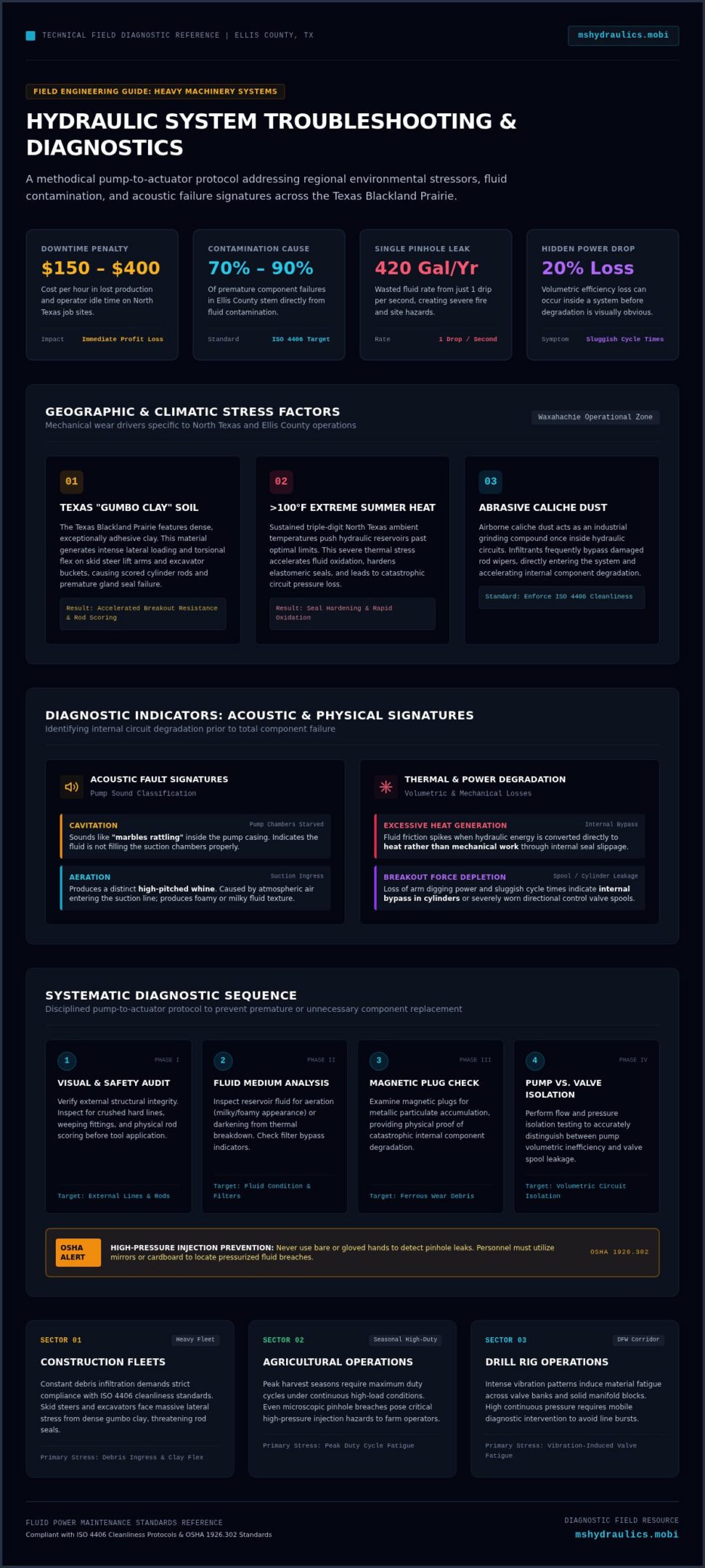
Waxahachie’s geography presents distinct challenges for heavy equipment maintenance. The region sits within the Texas Blackland Prairie, characterized by “gumbo clay” that is exceptionally adhesive and heavy. This soil type creates immense lateral loading and torsional flex on skid steer lift arms and excavator buckets. While performing hydraulic system troubleshooting Waxahachie technicians frequently observe that this increased breakout resistance leads to scored cylinder rods and premature gland seal failure. The environmental impact is compounded by North Texas summers, where sustained temperatures exceeding 100°F push oil reservoirs past optimal limits. This thermal stress accelerates fluid oxidation and hardens elastomeric seals, resulting in catastrophic pressure loss.
Technical data suggests that 70% to 90% of premature component failures in Ellis County stem from fluid contamination. Infiltrants like abrasive caliche dust act as a grinding compound within the circuit. Understanding the principles of hydraulic machinery is vital for identifying how these particulates bypass rod wipers and enter the system. High-intensity construction and drilling operations also place extreme demands on hose and fitting integrity. A single hydraulic leak dripping at one drop per second can waste 420 gallons of fluid annually, creating both an environmental hazard and a significant fire risk on the job site.
Symptoms of System Distress
Recognizing abnormal acoustic signatures is the first step in effective diagnostics. Cavitation sounds like marbles rattling inside the pump, indicating the fluid isn’t filling the pump chambers. Conversely, aeration produces a high-pitched whine caused by air entering the suction line. Operators should monitor for sluggish cycle times; a system can suffer a 20% loss in volumetric efficiency before the degradation becomes obvious. This loss of breakout force usually indicates internal bypass in the cylinders or worn directional control valve spools. Excessive heat generation is another critical indicator, as it signals that energy is being converted to heat through internal leakage rather than mechanical work.
Industry-Specific Challenges in Waxahachie
Local industrial sectors face unique mechanical stressors. Construction fleets deal with constant debris infiltration that necessitates strict adherence to ISO 4406 cleanliness standards. For agricultural operators, the peak harvest season demands maximum duty cycles where even a minor pinhole leak can lead to high-pressure fluid injection injuries. Drill rig operations in the DFW corridor encounter specific vibration-induced fatigue in valve banks and manifold blocks. Precise hydraulic system troubleshooting Waxahachie must account for these variables to ensure project timelines remain intact and machinery operates at peak OEM specifications.
A Systematic Approach to Hydraulic Troubleshooting
Effective hydraulic system troubleshooting Waxahachie relies on a methodical pump-to-actuator sequence. Jumping to conclusions often leads to unnecessary component replacement and extended downtime. Technicians must first verify basic operational parameters before dismantling complex assemblies. This disciplined approach ensures that field repairs are both accurate and cost-effective. A rigorous visual inspection serves as the initial diagnostic phase, where we identify external leaks, crushed lines, or damaged cylinder rods. Safety is paramount during this process. Adhering to OSHA standards for hydraulic tools ensures that personnel avoid high-pressure injection injuries by utilizing mirrors or cardboard rather than hands to detect pinhole breaches.
Step 1: Fluid and Filter Analysis
The condition of the hydraulic medium provides a historical record of the system’s internal health. Technicians check for aeration, which appears as a milky or foamy texture, or discoloration indicating thermal breakdown. Inspecting filter bypass indicators and magnetic plugs reveals the presence of metallic particulates that signal component degradation. Hydraulic fluid analysis serves as the primary diagnostic tool for internal wear. If you suspect contamination issues, utilizing on-site diagnostic services can provide immediate clarity before a minor issue escalates into a total system failure.
Step 2: Pressure and Flow Testing
Pressure gauges are essential for isolating faults within the circuit. By blocking off specific sections of the system, a technician can determine if the pump is meeting its rated output or if the pressure loss occurs downstream. Relief valve settings must be verified against manufacturer specifications to ensure they aren’t opening prematurely. This process is critical for diagnosing internal bypass in cylinders and motors, where fluid leaks past internal seals without manifesting as an external drip. Precise flow testing under load allows for the identification of volumetric efficiency losses that pressure tests alone might miss.
Operational testing under actual working loads is the final step in the diagnostic chain. Replicating the exact conditions that cause the malfunction allows for real-time data collection. This phase confirms that the system maintains its integrity during high-intensity cycles, such as heavy excavation or drilling. It validates that the restoration of system PSI is stable and reliable for long-term operation on the job site. This structured methodology prevents the “parts-cannon” approach and ensures that every repair is backed by technical data.
Diagnostic Indicators: Pump, Valve, and Cylinder Issues
Accurate component isolation is the most challenging phase of hydraulic system troubleshooting Waxahachie. Technicians often face the dilemma of determining whether a loss of performance stems from the primary power source or the downstream actuators. Misdiagnosing a failing pump as a cylinder issue leads to unnecessary expenses and extended machinery downtime. Professional On-Site Diagnostic Services provide the technical clarity needed to differentiate these faults through precise flow and pressure measurements. By isolating individual circuits, we can identify exactly where energy is being lost before any components are removed for repair.
Pump vs. Actuator Failure
Differentiating between pump inefficiency and actuator bypass requires a comparative analysis of heat signatures. In a healthy system, heat is generated by work; however, localized “hot spots” often indicate internal leakage where high-pressure fluid is forced through a narrow gap. If a cylinder is bypassing internally, the barrel will feel significantly hotter than the surrounding lines. Flow meter testing remains the definitive method for verifying pump efficiency. While a pump might maintain baseline pressure at idle, its volumetric efficiency often drops under load. Cylinder “drift,” or the unintended movement of an actuator, usually points toward worn piston seals or a leaking control valve check seat. We utilize the “50% Rule” for field overhauls: if restoration costs exceed half the replacement price and cannot guarantee OEM tolerances, a full unit replacement is recommended.
Valve and Control Logic Faults
Directional control valves are subject to spool wear and pilot pressure inconsistencies that disrupt machine logic. Sticking spools are a frequent symptom of fluid contamination or thermal expansion within the valve body. When spools don’t shift fully, the resulting flow restriction generates excessive heat and reduces cycle speeds. Identifying cracked or worn valve bodies is critical, as internal cross-port leakage can mimic the symptoms of a failing motor. Incorrect relief valve settings also pose a severe risk to both system safety and component longevity. If a relief valve is set too low, the machine will lack the necessary breakout force for heavy excavation. Conversely, settings that exceed manufacturer specifications can lead to catastrophic hose failure. Adhering to safe hydraulic maintenance practices is mandatory when adjusting these parameters to prevent accidental pressure release and ensure operator safety on the job site.
Internal seal bypass often remains hidden until a system reaches peak operating temperature. As oil thins, the leakage rate increases, causing the machine to become progressively sluggish throughout the workday. External rod leaks are more obvious but equally detrimental, as they allow environmental contaminants like North Texas caliche dust to be pulled directly into the system on the retraction stroke. Addressing these indicators early prevents the cascading failure of the entire hydraulic circuit.
Mobile Diagnostic Services and On-Site Repair in Waxahachie
Logistical efficiency is the determining factor in project profitability when heavy machinery fails. Transporting a 30 ton excavator or a specialized drill rig to a fixed facility involves significant transport fees and days of lost production. Utilizing mobile hydraulic repair allows for the immediate initiation of hydraulic system troubleshooting Waxahachie directly at the point of failure. Our mobile units operate with a dispatch response time of under 90 minutes for 92% of calls within the Ellis County and DFW corridor. This rapid deployment ensures that technical expertise arrives before project schedules are irreparably compromised.
Field troubleshooting under high pressure requires strict adherence to safety protocols. Technicians must manage stored energy and thermal hazards while operating in uncontrolled environments. We provide comprehensive coverage across the broader North Texas region, ensuring that fleets operating in Waxahachie, Alvarado, and Cedar Hill have access to OEM-grade diagnostics. By resolving issues on-site, we eliminate the secondary costs associated with equipment transport and facility lead times.
Field Repair Capabilities
Modern mobile service trailers are engineered to function as satellite facilities. These units are equipped with high-capacity crimpers and cut-off saws for on-site Hydraulic Hose Fabrication, capable of producing assemblies that withstand working pressures exceeding 6,000 PSI. When a component requires more extensive restoration, such as precision rod polishing or re-chroming, we perform on-site cylinder removal and manage the transport to our Cleburne facility for a full rebuild. Our technicians utilize advanced flow meters and pressure transducers to isolate faults in variable displacement pumps and hydrostatic drives without removing the units from the machine.
Minimizing Operational Downtime
The financial impact of idle machinery is substantial, with unplanned downtime on North Texas construction sites averaging between $150 and $400 per hour. Strategic field maintenance prevents these catastrophic failures by identifying latent system degradation, such as cylinder drift or pump cavitation, before the machine stops moving. Emergency response is particularly critical for infrastructure projects where project schedule delay penalties are high. Choosing field repair over shop transport often reduces total downtime from days to hours, providing a clear cost-benefit advantage for fleet managers. We focus on restoring mechanical tolerances to OEM specifications to ensure long-term reliability in the field.
Maintaining the integrity of your hydraulic circuits is essential for sustained performance in heavy-duty applications. If your equipment is exhibiting signs of pressure loss or sluggish cycle times, request on-site diagnostic services to identify the fault and restore your system’s operational efficiency immediately.
Professional Hydraulic Solutions by Ms. Hydraulics
Ms. Hydraulics LLC operates with a commitment to technical integrity that goes beyond simple parts replacement. We specialize in complex hydraulic system troubleshooting Waxahachie projects, ensuring that every diagnostic conclusion is supported by empirical data. Our team brings years of industrial experience to every job site, focusing on the precision required for high-pressure systems. We don’t just fix symptoms; we restore the mechanical tolerances necessary for long-term reliability. This disciplined approach signals a brand that values performance above all else, positioning Ms. Hydraulics LLC as a serious partner for major players in the construction and drilling sectors.
Our service portfolio includes comprehensive heavy equipment maintenance designed for DFW fleets. This proactive approach mitigates the risk of catastrophic failure by adhering to rigorous inspection schedules and international fluid cleanliness standards. For components that have reached the end of their service life, Ms. Hydraulics LLC provides specialized expertise in heavy equipment cylinder rebuilds. These restorations involve precision rod polishing and the application of high-performance seals to ensure the unit meets or exceeds original equipment manufacturer specifications. Every rebuild is verified for performance before it’s returned to service, reinforcing our legacy of excellence.
The Ms. Hydraulics LLC Advantage
We prioritize long-term client relationships by focusing on overall machinery efficiency and project uptime. Technicians at Ms. Hydraulics LLC possess deep technical proficiency in the hydraulic circuits of excavators, skid steers, and complex drill rig systems. This specialized knowledge allows us to navigate the intricate valve logic and sensor-integrated components found in modern machinery. We maintain a disciplined approach to service, treating every diagnostic challenge with the gravity it deserves. This veteran-level expertise ensures that we identify root causes that less experienced providers might overlook. Our goal is to ensure your equipment operates at peak volumetric efficiency, regardless of the environmental challenges posed by the North Texas terrain.
Request On-Site Troubleshooting
Scheduling a diagnostic service call in Waxahachie is a structured process designed for rapid response. When contacting Ms. Hydraulics LLC for immediate support, please provide the machine’s make, model, and a detailed description of the observed symptoms, such as cylinder drift or abnormal heat generation. Information regarding recent fluid changes or pressure fluctuations helps our mobile technicians prepare the necessary diagnostic toolsets for your specific system. We’re dedicated to getting Waxahachie businesses back to work by minimizing the interval between failure and restoration. Our mobile units are staged to provide efficient coverage throughout Ellis County, ensuring that professional hydraulic system troubleshooting Waxahachie is always within reach. This commitment to local infrastructure makes Ms. Hydraulics LLC a dependable partner for any industrial or construction operation in the region.
Restoring Operational Efficiency in Ellis County
Mastering a systematic approach to hydraulic failure is essential for maintaining project profitability on North Texas job sites. We’ve established that effective diagnostics begin with a disciplined pump-to-actuator sequence. This methodology ensures that environmental factors like adhesive gumbo clay and extreme thermal stress don’t lead to unnecessary component replacement. By prioritizing fluid cleanliness and precise pressure testing, operators can identify internal bypass before it results in catastrophic downtime. Professional hydraulic system troubleshooting Waxahachie requires this level of technical rigor to ensure that repairs are both accurate and sustainable.
Ms. Hydraulics LLC remains a dedicated partner for the construction and industrial sectors in the DFW corridor. Our mobile diagnostic units are equipped for comprehensive on-site repair, providing the specialized expertise required for complex heavy equipment and industrial machinery. As a locally owned and operated entity with deep North Texas expertise, we focus on restoring your system’s mechanical integrity with engineering precision. Don’t allow unplanned machinery failure to compromise your billable hours. Contact Ms. Hydraulics for Expert Mobile Troubleshooting in Waxahachie to restore your operational PSI today. We’re ready to ensure your fleet maintains peak performance.
Frequently Asked Questions
What are the most common signs of hydraulic system failure in heavy equipment?
Common indicators include abnormal acoustic signatures like cavitation rattling or high-pitched aeration whines. You should also monitor for sluggish cycle times and a noticeable loss of breakout force. A system can lose up to 20% of its volumetric efficiency before an operator notices perceptible hesitation. Excessive heat generation is another critical sign, often resulting from internal leakage that degrades seals and accelerates fluid oxidation.
How do I know if my hydraulic pump is failing or if it is just a bad valve?
Differentiating these components requires precise component isolation. A failing pump typically results in a systemic loss of pressure across all functions, while a worn valve spool usually affects only a specific circuit. We utilize flow meter testing to verify pump efficiency under load. If the pump meets OEM specifications, the fault likely lies in the directional control valve or internal cylinder bypass.
Can hydraulic hoses be fabricated on-site at my job location in Waxahachie?
Yes, our mobile service units are equipped with high-capacity crimpers and cut-off saws for on-site Hydraulic Hose Fabrication. We can produce OEM-grade assemblies capable of withstanding working pressures up to 6,000 PSI directly at your job site. This capability eliminates the need to transport equipment or wait for off-site sourcing, significantly reducing the downtime associated with hydraulic system troubleshooting Waxahachie.
What should I do if my hydraulic system is overheating during operation?
If your system exceeds optimal operating limits, typically between 140°F and 160°F, you must cease operations to prevent thermal degradation of anti-wear additives. Check the reservoir for proper fluid levels and aeration. Inspect the oil cooler for debris blockages, which are common in the Texas Blackland Prairie environment. Persistent overheating often indicates that energy is being converted to heat through internal seal bypass or incorrect relief valve settings.
How often should I perform hydraulic fluid analysis for my fleet?
We recommend moving from calendar-based changes to predictive laser particle sampling according to ISO 4406 standards. For heavy equipment operating in abrasive North Texas soil, fluid analysis should be conducted every 500 to 1,000 hours of operation. Regular sampling identifies solid particulate counts and moisture ingress early. This proactive approach prevents the fluid contamination that causes up to 90% of premature component failures.
Is it better to rebuild or replace a leaking hydraulic cylinder?
The decision depends on the “50% Rule” used by fleet managers. If the cost of precision rod polishing, re-chroming, and resealing exceeds 50% of the replacement price, a new unit is often preferred. However, a professional cylinder rebuild can restore OEM mechanical tolerances and provide a rapid turnaround. We evaluate the extent of rod bowing and gland seal wear to determine the most cost-effective restoration path.
What information do I need to provide when calling for mobile hydraulic repair?
Providing specific technical data ensures a rapid service dispatch. When calling for mobile hydraulic repair, have the machine’s make and model ready, along with a description of the symptoms, such as cylinder drift or sluggish cycles. Mentioning recent fluid changes or pressure fluctuations helps our technicians prepare the correct diagnostic toolsets. Accurate location details within the Waxahachie area are also essential for meeting our response thresholds.
Does Ms. Hydraulics serve agricultural equipment in the Waxahachie area?
Ms. Hydraulics provides comprehensive support for agricultural equipment throughout the Waxahachie and Ellis County corridor. Our technicians have the specialized expertise required for the high-duty cycles of tractors, harvesters, and irrigation systems. We understand that peak harvest seasons demand maximum machinery uptime. Our mobile units deliver the same level of hydraulic system troubleshooting Waxahachie for farming operations as they do for major construction and drilling projects.