How to Justify Mobile Hydraulic Repair Costs to Your Boss: A Cleburne Manager’s Guide
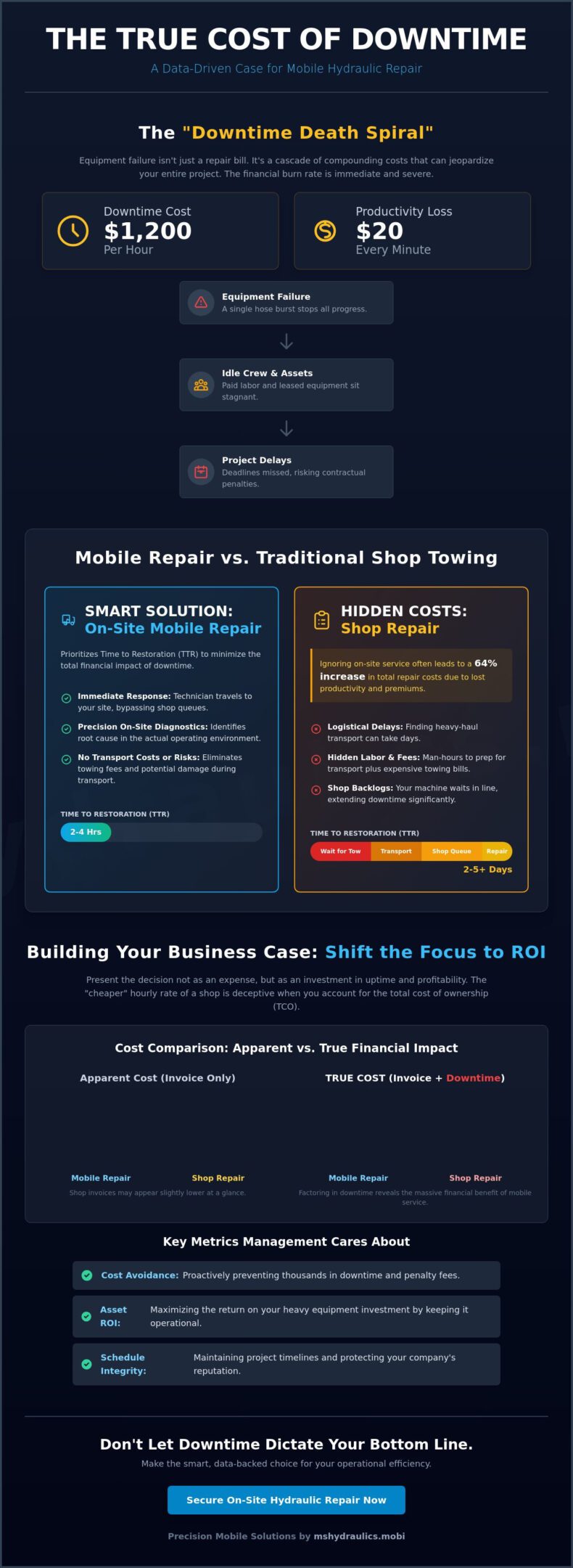
In high-stakes industrial operations, equipment downtime can cost an estimated $1,200 per hour. For many crews, the financial impact accumulates at a rate of $20 every single minute a machine sits idle. Managers understand that maintaining uptime is the priority; however, learning how to justify mobile hydraulic repair costs to my boss requires a precise analysis of technical data and operational impact.
It’s difficult to argue for a specialized technician’s hourly rate when management only sees the immediate invoice. Ignoring the strategic value of on-site service often leads to a 64% increase in total repair costs due to emergency premiums and lost productivity. This guide provides the data-driven framework you need to shift the focus from operational expenses to asset ROI. We’ll examine the hidden costs of project delays, compare mobile efficiency against traditional shop towing, and provide the technical metrics required to secure quick approval for on-site repairs.
Key Takeaways
- Quantify the “Downtime Death Spiral” by calculating the true hourly burn rate of idle heavy equipment and labor on North Texas job sites.
- Learn how to justify mobile hydraulic repair costs to my boss by utilizing a data-driven framework that prioritizes Time to Restoration (TTR) over simple service rates.
- Evaluate the hidden logistical expenses of traditional shop repairs, including towing fees and the mechanical risks associated with transporting compromised machinery.
- Address common management objections with objective metrics that demonstrate the ROI of professional on-site diagnostics and precision hose fabrication.
- Implement a proactive maintenance strategy to maintain project schedules and avoid the contractual penalties associated with extended equipment failure.
The Financial Reality of Equipment Downtime in North Texas
In the high-pressure environment of Dallas-Fort Worth industrial operations, equipment failure is rarely a contained incident. It initiates what we term the “Downtime Death Spiral.” This cycle includes immediate revenue loss, the drain of idle labor, and the breach of critical project deadlines. Consider a drill rig on a job site in Cleburne. If a single high-pressure hose fails, the entire site’s progress stops. Because understanding how hydraulic machinery works is essential to modern civil engineering, managers must view these systems as the primary drivers of their production. The repair invoice is a visible expense, but the true burden is the opportunity cost of a stagnant crew. Determining how to justify mobile hydraulic repair costs to my boss requires shifting the conversation from the price of the part to the cost of the pause.
Calculating the True Hourly Burn Rate
An accurate burn rate calculation must be comprehensive. It includes the operator’s hourly wages and the daily lease or financing costs of the machine. In the DFW market, these figures are significant. Research indicates that forestry and heavy construction operations can lose $20 for every minute a machine is non-operational. Over a standard work day, that’s $12,000 in lost productivity. When you add the project delay penalties common in North Texas municipal contracts, the financial risk becomes extreme. Total Cost of Ownership (TCO) is the cumulative expenditure of owning, operating, and losing access to an asset throughout its lifecycle. Using these metrics helps frame mobile service as a tool for cost avoidance rather than a simple maintenance line item.
The “Ripple Effect” on DFW Job Sites
Logistical delays in North Texas are systemic. A mechanical failure at a Cleburne site creates a bottleneck that affects every subsequent subcontractor. If the primary excavator is down, the utility teams cannot trench; if they cannot trench, the paving crews cannot mobilize. This sequence is particularly fragile during Texas weather windows. If a hydraulic failure occurs on a Friday, “waiting until Monday” for a traditional shop repair isn’t a cost-saving measure. It’s a gamble. A weekend storm can turn a two-day delay into a two-week project suspension. The cost of that lost time far outweighs any travel fee associated with an immediate mobile response. Fast intervention ensures the schedule remains intact, protecting both the budget and the company’s regional reputation.
Mobile Repair vs. Traditional Shop Towing: A Comparative Analysis
Traditional repair models usually require transporting disabled machinery to a central facility. While shop labor rates might look lower on a spreadsheet, this approach ignores the massive logistical overhead and extended Time to Restoration (TTR). When determining how to justify mobile hydraulic repair costs to my boss, the comparison must include the secondary mechanical risks associated with emergency transport. Modern fleet managers are increasingly viewing maintenance as a core business driver rather than a sunk cost. By prioritizing on-site intervention from Ms. Hydraulics LLC, an operation can bypass the standard shop backlog and preserve the project’s critical path.
The Logistics of Transport in the DFW Metroplex
Securing heavy-haul transport in Alvarado or Mansfield is often a multi-day challenge due to limited trailer availability and high regional demand. Preparing a disabled excavator or dozer for transport requires significant man-hours; technicians often have to manually bypass hydraulic circuits or disconnect final drives to prevent drivetrain destruction during the pull. These labor costs, combined with transport fees, often exceed the cost of a mobile service call before the machine even reaches the shop gates. A mobile technician can arrive and complete a 2-hour repair while a shop-bound machine is still sitting in the mud waiting for a trailer. This speed is why many local managers rely on mobile hydraulic repair to maintain their operational tempo.
Precision Diagnostics and Immediate Fabrication
On-site diagnostics provide a technical advantage that shop environments can’t replicate. By observing the equipment in its specific operating environment, a technician can identify root causes like vibration-induced fatigue or pressure spikes that a “parts changer” in a clean shop might overlook. Utilizing professional On-Site Diagnostic Services ensures that the repair addresses the system’s actual failure point, not just the symptoms. Furthermore, the ability to perform hydraulic hose fabrication at the machine eliminates the “trial and error” of multiple trips to a parts counter. Custom hoses are built to the exact specifications of the current configuration, ensuring perfect routing and preventing future abrasion failures. This level of technical precision is a hallmark of the mobile solutions provided by Ms. Hydraulics LLC.
Building Your Business Case: Data Points Your Boss Cares About
Managers often view maintenance as a liability rather than a strategy. Correcting this perception involves presenting objective data on ROI and risk mitigation. When analyzing how to justify mobile hydraulic repair costs to my boss, I must present the service as a technical shield for the company’s bottom line. A single $500 on-site intervention can prevent $5,000 in liquidated damages resulting from a missed project milestone. Shifting the management focus toward asset protection transforms the repair from an operational burden into a capital preservation strategy that extends the service life of expensive machinery.
The ROI Formula for Field Service
A successful justification requires a “Before vs. After” cost projection based on documented technical realities. The “Before” scenario includes the $1,200 hourly downtime cost and the $20 per minute productivity loss for a stagnant machine. In contrast, the “After” scenario demonstrates the equipment returning to full operational pressure and torque within a predictable two-hour window. This efficiency protects the company’s reputation for reliability with DFW prime contractors and municipal agencies. Proving that field service is the most efficient path to restoration makes the approval process objective. It removes the emotion from the budget discussion by focusing on the restoration of billable hours.
Liability and Safety Justifications
Risk mitigation is a technical requirement for any modern industrial operation. DIY hydraulic repairs on systems operating at several thousand PSI pose severe safety risks to personnel. Implementing professional Heavy Equipment Maintenance ensures that every hose, valve, and cylinder meets rigorous safety standards and performance specifications. Certified technicians provide the specialized documentation required for insurance audits and OSHA compliance. This paper trail is vital if an incident occurs, as it proves the company followed industry best practices for equipment upkeep.
Environmental factors also play a critical role in North Texas project management. A single ruptured hose can discharge gallons of fluid into sensitive watersheds or protected soil, leading to significant remediation fines and project shutdowns. Professional on-site services identify potential failure points, such as abrasion or fitting fatigue, before they result in a catastrophic spill. By documenting these preventative measures, a manager demonstrates a commitment to both operational excellence and environmental stewardship. This level of professional decorum is essential for global industrial players evaluating their partners’ market positions and long-term stability.
Overcoming Common Management Objections to Mobile Repair
Management often isolates travel fees as an unnecessary expense during a budget review. However, this fee must be evaluated against the alternative: the heavy-haul towing fee. Transporting a disabled dozer or excavator in North Texas requires specialized trailers, loading permits, and significant man-hours just to prep the machine for transit. When determining how to justify mobile hydraulic repair costs to my boss, the focus should remain on the delta between a flat travel fee and the thousands of dollars required for equipment transport and the associated risk of frame damage during loading.
Modern hydraulic systems require more than mechanical intuition. Today’s high-pressure circuits utilize electronic control units and precision sensors to manage displacement and torque. A general mechanic often lacks the specialized diagnostic computers and pressure-testing equipment required for technical troubleshooting. Relying on an expert ensures the machine is calibrated to OEM specifications. This prevents the expertise gap from turning a simple seal leak into a total system failure that requires a complete pump replacement.
The “Internal Labor” Fallacy
Assigning a general internal mechanic to hydraulic failures usually results in a double loss for the company. The technician is pulled from their primary preventative maintenance duties, and their lack of specialized training increases the probability of a misdiagnosis. This leads to incorrect orders for hydraulic parts and repeated downtime when the initial fix fails under operational load. Mobile trucks are stocked with technical inventories specifically selected for the DFW equipment market. This ensures the repair is completed correctly the first time, allowing internal staff to remain focused on their core responsibilities.
Justifying Emergency and After-Hours Fees
Emergency surcharges are best framed as a Priority Access Fee. If a pump fails at 4:00 PM on a project in Johnson County, an after-hours call ensures the machine is operational by 7:00 AM the following morning. Without this priority access, the manager faces an idle crew and stalled project momentum at sunrise. The surcharge is statistically insignificant when measured against the cost of eight employees standing around a dead machine for a full shift. Securing 24/7 technical support is a strategic move that protects the bottom line from the inherent volatility of mechanical failure. To maintain your project’s critical path, request on-site mobile repair to restore your equipment’s performance immediately.
Partnering with MS Hydraulics: Precision Mobile Solutions in DFW
MS Hydraulics operates with a commitment to technical integrity and long-term industrial partnerships. We recognize that North Texas fleet managers require more than a temporary fix; they require an engineering partner who understands the mechanical stresses of the region. Our service model is built on objective data and factual accuracy, aligning with the standards expected by global industrial players. We provide a comprehensive range of on-site services, including pump diagnostics, motor maintenance, and valve repair. Providing your superiors with a technically sound service plan is the most effective method for addressing how to justify mobile hydraulic repair costs to my boss. It shifts the narrative from a simple expense to a disciplined asset management strategy.
Our presence in the Cleburne, Dallas, and Fort Worth industrial sectors is defined by a no-nonsense approach to fluid power. We don’t rely on evocative marketing. Instead, we utilize performance metrics and specialized mechanical engineering terminology to communicate value. By maintaining a high level of professional decorum and adhering to rigorous safety protocols, we ensure that every on-site intervention meets the precision requirements of modern hydraulic systems. This methodical flow of service ensures predictability for your operations, which is a comforting factor for B2B stakeholders evaluating project stability.
Local Expertise for North Texas Heavy Equipment
North Texas job sites present unique challenges, from the abrasive clay in Cleburne to the limestone deposits found across the DFW Metroplex. These conditions place extreme torque and pressure demands on excavators, drill rigs, and skid steers. Our mobile units function as “shops on wheels,” specifically equipped to handle complex technical tasks such as on-site cylinder rebuilds and precision hose fabrication. We understand the specific urgency of Texas infrastructure projects. Our technicians arrive with the diagnostic tooling required to identify displacement issues or pressure drops immediately. This localized expertise ensures that your machinery is restored to its certified performance parameters without the delay of traditional shop backlogs.
Next Steps: Getting the Approval
Securing management approval requires a professional presentation of the facts. We recommend starting with a request for a rapid diagnostic estimate to establish a baseline for the repair. This allows you to provide your boss with a clear, professional service plan that outlines the TTR and the projected ROI of the intervention. By documenting how the mobile repair prevents secondary damage and eliminates towing costs, you demonstrate a disciplined focus on modern efficiency. Our team is ready to provide the technical data you need to justify the investment. To maintain your project’s momentum, Contact MS Hydraulics for a mobile service quote in Cleburne or DFW today.
Securing Your Project’s Critical Path
Effective fleet management requires a transition from reactive maintenance to strategic asset protection. We’ve established that the true cost of failure isn’t the repair invoice; it’s the $1,200 hourly burn rate and the significant logistical burden of equipment transport. Understanding how to justify mobile hydraulic repair costs to my boss involves shifting the focus from immediate service fees to the long-term preservation of project schedules. By prioritizing on-site diagnostics over traditional shop backlogs, you ensure your equipment maintains peak displacement and torque without unnecessary delays.
Ms. Hydraulics LLC has provided technical excellence to the DFW Metroplex since 2021. Our specialized mobile units are engineered to function as comprehensive field shops, delivering precision in custom hose fabrication and complex cylinder restoration. By presenting management with a data-driven service plan, you demonstrate a disciplined commitment to operational efficiency and technical reliability. Take the next step in protecting your equipment’s ROI and maintaining your professional standing as a results-oriented manager.
Request an On-Site Diagnostic Quote from Ms. Hydraulics LLC
Your operation deserves the stability that only professional hydraulic expertise can provide. We’re ready to help you restore your equipment’s performance immediately.
Frequently Asked Questions
How much does downtime actually cost per hour for heavy equipment?
Downtime costs vary by sector; however, forestry and heavy construction companies estimate a loss of $20 for every minute of operational inactivity. For a standard crew, this results in $2,400 of lost productivity during a typical two-hour service delay. In certain industrial regions, annual productivity losses due to equipment failure exceed $130 million. These figures quantify the severe financial impact that mechanical failure has on job site profitability.
Is mobile hydraulic repair more expensive than taking it to a shop?
Total project expenditures are typically lower with mobile service because it eliminates the requirement for heavy-haul towing. Traditional shop repairs involve significant logistical expenses and often result in a 48-hour turnaround compared to a 2-hour on-site fix. While mobile technicians may have specialized travel fees, the reduction in idle labor hours makes on-site service the more efficient financial choice for North Texas managers.
Can a mobile technician perform a full hydraulic cylinder rebuild on-site?
Specialized mobile units are engineered to perform comprehensive cylinder restoration and resealing at the machine’s location. These units carry the diagnostic tools and technical hardware required to restore displacement and torque without the need to remove the component. Performing these rebuilds on-site prevents the secondary damage often caused by dismantling and shipping large hydraulic cylinders to a remote facility.
How do I explain travel time fees to my company’s owner?
Travel fees should be presented as a strategic investment in priority access and cost avoidance. Explain that this fee is a small fraction of the cost required for professional towing or the 64% cost increase often associated with emergency part replacements and rush shipping. Using this data-driven approach is the most effective way regarding how to justify mobile hydraulic repair costs to my boss while focusing on uptime.
What industries in North Texas benefit most from mobile hydraulic services?
Construction, forestry, and municipal infrastructure sectors in North Texas derive the most value from on-site technical support. These industries operate heavy equipment like drill rigs and excavators that are difficult and expensive to transport across the DFW Metroplex. Mobile technicians provide the precision required to maintain high-pressure systems in the demanding soil conditions found across Cleburne and Fort Worth.
What happens if we try to fix a hydraulic hose ourselves without proper tools?
Improperly repaired hydraulic hoses pose significant safety risks and often lead to catastrophic system failure. Without professional fabrication and pressure testing, a hose may burst under load, causing fluid discharge and potential worker injury. Professional technicians ensure that every fitting meets exact torque specifications and that hose routing prevents future abrasion failures. This technical precision is essential for long-term system integrity.
How quickly can a mobile hydraulic technician reach a site in Cleburne or Fort Worth?
Mobile technicians are dispatched to minimize the “Downtime Death Spiral” on high-stakes job sites throughout Johnson and Tarrant counties. While specific arrival times depend on current regional demand, the objective is always to restore operations faster than a traditional shop could even receive the machine. This rapid response is a critical factor in maintaining project schedules during volatile Texas weather windows.
Does mobile repair include a warranty or guarantee on parts and labor?
Professional mobile services prioritize technical reliability through the use of certified components and ISO-aligned protocols. By providing documented service reports and adhering to engineering standards, technicians ensure the repair meets specific performance parameters. This commitment to quality and engineering expertise provides a level of dependability that internal fixes don’t match. It reinforces the company’s reputation for operational excellence and market stability.