Finding a Trustworthy Hydraulic Mechanic: A Technical Vetting Guide for 2026
The most expensive component in your hydraulic system isn’t the pump or the cylinder; it’s the diagnostic error made by a mechanic who guesses instead of measures. When a machine sits idle, every hour of lost production compounds the financial impact of the initial failure. You likely already know that finding a trustworthy hydraulic mechanic is the difference between a precision repair and a cycle of recurring failures. Most operators have experienced the frustration of “parts changers” who replace expensive components without addressing the root cause of the pressure drop or thermal spike.
Reliability is built on technical verification rather than social proof. This guide provides a structured framework for vetting technicians based on their understanding of specialized hydraulic circuits and their adherence to 2026 industrial standards. You’ll learn specific, data-driven questions to ask during the interview process to ensure your partner possesses the diagnostic equipment and engineering knowledge required for modern systems. We examine how to identify true competency, from their approach to OSHA’s updated Hazard Communication Standards to their proficiency with smart IoT sensors, helping you minimize equipment downtime and secure a high-performance maintenance relationship.
Key Takeaways
- Distinguish between “parts changers” and true specialists by prioritizing root-cause analysis to prevent recurring system failures and unnecessary component costs.
- Execute a rigorous vetting process when finding a trustworthy hydraulic mechanic by verifying their use of flow meters and pressure gauges before any hardware is replaced.
- Evaluate the financial advantages of mobile repair models that integrate on-site diagnostic services and hose fabrication to eliminate machine transport time.
- Identify critical operational red flags, such as a technician’s failure to maintain system cleanliness or their reluctance to perform a definitive flow test.
- Ensure long-term equipment reliability by partnering with specialists who adhere to OEM specifications for cylinder rebuilds and complex valve repairs.
The Critical Difference Between a Parts Changer and a Hydraulic Specialist
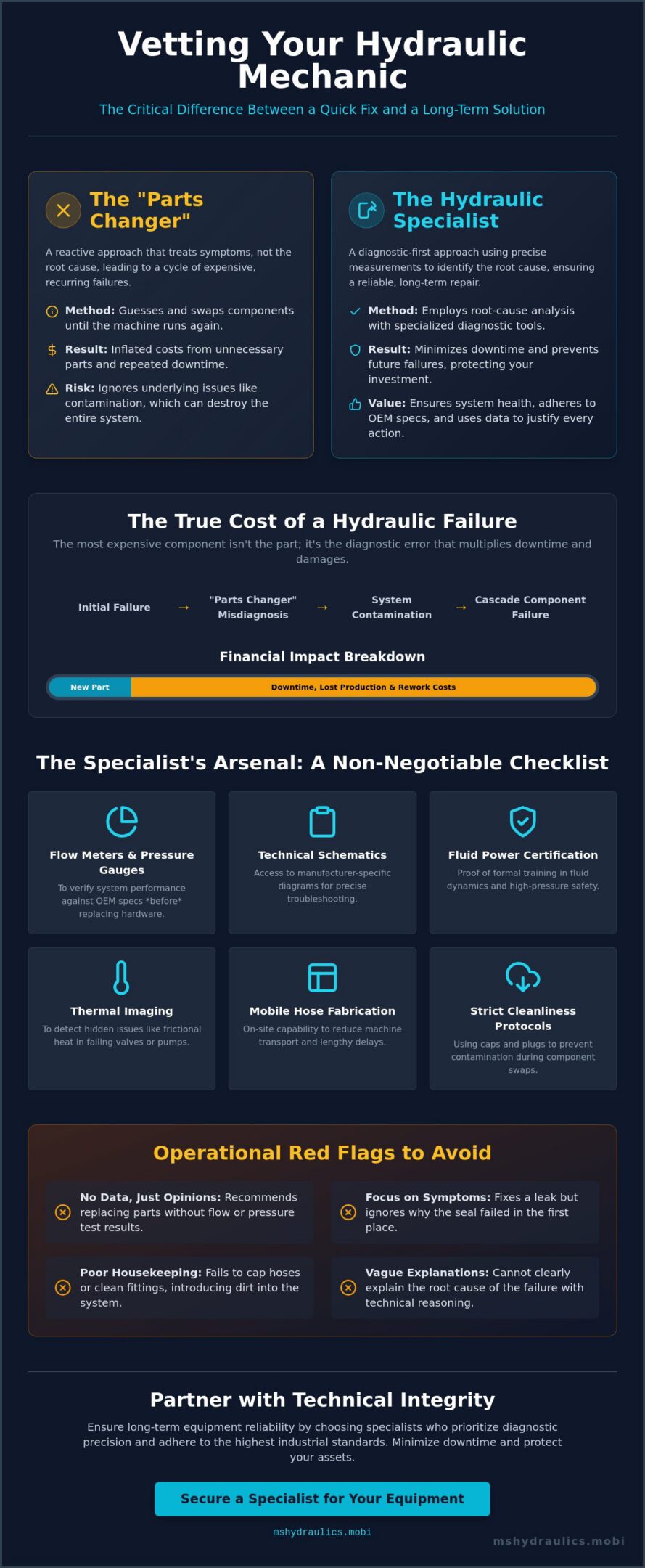
A trustworthy hydraulic mechanic isn’t defined by the speed of their wrench, but by the precision of their diagnostics. Finding a trustworthy hydraulic mechanic requires looking for a technician who prioritizes root-cause analysis over immediate component replacement. Many general mechanics operate as “parts changers,” a reactive approach where components are swapped until the system functions. This method often ignores the underlying systemic failure, leading to recurring downtime and inflated maintenance budgets for fleet owners. A specialist understands that a symptom in a cylinder often originates in a pump or a control valve blocks away in the circuit.
Hydraulic systems operate on complex circuits where a single point of failure can manifest symptoms elsewhere in the machine. While a diesel mechanic focuses on engine timing and fuel delivery, a hydraulic specialist must master the principles of hydraulics to interpret how pumps, valves, and actuators interact under load. This specialized knowledge is vital because hydraulic fluid serves as both a power transmission medium and a lubricant. A technician who lacks this perspective may fix a leak but miss the aeration or cavitation issues that will destroy the entire system within weeks.
Why Misdiagnosis is the Most Expensive Repair
In hydraulic systems, the cost of the part is often dwarfed by the cost of the error. When a technician misdiagnoses a pump failure and fails to perform a full system flush, metallic debris remains in the reservoir. This contamination eventually destroys the new pump and downstream valves. Trial and error repairs on a job site don’t just waste money on parts; they halt production and erode technical integrity. A specialist uses data to prove a component’s failure before removing a single bolt. This methodical approach protects the machine’s long-term health and ensures that the repair actually addresses the source of the inefficiency.
The Role of Specialized Hydraulic Training
The evolution of heavy equipment has moved toward electro-hydraulic systems and IoT integration. Finding a trustworthy hydraulic mechanic in 2026 involves verifying their familiarity with these modern advancements alongside legacy systems. Look for markers of specialized training, such as Fluid Power Certification. These credentials signal that the mechanic understands fluid dynamics and high-pressure safety standards. Whether it’s a 20-year-old excavator or a brand-new skid steer with smart sensors, a specialist treats the hydraulic system as a holistic engineered entity. They don’t just replace hoses; they ensure the entire circuit meets OEM specifications for flow and pressure. This dedication to technical precision is a hallmark of quality across various specialized mechanical fields, such as in the pool industry where Redzone Pools LLC provides expert equipment repair and remodeling with a similar focus on engineering standards.
Technical Standards: What a Reliable Mechanic Should Bring to the Job
Finding a trustworthy hydraulic mechanic requires more than a review of past work; it requires an audit of the technician’s technical arsenal. A professional specialist arrives with a comprehensive diagnostic suite including calibrated pressure gauges, digital flow meters, and thermal imaging cameras to detect frictional heat in failing valves. This level of investment is increasingly rare due to a nationwide skilled labor shortage, which has forced many operators to rely on generalists who lack the specialized tools for fluid power systems. Beyond hardware, a reliable technician relies on manufacturer-specific technical manuals and circuit schematics to ensure every adjustment aligns with the machine’s original engineering.
Efficiency on the job site is heavily dependent on immediate capability. A technician equipped for on-site hydraulic hose fabrication eliminates the hours typically lost to transit between the machine and a brick-and-mortar shop. However, speed shouldn’t compromise quality. Even in a mobile environment, a specialist maintains strict cleanliness protocols. Using caps and plugs to prevent environmental ingress during component swaps is non-negotiable. For complex hydraulic pump repairs, they must demonstrate an ability to keep the work area free of particulates that lead to premature wear.
Precision Diagnostics and Pressure Testing
Pressure testing under load is the only definitive method to verify that a pump or valve repair will hold up under the stresses of daily operation. Setting relief valves precisely to OEM specifications is a critical safety step to prevent system over-pressurization, which can lead to catastrophic hose or seal failure. While gauges show the system’s force, flow testing is required to identify internal leakage that high pressure might mask. This data-driven approach ensures the machine returns to the field at 100% capacity.
The Importance of Fluid Analysis
Proactive maintenance hinges on understanding the invisible state of the hydraulic fluid. Regular oil sampling reveals microscopic metallic particles, indicating internal component wear before a catastrophic failure occurs. Specialists use ISO 4406 cleanliness codes to quantify particulate levels and determine if the fluid meets the high-pressure demands of modern machinery. Implementing these standards is a core part of effective Heavy Equipment Maintenance in Cleburne & North Texas, where environmental dust and heavy duty cycles accelerate contamination.
Mobile vs. Shop Repair: Choosing the Right Service Model in North Texas
Finding a trustworthy hydraulic mechanic involves weighing the logistical advantages of field service against the controlled environment of a fixed shop. In North Texas, where heavy equipment operates in extreme heat and abrasive dust, the decision is often driven by the machine’s transportability and the urgency of the repair. Mobile service is ideal for high-pressure hose failures, minor leaks, and initial diagnostic assessments. While some operators hesitate at mobilization fees, the cost of hiring a low-boy trailer to transport a disabled 40-ton excavator often exceeds the technician’s travel costs by a significant margin. True value is found in the technician’s ability to adhere to official competency standards for hydraulic mechanics while working in suboptimal field conditions.
Environmental factors like the abrasive limestone dust common in Alvarado job sites require strict adherence to cleanliness protocols. A disciplined mechanic will utilize specialized plugs and containment systems to protect open circuits from the North Texas wind. In the context of DFW’s industrial growth, the “travel fee” objection often ignores the hidden costs of machine inactivity. A machine sitting idle in Mansfield for three days while waiting for a transport slot represents thousands in lost revenue. A mobile technician who arrives within hours provides a net positive return on investment by restoring production capacity immediately.
Minimizing Downtime in the DFW Metroplex
Logistics in the DFW Metroplex presents unique challenges for heavy equipment owners. Navigating high-traffic corridors in Arlington or Mansfield with oversized loads is both time-consuming and expensive. Utilizing expert mobile hydraulic repair Cleburne TX allows for immediate intervention on job sites in Alvarado or Granbury. This model bypasses the bottleneck of transport logistics, ensuring that diagnostics and hose fabrications are completed where the machine sits. Emergency response times are critical when a primary pump or valve bank fails during a time-sensitive project phase.
When a Shop Rebuild is Necessary
Certain restorations require precision machining that field service cannot provide. A heavy equipment cylinder rebuild Texas often necessitates the use of industrial honing machines and polishing lathes to restore rod surfaces to OEM tolerances. If a cylinder exhibits severe scoring or structural rod damage, the component must be removed and transported to a controlled environment. A trustworthy mechanic will identify this threshold early, preventing a failed field repair that requires a shop’s specialized equipment for verification. This integrity ensures that complex component restoration meets the engineering requirements for long-term operational stability.
Red Flags and Vetting Questions for Heavy Equipment Mechanics
Finding a trustworthy hydraulic mechanic requires a methodical vetting process that prioritizes technical data over social recommendations. The most significant red flag is a technician who proposes “trying” a new pump or valve without performing a definitive flow test. This trial-and-error approach indicates a lack of diagnostic equipment and increases the risk of catastrophic system failure. A professional should provide a clear, written explanation of the failure mode, supported by pressure and flow readings that deviate from OEM standards. If a mechanic cannot explain the “why” behind a component failure with quantitative data, they’re likely guessing at your expense.
System integrity depends on rigorous environmental control. Technicians who fail to use caps and plugs during hose changes or who ignore basic cleanliness protocols introduce particulates that accelerate internal wear. This negligence often leads to the failure of newly installed components within hours of operation. Additionally, verify that the provider carries comprehensive liability insurance and professional certifications. These are essential safeguards for on-site work where high-pressure failures can pose significant safety and environmental risks. Technical integrity and professional accountability are non-negotiable standards for any specialist touching high-value assets.
5 Questions to Ask Your Next Hydraulic Technician
- “How did you determine this specific component failed?” A trustworthy mechanic will cite specific pressure drops, flow rate variances, or thermal anomalies.
- “What is your process for preventing contamination during this repair?” Look for a commitment to using clean-room standards, including the use of high-quality caps, plugs, and lint-free wipes.
- “Do you have access to the specific flow and pressure specs for this machine?” Competent repairs require adherence to original manufacturer engineering data rather than generic estimates.
- “Can you fabricate the replacement hose on-site to OEM standards?” On-site fabrication capability is a hallmark of a fully equipped mobile specialist.
- “Do you provide a detailed diagnostic report after the repair?” Documentation of the repair process ensures transparency and assists in future predictive maintenance cycles.
Verifying Local Reputation in Johnson County
Reliability in the North Texas market is best verified through established relationships with local construction and agricultural firms in Cleburne and Waxahachie. A long-term presence in the region indicates a history of successful outcomes and technical stability. Social proof should be secondary to a technician’s willingness to provide professional references from fleet managers who oversee similar machinery. Prospective clients should evaluate On-Site Diagnostic Services reviews to gauge a technician’s ability to handle complex field repairs under pressure.
If your equipment is currently underperforming or experiencing a critical circuit failure, contact Ms. Hydraulics LLC for precision Mobile Hydraulic Repair to restore your operational efficiency.
Ms. Hydraulics: Technical Integrity in Mobile Repair
Ms. Hydraulics LLC is a Cleburne-based entity defined by technical precision and industrial integrity. Finding a trustworthy hydraulic mechanic involves identifying specialists who prioritize original engineering standards over temporary, reactive fixes. This commitment ensures that all custom hose fabrications and cylinder rebuilds maintain the original performance parameters required for high-value assets. By adhering to these rigorous specifications, the company provides a level of reliability that matches the demands of major international players operating in North Texas.
The technical expertise of Ms. Hydraulics LLC encompasses the complex, high-pressure systems found in excavators, skid steers, and heavy drill rigs. Rather than prioritizing high-volume turnover or superficial repairs, the focus remains on technical stability and the mitigation of recurring failures. This disciplined approach treats the hydraulic circuit as a holistic system, ensuring that every mechanical intervention aligns with the long-term operational goals of the fleet manager. It’s this focus on physical and mechanical parameters that establishes the company as a dependable partner for large-scale operations.
Our Approach to On-Site Diagnostics
Ms. Hydraulics LLC utilizes a methodical diagnostic workflow that relies on physical mechanical parameters rather than anecdotal guesswork. Every field assessment involves measuring flow and pressure to identify the specific failure mode before any hardware is removed from the machine. By utilizing high-quality hydraulic parts and components, the company ensures that mobile repairs across Alvarado, Crowley, and the wider DFW area meet the same rigorous standards as a specialized fixed-shop environment. This logistical efficiency eliminates the need for machine transport while maintaining the high technical standards of a dedicated facility.
Building Trust Through Transparency
Transparency is achieved by providing the client with a comprehensive technical explanation of every mechanical failure. Ms. Hydraulics LLC believes that educating fleet managers on the underlying causes of a repair is essential for effective long-term asset management. This collaborative approach allows for the implementation of preventative maintenance plans specifically calibrated for the abrasive dust and extreme heat of local Texas environments. If you’re currently finding a trustworthy hydraulic mechanic for critical machinery, Ms. Hydraulics LLC offers the engineering expertise and disciplined performance needed to secure your equipment’s reliability.
Securing Your Operational Efficiency for 2026
The process of finding a trustworthy hydraulic mechanic requires moving past social recommendations to verify technical competency and diagnostic integrity. By prioritizing technicians who utilize flow meters and pressure testing, you ensure that every repair addresses the root cause rather than just the symptom. This data-driven approach minimizes expensive downtime and protects the longevity of your high-value assets across the DFW Metroplex. Whether you’re managing a single excavator or a complex fleet of drill rigs, your partner must demonstrate a commitment to OEM standards and strict contamination control.
Ms. Hydraulics LLC has delivered specialized cylinder rebuild expertise and on-site custom hose fabrication to the Cleburne area and the entire North Texas region since 2021. Our methodical approach to heavy equipment maintenance ensures that your machinery returns to operation with maximum efficiency and mechanical stability. Reliable performance is built on precision diagnostics and professional accountability.
Schedule a Professional Hydraulic Diagnostic in North Texas to secure your machinery’s performance today. We look forward to optimizing your operational uptime.
Frequently Asked Questions
What is the most common cause of hydraulic system failure?
Particulate contamination is the primary cause of hydraulic system failure, accounting for the majority of component degradations. Microscopic debris enters the fluid during maintenance or through worn seals, causing abrasive wear on precision-machined surfaces. Maintaining ISO 4406 cleanliness codes is essential for preserving the volumetric efficiency of pumps and valves. Regular fluid analysis serves as a critical diagnostic tool to identify these contaminants before they lead to catastrophic mechanical failure.
How can I tell if my hydraulic mechanic is actually qualified?
A qualified technician demonstrates competency through the use of calibrated diagnostic equipment, such as digital flow meters and pressure gauges. When finding a trustworthy hydraulic mechanic, you should evaluate their proficiency with IoT sensors and smart technology, which are expected to be integrated into over 30% of systems by 2026. They must also be familiar with updated 2026 OSHA Hazard Communication Standards to ensure safety during the handling of industrial fluids and high-pressure components.
Is it better to repair or replace a failing hydraulic pump?
The decision to repair or replace depends on the condition of the pump housing and the cost of precision machining versus a new unit. If the internal housing is scored or exhibits signs of cavitation damage, replacement is often the most reliable path. However, many pumps can be restored to OEM specifications through a professional rebuild if the structural integrity of the casting remains intact. A specialist will use flow testing to verify if a rebuild can achieve the required performance metrics.
What should I expect to pay for a mobile hydraulic service call?
Mobile service call fees typically include a mobilization charge plus an hourly labor rate, which often carries a 20% to 30% premium over in-shop repairs. This cost is offset by the elimination of machine transport fees and the reduction in total downtime. Considering that annual maintenance costs for heavy equipment typically range from 10% to 15% of the machine’s purchase price, investing in immediate on-site diagnostics is a strategic method for protecting your capital assets.
How does contamination affect my hydraulic system after a repair?
Post-repair contamination occurs if the system isn’t thoroughly flushed after a primary component failure, allowing metallic debris to remain in the circuit. This debris eventually migrates to downstream valves and actuators, causing a secondary chain of failures. Finding a trustworthy hydraulic mechanic ensures that your system is properly decontaminated and that all reservoirs are cleaned. This methodical approach prevents the new components from being destroyed by residual particulates within the first few hours of operation.
Can all hydraulic hoses be fabricated on-site?
Most high-pressure hydraulic hoses, including multi-spiral and braided varieties, can be fabricated on-site using mobile crimping units. These units allow for the immediate restoration of machinery without the need for off-site transit. However, extremely large diameter industrial hoses or those requiring specialized permanent flange fittings may require fixed-shop equipment. A mobile specialist will assess the hose specifications and pressure requirements to determine the most effective fabrication method for your specific circuit.
What are the signs that a hydraulic cylinder needs a rebuild?
The most common signs include visible oil leakage at the rod seal, scoring on the chrome rod surface, and “drifting” where the cylinder fails to maintain its position under load. Internal bypass leakage can also be identified through a pressure hold test, indicating that the piston seals have failed. Addressing these issues through a rebuild prevents structural damage to the cylinder barrel. This proactive restoration is essential for maintaining the lifting and holding capacity of excavators and loaders.
Do you provide emergency hydraulic repair services in the DFW area?
Ms. Hydraulics LLC provides mobile hydraulic repair and on-site diagnostic services across the North Texas region, including Cleburne, Alvarado, Mansfield, and Waxahachie. Our mobile units are equipped to handle critical failures on-site to minimize equipment downtime for construction and industrial operations. We prioritize urgent circuit failures in Granbury, Crowley, and Cedar Hill to restore production capacity for our regional partners. This logistical coverage ensures that heavy equipment in Dallas and Fort Worth receives immediate technical intervention when needed.