Excavator Hydraulic Repair in Cleburne: Technical Solutions to Minimize Downtime
Every hour your excavator sits idle with a hydraulic failure, your project margin takes a direct hit. For contractors and fleet managers across Johnson County, that reality makes excavator hydraulic repair in Cleburne far more than a maintenance line item; it’s a critical engineering intervention that determines whether a job stays on schedule or spirals into costly delays.
You already know that transporting a 20-ton machine to a shop isn’t a realistic option when a pump fails mid-dig, and you’ve likely experienced the frustration of generic mechanics misdiagnosing a complex valve or cylinder issue. Those concerns are legitimate, and they’re precisely why the approach to hydraulic repair on Cleburne job sites demands both mobile capability and genuine technical depth.
This guide delivers both. It covers how to accurately diagnose excavator hydraulic failures in the field, when a cylinder rebuild versus a pump repair is the correct intervention, and how proactive maintenance protocols protect Tier 4 final machinery from repeat failures. Whether you’re dealing with a pressure loss, a contaminated circuit, or a failed directional control valve, the technical solutions ahead are built around restoring system integrity and keeping your equipment working.
Key Takeaways
- Accurate field diagnosis of excavator hydraulic failures—from Main Control Valve malfunctions to variable displacement pump degradation—requires subsystem-level technical knowledge, not generic mechanical assessment.
- Mobile hydraulic repair units eliminate the significant logistical and financial burden of transporting heavy equipment, making professional excavator hydraulic repair in Cleburne accessible directly on your job site.
- Engineering-led cylinder rebuilds and custom hose fabrication matched to OEM pressure and flow specifications are critical to restoring full system integrity rather than achieving a temporary fix.
- Preventative maintenance protocols tailored to North Texas operating conditions—including consistent fluid analysis and daily operator checks—are the most cost-effective defense against catastrophic hydraulic failure on Tier 4 final machinery.
- Understanding when to rebuild versus replace key hydraulic components can directly protect your project margin and prevent repeat failures that compound downtime costs.
Understanding Excavator Hydraulic Repair in Cleburne
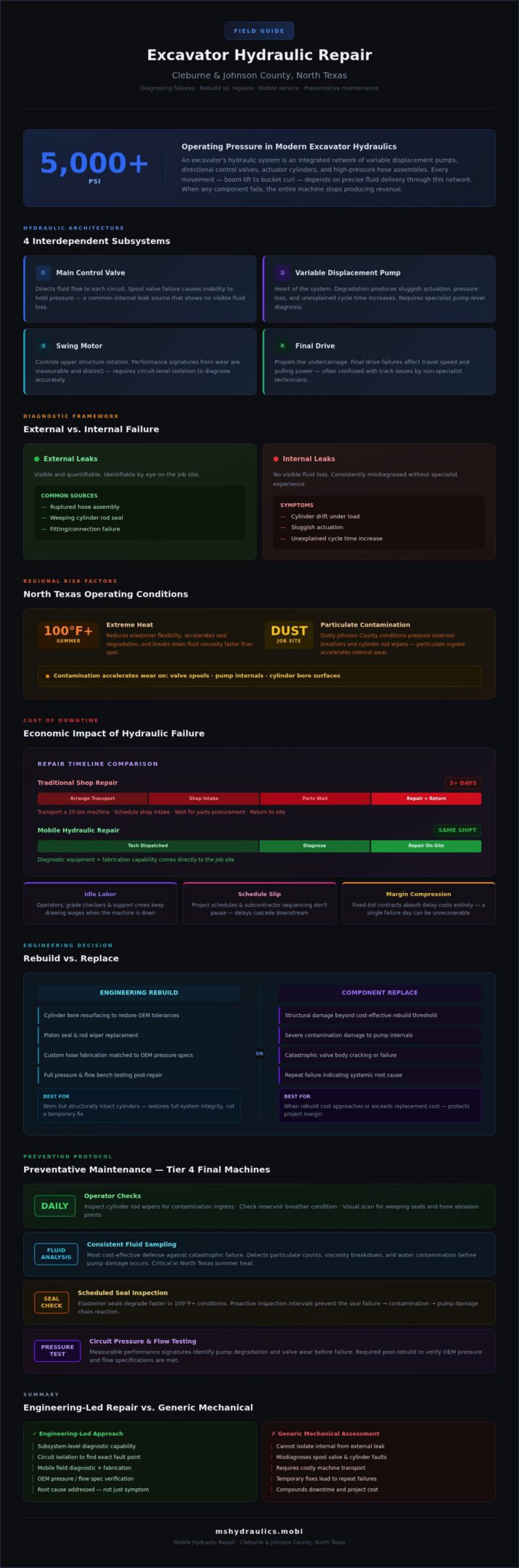
An excavator’s hydraulic system is not a single circuit. It’s an integrated network of variable displacement pumps, directional control valves, actuator cylinders, and high-pressure hose assemblies operating collectively at pressures that routinely exceed 5,000 PSI. Every movement the machine makes, from boom lift to bucket curl, depends on precise fluid delivery through that network. When any component within it fails, the entire machine stops producing revenue.
That technical reality defines what excavator hydraulic repair in Cleburne actually requires: subsystem-level diagnostic capability, not generalist mechanical assessment. The boom, arm, and bucket each draw from dedicated hydraulic circuits with distinct pressure and flow requirements. A technician who can’t isolate a fault to a specific circuit, whether it’s a failing pilot pressure signal or a worn piston seal in the arm cylinder, cannot resolve the failure efficiently.
Cleburne’s construction sector, which spans residential development, commercial infrastructure, and utility work across Johnson County, runs on excavator productivity. Agricultural operations in the surrounding area add further demand, with land clearing and drainage work keeping machines in continuous service across seasons. In both sectors, hydraulic performance isn’t a background consideration; it’s the operational baseline.
The Economic Impact of Hydraulic Failure
Idle labor costs accumulate immediately when a Tier 4 excavator goes down. Operators, grade checkers, and support crews don’t stop drawing wages because the machine has a failed seal. Project schedules don’t pause. Subcontractor sequencing doesn’t wait. A single hydraulic failure that keeps a machine offline for a full workday can compress project margins in ways that are difficult to recover, particularly on fixed-bid contracts where the cost of delay is absorbed entirely by the contractor.
The hidden cost that’s frequently underestimated is the “waiting for the shop” gap. Arranging transport for a 20-ton machine, scheduling shop intake, and waiting for parts procurement can extend a one-day hydraulic failure into a multi-day shutdown. Mobile hydraulic repair eliminates that gap by bringing diagnostic equipment and fabrication capability directly to the job site, converting what could be a three-day delay into a same-shift intervention.
Primary Failure Points in Modern Excavator Systems
Identifying whether a leak is external or internal is the first diagnostic decision. External leaks, such as a ruptured hose or a weeping cylinder rod seal, are visible and quantifiable. Internal leaks, where fluid bypasses worn piston seals within a cylinder or a spool valve fails to hold pressure, produce symptoms like drift, sluggish actuation, or unexplained cycle time increases without any visible fluid loss. Internal failures are consistently misdiagnosed by technicians who lack excavator-specific hydraulic experience.
Contamination is the compounding factor in both failure types. Particulate ingress into a high-precision hydraulic circuit accelerates wear on valve spools, pump internals, and cylinder bore surfaces. North Texas operating conditions intensify this risk. Sustained summer heat above 100°F accelerates seal degradation by reducing elastomer flexibility and increasing fluid viscosity breakdown. Dusty job site conditions in Johnson County create consistent contamination pressure on reservoir breathers and cylinder rod wipers. These regional factors make preventative fluid analysis and seal inspection protocols not optional, but operationally necessary for sustained machine availability.
Accurate excavator hydraulic repair in Cleburne begins with understanding these failure dynamics at the circuit level, which is the technical foundation that separates engineering-led repair from generic mechanical intervention.
Technical Analysis of Excavator Hydraulic Subsystems
A modern excavator’s hydraulic architecture is built around four interdependent subsystems: the main control valve, the variable displacement pump, the swing motor, and the final drive. Each operates within precise engineering parameters. When one degrades, the performance signatures it produces are measurable, and accurate diagnosis depends on understanding how each subsystem behaves under load.
The Main Control Valve and Precision Flow
The Main Control Valve (MCV) functions as the system’s central routing mechanism, directing pressurized fluid to each actuator circuit based on operator input through the pilot pressure signal. It’s a precision-machined assembly with tolerances measured in microns, and spool wear is its primary failure mode.
As spool-to-bore clearance increases through normal wear or contamination-accelerated abrasion, internal bypass becomes the consequence. Fluid that should be directed to the boom cylinder instead recirculates across the spool land, producing symptoms that operators describe as erratic or “lazy” boom and bucket response. The machine still moves, but cycle times increase and load-holding capacity diminishes. These are not operator errors; they are measurable signs of valve degradation.
Diagnosing internal bypass requires pressure testing at the work port, not just at the pump outlet. A technician who measures only pump output pressure and declares the system healthy has missed the fault location entirely. Correct diagnostic protocol isolates each circuit individually, comparing work port pressure under load against the manufacturer’s specified relief valve setting. Relief valve calibration is equally critical: an over-pressured circuit accelerates seal wear throughout the actuator; an under-pressured circuit reduces breakout force and lifting capacity.
Excavator Pump and Motor Diagnostics
Variable displacement piston pumps regulate output flow by adjusting the swashplate angle in response to system demand signals. Cavitation, which occurs when fluid supply to the pump inlet is restricted or when hydraulic fluid contains entrained air, produces a characteristic high-pitched whine and accelerated wear on piston shoes and the valve plate. Aeration, often introduced through a compromised case drain line or a reservoir return fitting above the fluid level, generates foam in the reservoir and erratic actuator movement under load.
Volumetric efficiency is the key performance indicator for both pumps and motors, expressing the ratio of actual fluid output to theoretical maximum output at a given displacement setting; a healthy variable displacement pump typically maintains volumetric efficiency above 90%, and readings below 85% indicate internal wear sufficient to warrant rebuild or replacement.
Swing motor diagnostics follow a parallel logic. Rotational drift under load, where the upper structure creeps when the swing brake is engaged, points to internal motor bypass across worn piston seals or a failing brake valve. Final drive performance is assessed through case drain flow measurement; elevated drain flow from a travel motor confirms internal wear in the hydrostatic transmission before catastrophic failure occurs.
For contractors managing equipment across Johnson County, understanding these failure signatures is the difference between a controlled repair and an unplanned shutdown. Precise excavator hydraulic repair in Cleburne begins at this subsystem level, which is why on-site diagnostic capability matters as much as the repair itself. If you’re seeing performance degradation in any of these subsystems, connect with a mobile hydraulic diagnostic specialist before a developing fault becomes a complete system failure.
Mobile Hydraulic Service vs. Shop Repair in Johnson County
Transporting a 20-ton excavator to a hydraulic shop is not a logistical inconvenience; it’s a structural disruption to your project schedule. The machine must be secured, permitted for road transport, delivered, assessed for shop intake, and then returned once repairs are complete. That sequence routinely consumes two to four days, and none of those days are recoverable on a fixed-bid contract. Mobile hydraulic repair eliminates every step in that chain by bringing the diagnostic equipment, fabrication tools, and replacement components directly to the job site.
Logistics of On-Site Mobile Service
Effective mobile hydraulic repair in Cleburne TX requires more than a service van with basic tools. A properly equipped mobile unit carries hydraulic pressure test gauges calibrated to heavy equipment specifications, portable hose crimping equipment capable of matching OEM pressure ratings, a range of fittings and hose stock across standard SAE and metric configurations, and fluid handling equipment for safe containment and replacement. This capability allows a technician to perform genuine diagnostic and repair work in the field rather than simply conducting a visual assessment and deferring the actual fix to a shop.
Service coverage across Johnson County includes Alvarado, Burleson, and the Chisholm Trail Parkway corridor, which collectively represent significant concentrations of active residential and commercial construction. Job sites along these growth corridors depend on excavator availability, and proximity to a mobile service provider directly reduces the exposure window when a hydraulic fault develops.
High-pressure hydraulic work on active job sites requires strict safety protocols. Technicians must depressurize circuits completely before any line disconnection, use appropriate personal protective equipment rated for hydraulic fluid injection risk, and establish a defined exclusion zone around the repair area. These are non-negotiable procedural requirements, not optional precautions.
Comparing Downtime: Shop vs. Field
The contrast in turnaround time is measurable. A hose failure that requires transport to a shop typically produces a downtime window of one to three days when scheduling, transport, and parts procurement are factored in. The same failure addressed by a mobile unit with on-site hose fabrication capability resolves in one to two hours in most cases. On-site diagnostic services compress that window further by isolating the fault before any components are touched, preventing the misdiagnosis cycles that extend shop repairs unnecessarily.
For contractors managing subcontractor sequencing across Johnson County job sites, that difference isn’t marginal. It’s the difference between a crew that works and a crew that waits. Accurate excavator hydraulic repair in Cleburne delivered on-site isn’t a convenience upgrade; it’s the operationally correct response to how heavy equipment actually fails in the field.
Preventative Maintenance for Excavators in North Texas
Reactive repair is always more expensive than prevention. That principle holds across every mechanical discipline, but it carries particular weight in hydraulic systems operating under the specific stresses that North Texas imposes: sustained ambient temperatures above 100°F through summer months, pervasive silica dust from Johnson County’s clay and limestone soils, and continuous high-cycle operation on residential and commercial development projects that rarely pause. Consistent heavy equipment maintenance structured around these regional conditions is the most cost-effective defense against the failures described in previous sections of this guide.
North Texas soil composition creates a contamination profile that’s more aggressive than operators moving from other regions typically expect. Fine silica particulate generated by grading and trenching operations penetrates cylinder rod wipers and reservoir breathers at a rate that accelerates component wear measurably. Seals that might last through a full service interval in milder climates degrade faster here because heat reduces elastomer flexibility while particulate abrasion compounds the damage simultaneously. Addressing both factors requires a maintenance protocol built around this environment, not a generic OEM schedule.
Daily Hydraulic Inspection Checklist
Pre-shift operator checks take less than ten minutes and intercept the majority of developing failures before they become full shutdowns. Each inspection should cover the following:
- Cylinder rod condition: Visually inspect all exposed rod surfaces for scoring, pitting, or chrome damage. A scored rod surface destroys the rod seal on every stroke, converting a surface defect into an internal leak within hours of continued operation.
- High-flex hose points: Check hose assemblies at boom pivot points and bucket linkage connections for abrasion wear, kinking, or weeping at fittings. These locations experience the highest flex cycles and are the first to show fatigue failure.
- Fluid level and condition: Low fluid level indicates a leak that hasn’t been located yet. Milky oil signals water contamination, most commonly from a compromised reservoir breather or a failed heat exchanger. Darkened oil with a burnt odor indicates thermal degradation and requires immediate fluid replacement before pump and valve damage follows.
These checks don’t require specialized tools. They require trained attention and a consistent pre-shift discipline that operators maintain regardless of schedule pressure.
Advanced Maintenance: Fluid Analysis and Filtration
ISO 4406 cleanliness standards provide the quantitative framework for hydraulic fluid integrity, classifying particulate contamination by particle count across three size ranges. Most modern excavator hydraulic systems specify a target cleanliness code of 17/15/12 or better; operating consistently above that threshold accelerates wear on pump valve plates, spool bores, and cylinder bore surfaces in direct proportion to the contamination level. Scheduled fluid sampling, analyzed against ISO 4406 benchmarks, converts fluid condition from a subjective assessment into a measurable maintenance trigger.
Viscosity selection becomes a precision decision in North Texas summers. High ambient temperatures reduce fluid viscosity, thinning the lubricating film between precision-fitted hydraulic components and increasing internal leakage across worn clearances. Specifying a fluid with a viscosity index appropriate for the operating temperature range, rather than defaulting to the base OEM recommendation written for temperate climates, maintains film strength through peak summer operating conditions.
Filtration is the mechanical complement to fluid analysis: a properly rated 10-micron filter captures abrasive particulate before it reaches pump internals, preventing the piston shoe and valve plate erosion that degrades volumetric efficiency over time.
Scheduled pressure testing, performed at defined service intervals rather than only after a symptom appears, identifies circuit degradation while it’s still a maintenance item rather than an emergency. For contractors managing equipment across Johnson County, this proactive approach to excavator hydraulic repair in Cleburne is what separates controlled maintenance costs from unplanned project disruptions. Schedule a preventative hydraulic inspection before North Texas summer operating conditions put additional stress on your machine’s hydraulic circuits.
Expert Cylinder Rebuilds and Hose Fabrication in Cleburne
A cylinder that’s leaking externally or drifting under load isn’t a component you patch. It’s a precision assembly that requires disassembly, measurement, and engineering-led restoration to return to specification. The difference between a professional rebuild and a temporary seal swap is measurable in service life, and it’s the difference that defines Ms. Hydraulics LLC’s approach to heavy equipment cylinder rebuild in Texas.
The Anatomy of a Professional Cylinder Rebuild
Disassembly is the diagnostic phase, not just the preparatory one. Once a cylinder is opened, the bore surface is measured for out-of-round wear, scoring depth, and chrome integrity on the rod. Barrel honing restores the surface finish required for proper seal seating; installing new seals into a degraded bore produces a shorter service interval than the original failure, not a genuine repair. Seal kit selection follows from that inspection: high-performance polyurethane and PTFE-based seals rated for the operating pressure and temperature range of the specific circuit replace OEM-equivalent materials where the application demands it. Final pressure testing at or above the system’s rated working pressure confirms seal integrity before the cylinder returns to service. No assumption is made about performance; it’s verified.
On-Demand Hose Fabrication in the Field
Hose failure on an excavator doesn’t follow a shop schedule. Mobile hose fabrication capability closes that gap by producing replacement assemblies on-site, matched to OEM pressure ratings and flow specifications. The precision of the crimp connection is the critical variable: an under-crimped fitting separates under pressure; an over-crimped fitting compromises hose wall integrity at the ferrule. Properly calibrated crimping equipment in a mobile unit eliminates both failure modes.
Fitting identification is a non-negotiable competency in this work. The three dominant thread and sealing configurations on excavator hydraulic circuits each require a different approach:
- JIC (37-degree flare): Common on older machine circuits; relies on metal-to-metal flare contact for sealing.
- NPT (tapered pipe thread): Seals through thread deformation; requires correct torque to prevent cross-threading and weeping.
- ORFS (O-ring face seal): The standard on modern Tier 4 equipment; provides positive sealing at the face rather than at the thread, making it the most reliable configuration for high-pressure hydraulic circuits.
Hose routing discipline matters equally. Replacement assemblies on excavator boom and arm circuits must account for flex radius, clearance from structural contact points, and clamp spacing to prevent abrasion wear that shortens service life regardless of hose quality. Reviewing the hydraulic parts and fittings appropriate for each circuit position prevents substitution errors that introduce premature failure points.
For contractors managing equipment across Johnson County, this level of technical precision in both cylinder rebuilds and hose fabrication is what closes the gap between hydraulic failure and operational readiness. Accurate excavator hydraulic repair in Cleburne delivered by a provider who treats each repair as an engineering intervention, not a parts swap, is what protects machine availability across the full project schedule. Contact Ms. Hydraulics LLC to schedule an on-site assessment before a developing fault forces the decision.
Put Your Excavator Back to Work with the Right Technical Partner
Hydraulic failure on an active job site isn’t an abstract risk; it’s a direct threat to your project margin and crew productivity. This guide has established that accurate diagnosis at the subsystem level, mobile service capability that eliminates transport delays, and engineering-led cylinder rebuilds are the technical standards that separate controlled maintenance costs from compounding downtime.
Ms. Hydraulics LLC has been serving Cleburne and North Texas since 2021, delivering on-site diagnostics, custom hose fabrication in the field, and precision cylinder rebuilds directly to Johnson County job sites. When your machine develops a fault, the response comes to you, not the other way around.
Don’t let a developing hydraulic fault become a full project disruption. For professional excavator hydraulic repair Cleburne contractors can rely on, request mobile excavator repair from Ms. Hydraulics LLC today and keep your equipment producing revenue where it belongs: on the job site.
Frequently Asked Questions About Excavator Hydraulic Repair in Cleburne
How quickly can you respond to an excavator hydraulic failure in Cleburne?
Response times vary based on current dispatch availability and your job site location within Johnson County. Ms. Hydraulics LLC operates mobile units serving Cleburne and the surrounding area, so contacting us directly with your location and fault description is the fastest way to get an accurate arrival estimate. We recommend calling as soon as a fault develops rather than waiting to see if the problem resolves, since operating a degraded hydraulic system accelerates secondary damage.
Can you fabricate high-pressure hydraulic hoses on-site?
Yes. Mobile units carry hose stock, fittings, and calibrated crimping equipment capable of producing replacement assemblies matched to OEM pressure ratings across standard SAE and metric configurations, including JIC, NPT, and ORFS fitting types. Fabrication happens at the job site, which means a hose failure that would otherwise require shop transport and scheduling can typically be resolved in hours rather than days. Correct crimp specification is verified before the assembly goes back into service.
Is it better to rebuild or replace a leaking excavator cylinder?
Rebuild is the correct intervention in most cases, provided the barrel bore and rod chrome surface are within serviceable tolerances. A professional rebuild restores the cylinder to specification through bore measurement, surface honing where needed, and high-performance seal installation, then confirms integrity through pressure testing. Replacement becomes the appropriate decision when bore scoring exceeds correctable depth or rod damage has compromised the structural envelope. The inspection findings, not a default preference, should drive that decision.
What are the most common causes of excavator pump failure?
Cavitation and contamination are the two primary failure drivers. Cavitation occurs when the pump inlet is starved of fluid or when entrained air enters the circuit, producing accelerated wear on piston shoes and the valve plate. Contamination from particulate ingress erodes internal clearances over time, reducing volumetric efficiency below serviceable thresholds. In North Texas operating conditions, thermal degradation of hydraulic fluid during sustained high-temperature operation compounds both failure modes by thinning the lubricating film between precision-fitted pump components.
Do you provide mobile hydraulic services for all excavator brands?
Ms. Hydraulics LLC provides mobile hydraulic repair and on-site diagnostics for heavy equipment across major excavator brands operating in Johnson County and the broader North Texas market. Hydraulic system architecture, including variable displacement pumps, main control valves, and actuator cylinders, follows consistent engineering principles across manufacturers. Diagnostic and repair capability applies at the subsystem level, so brand isn’t the limiting factor. Contact us with your machine’s make, model, and the symptoms you’re observing to confirm service applicability for your specific unit.
What information do I need to provide for a mobile service call?
Provide your job site address or GPS coordinates, the excavator’s make and model, a description of the symptoms you’re observing, and whether the machine is still operational or fully down. If you’ve noticed specific patterns, such as drift under load, fluid loss from a visible location, or unusual sounds during operation, include those details. That information allows the technician to arrive with the most relevant diagnostic equipment and a targeted selection of components, reducing diagnostic time once on-site.
How do I know if my excavator’s swing motor is failing?
The clearest field indicator is rotational drift: if the upper structure creeps when the swing brake is engaged and the operator hasn’t commanded movement, that points to internal motor bypass across worn piston seals or a failing brake valve. You may also notice reduced swing acceleration under load or difficulty holding position on a slope. These symptoms don’t always produce visible fluid loss, which is why they’re frequently misread as operator or grade issues. A case drain flow measurement confirms internal wear before the motor reaches catastrophic failure.
Are your mobile technicians equipped to handle Tier 4 final systems?
Yes. Tier 4 final excavators integrate hydraulic and electronic control systems more tightly than earlier machine generations, with pilot pressure signals and pump displacement managed through electronic control units rather than purely mechanical inputs. Accurate excavator hydraulic repair in Cleburne on Tier 4 equipment requires technicians who understand both the hydraulic circuit behavior and the electronic feedback loops that govern it. Ms. Hydraulics LLC’s on-site diagnostic capability is built around this architecture, not around legacy mechanical systems alone.