Hydraulic Hose Repair Near Me: The 2026 Guide to Mobile Service in North Texas
In the industrial hubs of Dallas, Fort Worth, and Arlington, searching for “hydraulic hose repair near me” should not result in a logistical nightmare involving equipment transport to a brick-and-mortar facility. For a project manager or fleet operator, a blown hose on a drill rig or excavator is more than a mechanical failure; it’s a direct threat to the bottom line. You recognize that high-pressure systems demand absolute precision and that a poorly fabricated hose failing under load is a risk your operation cannot afford.
This 2026 guide explains how to minimize heavy equipment downtime through expert mobile hydraulic hose repair and on-site fabrication services across the North Texas metroplex. You’ll learn the technical advantages of field-based diagnostics and why adhering to current SAE J 1273-2021 standards is essential for long-term system reliability. We provide a detailed look at how professional mobile units deliver factory-quality assemblies directly to your job site to keep your critical operations moving without delay.
Key Takeaways
- Eliminate the high cost of machinery downtime by shifting from traditional shop repairs to on-site diagnostics and immediate hose fabrication.
- Identify the mechanical triggers for hose failure, such as external abrasion and pressure spikes, to improve the long-term reliability of your hydraulic systems.
- Ensure every field-fabricated assembly meets rigorous SAE standards by partnering with a technician capable of matching OEM specifications for length and fitting orientation.
- Accessing professional hydraulic hose repair near me enables immediate on-site fabrication that adheres to international industry standards, reducing the risk of premature component failure.
- Master the technical differences between American, British, and Metric fittings to prevent installation errors that lead to catastrophic system leaks.
What is Mobile Hydraulic Hose Repair and Why is it Critical?
Mobile hydraulic hose repair is the on-site fabrication and installation of high-pressure fluid power lines. This service utilizes a specialized mobile workshop to replicate failed assemblies at the machine’s GPS coordinates. For industrial operators searching for hydraulic hose repair near me, the objective is the restoration of mechanical function without the logistical burden of component transport. These mobile units are engineered to perform precision crimping and cleaning that meets or exceeds OEM specifications. Modern hydraulic maintenance relies on these units to provide a technical accuracy that retail storefronts often lack, particularly regarding hose cleanliness and fitting integrity.
The True Cost of Machinery Downtime in DFW
In the North Texas industrial sector, equipment idleness represents a quantifiable loss in operational efficiency. When a primary asset like a drill rig or excavator fails in Cleburne or Arlington, the financial impact extends beyond a simple repair bill. Project managers must account for lost revenue per hour, which often reaches several thousand dollars depending on the specific contract. Secondary costs include idle operator wages and potential liquidated damages for project delays. North Texas construction projects in Dallas and Fort Worth operate under rigorous timelines where a single failed line can halt an entire crew. Rapid response times from localized technicians mitigate these losses by restoring system pressure within hours rather than days.
Mobile Service vs. Traditional Repair Shops
Traditional repair models often rely on retail “while-you-wait” services. This approach requires an operator to remove the hose and transport it to a facility, leaving the equipment exposed to environmental contaminants and increasing the window of downtime. Accessing professional hydraulic hose repair near me eliminates these risks through several key advantages:
- Elimination of Transport Logistics: There’s no need to haul heavy machinery or dispatch personnel to a physical storefront.
- In-Situ Diagnostics: Technicians observe the hose in its operational environment. This allows for the identification of routing errors or abrasion points that a shop-based technician would miss.
- Technical Precision: On-site fabrication ensures the replacement assembly matches the exact length and orientation required for the specific hydraulic circuit.
Professional installation on-site also enhances safety. Technicians verify that all connections are torqued to specification and that the system is purged of air before the machine returns to service. This holistic approach ensures the long-term reliability of the hydraulic system and prevents the recurring failures common with improperly installed retail hoses.
Technical Causes of Hydraulic Hose Failure
Hydraulic hose failure is rarely a random occurrence. It’s usually the result of specific mechanical or environmental stressors that compromise the assembly’s structural integrity. Operators searching for hydraulic hose repair near me often find that failure stems from accumulated wear that went undetected during routine operation. Identifying these technical triggers is essential for preventing catastrophic system discharge and maintaining operational safety.
External abrasion remains the primary cause of hose failure in rugged North Texas environments. When hoses rub against machine frames or other lines, the protective outer cover erodes, exposing the steel reinforcement to oxidation and mechanical damage. Additionally, pressure spikes and impulse cycles fatigue the reinforcement layers. If a system’s relief valves are improperly calibrated, these transient spikes exceed the hose’s rated working pressure, leading to immediate rupture. Chemical degradation also plays a role. If the internal tube material is incompatible with the specific hydraulic fluid, the elastomer loses its physical properties and begins to erode. In the North Texas climate, extreme ambient heat further accelerates this process by reducing the hose’s elasticity and making the assembly brittle over time.
Understanding Hose Construction and SAE Standards
Modern hydraulic hoses utilize a complex three-layer architecture designed to withstand extreme physical parameters. The inner tube provides fluid containment and chemical resistance. The reinforcement layer, consisting of either wire braid or spiral wire, determines the hose’s pressure capacity. For medium-pressure applications, wire braid reinforcement like SAE 100R2 is standard. However, high-PSI systems with severe impulse cycles require spiral wire reinforcement, such as SAE 100R15, to prevent wire fatigue. Adhering to these SAE ratings ensures the assembly can manage the specific mechanical loads of the equipment.
Identifying Warning Signs Before Catastrophic Failure
Proactive inspection can identify failing components before they cause significant downtime. Operators should monitor for “weeping” or localized dampness at the crimp fitting, which indicates a compromised seal. Bubbles or blisters in the outer cover are also critical indicators; they suggest that the inner tube has failed, allowing pressurized fluid to migrate between the layers. If the steel reinforcement is visible due to cover damage, the hose must be replaced immediately. Once the wire is exposed, oxidation begins, and the assembly no longer meets its original safety factor. Implementing a consistent schedule for heavy equipment maintenance allows technicians to identify these risks during hydraulic hose repair near me and replace compromised lines before they burst.
Mobile Hose Fabrication: Engineering Precision in the Field
Mobile fabrication transforms the job site into a controlled engineering environment. When searching for hydraulic hose repair near me, the expectation is a replacement that mirrors the original equipment manufacturer (OEM) specifications. Achieving this requires more than basic tools. Technicians must calculate the exact “cut-off” length, which accounts for the space occupied by the fittings to ensure the finished assembly doesn’t experience excessive tension or slack. Proper hose orientation, or “clocking,” is equally vital. If the fittings aren’t aligned with the natural bend of the machine’s routing, the hose will twist under pressure, leading to premature failure of the reinforcement layers.
Precision crimping is the cornerstone of high-pressure safety. Every hose and fitting combination has a specific crimp diameter that must be met within thousandths of an inch. An over-crimped fitting can crush the inner tube and restrict flow; an under-crimped fitting may result in a catastrophic blow-off. After the crimp is verified, the assembly undergoes a rigorous cleaning process. Mobile units utilize projectile cleaning systems or high-pressure flushing to remove metal shavings and rubber dust generated during the cutting process. This prevents internal contamination, protecting sensitive valves and pumps from abrasive wear.
The Mobile Fabrication Unit Setup
A modern mobile unit is a self-contained industrial workshop. These vehicles are equipped with high-performance saws and adjustable crimpers capable of handling heavy-duty 4-spiral wire hoses. Maintaining a comprehensive inventory of JIC, NPT, and Metric fittings is essential for immediate service across North Texas. On-board testing equipment allows for pressure verification, ensuring every assembly can withstand the impulse cycles of industrial work. This capability ensures that hydraulic hose repair near me provides a permanent solution rather than a temporary patch.
Custom Hose Assemblies for Heavy Equipment
Specialized machinery, including excavators, skid steers, and forklifts, requires custom hose configurations that vary by manufacturer. High-pressure lines on drill rigs, for instance, must manage extreme PSI and constant vibration. Integrating On-Site Diagnostic Services into the fabrication process allows technicians to identify the root cause of a failure before installing the new assembly. This holistic approach ensures the new hose is routed correctly and protected from the environmental stressors that caused the initial breakdown.
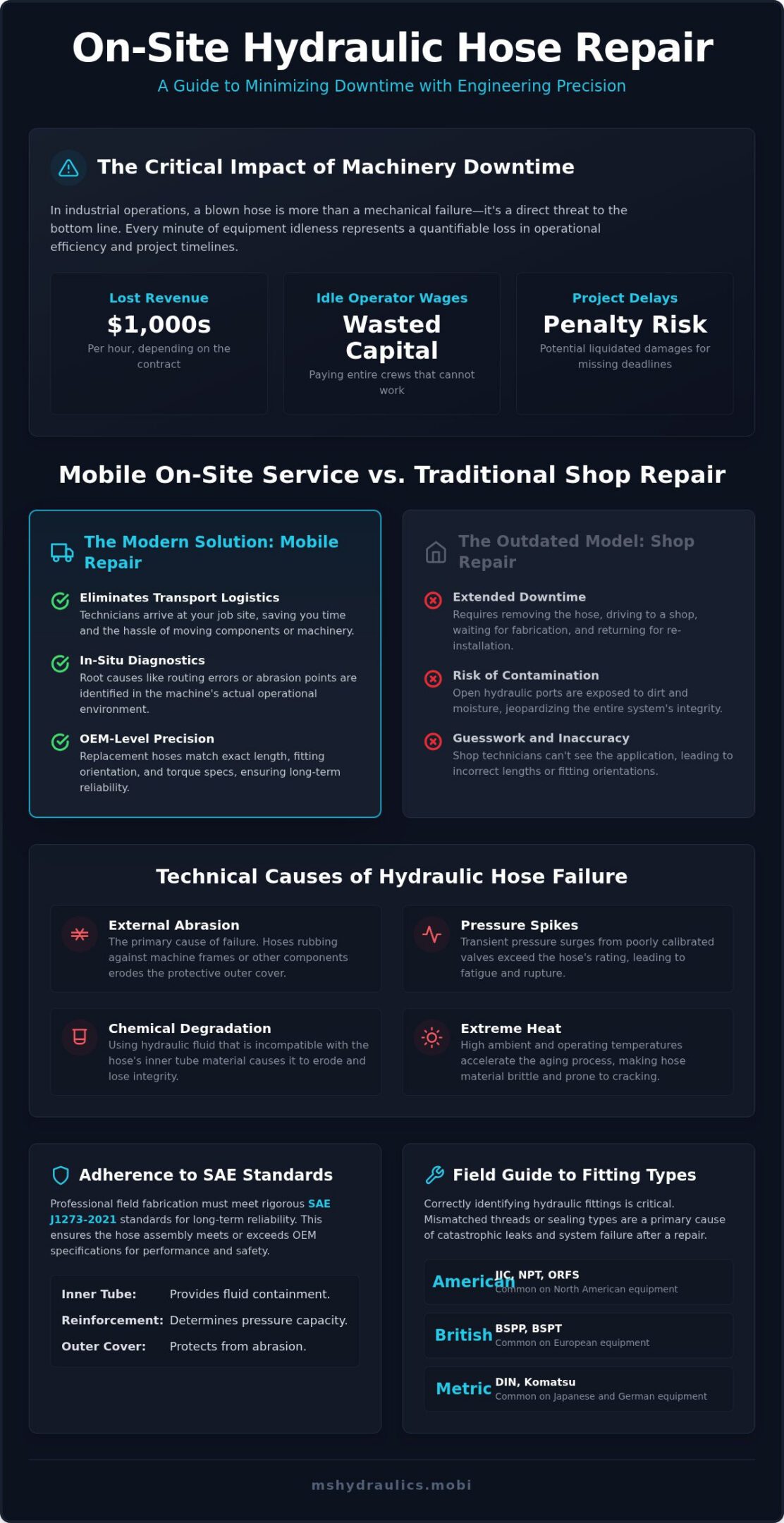
Field Guide: Identifying Hydraulic Fittings and Threads
Precise identification of hydraulic fittings is a critical competency for maintaining system integrity. When requesting hydraulic hose repair near me, the ability to communicate specific fitting requirements can significantly accelerate the restoration of service. The complexity of modern machinery means that American, British, and Metric threads often coexist on a single piece of equipment. Using the wrong fitting doesn’t just cause leaks; it can permanently strip the threads of expensive pumps or valves, leading to extensive component replacement costs.
Technicians use a systematic approach to identify these components. A digital caliper measures the outside diameter of male threads or the inside diameter of female threads with high precision. Following this, a thread pitch gauge determines the number of threads per inch or the distance between crests in metric systems. This verification is essential because many thread types appear identical to the naked eye. For instance, a 1/2 inch JIC fitting and a 1/2 inch BSP thread have similar diameters but different pitch and seat angles. Sealing methods also vary. Metal-to-metal seals, like the 37-degree flare, rely on mechanical deformation, while O-ring seals use an elastomer to provide a leak-proof barrier under high-vibration conditions.
Common Fitting Types in North Texas Machinery
JIC (Joint Industry Council) 37-degree flare fittings are the most prevalent in North Texas construction equipment due to their reliability and ease of assembly. However, for high-vibration applications, O-Ring Face Seal (ORFS) fittings are becoming the standard. ORFS provides a “zero-leak” connection that handles the thermal expansion and mechanical shock common in heavy-duty hydraulics. While NPT (National Pipe Thread) is still found on older equipment, its use is declining in high-pressure circuits. NPT relies on tapered threads to create a seal, which often leads to over-torquing and cracked port castings.
Quick Disconnects and Specialized Couplers
Skid steer attachments and other modular implements rely on quick disconnects for rapid tool changes. Flat-face couplers are the standard here because they minimize fluid loss and prevent air ingestion during connection. For extreme pressure applications, thread-to-connect couplers provide a more secure mechanical interface that won’t accidentally disconnect under load. Maintenance is vital for these components. Even a small amount of grit can score the internal seals, leading to persistent drips. Keeping dust caps in place and cleaning the mating surfaces before every connection ensures long-term reliability. If your system is experiencing coupling failures, contact us for professional mobile hydraulic repair to evaluate your connector specifications.
Choosing the Right Repair Partner in North Texas
Selecting a service provider in the Dallas-Fort Worth metroplex requires a rigorous evaluation of technical capabilities. While many search results for hydraulic hose repair near me lead to general retail outlets, sophisticated industrial operations require a partner capable of field-based engineering. Local expertise in Cleburne, Dallas, and Fort Worth is essential because it dictates response times and the technician’s familiarity with regional equipment stressors. A qualified partner doesn’t merely replace a component; they perform Expert Mobile Hydraulic Repair in Cleburne, TX by analyzing the failure and ensuring the new assembly integrates seamlessly with existing system parameters.
Integrity and Reliability in Field Service
Industrial veterans understand that the lowest initial cost often results in the highest total cost of ownership. Retail hoses frequently utilize sub-standard reinforcement or generic fittings that fail under the rigorous impulse cycles of heavy machinery. Professional field service relies on transparent communication regarding technical specifications and material standards. Building long-term relationships with North Texas construction and agricultural businesses depends on this engineering integrity. Effective Heavy Equipment Maintenance prevents the recurring failures associated with temporary retail patches that don’t meet SAE specifications.
Comprehensive Hydraulic Support Beyond Hoses
A comprehensive repair partner looks beyond the immediate rupture to the health of the entire fluid power system. Hose failure is often a symptom of deeper mechanical issues, such as pump cavitation or valve malfunctions. By utilizing on-site diagnostics, technicians can identify the root cause of pressure spikes before they compromise new assemblies. This holistic approach ensures that hydraulic hose repair near me serves as a permanent solution rather than a recurring expense.
This technical depth naturally extends to other critical components, such as a Heavy Equipment Cylinder Rebuild in Texas. Integrating hose replacement into custom maintenance plans for industrial fleets ensures that every component operates within its designed safety factor. This methodical strategy minimizes the risk of catastrophic failure and maintains the precision required for high-stakes North Texas infrastructure projects.
Maximizing Operational Efficiency through Precision Field Service
Maintaining the structural integrity of high-pressure hydraulic systems requires a shift from reactive shop visits to proactive, on-site engineering. By prioritizing precise thread identification and adhering to SAE J 1273-2021 standards, industrial operators can significantly reduce the financial impact of equipment idleness. Finding reliable hydraulic hose repair near me is not merely a search for convenience; it’s a strategic decision to implement factory-quality fabrication directly at the machine’s location. This technical approach ensures that every replacement assembly matches OEM specifications for length, pressure rating, and fitting orientation.
Ms. Hydraulics LLC provides specialized mobile units equipped for on-site diagnostics and custom fabrication across Cleburne, Dallas, Fort Worth, and Arlington. Our expertise in industrial hydraulics and heavy equipment maintenance allows us to address the root causes of failure rather than providing temporary patches. We’re committed to the long-term reliability of your fleet and the success of your North Texas operations. Contact Ms. Hydraulics LLC for Professional Mobile Hose Repair today to restore your system pressure with engineering precision. Your machinery is the backbone of your project, and we’re here to keep it moving.
Frequently Asked Questions
How long does a mobile hydraulic hose repair typically take?
Most on-site repairs are completed within one to two hours once the technician arrives at the location. The duration depends on the accessibility of the failed line and the complexity of the routing within the machine’s chassis. Specialized mobile units carry high-speed saws and crimpers to expedite the process. This rapid turnaround is essential for minimizing the high costs of equipment idleness on North Texas job sites.
Can you repair a hydraulic hose or do I have to replace it?
Hydraulic hose assemblies must be replaced rather than repaired to ensure system safety and compliance with SAE J 1273-2021 standards. Attempting to patch a high-pressure line or reuse old fittings introduces significant risks of catastrophic failure. A professional technician will fabricate a new assembly using fresh hose and fittings that match original specifications. This ensures the assembly can handle the required PSI and impulse cycles without leaking under heavy loads.
What information do I need to provide for a mobile hose service call?
Providing the machine’s make and model, the hose’s approximate length, and the fitting types helps the technician prepare for the call. If possible, identify the SAE rating on the hose layline and describe the specific application, such as an excavator boom or a drill rig feed line. Accurate GPS coordinates for the job site are also required. This technical data allows the mobile unit to arrive with the correct inventory for your hydraulic hose repair near me.
Do you offer 24/7 emergency hydraulic hose repair in Fort Worth?
You should check our current operational hours for specific availability in the Fort Worth area. While we prioritize emergency calls for critical machinery, we don’t make universal claims of 24/7 service without prior confirmation. Our focus remains on providing expert technical support during established operational windows to keep your industrial projects moving. We recommend contacting our dispatch team directly to verify the current response times for your specific location in North Texas.
Is it safe to use a hose from a parts store on my excavator?
Using generic hoses from retail parts stores introduces risks because these components may not meet the specific PSI or impulse requirements of heavy equipment. Excavators require high-performance, multi-wire reinforced hoses that can withstand constant vibration and pressure spikes. Retail hoses are frequently designed for lower-duty applications. Professional fabrication ensures the assembly meets the exact SAE standards required for your machine’s hydraulic circuit, preventing premature failure and environmental fluid discharge.
What areas in North Texas do your mobile repair units cover?
Our mobile service units provide technical coverage across a broad region, including Cleburne, Dallas, Fort Worth, and Arlington. We specialize in reaching remote job sites where transporting heavy equipment to a shop is logistically impossible. By providing hydraulic hose repair near me directly at your GPS coordinates, we eliminate the need for equipment hauling. Our technicians are familiar with the industrial hubs and construction corridors throughout the North Texas metroplex.
How do I know if my hydraulic hose is about to fail?
Visual indicators such as “weeping” at the crimp, blisters on the outer cover, or exposed wire reinforcement suggest imminent failure. You should also check for localized heat buildup or stiffening of the elastomer, which indicates the hose has reached the end of its service life. Regular inspections are vital for identifying these risks before they lead to a rupture. Once the steel reinforcement is visible or oxidized, the hose’s structural integrity is compromised.
Can you fabricate high-pressure 4-spiral hoses on-site?
Yes, our mobile units are equipped with industrial-grade crimpers and saws capable of fabricating high-pressure 4-spiral wire hoses. These assemblies are common on modern heavy equipment that operates at high PSI with frequent pressure impulses. We carry a comprehensive inventory of spiral-rated fittings to ensure the finished product meets OEM performance benchmarks. This capability allows us to restore function to complex machinery like drill rigs and large excavators without leaving the site.