Emergency Hydraulic Repair in Fort Worth: Minimizing Industrial Downtime with Engineering Precision
With the global hydraulic components repair services market projected to reach USD 9.17 Billion by 2035, the margin for error in industrial maintenance has effectively disappeared. For operators in North Texas, a blown seal or a pump failure isn’t just a mechanical setback. It’s a critical threat to project timelines and environmental compliance. When a system fails, securing reliable emergency hydraulic repair Fort Worth services becomes the difference between a minor delay and a catastrophic loss of revenue. You likely recognize that every hour of machine downtime erodes your bottom line while increasing the risk of reportable incidents under Texas Commission on Environmental Quality (TCEQ) standards.
This guide provides a technical framework for identifying hydraulic failure modes and selecting engineering-led mobile repair solutions that restore equipment to peak performance. We’ll examine the logistical advantages of on-site diagnostics and the specific reporting thresholds for petroleum product spills, such as the 25-gallon limit for non-exempt PST facilities. By prioritizing precision over temporary fixes, you can ensure the long-term reliability of your heavy equipment and maintain a steady operational rhythm.
Key Takeaways
- Quantify the financial impact of machinery downtime and the role of rapid intervention in preventing secondary mechanical damage to complex hydraulic circuits.
- Identify how the North Texas climate accelerates thermal degradation of fluids and how particulate contamination compromises system integrity in high-dust environments.
- Contrast the significant logistical expenses and risks of transporting oversized machinery with the precision and speed of emergency hydraulic repair Fort Worth mobile services.
- Understand the engineering-led diagnostic protocol, including systematic pressure testing and on-site hydraulic hose fabrication using high-impulse rated materials.
- Evaluate the technical advantages of specialized mobile fleets that prioritize long-term component reliability and adherence to international industrial standards.
Navigating Industrial Downtime with Emergency Hydraulic Repair in Fort Worth
Fort Worth’s rapid infrastructure expansion places immense pressure on heavy equipment reliability. When a primary excavator or drill rig fails on a critical path, the entire project timeline is compromised. In these scenarios, emergency hydraulic repair Fort Worth provides a tactical intervention that exceeds simple component replacement. A true emergency exists when machinery inactivity halts the sequence of operations, leading to cascading delays across multiple trades. Rapid response is not merely about speed; it’s about technical preservation. Hydraulic machinery relies on precise pressure balances. A minor hose rupture can introduce air into the system, causing pump cavitation. If left unaddressed, this leads to internal scoring and total system contamination, turning a minor leak into a full system overhaul.
The True Cost of Equipment Inactivity
Industrial downtime is an expensive variable that directly erodes project margins. Beyond idle labor costs, contractors often face liquidated damages for missed milestones. Environmental factors add another layer of financial risk. Under Texas Commission on Environmental Quality (TCEQ) regulations, certain petroleum product spills, such as those exceeding 25 gallons from non-exempt PST facilities, require formal reporting. The cost of environmental remediation and potential fines often dwarfs the cost of the actual mechanical repair. Safety remains the final, most critical metric. A sudden loss of hydraulic pressure can lead to unintended load drops, creating significant hazards for site personnel and nearby structures.
Immediate Steps Following a Hydraulic Failure
Proper field response begins with safety and containment. Technicians should follow these steps to stabilize the site before the mobile repair unit arrives:
- Lockout/Tagout (LOTO): Implement LOTO procedures for high-pressure systems to isolate stored energy and prevent accidental activation during the inspection.
- Initial Containment: Deploy spill kits or absorbent materials to prevent hydraulic fluid from reaching soil or water sources. This step is vital for meeting TCEQ compliance and minimizing cleanup costs.
- Technical Data Collection: Document the make, model, and serial number of the failed component. Providing this information to the response team ensures they arrive with the specific technical specifications and high-impulse materials required for a permanent fix.
By following these protocols, operators can mitigate secondary damage and prepare the system for a precise, engineering-led restoration. This proactive approach ensures that emergency hydraulic repair Fort Worth services can be executed with maximum efficiency, restoring the machinery to its original performance parameters without unnecessary delay.
Technical Analysis of Hydraulic System Failures on North Texas Job Sites
Fort Worth’s industrial environment presents specific stressors that accelerate component fatigue. While standard wear is expected, the combination of extreme ambient temperatures and high particulate counts creates a hostile environment for precision components. When these variables converge, the need for emergency hydraulic repair Fort Worth often arises from systemic neglect rather than isolated incidents. Effective hydraulic systems preventive maintenance requires a deep understanding of these localized variables to prevent catastrophic failure.
Fluid and Seal Integrity in Extreme Heat
Ambient temperatures in North Texas frequently exceed 100°F, pushing hydraulic systems toward their thermal limits. As the system temperature rises, the chemical structure of seals and gaskets begins to change. Elastomeric polymers lose their elasticity, leading to seal hardening and eventual cracking. This degradation is compounded by viscosity breakdown in the hydraulic fluid itself. Thermal stress triggers the oxidative breakdown of ISO 46 hydraulic fluid, resulting in the formation of sludge and varnish that restricts orifice flow and compromises valve response. When fluid loses its lubricating film strength, pump components experience metal-to-metal contact, leading to rapid scoring of swash plates and pistons.
Contamination and Abrasive Wear
The clay-rich soil and high dust levels characteristic of North Texas job sites act as a constant abrasive. Rod seals and wipers are the primary defense against this particulate matter. However, even high-quality seals can fail when fine dust bypasses the wiper, entering the cylinder and scoring the rod surface. This contamination eventually reaches the reservoir, where it circulates through the entire system. Internal component scoring in valves and motors often starts as a “silent” failure, manifesting as increased heat or sluggish response before a total breakdown occurs.
Mechanical fatigue in high-cycle equipment like skid steers and loaders is another critical factor. Constant pressure spikes during heavy-duty cycles place extreme stress on hose assemblies. These spikes can exceed the rated working pressure of the hose, leading to wire reinforcement fatigue and eventual rupture. Identifying these issues early through on-site diagnostic services can prevent the logistical nightmare of a field failure. Precision diagnostics allow technicians to isolate the root cause, whether it’s a failing relief valve or an improperly rated hose assembly, ensuring the repair addresses the technical reality of the machine’s environment.
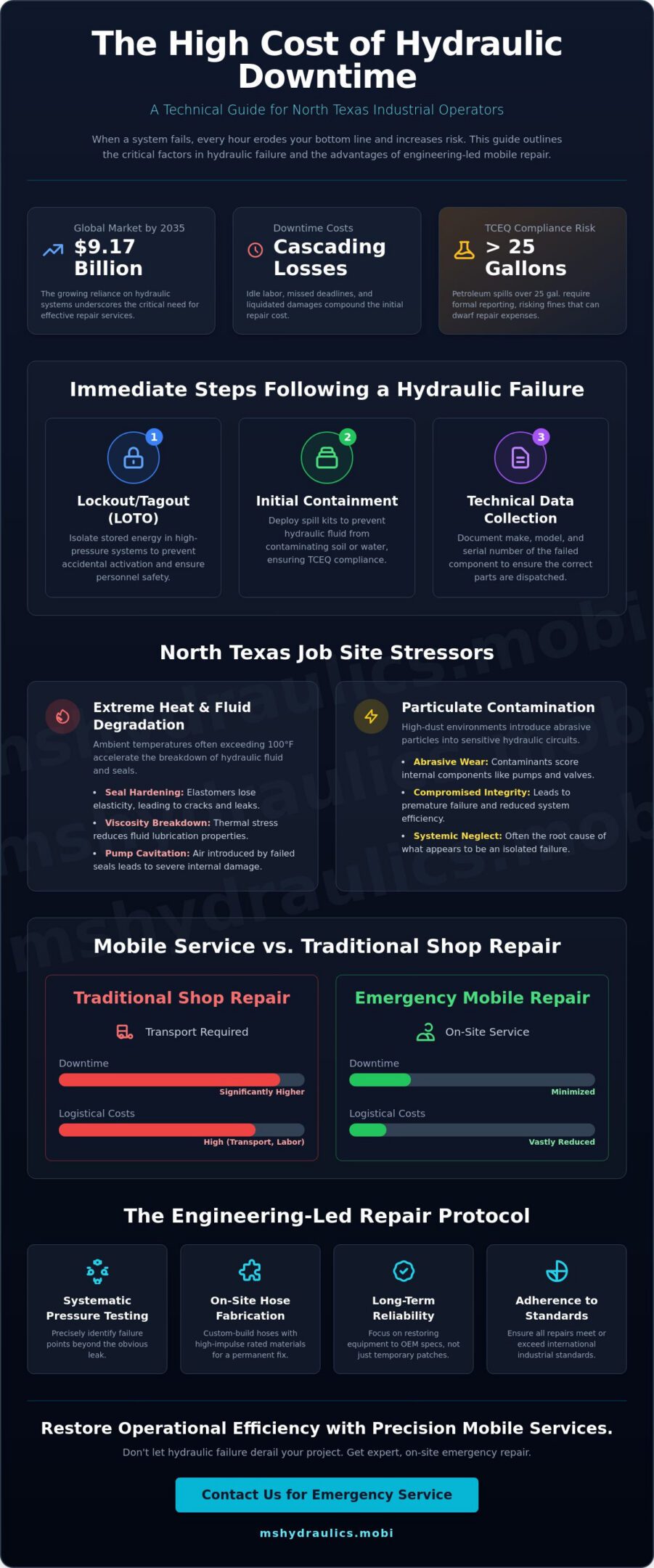
Evaluating Mobile Service vs. Traditional Shop Repair for Heavy Equipment
Selecting between on-site intervention and shop-based service is a critical decision for fleet managers. While traditional thinking suggests a fixed facility offers superior control, modern mobile units are engineered to deliver equivalent precision for the majority of hydraulic failures. For critical path projects in North Texas, emergency hydraulic repair Fort Worth services eliminate the logistical friction of equipment transport. This approach prioritizes immediate machine availability. It reduces the total cost of ownership by bypassing the secondary expenses associated with oversized load logistics.
Logistics and Transport Mitigation
Transporting a 40-ton excavator or a specialized drill rig across the DFW Metroplex involves more than just fuel costs. It requires heavy-haul permits, pilot cars for oversized loads, and significant labor for loading and unloading. These logistical hurdles often add 24 to 48 hours to the restoration timeline before a technician even inspects the machine. Additionally, fixed shops frequently operate on a first-in, first-out basis. This shop queue can leave a machine sitting idle for days. Mobile service restores functionality in-situ, maintaining the continuity of the job site and avoiding the disruption of the operational sequence.
Mobile Capability Benchmarks
Modern mobile hydraulic units are essentially rolling laboratories equipped with high-precision fabrication and diagnostic tools. On-site hydraulic hose fabrication is a standard capability, utilizing crimping technology that matches or exceeds OEM specifications for high-impulse applications. For cylinder failures, mobile units can perform on-site resealing by implementing strict cleanliness protocols to prevent the ingress of environmental contaminants. Technicians utilize advanced diagnostic tooling, such as digital flow meters and pressure transducers, to isolate circuit inefficiencies without removing components. This data-driven approach ensures that the repair addresses the root cause rather than just the visible symptom.
There are, however, technical scenarios where a shop environment remains mandatory. Repairs requiring heavy machining, line boring, or large-scale structural welding of cylinder barrels often necessitate the specialized equipment found in a fixed facility. For the vast majority of hose, seal, and valve failures, the technical parity of mobile services makes them the more efficient choice for emergency hydraulic repair Fort Worth. By resolving the issue at the point of failure, operators can resume production with minimal impact on their project schedule.
The Engineering-Led Protocol for On-Site Hydraulic Diagnostics and Repair
Engineering precision dictates that effective emergency hydraulic repair Fort Worth begins with a systematic diagnostic phase rather than immediate component removal. While many service providers prioritize a rapid “arrival and replace” workflow, Ms. Hydraulics LLC utilizes a disciplined approach that identifies the specific point of system compromise via data-driven metrics. This ensures that the restored component doesn’t fail prematurely due to unaddressed circuit imbalances or pressure spikes. By integrating On-Site Diagnostic Services into the initial response, technicians verify the health of the entire hydraulic circuit before completing the repair.
Advanced Diagnostic Procedures
Modern field diagnostics employ thermal imaging to detect internal valve leakage by identifying localized heat signatures that indicate fluid bypass. Volumetric efficiency is another critical metric; technicians perform flow testing on pumps to determine if they maintain the required output under high-pressure loads. To isolate a faulty relief valve in the field, technicians follow a rigorous sequence:
- Connect a calibrated pressure gauge to the primary circuit test port.
- Cycle the actuator to its mechanical limit to force the system into relief.
- Monitor the pressure reading against OEM specifications; if the pressure fails to hold or reaches the setting too slowly, the valve is likely compromised.
- Inspect the valve seat and spring for mechanical fatigue or particulate interference before attempting recalibration.
Component Restoration Standards
Restoring a machine to peak efficiency requires adherence to international industrial standards during component fabrication. For hose assemblies, this involves selecting the correct wire braid or spiral reinforcement based on the system’s impulse frequency and vibration profile. Utilizing high-impulse rated materials prevents the premature fatigue of the wire reinforcement under heavy-duty cycles. During cylinder rebuilds, technicians verify rod alignment and surface integrity to prevent seal scoring. Proper torqueing of piston nuts and head glands is performed using calibrated equipment to ensure structural stability under high-pressure operation.
The final phase of the protocol involves post-repair system flushing to remove metallic particulates or elastomeric debris introduced during the failure. Once the system is clean, final pressure calibration and performance validation confirm the machine meets all operational parameters. If your machinery is experiencing sluggish response or visible leaks, contact Ms. Hydraulics LLC for Mobile Hydraulic Repair services that prioritize technical integrity and long-term reliability.
Ms. Hydraulics LLC: Restoring Operational Efficiency with Precision Mobile Services
Ms. Hydraulics LLC operates a specialized mobile fleet engineered to meet the technical demands of the North Texas industrial sector. Our service model prioritizes engineering integrity over superficial component replacement. This commitment ensures that every emergency hydraulic repair Fort Worth intervention adheres to rigorous industrial standards. By maintaining a strategic operational base in Cleburne, we optimize response times throughout Johnson and Tarrant Counties. This geographic positioning allows our technicians to reach critical job sites rapidly, minimizing the window of equipment inactivity and preventing the cascading costs of project disruption.
The relationship between reactive intervention and Heavy Equipment Maintenance is fundamental to long-term fleet reliability. While emergency services resolve immediate system failures, a structured maintenance program identifies wear patterns before they manifest as catastrophic breakdowns. Our technicians utilize data gathered during field repairs to inform future maintenance schedules. This creates a technical feedback loop that enhances machinery health and reduces the frequency of unscheduled downtime for major international players and local contractors alike.
Expertise Beyond the Hose
Our field capabilities extend well beyond basic hose fabrication. We provide advanced heavy equipment cylinder rebuild Texas services, utilizing precision measurement tools to verify rod straightness and barrel integrity on-site. This level of technical support is vital for heavy-duty machinery such as excavators, skid steers, and drill rigs, where component failure often involves high-pressure seals and complex valve architectures. For contractors operating in the southern industrial corridor, our mobile hydraulic repair Cleburne TX services provide a localized solution that combines engineering expertise with rapid field deployment.
Securing Your Fleet’s Future
Transitioning from a reactive to a proactive operational stance is the most effective method for managing industrial downtime. Ms. Hydraulics LLC assists fleet managers in this transition by providing comprehensive technical resources, including our comprehensive guide to hydraulic parts. This documentation helps operators understand component lifecycles and the specific selection criteria required for high-vibration environments. When a failure occurs, our disciplined response team remains prepared for immediate dispatch across the Fort Worth area. You can rely on Ms. Hydraulics LLC to restore your system’s performance with engineering precision and verified reliability. Contact our dispatch team today to secure a partner dedicated to your machinery’s technical excellence.
Optimizing Industrial Reliability through Engineering Precision
Maintaining operational continuity in the North Texas industrial sector requires more than just rapid parts replacement. It demands a sophisticated understanding of hydraulic fluid dynamics and component fatigue. By prioritizing engineering-led diagnostics over surface-level fixes, operators can secure the long-term reliability of their high-pressure systems. Ms. Hydraulics LLC provides this level of technical oversight, ensuring that every mobile intervention restores the machine to its validated performance parameters. Our specialized support for excavators, skid steers, and drill rigs across Fort Worth and Cleburne protects your project milestones from the risks of recurring mechanical failure.
When a critical system failure occurs, securing emergency hydraulic repair Fort Worth services ensures your project remains on its critical path. Our technicians utilize calibrated diagnostic equipment to isolate root causes and restore peak volumetric efficiency in the field. Don’t let mechanical fatigue compromise your production schedule. Request Immediate Emergency Hydraulic Repair in Fort Worth to restore your heavy equipment with technical excellence and disciplined precision. We’re ready to stabilize your operations and secure your fleet’s productive future.
Frequently Asked Questions
How quickly can you respond to an emergency hydraulic repair call in Fort Worth?
Response times are optimized through our strategic location in Cleburne, facilitating rapid deployment to Tarrant and Johnson Counties. While arrival windows depend on current logistical variables and technician availability, our priority is minimizing the duration of equipment inactivity. We recommend contacting our dispatch team immediately to confirm the current arrival schedule for emergency hydraulic repair Fort Worth and to initiate the diagnostic process.
Can you fabricate custom hydraulic hoses on-site for any machine type?
Yes, our mobile service units are equipped with high-precision crimping technology for on-site hydraulic hose fabrication. We utilize high-impulse rated materials and specific fittings that match or exceed OEM specifications for various industrial machine types. This capability allows technicians to resolve hose ruptures in-situ, ensuring the system is restored to its original pressure and flow parameters without the need for shop transport.
What types of heavy equipment do you specialize in repairing?
We specialize in the maintenance and repair of complex hydraulic systems found in excavators, skid steers, drill rigs, and loaders. Our technical expertise encompasses diverse machinery configurations from major international manufacturers. Whether the failure involves high-cycle excavation equipment or specialized foundation drilling machinery, our technicians possess the specialized diagnostic tooling required to isolate and resolve systemic hydraulic failures and component fatigue.
Is it possible to rebuild a hydraulic cylinder on a job site, or does it need to go to a shop?
Hydraulic cylinder rebuilds can be performed on-site provided the failure is limited to seal degradation or minor component wear. Our technicians implement strict cleanliness protocols to prevent environmental contamination during the resealing process. However, if the failure involves structural barrel damage, significant rod scoring, or requires heavy machining, the component may require transport to a fixed facility where specialized line boring and honing equipment is available.
What are the most common signs that a hydraulic system is about to fail?
Common indicators of impending system failure include increased operational heat, sluggish actuator response, and unusual mechanical noise, such as pump cavitation. Visible fluid leaks or an increase in particulate matter within the reservoir are also critical warning signs. Operators should monitor these physical parameters closely; early detection of these anomalies through emergency hydraulic repair Fort Worth services can prevent catastrophic component failure and extensive environmental remediation costs.
Do you offer 24/7 emergency services for weekend or night-shift breakdowns?
Operational availability varies based on current scheduling and technician capacity. While we prioritize rapid response to mitigate industrial downtime, we do not claim universal 24/7 or after-hours availability. We advise fleet managers to contact our office directly to verify current service availability for weekend or night-shift breakdowns. This ensures a methodical approach to restoring machine functionality based on the technical requirements of the failure.
How do your mobile repair fees compare to the cost of towing equipment to a shop?
Mobile repair services eliminate the significant logistical costs associated with heavy-haul trucking, pilot cars, and oversized load permits in the DFW Metroplex. By resolving the issue at the point of failure, you avoid the secondary expenses of equipment transport and the potential for project delays caused by shop queues. While we don’t quote specific pricing, the reduction in total downtime typically results in a lower overall cost of restoration.
What warranty or guarantee do you provide on emergency hydraulic repairs?
We stand behind the technical integrity of our repairs through adherence to international industrial standards and the use of high-quality, verified components. While specific warranty terms depend on the nature of the repair and the condition of the existing system, our focus remains on long-term component reliability. We provide detailed diagnostic reports for every intervention, ensuring that the repair addresses the root cause of failure for lasting machinery health.