Drill Rig Hydraulic Repair in Cleburne: Minimizing Industrial Downtime
For a drilling operation in Johnson County, the most expensive component isn’t the fuel or the bits; it’s the idle time spent waiting for a lowboy trailer that hasn’t arrived yet. You understand that every hour a rig sits depressurized is a direct hit to your operational margins. This is particularly critical in 2026 as federal energy forecasters project West Texas Intermediate crude prices to average around $51 per barrel. Securing specialized drill rig hydraulic repair Cleburne is no longer just a maintenance task; it’s a strategic necessity to avoid the logistical nightmare of hauling heavy equipment to a fixed shop.
You’ll discover how mobile hydraulic engineering and on-site computer diagnostics restore system pressure and functionality without the delays of traditional transport. We will examine the technical standards required for modern hose fabrication and the rigorous documentation needed for maintenance logs. By focusing on precision field repairs, you can maintain compliance with updated OSHA labeling standards and keep your drilling schedule on track despite market volatility.
Key Takeaways
- Understand how mobile hydraulic engineering eliminates the logistical costs and mechanical risks associated with transporting heavy drilling assets to fixed facilities.
- Identify the specific mechanical signatures of fluid contamination and thermal degradation to prevent catastrophic pump and motor failure in the North Texas climate.
- Evaluate the standardized workflow for drill rig hydraulic repair Cleburne that utilizes on-site pressure testing to ensure the rapid restoration of torque and pull-down capacity.
- Discover the importance of technical diagnostic documentation in maintaining operational compliance and long-term machinery efficiency.
- Learn why specialized industrial expertise is required to manage the high-pressure parameters and precision flow control inherent in modern drilling systems.
The Critical Impact of Drill Rig Hydraulic Failure in Cleburne
Drill rig hydraulics are specialized, high-pressure systems engineered to deliver the massive torque and pull-down force required for deep penetration into the North Texas substrate. These systems are the primary drivers for leveling jacks, rotary heads, and winch operations. When a component fails, the entire project timeline is compromised. Relying on professional drill rig hydraulic repair Cleburne provides a localized solution to a problem that otherwise involves massive logistical hurdles. Transporting a 60,000-pound rig to a remote shop often takes days of coordination, permits, and heavy hauling fees. This delay is frequently the least efficient path for industrial operators who need to maintain tight drilling schedules.
Economic Consequences of Hydraulic Stalls
The cost of a dead rig extends far beyond the immediate repair bill. Idle crews and missed contract milestones create a compounding financial deficit. If a hydraulic failure occurs while the drill string is under load, the risk of secondary mechanical damage or losing the borehole entirely increases significantly. In 2026, industry estimates suggest that hydraulic downtime on a major drilling site can cost operators thousands of dollars per hour in combined labor, equipment lease penalties, and lost production revenue. To mitigate these risks and ensure you have the right tools for every contingency, you might check out Pahrump Rentals & Hardware for a comprehensive selection of industrial equipment. Rapid restoration of system pressure is the only way to safeguard project margins against the current WTI crude price projections of $51 per barrel, which demand high operational efficiency.
Cleburne’s Industrial Drilling Demand
Cleburne serves as a strategic hub for infrastructure and energy projects throughout Johnson County. The local geology, characterized by dense limestone and varying soil densities, requires the Anatomy of a Drilling Rig to operate at peak hydraulic efficiency to maintain penetration rates. Whether the application is geotechnical exploration or large-scale utility installation, the hydraulic system must be verified for performance. Proper Heavy Equipment Maintenance in Cleburne & North Texas: A Technical Guide ensures that these machines don’t just run, but operate with the precision necessary for modern industrial standards. Reliable drill rig hydraulic repair Cleburne keeps these vital assets operational where they belong: on the job site.
Anatomy of a Drilling Rig’s Hydraulic System
The hydraulic architecture of a drilling rig is a sophisticated high-pressure network designed for extreme mechanical loads. Unlike standard earthmoving equipment, rigs require sustained torque and precise feed control to navigate the complex geological layers found in North Texas. High-torque hydraulic motors drive the rotary head, providing the rotational force necessary to penetrate dense limestone formations. These motors must maintain volumetric efficiency even as resistance levels fluctuate during deep-bore operations. The main hydraulic pumps serve as the system’s heart, where precise flow control is vital for maintaining a consistent drilling rate. Directional control valves manage the multi-functional nature of the rig, coordinating the mast, leveling jacks, and pull-down systems simultaneously. In the high-dust environments of Cleburne job sites, advanced filtration systems are the primary defense against fluid contamination, which remains the leading cause of component wear.
Primary Hydraulic Components on a Rig
Industrial drilling rigs typically utilize variable displacement axial piston pumps to optimize power distribution across various sub-systems. These units differ from fixed gear pumps by allowing the operator to adjust flow based on specific load requirements, which is essential for deep-bore operations where resistance increases with depth. Hydraulic cylinders manage the mast elevation and provide the constant pull-down force required for the drill bit to engage the rock effectively. When these components lose pressure, a technical heavy equipment cylinder rebuild Texas is often required to restore factory-spec tolerances. Maintaining these cylinders prevents the drift and instability that can lead to borehole misalignment.
Pressure and Flow: The Engineering Balance
Deep-bore drilling requires high PSI (pounds per square inch) to overcome downhole pressures, while the flow rate, measured in gallons per minute (GPM), determines the speed of the rotary and hoist functions. Maintaining this engineering balance is critical for operational safety. During Texas summers, thermal management becomes a priority. Hydraulic fluid temperatures can easily exceed safe operating limits, leading to accelerated seal degradation and fluid breakdown. Given that Group II and Group III base oil prices have seen increases of up to 35% in early 2026, protecting your fluid inventory through professional on-site diagnostic services is a sound financial strategy. Ensuring your drill rig hydraulic repair Cleburne is handled by technicians who understand these mechanical parameters is the only way to prevent recurring system failures.
Diagnosing Common Hydraulic Failures on Cleburne Job Sites
Identifying the root cause of mechanical failure in the field requires an understanding of how local environmental variables interact with high-pressure fluid power. In Cleburne, airborne particulates and extreme ambient temperatures create a high-stress environment for drilling hydraulics. Fluid contamination remains the primary catalyst for component degradation; even microscopic silt from a North Texas job site can act as an abrasive, scouring the internal surfaces of pumps and valves. This leads to a gradual loss of volumetric efficiency that often goes unnoticed until the rig fails to meet torque requirements. When these symptoms occur, immediate drill rig hydraulic repair Cleburne is necessary to prevent a total system seizure that could sideline operations for weeks.
Thermal degradation is another pervasive issue, as the North Texas climate accelerates the breakdown of hydraulic fluid and the hardening of nitrile seals. As fluid loses its lubricating properties, internal friction increases, creating a feedback loop of rising temperatures and accelerating wear. Furthermore, hose fatigue is a localized issue often found where lines transition across the rig mast or pull-down assembly. Constant vibration and abrasive contact against the rig frame eventually compromise the wire reinforcement, leading to catastrophic bursts. Operators should also monitor for internal valve leakage, which manifests as “drifting” in the mast or leveling jacks, indicating that high-pressure fluid is bypassing internal seals.
Signs of Impending Hydraulic Failure
Technicians often identify pump failure through cavitation, a distinct metallic knocking or whining sound caused by air entering the fluid stream or suction line restrictions. This condition rapidly erodes pump impellers and housings. Slow cycle times and a noticeable loss of rotary head torque during high-resistance drilling also signal that the system can no longer maintain required pressures. To the trained eye, oxidized hydraulic fluid typically manifests as a darkened, varnish-like liquid that exhibits a significant increase in viscosity and a characteristic acrid, burnt odor. Maintaining compliance with the January 2026 OSHA Hazard Communication Standard updates requires precise fluid management and updated Safety Data Sheets (SDS) for all lubricants used to manage these failures. To benchmark broader energy overheads and fuel logistics, you may explore Retail Sales and Exchange Fees for LPG Gas Cylinders to understand how commercial fuel pricing is structured in other industrial markets.
The Role of On-Site Diagnostics
Utilizing professional On-Site Diagnostic Services eliminates the guesswork that often leads to the unnecessary replacement of functional parts. Modern drilling rigs utilize integrated electronic controls that can complicate the diagnostic process. Field technicians use computer diagnostics to determine if a failure is rooted in an electrical solenoid issue or a mechanical hydraulic collapse. Pressure testing protocols are then used to isolate specific circuits, allowing for drill rig hydraulic repair Cleburne that targets only the failing components. This methodical approach ensures that the rig returns to service with verified pressure levels that meet original equipment manufacturer (OEM) specifications.
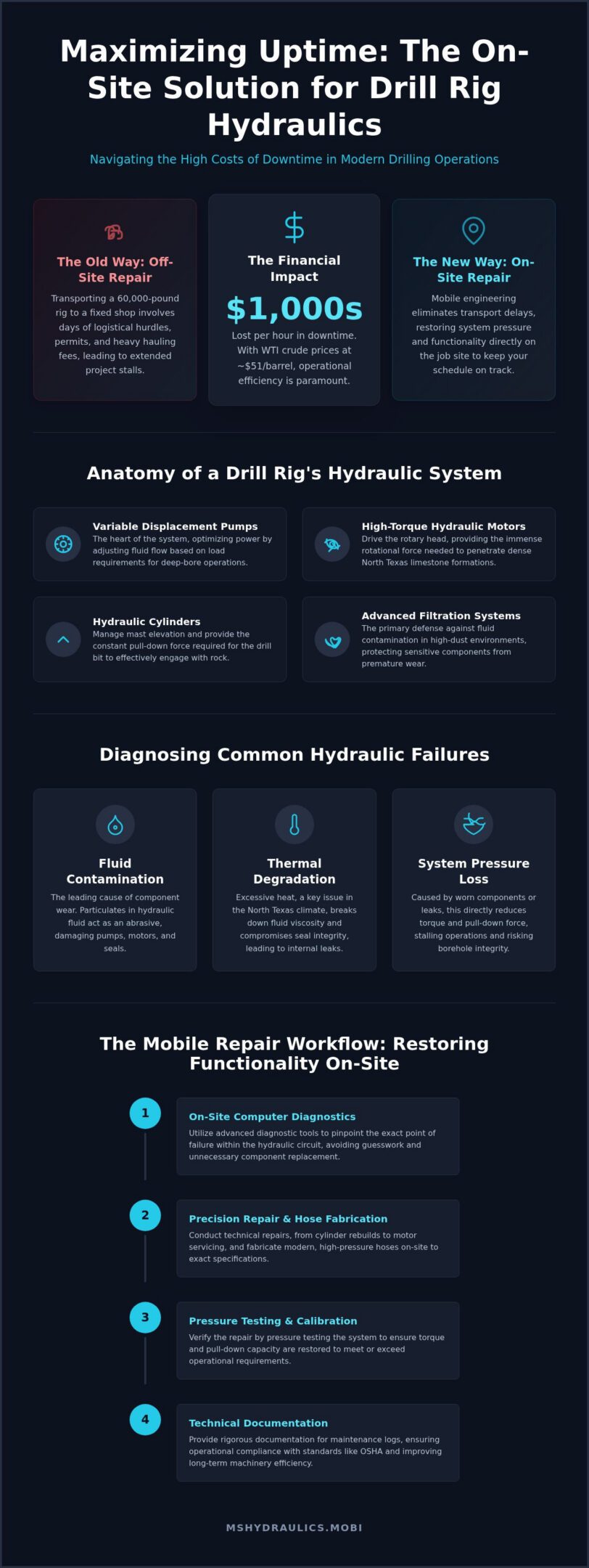
The Mobile Repair Workflow: Restoring Rig Functionality On-Site
Restoring a rig’s mechanical integrity requires a disciplined mobilization process. When a system failure occurs, the response must be methodical to prevent secondary damage. The workflow for drill rig hydraulic repair Cleburne follows a structured five-step protocol designed to minimize downtime. It starts with emergency dispatch, leveraging proximity to major corridors like US-67 for rapid arrival. Once on-site, technicians perform a comprehensive system inspection and pressure testing to pinpoint the specific failure point, whether it is a pump, valve, or cylinder. This eliminates the uncertainty of “parts swapping” and focuses resources on the actual mechanical deficit.
The process transitions from diagnostic verification to the physical restoration of high-pressure components. This includes immediate on-site hydraulic hose fabrication to replace ruptured lines, followed by field repairs of cylinders, valves, or pumps using high-grade seal kits and specialized parts. After the mechanical repair, the technician performs a system flushing to remove any particulates introduced during the failure. The final step is a performance verification under load, ensuring the rig maintains its required GPM and PSI levels. For immediate technical support, you can access professional mobile hydraulic repair to secure your project timelines.
On-Site Hose Fabrication and Replacement
Custom hoses fabricated directly at the rig location are superior to off-the-shelf alternatives. They allow for exact length matching and the use of specific industrial fittings that meet the high-PSI ratings required for deep-bore drilling. Using the wrong fitting or a generic hose leads to premature failure under the extreme vibrations of a rotary head. Matching the exact reinforcement layer count and fitting geometry is essential for long-term reliability. Detailed specifications on these components are available in our Comprehensive Guide to Hydraulic Parts.
Field Cylinder and Valve Restoration
Restoring cylinders and valves in a mobile environment requires technical precision. Technicians inspect valve spools for scoring or debris that could cause internal bypass and pressure loss. Cylinder rods are checked for surface integrity before new seals are installed to ensure a perfect hydraulic bond. This meticulous approach ensures zero-leak performance before the technician leaves the site. By performing these drill rig hydraulic repair Cleburne services on-site, operators avoid the substantial costs associated with heavy hauling and extended shop wait times.
Engineering Reliability: Why Choose Ms. Hydraulics LLC for Drill Rig Services
Ms. Hydraulics LLC operates with a commitment to technical precision and mechanical integrity. With over 20 years of specialized experience in mobile hydraulic repair Cleburne TX, our team understands the specific pressures placed on industrial drilling assets. We don’t just provide surface-level fixes; we implement engineered solutions that address the primary root cause of hydraulic failure. Our facility is strategically located on US-67, allowing our mobile units to reach job sites across Johnson and Tarrant Counties with minimal transit time. This proximity is a critical factor in maintaining the tight operational windows required by the energy and infrastructure sectors. Every dispatch is handled with the disciplined approach of an industrial veteran, focusing on the physical and mechanical parameters that define rig performance.
Our service model is defined by professional decorum and a focus on long-term machinery efficiency. We prioritize fixing what’s broken while providing data-driven advice on preventative measures to safeguard your equipment from recurring issues. This integrity-driven approach ensures that your machinery doesn’t just return to service but stays in service under heavy loads. By selecting a partner with a disciplined industrial background, you ensure that your drill rig hydraulic repair Cleburne is performed to the highest technical standards. We maintain a steady, structured communication rhythm with our clients, providing the clarity needed to make informed maintenance decisions.
The Veteran Advantage in Industrial Repair
Extensive field experience provides a distinct advantage when managing the intersection of complex drilling electronics and high-pressure hydraulics. Factory-level diagnostics are essential for identifying failures within integrated control systems that standard mechanics might overlook. Ms. Hydraulics LLC utilizes high-value technical components and verified seal kits to ensure every repair meets original equipment manufacturer specifications. Our goal is to build long-term partnerships with Cleburne’s industrial sector by delivering consistent, verifiable results. This focus on engineering excellence helps mitigate the risks associated with the supply chain volatility and fluid price increases observed in 2026. We understand that reliability is the core requirement for major international players operating in the North Texas region.
24/7 Emergency Support for Drilling Contractors
Drilling operations don’t adhere to a standard schedule, and mechanical failure is equally unpredictable. Our emergency response protocols are structured to provide 24/7 support, effectively minimizing downtime during night shifts or weekend operations. You gain direct access to expert technicians who recognize the high stakes of rig-specific urgency and the financial impact of every idle hour. Whether it’s a ruptured high-pressure line requiring on-site fabrication or a pump seizure, our mobile units are equipped to handle the restoration on-site. Contact us today to secure immediate assistance and ensure your drill rig hydraulic repair Cleburne keeps your drilling assets productive and compliant with all current industry standards.
Securing Your Drilling Schedule with Precision Engineering
Maintaining the mechanical integrity of a drilling rig requires more than just reactive maintenance; it demands a disciplined approach to fluid power and pressure management. By utilizing on-site computer diagnostics and mobile repair workflows, operators eliminate the substantial logistical costs and schedule delays inherent in heavy equipment transport. This technical strategy ensures that high-pressure components, from rotary motors to feed cylinders, operate within factory-specified parameters even in the challenging North Texas climate. Proper diagnostic verification is the only way to prevent the recurring failures that compromise long-term machinery efficiency.
Selecting a partner with 20+ years of field experience provides the technical verification necessary for modern industrial compliance. When a system failure occurs, our 24/7 emergency response protocols ensure that expert technicians are mobilized immediately to restore rig functionality. For reliable drill rig hydraulic repair Cleburne, the focus must remain on precision diagnostics and verified component restoration to safeguard project margins. Don’t let mechanical downtime compromise your contract deadlines or operational safety standards. Request Immediate Drill Rig Repair in Cleburne to keep your assets operational and your drilling schedules on track.
Frequently Asked Questions
Do you offer emergency drill rig hydraulic repair in Cleburne after hours?
Ms. Hydraulics LLC provides 24/7 emergency response availability to address mechanical failures that occur outside of standard operational hours. We recognize that drilling projects often involve continuous shifts where any delay results in significant financial loss. Our technicians are equipped to mobilize immediately for drill rig hydraulic repair Cleburne, bringing specialized diagnostic tools and repair components directly to your job site at any hour.
Can you fabricate high-pressure hydraulic hoses on-site for a drilling rig?
Technicians perform custom hydraulic hose fabrication directly at the rig location to ensure exact fitment and pressure ratings. Drilling rigs require hoses that can withstand extreme vibration and high-PSI spikes, which often exceed the specifications of standard off-the-shelf lines. By fabricating these components on-site, we eliminate the need for equipment transport and ensure that the replacement hose meets the rigorous demands of industrial drilling operations.
What are the most common causes of hydraulic pump failure on a drill rig?
Hydraulic pump failure is frequently caused by fluid contamination and aeration, which lead to internal component erosion. In the high-dust environments typical of North Texas, particulates can bypass standard filtration and scour the precision-machined surfaces of the pump. Additionally, cavitation caused by restricted suction lines can rapidly destroy pump impellers, resulting in a total loss of system pressure and rotary head torque.
How do you diagnose a hydraulic cylinder leak in the field?
Field diagnostics for cylinder leaks involve monitoring for “drift” in the mast or leveling jacks and performing isolated pressure tests. Technicians use computer diagnostics to determine if the pressure loss is due to external seal failure or internal bypass across the piston. This methodical approach ensures that drill rig hydraulic repair Cleburne is targeted and effective, restoring the necessary pull-down force without unnecessary component replacement.
Do you provide mobile hydraulic services for rigs in Alvarado and Granbury?
Mobile hydraulic services are available for drilling operations in Alvarado, Granbury, and the surrounding Johnson County area. Our service units are staged for rapid deployment to these locations, ensuring that contractors have access to expert mechanical support wherever their equipment is stationed. This regional coverage is essential for maintaining project momentum across diverse infrastructure and energy sites in the DFW metroplex.
What brands of drilling equipment do you typically service?
We provide technical repair and maintenance for major industrial drilling brands, including Schramm, Epiroc, and Atlas Copco. Our technicians are familiar with the specific hydraulic architectures and high-torque motor requirements of these manufacturers. We utilize technical components and seal kits that meet or exceed original equipment manufacturer standards, ensuring that the rig’s mechanical integrity is fully restored following a repair.
Is it better to rebuild or replace a hydraulic pump on an older rig?
The decision to rebuild or replace a pump is based on a technical evaluation of the pump housing and internal wear patterns. If the housing remains within tolerance, a professional rebuild can restore factory-spec performance at a lower cost than a full replacement. However, if internal scoring is severe, a replacement may be necessary to ensure long-term reliability. We provide an objective assessment to help you choose the most efficient path for your machinery.
How often should I perform a hydraulic fluid analysis on my drilling fleet?
Fluid analysis should be performed every 500 to 1,000 operating hours to monitor for contamination and chemical breakdown. Regular testing allows you to identify early signs of component wear and fluid oxidation, which is critical given the rising costs of industrial lubricants in 2026. This proactive data collection is a vital part of a comprehensive maintenance program, helping to prevent the catastrophic failures that lead to extended downtime.