Bulldozer Hydraulic Repair in Fort Worth: Professional Mobile Solutions
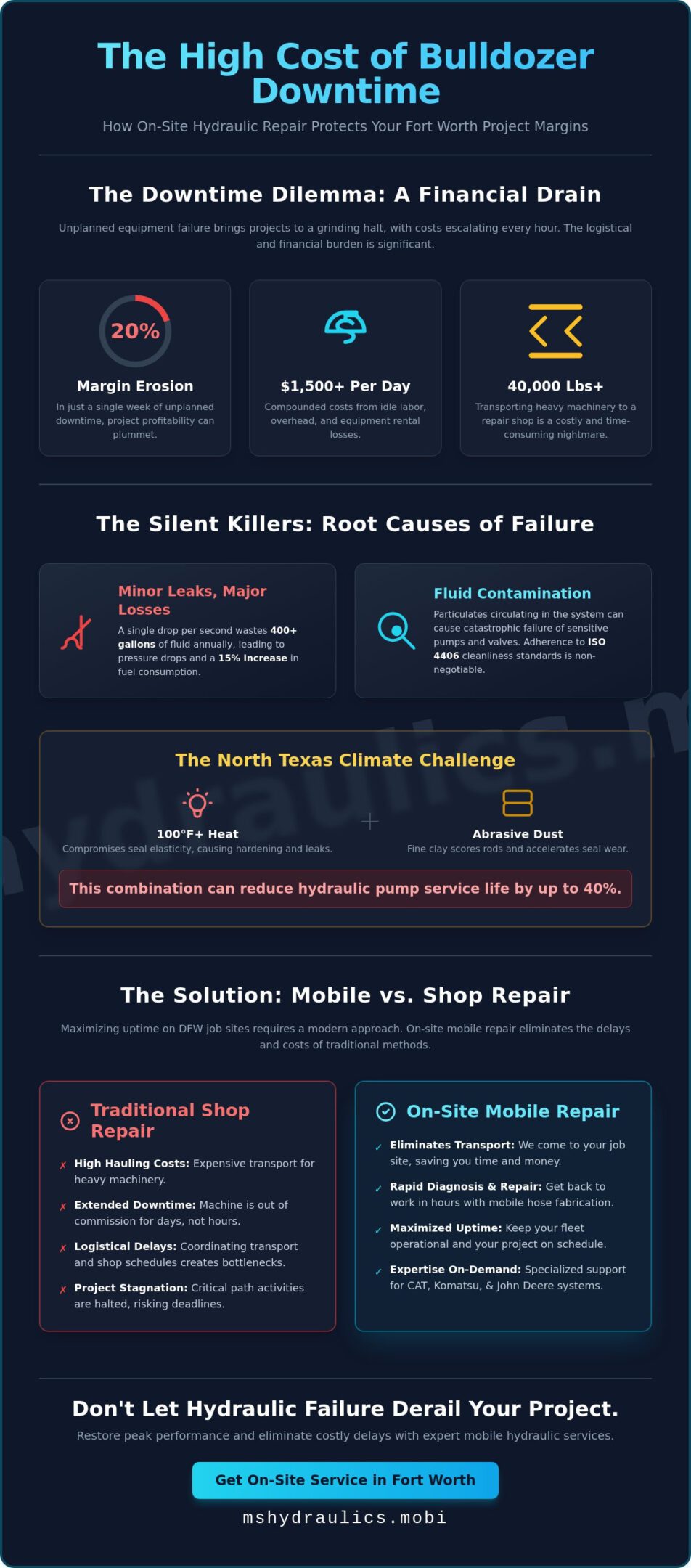
According to industry data from the Associated General Contractors of America, unplanned equipment downtime can erode project margins by 20% in a single week. When a hydraulic system loses pressure or a cylinder seal fails, the immediate halt in operations translates to measurable revenue loss every hour. For contractors managing sites in North Texas, securing reliable bulldozer hydraulic repair Fort Worth services shouldn’t involve the logistical burden of transporting a 40,000-pound machine to a distant facility. You’re likely aware that every minute a machine sits idle, your overhead continues to climb while production stagnates.
This article demonstrates how to minimize downtime through precision mobile solutions that restore your equipment to factory specifications. We’ll show you how to eliminate the risks of unreliable mechanical work and the high costs of hauling heavy-duty assets. You’ll learn about our protocols for rapid on-site diagnosis, high-pressure hose fabrication capable of withstanding 6,000 PSI, and the engineering standards we apply to ensure long-term cylinder seal reliability. We provide the technical expertise required to maintain peak hydraulic performance and ISO-aligned quality directly at your job site.
Key Takeaways
- Identify critical failure points in high-pressure systems to prevent catastrophic downtime on major Tarrant County construction projects.
- Learn how professional bulldozer hydraulic repair Fort Worth services utilize mobile hose fabrication to eliminate the logistical costs of transporting heavy machinery.
- Analyze the technical requirements of multi-function hydraulic circuits to ensure precise control over blade lift, tilt, and pitch operations.
- Master diagnostic techniques for identifying hydraulic overheating and fluid aeration to maintain peak performance in the demanding Texas climate.
- Discover the advantages of on-site technical support for CAT, Komatsu, and John Deere hydraulic systems to keep your fleet operational.
Professional Bulldozer Hydraulic Repair in Fort Worth: Solving Critical Failure Points
Bulldozer hydraulic repair in Fort Worth represents a specialized engineering discipline that demands high-pressure expertise and immediate on-site fabrication capabilities. In the high-density construction zones along the I-35 corridor and across Tarrant County, equipment availability determines project profitability. Operators cannot afford the logistical delays of transporting 50,000-pound machines to a shop when a hydraulic line fails. These systems operate under extreme pressures, often exceeding 3,000 PSI, requiring a fundamental understanding of how hydraulic systems work to diagnose faults accurately. Most failures originate from three distinct categories: fluid contamination, seal degradation, and mechanical component wear. In the competitive DFW market, where equipment rental rates can exceed $1,500 per day, every hour of bulldozer downtime compounds labor costs and pushes project completion dates. Rapid response is the only way to mitigate these overhead expenses.
The High Cost of Hydraulic Inefficiency
Minor leaks are never just cosmetic issues. A standard hydraulic leak of one drop per second results in a loss of approximately 400 gallons of fluid annually. This loss correlates directly with significant pressure drops, forcing the engine to work harder and increasing fuel consumption by up to 15%. Ignoring these symptoms risks catastrophic failure, where metal fragments from a failing pump circulate through the entire system. We adhere strictly to ISO 4406 cleanliness standards to ensure that particulate counts remain within the 18/16/13 range required for high-performance piston pumps. Maintaining these benchmarks prevents the premature destruction of sensitive control valves and cylinders. Precise pressure testing can identify these internal bypasses before they cause a total system shutdown.
Fort Worth Environmental Factors
The North Texas climate presents unique challenges for bulldozer hydraulic repair in Fort Worth and surrounding municipalities. During summer peaks exceeding 100 degrees Fahrenheit, hydraulic fluid often reaches temperatures that compromise seal elasticity, leading to hardening and eventual bypass. The local Texas Blackland Prairie soil contains high concentrations of montmorillonite clay. This fine dust acts as an abrasive, scoring hydraulic rods and accelerating seal wear during cylinder extension and retraction. The viscosity index of a fluid measures its ability to maintain a consistent flow rate despite the extreme thermal shifts common in Fort Worth summers. Proper fluid selection is critical to prevent cavitation and ensure the bulldozer maintains full breakout force during heavy excavation. Without regular inspections, the combination of heat and abrasive dust can reduce the service life of a hydraulic pump by 40%. Just as your machinery requires specialized care to survive these temperatures, you can discover Crome Mechanical for expert residential AC installation and maintenance.
Technical Analysis of Bulldozer Hydraulic Systems: From Blades to Rippers
Bulldozer efficiency relies on high-capacity variable displacement axial piston pumps. These components serve as the heart of the machine; they provide the necessary flow for complex, multi-function operations. Operators often require simultaneous blade adjustment and track steering while under full load. This demands a hydraulic circuit capable of maintaining 3,000 to 6,000 PSI without losing response time. Modern machines integrate steering clutches and brakes directly into the main hydraulic circuit. This design improves cooling and lubrication but means a single pump failure can immobilize the entire unit. When these systems fail on-site, specialized bulldozer hydraulic repair Fort Worth becomes critical to prevent extended downtime on high-stakes projects.
The engineering behind these systems includes load-sensing technology. This feature adjusts pump output based on the actual demand from the actuators. It reduces fuel consumption and heat generation. However, it adds layers of complexity to the diagnostic process. A fault in a small sensing line can mimic a total pump failure, requiring a technician with deep technical knowledge to isolate the issue.
Blade Hydraulics and Precision Grading
The blade circuit utilizes complex control valves to manage lift, tilt, and pitch functions. Precision grading requires these valves to maintain exact spool positions. If an operator notices the blade dropping slowly during operation, it’s usually a symptom of blade drift. This issue typically points to internal cylinder seal bypass or worn valve spools that no longer hold pressure. Heavy-duty pioneering work requires maximum system pressure to break through compacted soil. Conversely, finish grading relies on fine-tuned flow control to prevent over-correction. Maintaining these tolerances is vital for meeting exact project specifications in the North Texas construction sector.
The Ripper and Auxiliary Hydraulics
Rear rippers face the most extreme stresses in any bulldozer system. Ripping through the dense limestone and rocky soil common in the Fort Worth basin requires massive breakout forces. These cylinders often endure shock loads that exceed standard operating parameters. Common failure points include hydraulic hose abrasion and quick-disconnect fitting leaks caused by constant vibration and debris impact. When these heavy-duty components fail, a professional heavy equipment cylinder rebuild Texas service is necessary to restore the rod and barrel to ISO-certified standards. Ensuring the ripper circuit is operating at peak efficiency is essential for maintaining production rates in tough terrain. For technical diagnostic support or urgent field service, you can consult with our mobile technicians to schedule a system pressure test.
Mobile vs. Shop Repair: Maximizing Uptime on DFW Job Sites
Deciding between transporting a bulldozer to a service center or opting for on-site repair is a critical operational choice. For heavy machinery like the Caterpillar D8 or D10, the logistics of movement often outweigh the repair time itself. Professional bulldozer hydraulic repair Fort Worth services prioritize field-based solutions to keep projects moving without the administrative and physical burden of machine transport.
Eliminating Transport Logistics
Moving a D10 bulldozer through Tarrant County is a massive undertaking. These units often exceed 160,000 pounds, requiring specialized heavy-haul trailers and specific permits from the Texas Department of Motor Vehicles. The cost of these permits and specialized freight can be substantial. Beyond the expense, loading a non-functional dozer onto a lowboy trailer presents mechanical risks. Winching a dead machine causes significant stress on the undercarriage, leading to premature wear on pins, bushings, and track links. By utilizing mobile hydraulic repair Cleburne TX, fleet managers eliminate these risks. Our technicians service the entire southern DFW sector, arriving at the job site with the tools necessary to perform complex repairs in the dirt.
On-Site Hose Fabrication and Fitting
Hydraulic failures often stem from ruptured lines or leaking connectors. Our mobile workshops are engineered to handle the rigorous demands of 4-wire and 6-wire high-pressure hoses found on modern earthmovers. We maintain a rigorous inventory of JIC, ORFS, and Caterpillar-style XT fittings to ensure every bulldozer hydraulic repair Fort Worth meets factory specifications. Crimp-on-site technology allows our team to match the exact length and orientation of complex hose routings. This precision eliminates the need for “parts runs,” which typically stall a project for four to six hours. Instead of waiting for a delivery truck, the machine returns to work with a hose that matches the original equipment’s pressure and flow ratings.
Diagnostic Precision and Safety
Performing repairs in the equipment’s natural operating environment provides a technical advantage. Our On-Site Diagnostic Services allow us to monitor system pressures and thermal signatures while the bulldozer is under actual load. Intermittent pressure spikes or valve bypass issues often vanish in a shop setting but reappear once the blade hits the soil. Diagnosing these faults in-situ ensures that the root cause is identified and corrected. Furthermore, on-site repair is inherently safer for the crew. It removes the hazards of winching, binding, and securing unstable, heavy equipment on public roadways, keeping the focus on technical execution and mechanical reliability.
Troubleshooting Common Bulldozer Hydraulic Issues in the Texas Climate
High ambient temperatures in North Texas demand rigorous monitoring of hydraulic systems. When external temperatures exceed 100°F, hydraulic oil often reaches a critical thermal threshold. Operators should monitor the system for signs of overheating before a total shutdown occurs. If the hydraulic tank feels excessively hot or the machine’s cycle times slow down, check the oil cooler for debris. A restricted cooler can cause fluid temperatures to spike above 180°F, which leads to rapid oxidation and accelerated seal failure.
Daily inspections must include a reservoir check. Look for milky or foaming oil; this indicates aeration. Air in the system causes cavitation, a process that creates microscopic explosions within the pump, pitting the metal surfaces. It’s also vital to inspect cylinder rods for pitting or chrome damage. Even minor scratches act as conduits for dust, pulling abrasive North Texas soil into the hydraulic circuit. To verify pump health, perform a cycle time test. Measure how long the blade takes to reach full lift. If the time is 15% slower than the OEM specification, the pump isn’t reaching its rated displacement. This often necessitates professional bulldozer hydraulic repair Fort Worth services to restore system pressure and flow.
Identifying Cylinder and Seal Failure
External leaks are obvious, but internal bypass is more deceptive. If a bulldozer blade drifts downward under load, the piston seal has likely failed. Technicians use a bypass test to confirm this. They extend the cylinder fully, safely disconnect the return line, and apply pressure to the piston side. Any oil bypassing the seal and exiting the return port confirms internal failure. For equipment running in the DFW heat, we recommend high-temp Viton seals. These components maintain their durometer and sealing profile at temperatures where standard nitrile seals become brittle and fail.
Preventative Maintenance for DFW Fleets
Maintaining a strict Heavy Equipment Maintenance schedule is the only way to avoid catastrophic downtime. Scheduled Oil Sampling (SOS) provides a chemical snapshot of system health, identifying elevated iron or copper levels before a pump seizes. In high-dust regions like Alvarado or Waxahachie, standard 500-hour filter intervals are often insufficient. Reducing these intervals to 300 hours prevents fine particulates from scoring valve spools. This proactive approach ensures your fleet remains operational during peak demand cycles.
Ms. Hydraulics: Expert Mobile Hydraulic Services for Fort Worth Earthmovers
Ms. Hydraulics operates as the primary technical resource for heavy equipment fleets across North Texas. We specialize in the high-pressure hydraulic circuitry found in CAT, Komatsu, and John Deere bulldozers. Our field engineering team focuses on restoring system pressure, torque, and flow rates to original equipment manufacturer (OEM) specifications. We utilize an “Integrity First” diagnostic protocol. This engineering-led approach ensures we identify the specific failure point, whether it is a degraded piston seal or a malfunctioning control valve, rather than recommending unnecessary full-system overhauls. We prioritize safety and performance through precise component analysis and objective data.
Our expertise covers the specific load-sensing hydraulics used in modern CAT D-series machines and the closed-center load-sensing systems (CLSS) found in Komatsu earthmovers. We analyze hydraulic fluid samples on-site to check for particulate contamination that could lead to pump failure. Our technicians evaluate the pump’s displacement efficiency and the relief valve settings to ensure the system handles the heavy clay soils common in the North Texas region. This technical rigor ensures that your bulldozer hydraulic repair Fort Worth is handled with professional accuracy.
Our Service Area and Response Capabilities
We maintain a strategic presence across the DFW Metroplex to ensure rapid deployment. Our service hubs include Cleburne, Burleson, Mansfield, and Fort Worth. Every Ms. Hydraulics field technician possesses advanced qualifications in fluid power systems and mechanical tolerances. When we respond to a field call, our mobile units arrive equipped with comprehensive hydraulic parts. This mobile inventory includes high-pressure hoses, fittings, and seals. This allows for immediate on-site remediation and prevents the logistical delays associated with off-site parts sourcing. We bring the shop to your job site, ensuring that technical standards are never compromised by location.
Requesting On-Site Service
To facilitate a rapid quote and deployment, please provide our dispatch team with the machine’s model number, the observed symptoms, and the precise site location. Knowing if the issue involves a loss of blade lift capacity or a failure in the hydrostatic drive allows our engineers to prepare the necessary diagnostic tools before arrival. We’re committed to minimizing downtime through efficient field engineering and technical accuracy. Reliability is our standard, and we ensure every repair meets rigorous industrial benchmarks. Schedule your mobile bulldozer hydraulic repair with Ms. Hydraulics today.
Optimizing Hydraulic Efficiency for North Texas Earthmovers
Maintaining peak operating pressure in heavy equipment requires more than just reactive fixes; it demands a technical understanding of the entire circuit. Since 2021, Ms. Hydraulics has addressed critical failure points for local operators, ensuring that blade and ripper performance remains consistent under high-load conditions. The decision to utilize mobile services over traditional shop transport significantly reduces equipment downtime on DFW job sites. Our technicians provide specialized bulldozer hydraulic repair Fort Worth by focusing on precision engineering and immediate on-site solutions. We offer on-site high-pressure hose fabrication and specialized bulldozer cylinder rebuilds to restore system integrity right where the machine sits. This approach eliminates the logistical complexity of hauling large-scale earthmovers across North Texas. Reliability in the hydraulic industry is built on documented performance and technical certifications. You’ll find that our disciplined approach to mechanical maintenance keeps your fleet moving forward regardless of the environmental demands. Don’t let a seal failure or hose burst halt your project’s progress. It’s time to prioritize the technical health of your machinery with expert support.
Contact Ms. Hydraulics for Expert Mobile Bulldozer Repair
Frequently Asked Questions
How much does bulldozer hydraulic repair cost in Fort Worth?
The total cost for hydraulic services depends on the specific component failure and the labor hours required for system calibration. According to 2023 industry data from the Associated Equipment Distributors, labor rates for certified heavy equipment technicians are influenced by the technical complexity of the hydraulic system. We provide a detailed line-item estimate after a 50-point diagnostic inspection to ensure full transparency regarding replacement parts and technical labor.
Can you make high-pressure Caterpillar hoses on-site?
We manufacture custom Caterpillar high-pressure hoses on-site using mobile crimping units that adhere to SAE J517 standards. Our service trucks carry a 100% inventory of spiral and braided hose stock capable of withstanding pressures up to 6,000 PSI. This mobile capability ensures your bulldozer hydraulic repair Fort Worth is completed without the 4-hour delay often associated with visiting a traditional parts store. It’s the most efficient way to restore system integrity.
What are the signs that my bulldozer hydraulic pump is failing?
Increased cycle times and unusual cavitational noise are the primary indicators of a failing hydraulic pump. When internal tolerances exceed the 0.002-inch specification, you’ll notice a 20% or greater loss in lift capacity or steering response. If you detect metal shavings in the 10-micron return filter, the pump’s internal components have likely begun to disintegrate. We recommend an immediate shutdown to prevent contamination of the entire hydraulic circuit.
Do you offer emergency hydraulic repair in Arlington or Mansfield?
We provide 24/7 emergency bulldozer hydraulic repair Fort Worth services across Arlington and Mansfield. Our technicians typically respond to service calls within a 30-mile radius of our central dispatch point. We prioritize critical machine failures where a bulldozer is blocking a high-traffic construction zone or a municipal project. Each mobile unit is equipped to perform 90% of standard hydraulic repairs without requiring the machine to be transported to a shop facility.
How long does a typical bulldozer cylinder rebuild take?
A standard bulldozer cylinder rebuild typically takes between 4 and 8 hours depending on the bore size and rod condition. Replacing the seal kit and polishing the chrome rod accounts for 60% of the labor time during a standard service. If the cylinder barrel requires honing or the rod needs a complete re-chrome, the timeline extends by 3 to 5 business days. This ensures the component meets ISO 4406 cleanliness standards before re-installation.
Is it better to repair or replace a hydraulic valve?
You should repair a hydraulic valve if the internal spool and bore show less than 0.0005 inches of wear. Re-sealing a valve block is a cost-effective solution for 75% of external leaks encountered in the field. However, if the casting is cracked or the internal bores are scored, replacement is the only way to guarantee system pressure stability. A compromised valve can lead to a 15% drop in overall hydraulic system efficiency.
What hydraulic fluid is best for bulldozers operating in Texas heat?
Bulldozers operating in North Texas require an ISO VG 68 or ISO VG 100 hydraulic oil to maintain proper viscosity at temperatures exceeding 100 degrees Fahrenheit. These higher viscosity grades ensure the lubricant film doesn’t thin out when the system reaches its 180-degree operating limit. Using an oil with a high Viscosity Index of 140 or more prevents thermal breakdown during 12-hour summer shifts. It’s essential for protecting high-torque components from premature wear.