Tractor Hydraulic Troubleshooting Guide for Granbury
A single hour of idle machinery during harvest doesn’t just stall your schedule; it erodes your annual profit margin through compounding logistical delays. For operators in North Texas, the logistical nightmare of transporting heavy equipment to a service center often proves more costly than the repair itself. Mastering farm tractor hydraulic troubleshooting Granbury allows you to address inconsistent pressure or implement failure directly in the field, ensuring that technical issues don’t escalate into prolonged operational shutdowns.
You recognize that a methodical approach is required to maintain the precision of your agricultural implements. This guide provides the technical framework necessary to diagnose mechanical failures without the delays of a traditional shop visit. By following a disciplined diagnostic hierarchy, you’ll identify failure points accurately, restore system flow, and leverage mobile repair solutions to bypass unnecessary hauling costs.
The following analysis covers the critical parameters of hydraulic performance, from pump efficiency to valve functionality and cylinder seal integrity. This structured review provides the technical data needed to make informed maintenance decisions and return your equipment to peak service capacity with industrial precision.
Key Takeaways
- Establish a rigorous diagnostic hierarchy to isolate mechanical failure points and avoid the high costs of premature component replacement.
- Utilize standardized fluid analysis and thermal assessments as the baseline for farm tractor hydraulic troubleshooting Granbury to ensure accurate system evaluation.
- Detect early indicators of pump cavitation and internal valve leakage to maintain the precise pressure required for heavy implement performance.
- Adhere to strict safety protocols for relieving system pressure, which mitigates the risk of fluid injection injuries during high-pressure diagnostic procedures.
- Optimize operational efficiency by leveraging on-site diagnostic capabilities that bypass the logistical delays associated with traditional dealership service models.
Farm Tractor Hydraulic Systems: Common Failure Points in Granbury
Efficient agricultural operations depend on the mechanical integrity of a tractor’s hydraulic circuit. When performing farm tractor hydraulic troubleshooting Granbury, operators must first distinguish between gradual system degradation and acute component failure. System degradation often manifests as a reduction in response time or a failure to maintain implement height under load. These symptoms signal that the hydraulic fluid’s physical parameters or the hardware’s mechanical tolerances are no longer within operational specifications. Establishing a baseline of normal performance is essential for identifying these deviations before they result in total system collapse.
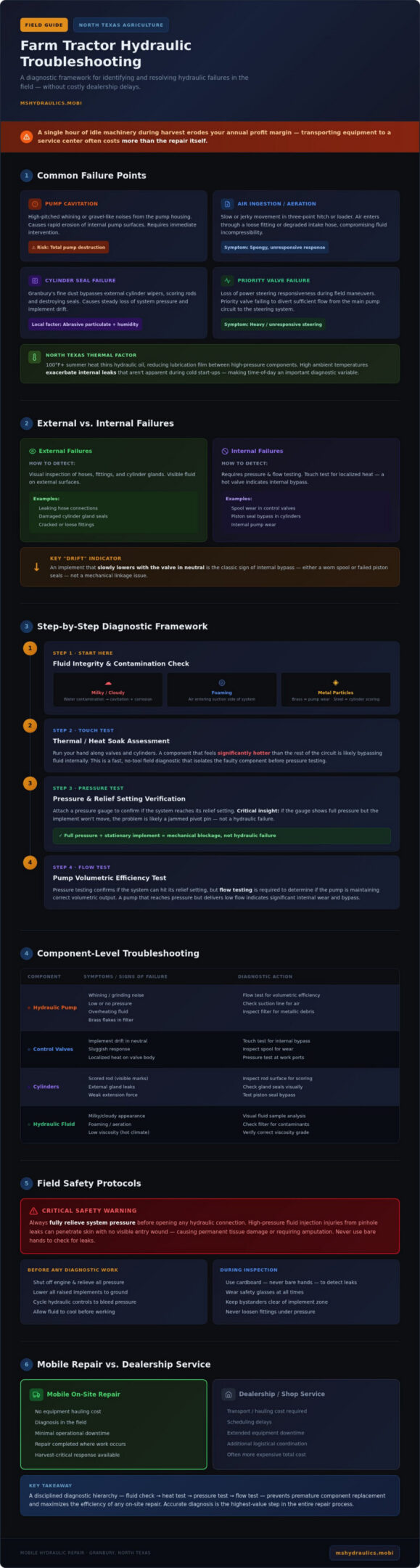
Granbury’s specific agricultural environment, characterized by fine particulate matter and variable humidity, poses a unique challenge to seal integrity. Abrasive dust can bypass external wipers on cylinders, leading to scored rods and premature seal failure. This contamination accelerates the wear of internal components, causing a steady loss of system pressure. Additionally, operators must differentiate between a mechanical blockage in the linkage and a true hydraulic pressure loss. A jammed pivot pin can mimic a weak cylinder; however, a pressure gauge will reveal that the hydraulic system is reaching its relief setting while the implement remains stationary.
Symptom Identification: Lifting and Steering Issues
Slow or “jerky” movement in the three-point hitch or front-end loader often indicates air ingestion. This occurs when the suction side of the pump pulls air through a loose fitting or a degraded intake hose. This “spongy” response is a primary indicator of aeration, which compromises fluid incompressibility. Loss of power steering responsiveness during field maneuvers suggests that the priority valve is failing to divert sufficient flow from the main pump circuit. If you hear high-pitched whining or “gravel-like” noises from the pump housing, it’s likely cavitation, a condition that causes rapid erosion of internal pump surfaces and requires immediate intervention to prevent total pump destruction.
External vs. Internal System Failures
Distinguishing between an external leak and an internal bypass is critical for accurate farm tractor hydraulic troubleshooting Granbury. External failures are verified through visual inspection of hoses, fittings, and cylinder glands. Internal failures, such as spool wear in control valves or piston seal bypass in cylinders, are more subtle. These issues often manifest as “drift,” where an implement slowly lowers despite the valve being in the neutral position. In North Texas, thermal expansion plays a significant role. High ambient temperatures decrease fluid viscosity, which can exacerbate existing internal leaks that aren’t apparent during cold start-ups. Understanding these thermal parameters allows for a more precise diagnosis of component wear levels.
Step-by-Step Diagnostic Framework for Agricultural Hydraulics
A disciplined diagnostic framework prevents the unnecessary replacement of functional components. Successful farm tractor hydraulic troubleshooting Granbury relies on a methodical elimination of variables, starting with the most accessible system parameters before moving to complex flow analysis. This approach ensures that you don’t overlook simple fluid issues that mimic expensive mechanical failures.
Fluid Integrity and Contamination Checks
Begin by extracting a fluid sample from the reservoir to check for visual anomalies. Milky or cloudy fluid indicates water contamination, which leads to pump cavitation and corrosion. Conversely, foaming suggests that air is entering the suction side of the system. Check the filter housing for metallic particulates; brass flakes usually signal pump wear, while steel shavings may indicate cylinder barrel scoring. Maintaining correct fluid viscosity is critical during 100-degree Texas summers, as excessive heat thins the oil and reduces its ability to maintain the necessary lubrication film between high-pressure components.
A secondary field check involves the ‘touch test’ to identify localized heat soak. If a specific valve or cylinder feels significantly hotter than the rest of the circuit, it’s likely bypassing fluid internally. While pressure testing confirms if the system can hit its relief setting, flow testing is required to determine if the pump can maintain that pressure under a continuous load. This distinction is vital; a pump might reach 2,500 PSI at a dead head but fail to deliver the required GPM (gallons per minute) to move a heavy implement effectively.
Pressure Gauge Integration and Testing
Integrate a calibrated pressure gauge into the auxiliary remote or the pump discharge port using high-pressure quick-connects. It’s vital to compare these live readings against the manufacturer’s OEM specifications to identify performance gaps. A significant pressure drop across a control valve often points to worn spools or a compromised relief valve seat. If the tractor’s internal systems meet specifications but the implement fails to operate, the fault lies within the external circuit. When field variables become too complex for manual testing, on-site diagnostic services provide the precision flow meters needed to isolate the fault without moving the machine.
Troubleshooting Specific Components: Pumps, Valves, and Cylinders
Isolating a failure to a specific hardware component is the most critical phase of farm tractor hydraulic troubleshooting Granbury. Once you’ve verified fluid integrity, the diagnostic focus must shift to the mechanical tolerances of the pumps, valves, and cylinders. These components operate under extreme pressures where even a few thousandths of an inch of wear can lead to a significant drop in volumetric efficiency. Understanding the specific failure modes of each part allows for targeted repairs rather than costly, wholesale system replacements.
Hydraulic Pump and Motor Diagnostics
Evaluating pump health requires measuring output against RPM performance. If the flow rate decreases as the engine speed increases, it’s a definitive sign of internal slippage caused by wear in the gear teeth or vane tips. Another frequent failure point is the pump shaft seal. When this seal degrades, it often allows air to be drawn into the suction side of the system, causing aeration without any visible external oil leaks. If the pump is delivering adequate flow but the system still lacks lifting force, it’s often more cost-effective to prioritize a heavy equipment cylinder rebuild Texas before assuming the pump has reached its end of life.
Control valves are equally susceptible to wear, specifically “spool wear.” This occurs when the hard plating on the valve spool erodes, allowing high-pressure fluid to bypass the seals and return to the reservoir. This internal leakage is a primary cause of “spool drift,” where an implement fails to hold its position. Identifying this requires a steady hand and precise temperature monitoring, as the bypass point will generate localized heat that is detectable during a sustained load test.
Cylinder Performance and Seal Integrity
Hydraulic cylinders are the primary workhorses of the tractor, and their failure is usually indicated by “drift” or external leakage at the rod gland. Rod scoring is a particularly destructive issue; these physical scratches act as an abrasive file, destroying new seals within hours of operation. To determine if a cylinder is bypassing internally, you must isolate the circuit and check for fluid movement across the piston seal while the valve is in a neutral position. Because these internal failures aren’t always visible, professional On-Site Diagnostic Services are essential for pinpointing the exact bypass location without the need for complete component teardown.
Finally, the role of custom hose fabrication shouldn’t be overlooked. A collapsed internal liner in a hydraulic hose can act as a one-way check valve, restricting flow and mimicking a pump failure. Ensuring that every hose is fabricated to meet the specific GPM and PSI requirements of the tractor is the final step in restoring full system performance and preventing future pressure bottlenecks.
Field Safety and Preventative Maintenance Protocols
Technical procedures for farm tractor hydraulic troubleshooting Granbury must prioritize operator safety above all other operational goals. High-pressure hydraulic systems store immense potential energy that can be lethal if released uncontrollably. The fundamental protocol, often referred to as the “Golden Rule,” is the complete relief of system pressure before any fitting is loosened or component is inspected. This involves cycling the control valves with the engine off until all implement movement ceases and the accumulators are discharged.
Fluid injection injuries represent the most significant risk during field diagnostics. These occur when a high-velocity stream of oil penetrates the skin, often leading to severe tissue necrosis. These leaks are frequently invisible to the naked eye and can occur at pressures as low as 100 PSI. Operators should always use a piece of cardboard or wood to scan for pinhole leaks rather than their hands. If an injury occurs, immediate surgical intervention is required, as the internal chemical damage is far more extensive than the external puncture suggests.
Hydraulic Safety in the Field
Mechanical lockouts are mandatory before inspecting cylinders or hoses. Never rely on the hydraulic circuit alone to hold an implement aloft during troubleshooting; use jack stands or cylinder stops to secure the load. Additionally, managing fluid temperature is critical. Hydraulic oil can reach temperatures exceeding 180 degrees Fahrenheit, posing a significant burn risk. Wait for the system to cool before extracting samples or replacing hydraulic parts to ensure thermal stability and operator protection during the procedure.
Granbury-Specific Maintenance Needs
The environmental conditions in North Texas necessitate an aggressive maintenance schedule. High-dust environments, common during Granbury harvests, rapidly saturate hydraulic filters, which can force the system into bypass mode and introduce contaminants directly into sensitive valves. Adhering to a rigorous Heavy Equipment Maintenance program is essential for machinery operating in abrasive North Texas soil types. These soils can accelerate rod scoring and seal degradation if wipers aren’t maintained. Regularly monitor hose abrasion points on articulating machinery where constant movement against dry, dusty surfaces can wear through protective outer jackets.
If your field diagnostics reveal a failure that requires specialized tools or high-pressure hose replacement, professional Mobile Hydraulic Repair ensures your tractor is restored to OEM specifications without the need for costly equipment transport.
Professional Mobile Hydraulic Repair Services in Granbury
While the technical hierarchy of farm tractor hydraulic troubleshooting Granbury allows operators to identify basic system deviations, executing a definitive repair requires specialized precision tools and diagnostic instrumentation. Traditional dealership service models often impose significant delays and the logistical burden of transporting heavy machinery. Mobile repair services bypass these obstacles by bringing a fully equipped laboratory and machine shop directly to the field. This ensures that technical verification occurs under the actual working conditions of the machinery, leading to a more accurate assessment of mechanical failure points.
Mobile Diagnostic Advantages
Eliminating the logistical cost of tractor transport is the most immediate operational gain. Hauling heavy agricultural equipment in North Texas often requires specialized trailers and permits, adding hidden expenses and time to the repair process. More importantly, mobile diagnostics allow for the real-world testing of hydraulic circuits under actual loads. A pump may show adequate pressure in a static shop setting but fail when subjected to the specific resistance of regional soil. Utilizing mobile hydraulic repair Cleburne TX ensures that technical data is gathered in the exact environment where the failure occurs.
Our mobile units feature calibrated flow meters and high-pressure transducers capable of isolating faults within complex hydrostatic drives and open-center systems. This level of technical capability allows for the precise measurement of volumetric efficiency in pumps and motors. By pinpointing the specific location of internal leakage, we avoid the inefficient “parts replacement” strategy often seen in generalist shops. This technical depth is essential for Granbury farms where machinery must maintain peak performance during narrow seasonal windows.
The Ms. Hydraulics LLC Commitment to Integrity
Ms. Hydraulics LLC operates with a focus on technical transparency and engineering-led solutions. We prioritize data-driven assessments, opting to rebuild components like cylinders and valves whenever the mechanical tolerances allow for restoration. This philosophy extends to our on-site hose fabrication capabilities. We eliminate the delays of parts-ordering cycles by manufacturing custom hoses on the spot, ensuring each assembly meets the exact GPM and PSI requirements of your machinery. Whether you require heavy equipment maintenance or an emergency service call for a critical failure, our focus remains on restoring operational efficiency with industrial accuracy and professional integrity.
Optimizing Agricultural Uptime with Technical Precision
A disciplined approach to maintenance ensures that small performance deviations don’t escalate into catastrophic system failures. By implementing a rigorous diagnostic hierarchy, you can effectively isolate component wear and maintain the volumetric efficiency of your hydraulic circuits. Accurate farm tractor hydraulic troubleshooting Granbury requires a combination of field-level observations and specialized technical verification to bypass the high costs of equipment transport and dealership downtime.
Ms. Hydraulics LLC provides the engineering expertise necessary to restore your machinery directly in the field. Our mobile units deliver precision on-site diagnostics and custom hose fabrication, ensuring that your hydraulic parameters meet OEM specifications without logistical delays. We prioritize integrity-driven cylinder rebuilds and pump repairs that focus on restoring existing hardware whenever technically feasible.
Ready to minimize downtime? Request Mobile Hydraulic Repair in Granbury to secure expert technical support for your agricultural operations. Maintaining the mechanical integrity of your fleet ensures long-term reliability and peak field performance.
Frequently Asked Questions
What are the first signs of hydraulic pump failure on a tractor?
The initial indicators of pump failure often include audible cavitation and a measurable decrease in volumetric efficiency as engine RPMs increase. As internal components wear, mechanical friction generates excessive heat, making the pump housing significantly hotter than the rest of the circuit. This thermal increase is a critical marker in farm tractor hydraulic troubleshooting Granbury, signaling that the pump can no longer maintain the pressure required for heavy implement operation. Early detection prevents the distribution of metallic debris through the entire system.
Can I repair a leaking hydraulic hose myself in the field?
Attempting to patch a high-pressure hydraulic hose in the field is not recommended due to the extreme risk of catastrophic failure and fluid injection injuries. Standard field patches cannot withstand the thousands of PSI generated during agricultural operations. Ms. Hydraulics LLC provides specialized mobile units that perform custom hose fabrication on-site. This ensures that every replacement hose meets the specific GPM and PSI requirements of your tractor, maintaining a level of safety and reliability that manual field repairs cannot achieve.
How do I bleed air out of my tractor’s hydraulic system?
To purge air from a tractor’s hydraulic circuit, you must cycle all cylinders and implements through their full range of motion several times. This process allows trapped air to migrate back to the reservoir, where it can be vented from the fluid. It’s essential to monitor the reservoir level throughout this procedure; if the fluid level drops too low, the pump may draw in additional air. Most modern agricultural systems are self-purging, provided that the suction side of the system is completely airtight.
Why is my tractor’s hydraulic fluid turning milky or white?
Hydraulic fluid that appears milky or white indicates significant water contamination. When moisture enters the reservoir, it emulsifies with the oil under high pressure, which severely compromises the fluid’s lubricity and incompressibility. This contamination leads to rapid oxidation and corrosion of internal valve spools and pump surfaces. Resolving this issue requires a comprehensive system flush and the replacement of all filters to ensure that the mechanical tolerances of your hydraulic components are protected from moisture-induced wear.
Is it safe to use a tractor if the hydraulics are sluggish?
Operating a tractor with sluggish hydraulic response is unsafe and can lead to more expensive mechanical failures. Slow movement usually indicates low system pressure, internal bypass, or severe aeration. Continued operation in this state forces the pump to work harder, which can lead to pump seizure or internal scoring of the cylinder barrels. It’s more efficient to pause operations and conduct a technical diagnostic check rather than risking a total system collapse during a critical agricultural window.
What is the difference between a hydraulic rebuild and a replacement?
A hydraulic rebuild involves disassembling the unit to replace seals, gaskets, and specific worn internals while retaining the original high-value housing. Replacement involves installing an entirely new component assembly. Ms. Hydraulics LLC prioritizes rebuilds when the mechanical tolerances of the housing remain within engineering specifications. This approach provides an integrity-driven restoration of system performance while significantly reducing the total cost of repair compared to the wholesale replacement of functional hardware.
How often should I change hydraulic filters in Granbury’s dusty conditions?
The fine particulate matter common in North Texas environments necessitates more frequent filter changes than standard OEM intervals suggest. Abrasive dust can saturate filters rapidly, potentially forcing the system into bypass mode and allowing contaminants to enter the sensitive control valves. We recommend monitoring your system’s pressure-drop indicators and performing filter replacements more aggressively during harvest or tilling seasons. This preventative measure is a fundamental part of farm tractor hydraulic troubleshooting Granbury to ensure long-term component health.
Do you provide mobile hydraulic services directly to farms in Granbury?
Yes, Ms. Hydraulics LLC provides specialized mobile hydraulic repair and on-site diagnostic services directly to agricultural operations throughout the Granbury area. Our technicians arrive with the instrumentation needed to isolate pressure and flow issues without the need for equipment transport. By performing repairs in the field, we eliminate the logistical nightmare of hauling heavy machinery to a shop and minimize your operational downtime. This mobile capability allows for real-world testing under the actual load conditions of your farm.