Certified Dielectric Testing in Cleburne & Fort Worth
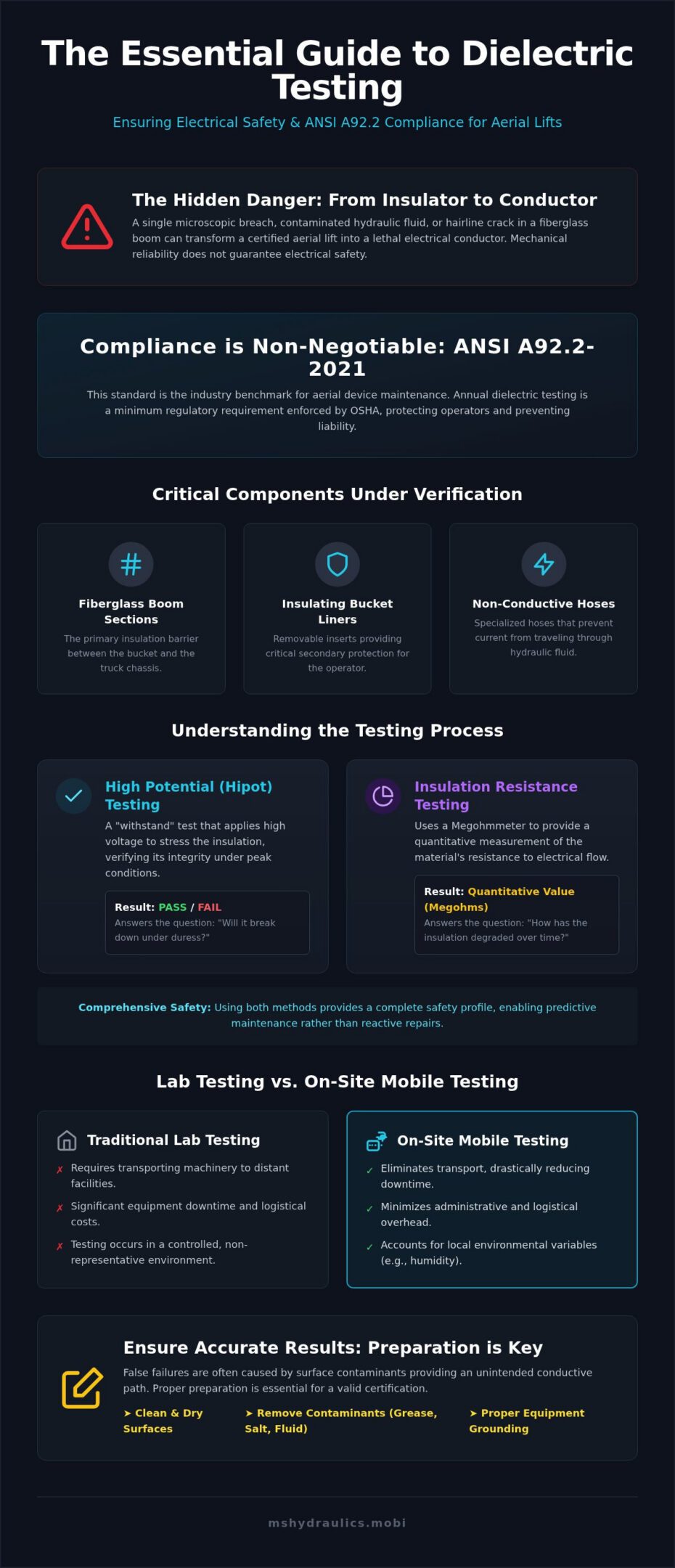
A single microscopic breach in the fiberglass boom or a trace amount of contaminated hydraulic fluid can transform a certified aerial lift into a lethal conductor. For fleet managers in Cleburne and Fort Worth, the reality remains that mechanical reliability doesn’t automatically guarantee electrical insulation. Rigorous dielectric testing serves as the definitive verification of equipment integrity, ensuring that your secondary insulation systems withstand specified voltage thresholds without excessive leakage current. You shouldn’t have to risk catastrophic failure or liability because of administrative confusion or logistical delays.
We understand the pressure of maintaining full compliance with the ANSI A92.2-2021 standards while managing a demanding project schedule in North Texas. This guide will help you master the technical requirements and safety protocols of dielectric testing to ensure your aerial equipment remains compliant and your operators stay protected. We’ll analyze the critical intersection of hydraulic maintenance and electrical safety, providing the data-driven clarity needed to verify equipment performance and eliminate the downtime caused by transporting machinery to distant testing facilities.
Key Takeaways
- Master the specific requirements of ANSI A92.2-2021 to ensure your North Texas fleet remains compliant with mandatory annual safety standards for Category A and B aerial lifts.
- Understand the technical parameters of Hipot and leakage current measurements to accurately verify the dielectric strength of your equipment’s insulating components.
- Identify why routine dielectric testing is a critical diagnostic for detecting hidden hydraulic fluid contamination or boom degradation before catastrophic failure occurs.
- Compare the logistical advantages of on-site mobile testing against traditional lab diagnostics to minimize equipment downtime and account for local environmental variables.
- Learn how to properly prepare boom surfaces and ground equipment to eliminate false failures and ensure precise verification of electrical integrity.
Fundamentals of Dielectric Testing in Heavy Equipment
Dielectric strength represents the maximum electric field a specific material can withstand before its molecular structure breaks down and allows electrical conduction. In the context of heavy machinery, this value determines the safety envelope for operators working near high-voltage lines. Materials like fiberglass and specialized polymers are selected for their high dielectric strength, yet their performance isn’t static. Environmental exposure, mechanical stress, and chemical contamination can reduce this strength over time, turning a safe barrier into a potential conductor.
Regular dielectric testing identifies microscopic failures that are invisible to the naked eye. Moisture ingress within fiberglass pores or hairline fractures in an insulating liner can create tracking paths for electricity. By subjecting these components to controlled electrical stress, technicians can verify that the equipment maintains its original engineering specifications. This process is the only reliable method to ensure that an aerial device remains a safe insulator rather than a path to ground.
Hipot Testing vs. Insulation Resistance
Understanding the distinction between high potential (Hipot) testing and insulation resistance testing is vital for fleet compliance. The Fundamentals of Dielectric Testing involve a “withstand” methodology where a high-voltage load is applied to the component for a specific duration. This test stresses the insulation barrier to ensure it won’t fail under peak operating conditions. It’s a pass or fail verification of the material’s integrity under duress.
In contrast, insulation resistance testing utilizes a Megohmmeter to provide a quantitative measurement of the material’s resistance. While Hipot testing proves the material won’t break down, resistance testing helps track the gradual degradation of the insulator over several years. Utilizing both methods provides a comprehensive safety profile, allowing for predictive maintenance rather than reactive repairs following a field incident.
Key Components Requiring Testing
Several critical assemblies on an aerial device must undergo periodic verification to meet safety standards. These include:
- Fiberglass Boom Sections: The primary insulation between the bucket and the truck chassis.
- Insulating Liners: Removable bucket inserts that provide secondary protection for the operator.
- Non-Conductive Hydraulic Hoses: Specialized hydraulic hose fabrication is required for these lines to prevent current from traveling through the fluid or the hose reinforcement.
Each component must be clean and dry before testing. Surface contaminants like road salt, grease, or hydraulic fluid can cause false failures during the verification process by providing a conductive path across the exterior of the insulator. Precise cleaning and inspection are prerequisite steps for any valid certification.
ANSI A92.2 and OSHA Compliance for North Texas Operators
ANSI/SAIA A92.2-2021 stands as the industry benchmark for the design and maintenance of aerial devices. While ANSI is a consensus standard, it carries regulatory weight through OSHA’s “General Duty Clause” and specific mandates. For utility and construction firms operating in the DFW metroplex, annual dielectric testing is the minimum regulatory threshold. Skipping these inspections doesn’t just endanger operators; it creates a documented trail of negligence. If a catastrophic electrical event occurs, the absence of a current certification will likely lead to maximum OSHA fines and increased insurance premiums.
Maintaining OSHA Compliance for North Texas Operators involves more than just a visual check. It requires a technical verification that the insulating components still meet their original factory ratings. Environmental stressors like the extreme North Texas heat can accelerate the degradation of fiberglass resins, making the annual requirement a critical safety barrier. Consistent verification ensures that your fleet remains legally compliant and mechanically sound for high-voltage operations.
Category A vs. Category B Aerial Devices
The ANSI A92.2 standard classifies equipment based on its intended electrical protection level. Category A devices are engineered for high-voltage environments where the boom acts as the primary insulation. These units undergo the most rigorous dielectric testing, often at higher voltages with lower tolerance for leakage. Category B devices provide secondary protection, typically used in standard utility work where operators rely on additional protective equipment like rubber gloves and sleeves. While the testing requirements differ, both categories require verified performance to remain in service. Failure to distinguish between these categories during testing can lead to inadequate protection for your specific job site hazards.
Documentation and Record Keeping
Documentation is the primary evidence of your safety program’s efficacy. A certified dielectric test report must include the machine’s serial number, the test date, the specific voltage applied, and the measured leakage current in microamperes. Generic “pass” stickers are insufficient for OSHA audit readiness. You should maintain these serial-number-specific records for the life of the equipment or a minimum of five years. This methodical tracking allows you to identify trends in insulation degradation across your fleet. Integrating these safety verifications with your heavy equipment maintenance ensures that mechanical and electrical integrity are managed simultaneously, reducing the risk of unexpected downtime.
Lab Testing vs. On-Site Mobile Dielectric Testing
Transporting heavy equipment like drill rigs or bucket trucks to a fixed laboratory facility presents a significant logistical burden for North Texas operators. Moving specialized machinery from a Cleburne job site to a distant lab involves substantial fuel costs, specialized transport labor, and prolonged periods of non-productivity. Beyond the direct expenses, the equipment stays idle in a laboratory queue, often for several days. Mobile verification addresses these inefficiencies by bringing calibrated equipment directly to the job site or fleet yard, ensuring that safety verifications don’t interrupt critical project timelines.
Environmental variables in the DFW metroplex also play a role in testing accuracy. Fixed labs operate in climate-controlled spaces, which may mask issues that only appear under the stress of local conditions. High humidity levels and extreme heat can affect surface conductivity on fiberglass booms. Conducting dielectric testing in the field provides a realistic assessment of the machine’s insulating properties under actual working conditions. This field-first approach aligns with the requirements for ANSI A92.2 Compliance, which emphasizes the need for verified safety protocols throughout the equipment’s operational life.
The Advantages of Mobile Diagnostics in Cleburne
Mobile testing maximizes fleet availability by eliminating the transit window. When a technician performs dielectric testing on-site, the results are immediate. This real-time feedback is invaluable for troubleshooting. For instance, an unexpected failure during a leakage test often stems from surface contamination rather than structural degradation. Having immediate access to On-Site Diagnostic Services allows a technician to identify if a hydraulic leak is creating a conductive path across the boom. Addressing these mechanical issues on the spot prevents the machine from being red-tagged and sent back to the shop for minor repairs.
When Lab Testing is Preferable
While mobile testing is the standard for annual fleet certifications, laboratory environments remain necessary for specific engineering tasks. During a comprehensive heavy equipment cylinder rebuild, technicians may require component-level testing that isn’t feasible in the field. Laboratories provide the high-precision equipment needed to verify new insulating materials before they are integrated into a machine. Additionally, if an electrical accident occurs, a fixed lab is the appropriate setting for deep forensic analysis to determine the exact point of insulation breakdown without the interference of external environmental factors.
The Technical Process of Hipot and Leakage Testing
The technical execution of dielectric testing requires a methodical sequence to ensure data accuracy and personnel safety. It begins with rigorous physical preparation. Any foreign material on the insulating surface acts as a shunt, allowing current to bypass the dielectric barrier. Following cleaning, technicians attach electrodes to the boom and secure grounding straps to the chassis. This configuration ensures that any leakage current is captured and measured by the testing unit rather than dissipating into the environment. Digital high-potential testers provide precise control over the electrical gradient, allowing for a steady voltage ramp-up that follows manufacturer-specific parameters.
During the ramp-up phase, the technician monitors the leakage current in real-time. The goal is to reach the rated test voltage without a “flashover” or a total insulation breakdown. Flashover occurs when the electrical charge travels across the exterior surface of the boom, while breakdown indicates the current has punctured through the material itself. Both events signify a failure of the insulation system. Modern digital equipment allows for the detection of minute fluctuations that indicate an impending failure, providing a safety margin that older analog systems lacked. If your equipment fails to maintain these electrical parameters, our team provides comprehensive heavy equipment maintenance to identify if mechanical degradation or hydraulic contamination is the root cause.
Cleaning and Environmental Preparation
Visual inspection must always precede electrical stress. Technicians look for fiberglass blooming, deep gouges, or signs of UV degradation. Road grime, salt, and hydraulic oil are particularly hazardous because they are highly conductive. These contaminants must be removed using approved non-conductive solvents before the test begins. In North Texas, relative humidity significantly impacts air gap insulation. High moisture content in the air can lead to surface flashover at lower voltages than the material’s rated capacity. Testing should only occur when environmental conditions fall within the calibrated range of the testing equipment to avoid false failures.
Interpreting Leakage Current
Once the specified voltage is reached, the focus shifts to the microampere readings. For a standard 46kV test on a Category B device, the allowable leakage current is strictly defined by the manufacturer and ANSI standards. Technicians must distinguish between capacitive leakage and resistive leakage. Capacitive leakage is a natural byproduct of the alternating current test environment and is usually stable. Resistive leakage indicates that the insulation material itself is starting to conduct. Sudden spikes or erratic readings often signal internal insulation tracking. This phenomenon occurs when carbonized paths form inside the fiberglass structure. These paths are irreversible and typically necessitate immediate boom replacement to prevent a lethal equipment failure.
Integrating Dielectric Safety into Your Maintenance Strategy
Dielectric failure rarely occurs as an isolated event; it’s typically the final symptom of a broader breakdown in equipment upkeep. When an aerial device fails a safety verification, the root cause often lies within the hydraulic system. Contamination, specifically the accumulation of metallic wear particles or water ingress, significantly reduces the insulating properties of the entire assembly. Integrating dielectric testing into a comprehensive 12-month preventative maintenance calendar ensures that these issues are identified before they compromise operator safety. For North Texas fleets, this schedule should prioritize quarterly visual boom inspections and semi-annual fluid analysis to maintain the integrity of the insulation barrier.
The selection of components plays a decisive role in the machine’s electrical safety profile. Standard hydraulic lines often contain steel wire reinforcement which acts as a primary conductor. In contrast, specialized hydraulic hose fabrication for aerial lifts utilizes synthetic fiber reinforcements to maintain a non-conductive path. These hoses are engineered to resist electrical tracking even when subjected to high-pressure cycles. Replacing these critical parts with non-compliant alternatives during routine repairs is a common cause of test failures and job site accidents.
Hydraulic Fluid and Dielectric Integrity
Contaminated hydraulic oil is a potent conductor. As internal components like pumps or valves wear down, they release microscopic metallic shards into the fluid stream. These particles create a bridge for electrical current to travel across the insulated sections of the boom. Rigorous heavy equipment maintenance protocols must include regular oil purity checks to prevent this degradation. Testing the dielectric strength of the fluid itself serves as an excellent precursor to the full boom test. If the oil fails to meet the minimum kilovolt-per-millimeter threshold, the boom’s overall insulation rating will inevitably be compromised regardless of the fiberglass condition.
Choosing the Right Service Partner in DFW
A reliable service partner in the Cleburne and Fort Worth area must possess a dual expertise in both hydraulic systems and electrical safety standards. A provider who only understands the electrical parameters might red-tag a machine without being able to diagnose the underlying mechanical fault. The primary value of a qualified technician is the ability to provide mobile hydraulic repair immediately following a failed test. This integrated approach ensures that your machinery isn’t only tested but restored to a compliant state with minimal interruption to your operations. Always verify that your provider utilizes calibrated equipment for dielectric testing that meets current national certification standards.
Securing Your Fleet’s Electrical Integrity
Maintaining a compliant aerial fleet requires a methodical approach that bridges the gap between mechanical performance and electrical safety. The transition to the ANSI A92.2-2021 standard necessitates rigorous verification of insulating components to prevent catastrophic field failures. By prioritizing routine dielectric testing, you protect your operators from high-voltage hazards and ensure your North Texas operations remain audit-ready for OSHA inspections. Documented safety protocols are the foundation of a reliable industrial enterprise.
Success in these safety verifications depends on more than just the fiberglass boom; it requires a focus on hydraulic fluid purity and the use of verified non-conductive components. Our on-site mobile technicians across Cleburne and the DFW metroplex provide specialized expertise in heavy equipment hydraulic systems to ensure your machinery meets all safety thresholds. We focus on minimizing operational downtime by integrating immediate repairs with technical safety diagnostics. You don’t have to sacrifice productivity for compliance when your maintenance strategy is built on engineering precision.
Take the next step in securing your operations today. Request an On-Site Diagnostic and Safety Consultation to verify your equipment’s integrity and maintain peak performance on every job site.
Frequently Asked Questions
What is the difference between dielectric strength and dielectric withstand testing?
Dielectric strength is an inherent material property while dielectric withstand testing is the protocol used to verify that property in a specific machine. During a withstand test, a high-voltage load is applied to ensure the insulation barrier maintains its integrity without failure. This verification is critical for aerial equipment in Cleburne to confirm that fiberglass components meet the required safety thresholds under extreme operational stress.
How often does OSHA require dielectric testing for bucket trucks?
OSHA requires annual dielectric testing for Category A and B aerial lifts to maintain compliance with federal safety standards. This requirement aligns with ANSI A92.2-2021 guidelines, which mandate periodic verification of the machine’s insulating properties. For operators in the Fort Worth area, keeping these certifications current is essential to avoid regulatory fines and ensure the safety of personnel working near high-voltage lines. Frequent inspections identify degradation before failure.
Can dirty hydraulic oil cause a dielectric test failure?
Contaminated hydraulic oil is a frequent cause of failed tests because metallic wear particles and moisture create a conductive path through the system. These contaminants allow electricity to bypass the non-conductive components of the boom. Regular fluid analysis and heavy equipment maintenance are necessary to ensure oil purity remains within specified limits. If the fluid’s dielectric strength is compromised, the entire aerial device will likely fail its electrical safety certification.
Is AC or DC testing better for aerial lift booms?
Both AC and DC testing methodologies are technically valid, though AC testing is traditionally used for most aerial lift booms to simulate real-world utility line conditions. The choice often depends on the manufacturer’s specifications and the specific application of the equipment. Modern digital testers can perform both, but technicians must ensure the voltage levels are correctly adjusted for the specific test type to avoid damaging the insulating materials during the verification process.
What should I do if my equipment fails a dielectric test on-site?
You must immediately remove the equipment from service and red-tag it to prevent unauthorized use following a failed test. The next step involves a thorough visual inspection and cleaning to eliminate surface contamination as a cause. If the failure persists, a technician should evaluate the hydraulic system for leaks or fluid contamination. Our mobile repair teams in Cleburne can often diagnose and resolve these mechanical issues on-site to facilitate a successful retest.
Does dielectric testing damage the fiberglass boom or hydraulic seals?
Properly executed testing doesn’t damage fiberglass booms or hydraulic seals when performed within the manufacturer’s rated voltage parameters. The test is designed to stress the insulation barrier without reaching the point of physical breakdown. However, if the insulation is already compromised by internal tracking or microscopic cracks, the test will identify these existing failures. Using calibrated equipment ensures that the applied voltage remains within safe engineering limits throughout the procedure.
How long does a standard dielectric test take to complete?
A standard dielectric testing session typically requires one to two hours to complete, including the necessary preparation and cleaning of the boom surfaces. This timeframe allows for a controlled voltage ramp-up and a sustained period of monitoring for leakage current. On-site mobile testing in the DFW area minimizes total downtime because it eliminates transit time to a laboratory facility. Precise documentation of the results is completed immediately following the test.
Can I perform dielectric testing myself with a megohmmeter?
You can’t perform a full dielectric withstand test using only a standard megohmmeter because it lacks the high-voltage capacity required for Hipot verification. While a megohmmeter measures insulation resistance, it doesn’t provide the high potential stress needed to confirm a withstand rating under ANSI A92.2 standards. Certified testing requires specialized high-voltage equipment and qualified technicians who understand the technical parameters of leakage current and flashover prevention for heavy machinery.