Bucket Testing for Safety: DFW Aerial Lift Guide
Did you know that an OSHA citation for electrical safety non-compliance now starts at $16,131 per instance? For fleet managers across North Texas, this figure is a stark reminder that technical oversight in bucket testing for safety can lead to catastrophic consequences. You likely understand that maintaining a fleet of aerial lifts requires more than just basic fluid checks. The complexity of balancing dielectric integrity with mechanical structural health often creates a confusing landscape of compliance requirements and technical standards.
This guide clarifies the rigorous standards of dielectric and structural testing, ensuring your equipment meets ANSI A92.2 specifications while maximizing hydraulic reliability. By mastering these technical requirements, you can protect your operators from electrical hazards and prevent the structural failures that lead to costly job site accidents. We’ll examine the critical distinctions between testing types, the mandatory 12-month dielectric testing cycle, and the mobile preventative maintenance strategies that eliminate unnecessary downtime in Cleburne and the greater DFW area. We’ll also look at how expert hydraulic cylinder rebuilds and hose fabrication contribute to a zero-incident safety culture.
Key Takeaways
- Understand the 2026 regulatory framework for ANSI A92.2 and OSHA 1926.453 to ensure full compliance for vehicle-mounted elevating devices.
- Learn the technical preparation required for dielectric bucket testing for safety, specifically focusing on the removal of conductive contaminants and liner inspections.
- Identify mechanical vulnerabilities in excavator buckets by systematically checking pins, bushings, and weldments for signs of structural fatigue.
- Discover how mobile hydraulic diagnostics and on-site cylinder rebuilds minimize downtime while resolving safety inspection failures in the DFW area.
- Recognize the critical link between hydraulic hose integrity and operator safety to prevent catastrophic mechanical failures during high-reach operations.
Defining Bucket Testing for Aerial and Heavy Equipment
Bucket testing is a comprehensive verification protocol designed to assess the operational integrity of an Aerial Work Platform. It involves rigorous diagnostic procedures to ensure that the equipment protects the operator from electrical discharge while maintaining structural load-bearing capacity. For contractors in the DFW area, bucket testing for safety is a regulatory necessity that mitigates the risk of catastrophic mechanical failure and ensures compliance with federal oversight. Effective testing isn’t merely a checklist; it’s a technical audit of the vehicle’s electrical insulation and mechanical stability.
In the North Texas industrial sector, the reliability of hydraulic systems remains central to these inspections. A bucket’s safety is inextricably linked to the health of its hydraulic cylinders and hoses. If a hydraulic seal fails or a hose ruptures under load, even a dielectrically sound boom becomes a liability. Maintaining these components through precise hydraulic cylinder rebuilds and expert hose fabrication is the foundation of a successful safety program. Proactive maintenance ensures that the mechanical infrastructure can support the rigors of high-reach tasks without compromising technician safety.
Dielectric vs. Structural Testing
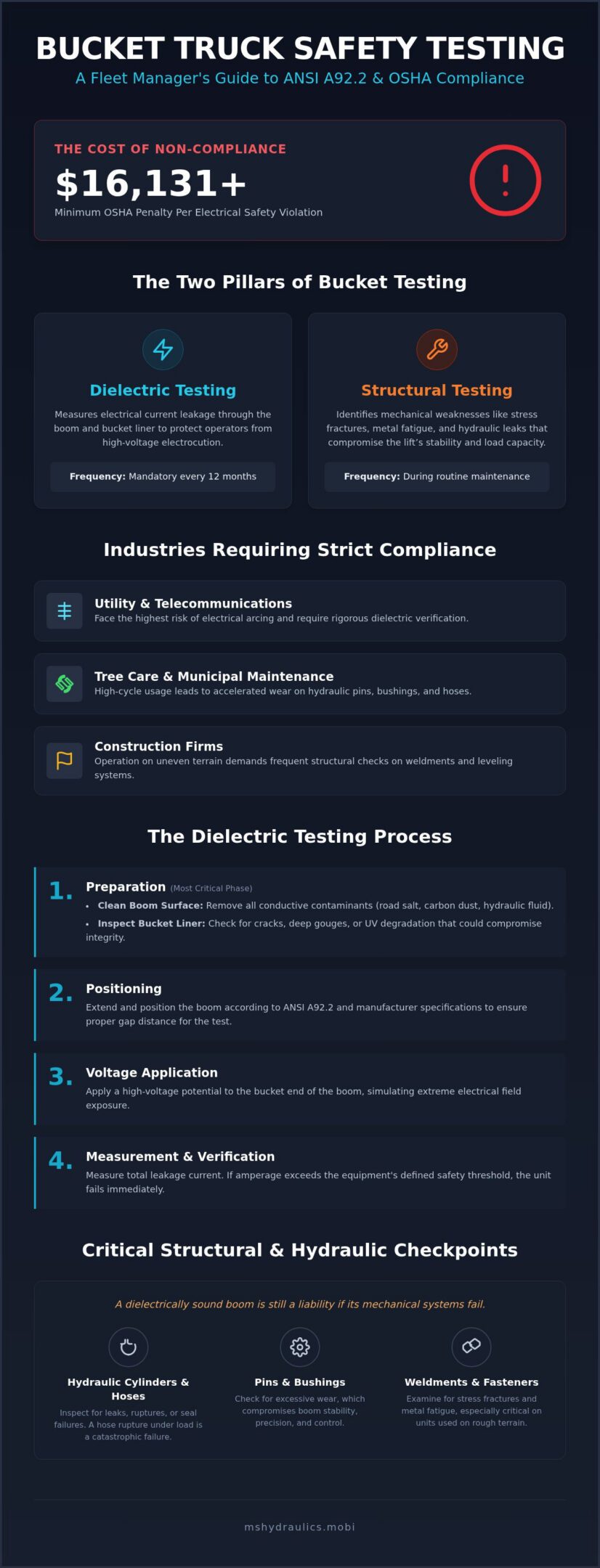
Dielectric testing specifically measures the amount of electrical current leakage through the boom and bucket liners. This process verifies that the non-conductive materials can withstand high-voltage exposure without endangering the technician. In contrast, structural testing focuses on the mechanical assembly. It identifies stress fractures, metal fatigue, and hydraulic leaks that could compromise the lift’s stability. While dielectric tests are mandated annually by ANSI A92.2, structural assessments should occur during routine maintenance cycles or after the equipment has been subjected to extreme stress or environmental conditions.
Who Needs Periodic Bucket Inspections?
Any organization operating vehicle-mounted elevating devices must implement a structured testing schedule. This is particularly critical for the following sectors:
- Utility and Telecommunications: These teams face the highest risk of electrical arcing and require strict dielectric verification.
- Tree Care and Municipal Maintenance: High-cycle usage in these industries leads to accelerated wear on hydraulic pins and bushings.
- Construction Firms: Platforms used on uneven terrain require frequent structural checks to ensure the leveling systems and boom weldments remain intact.
Ignoring these requirements often leads to equipment downtime or severe OSHA penalties. Proactive bucket testing for safety allows fleet managers in Cleburne and Fort Worth to identify hydraulic vulnerabilities before they escalate into job site accidents.
Dielectric Testing Procedures for Hydraulic Bucket Trucks
Dielectric testing is a precision-based verification process that ensures the insulating components of a bucket truck function as an effective barrier against high-voltage electricity. Preparation is the most critical phase. Technicians must thoroughly clean the boom surface to remove conductive contaminants such as road salt, carbon dust, or hydraulic residue. Even minor surface debris can facilitate a “flashover,” leading to an immediate test failure. Simultaneously, a visual inspection of the bucket liner is mandatory. Technicians look for cracks, deep gouges, or signs of ultraviolet degradation that could compromise the liner’s integrity. Following OSHA aerial lift safety standards, these pre-test checks ensure that the equipment is in a suitable state for high-voltage application.
The Step-by-Step Leakage Test
The core of bucket testing for safety involves a methodical leakage current measurement. The procedure follows three primary phases:
- Step 1: Positioning. The boom is extended and positioned according to ANSI A92.2 and specific manufacturer technical manuals to ensure proper gap distance.
- Step 2: Voltage Application. A high-voltage potential is applied to the bucket end of the boom, simulating extreme field conditions.
- Step 3: Measurement. Total leakage current is measured through the insulating sections. If the amperage exceeds the threshold defined by the equipment’s category, the unit fails; it’s a non-negotiable safety limit.
Factors Affecting Dielectric Results
Environmental variables significantly influence test accuracy. High humidity in the North Texas region often increases surface conductivity, potentially causing false failures. Contaminated hydraulic fluid also serves as a hidden conductor within the boom assembly. If the fluid contains metallic particles or excessive moisture, it can lead to a dielectric breakdown. In the context of hydraulic oil, dielectric breakdown is the point at which the fluid’s insulating properties fail, allowing an electric arc to pass through the oil and reach grounded components. This risk highlights why bucket testing for safety should always be preceded by on-site diagnostic services to identify fluid contamination. Proper documentation is the closing requirement. A successful certification must include the test date, voltage applied, and the maximum leakage current recorded to maintain a valid safety audit trail.
Structural and Hydraulic Integrity for Excavator Buckets
While dielectric testing protects against electrical hazards, the mechanical stability of heavy equipment relies on structural verification. For excavator operators in the DFW area, bucket testing for safety requires a meticulous inspection of pins and bushings to identify excessive play. Components that exceed manufacturer tolerances for wear create uneven loading, which accelerates fatigue across the entire boom assembly. Technicians must also scrutinize the weldments of the bucket ears for stress fractures. These hairline cracks often precede catastrophic failure during high-load operations. Under OSHA Standard 1926.453, maintaining lift controls and structural integrity is mandatory to prevent accidental bucket detachment. Quick-coupler engagement mechanisms serve as a final line of defense, requiring verification that locking pins are fully seated and free of debris.
Hydraulic Cylinder and Hose Safety
The hydraulic circuit is the lifeblood of bucket stability. Operators should monitor for “weeping” hoses, which are small damp spots on the outer jacket that indicate the internal wire braid is compromised. These leaks often signal an imminent rupture that could cause a sudden loss of bucket control. Utilizing an expert heavy equipment cylinder rebuild Texas service ensures that internal seals and rods meet original engineering specifications. This precision prevents hydraulic cylinder drift, a dangerous condition where a bucket slowly loses its position during overhead tasks. Pressure testing the circuit verifies that load-holding valves function correctly, maintaining the bucket’s posture even if a pump fails.
Wear Parts and Attachment Security
Consistent Heavy Equipment Maintenance is the primary method for identifying structural vulnerabilities before they cause job site downtime. This includes monitoring bucket tooth wear, as blunted or missing teeth force the hydraulic system to work harder, increasing heat and pressure. It’s essential to verify that all safety pins are correctly seated and locked with the appropriate lynchpins or cotter keys. When performing bucket testing for safety, technicians examine the bucket’s floor and side cutters for thinning metal, which can lead to structural collapse under maximum breakout force. Maintaining these physical parameters ensures the machine remains a reliable asset for Cleburne contractors.
OSHA Compliance and ANSI Standards for 2026
Compliance in the North Texas industrial sector is governed by a dual-framework approach. ANSI A92.2 serves as the primary design and performance benchmark for vehicle-mounted elevating and rotating aerial devices. Simultaneously, OSHA 1926.453 dictates the operational safety requirements for these lifts on construction sites. Central to these standards is the mandatory 12-month interval for dielectric boom testing. This annual verification ensures that the insulating properties of the boom remain effective against voltage leakage. Neglecting this cycle is a direct violation that triggers significant financial penalties; as of September 2026, OSHA serious violation citations for electrical safety non-compliance start at $16,131 per instance.
Maintaining a “safety-ready” fleet file is essential for surviving a surprise audit. This file should contain timestamped dielectric test results, structural inspection reports, and maintenance logs for critical hydraulic components. In the DFW area, where equipment often crosses municipal lines, having these records readily accessible proves that the vehicle meets federal standards and local safety expectations. Documentation must be precise, detailing the specific voltage applied and the maximum leakage current recorded during the most recent bucket testing for safety.
2026 Regulatory Updates
The 2026 regulatory landscape has introduced a heightened focus on electronic safety monitoring systems. These systems provide real-time data on boom position and load limits to prevent tip-overs or structural overstressing. Additionally, updated requirements for fall protection anchorage points within buckets now mandate that they withstand specific load parameters without permanent deformation. Operating an untested bucket truck creates a significant legal liability that can lead to criminal negligence charges if a mechanical or electrical failure results in a worker injury.
Failing an Inspection: Next Steps
If a unit fails a safety inspection, immediate lockout/tagout (LOTO) procedures must be initiated. The equipment must be removed from service and clearly tagged to prevent accidental operation. Fleet managers should utilize On-Site Diagnostic Services to pinpoint the exact cause of the failure, whether it’s contaminated hydraulic fluid or a compromised cylinder seal. Once repairs are finalized, the unit must undergo a full re-test and receive formal certification before returning to the field. For comprehensive assistance with your fleet’s mechanical compliance, you can request mobile hydraulic support to resolve inspection failures efficiently.
Mobile Hydraulic Support for Bucket Safety in Cleburne
A safety certification is only as valid as the hydraulic infrastructure supporting the equipment. While dielectric and structural inspections identify current failures, they don’t address the underlying mechanical health required for sustained operation. Ms. Hydraulics LLC provides specialized mobile repair for bucket trucks and excavators, focusing on the precision components that ensure operator safety. By integrating hydraulic reliability into the broader context of bucket testing for safety, fleet managers in Cleburne, Fort Worth, and Arlington can maintain high-performance standards without the logistical burden of transporting heavy machinery to a central shop. Our technical expertise covers the full spectrum of mechanical and hydraulic components, ensuring that your equipment remains a serious asset rather than a liability.
The Advantage of Mobile Diagnostics
Mobile service units provide the capability for real-time troubleshooting of hydraulic pressure issues during the testing phase. If a safety audit identifies leaking fittings, weeping hoses, or compromised seals, on-site intervention allows for immediate resolution. This approach eliminates the downtime typically associated with equipment failure during an inspection. Expert mobile hydraulic repair Cleburne TX ensures that every component, from the primary pump to the bucket actuators, operates within specified technical parameters. On-site hose fabrication and cylinder service allow for rapid restoration of structural integrity. This ensures the unit passes re-certification without leaving the job site, providing a seamless transition from a failed inspection to a certified, safety-ready status.
Custom Maintenance for Safety Compliance
Developing a preventative maintenance schedule that aligns with annual testing requirements is the most effective way to achieve zero safety incidents. This proactive strategy ensures that all hydraulic parts meet or exceed OEM safety specifications before they are subjected to high-voltage or high-load bucket testing for safety. By monitoring physical and mechanical parameters throughout the year, contractors can prevent the structural cracks and hydraulic drift discussed earlier in this guide. This methodical flow of maintenance mirrors the rigorous processes required by ANSI and OSHA standards. Maintaining a disciplined service record is the primary evidence of capability for any top-tier industrial entity in North Texas. Reliability isn’t a byproduct of chance; it’s the result of engineering expertise and consistent verification. To ensure your fleet remains fully compliant and operationally sound, Schedule your heavy equipment safety diagnostic today.
Securing Operational Excellence Through Technical Verification
Maintaining a fleet of aerial lifts requires a disciplined approach to both electrical insulation and mechanical structural health. You’ve seen that dielectric integrity prevents high-voltage discharge, while structural assessments mitigate the risk of component fatigue and hydraulic failure. Adhering to the 12-month testing cycle mandated by ANSI A92.2 isn’t just a regulatory hurdle; it’s a critical protocol for protecting your personnel and your company’s market position.
Effective bucket testing for safety relies on the high-performance hydraulic systems that power your equipment. Ms. Hydraulics LLC specializes in hydraulic safety for heavy equipment, providing expert cylinder and hose repair to ensure your machines meet the most rigorous engineering standards. Our mobile service units operate across Johnson and Tarrant Counties, delivering on-site diagnostic precision that minimizes downtime. Ensure your equipment is job-site ready—Contact Ms. Hydraulics for Expert Diagnostics to verify your fleet’s mechanical readiness. Your commitment to these technical standards ensures a safer, more efficient work environment for every operator in the field.
Frequently Asked Questions
How often is dielectric bucket testing required by OSHA?
Dielectric bucket testing for safety must be performed at least every 12 months according to ANSI A92.2 and OSHA standards. This annual requirement ensures that the insulating boom sections maintain their ability to protect operators from electrical discharge. Category A units used for bare-hand work may have different intervals, but most service trucks in Cleburne and Fort Worth must adhere to the yearly cycle. Failure to complete this testing can result in significant OSHA penalties and increased liability.
Can I perform bucket testing myself or do I need a certified tech?
You cannot perform these tests yourself unless you possess the calibrated high-voltage equipment and technical training required by ANSI standards. Qualified technicians must manage the application of voltage and the measurement of leakage current to ensure accurate results. For contractors in the DFW area, it’s more efficient to use a specialized provider. While Ms. Hydraulics LLC focuses on mechanical repairs, we often support these inspections by providing on-site diagnostics for the underlying hydraulic systems.
What is the difference between a leakage test and a withstand test?
A leakage test measures the exact amount of current that passes through the boom’s insulating sections during voltage application. This provides a quantitative assessment of the boom’s condition. A withstand test, however, applies a higher voltage for a specific duration to verify that the insulation won’t suffer a catastrophic breakdown. Both are integral to a comprehensive safety program, though leakage tests are the standard for routine annual certifications on most aerial devices in North Texas.
What causes a bucket truck to fail a dielectric test?
Failure often results from conductive contaminants such as road salt, carbon dust, or moisture on the boom surface. Internal issues like contaminated hydraulic fluid or moisture inside the fiberglass boom can also lead to test failures. If your unit fails in Cleburne or Arlington, our technicians can perform on-site diagnostic services to identify if hydraulic residue or mechanical wear is the culprit. Replacing compromised hoses or rebuilding cylinders often resolves the issues that trigger a failed safety audit.
Are there specific bucket testing requirements for tree trimmers in Texas?
Tree trimmers in Texas must follow the same OSHA 1910.269 and ANSI A92.2 regulations as utility contractors. These operators face unique challenges because sap, sawdust, and debris can accumulate on the boom and act as conductors. This makes pre-test cleaning even more critical. Maintaining a regular schedule for bucket testing for safety helps tree care companies avoid the legal and physical risks associated with electrical arcing in high-voltage environments across Johnson and Tarrant Counties.
How long does a typical on-site bucket safety inspection take?
A typical on-site safety inspection for a single bucket truck usually takes between one and three hours. This timeframe includes the pre-test visual inspection, boom positioning, and the actual dielectric or structural testing phases. If mechanical issues like weeping hoses or cylinder drift are discovered, the process may take longer for repairs. Mobile service units in the DFW area aim to complete these assessments quickly to minimize equipment downtime for your crew and maintain project momentum.
Does my excavator bucket need formal safety testing?
Excavator buckets don’t require dielectric testing because they aren’t designed for high-voltage insulation. However, they do require rigorous structural and hydraulic integrity checks. You must inspect pins, bushings, and weldments for signs of fatigue or excessive wear. Ensuring that the quick-coupler remains secure is vital for preventing accidental bucket detachment. Regular heavy equipment maintenance in the DFW region should always include a detailed review of these mechanical parameters to ensure safe job site operation.
What happens if a hydraulic hose bursts during a bucket operation?
If a hydraulic hose bursts during operation, the bucket may experience uncommanded movement or a total loss of stability. This creates an immediate hazard for the operator and ground crew. When a failure occurs in Cleburne or Mansfield, immediate mobile hydraulic repair is necessary to restore the system’s pressure and control. After any significant hydraulic failure, the equipment should undergo a structural re-evaluation to ensure that the incident didn’t cause secondary damage to the boom or bucket assembly.