Preventative Hydraulic Maintenance Plan for Farm Equipment in Texas (2026)
In the Texas agricultural sector, heat isn’t just a weather condition; it’s a mechanical pathogen that aggressively degrades hydraulic fluid and compromises seal integrity. When your harvest schedule depends on the precision of a combine or the lifting power of a tractor, a single blown hose or a cavitating pump represents more than a repair bill. It’s a critical failure of operational readiness. Implementing a rigorous preventative hydraulic maintenance plan for farm equipment in Texas is the only way to ensure that extreme ambient temperatures and high-duty cycles don’t lead to catastrophic component failure.
You understand that reactive repairs are the most expensive way to manage a fleet, especially when mobile diagnostic services aren’t immediately reachable. This article provides a technical engineering-grade framework designed to eliminate hydraulic-related downtime and extend the lifespan of your cylinders. We’ll examine fluid cleanliness standards, thermal management strategies, and the specific fabrication requirements for high-pressure hoses that can withstand the unique demands of the 2026 Texas growing season. By shifting from a reactive to a data-driven maintenance model, you can secure predictable costs and maintain peak equipment performance throughout the year.
Key Takeaways
- Standardize your operations with a preventative hydraulic maintenance plan for farm equipment in Texas that prioritizes system pressure stability and component reliability across high-duty cycles.
- Shift from calendar-based servicing to a technical schedule grounded in equipment operating hours to ensure precise maintenance of pumps, valves, and cylinders.
- Combat thermal degradation and fluid varnishing by implementing filtration protocols that meet rigorous ISO cleanliness standards for agricultural applications.
- Reduce operational delays in Cleburne and North Texas by utilizing mobile hydraulic repair and on-site diagnostics to address mechanical failures directly in the field.
The Fundamentals of a Texas Preventative Hydraulic Maintenance Plan
A preventative hydraulic maintenance plan for farm equipment in Texas is a proactive engineering strategy designed to maintain laminar flow and rated system pressure. It’s not merely a list of visual checks. This framework prioritizes the mechanical integrity of the entire circuit to prevent the loss of power during critical operations. By focusing on technical parameters rather than reacting to failures, operators can ensure their machinery remains within original equipment manufacturer (OEM) specifications.
The system relies on several core components working in unison. Hydraulic pumps generate the necessary flow, while valves regulate direction and pressure. Cylinders provide the mechanical force required for heavy lifting or tillage. Connecting these parts are custom hydraulic hoses, which must withstand extreme internal pressures and external abrasions. A failure in any one of these elements can lead to a complete system shutdown, often at the most inconvenient time.
Texas agricultural environments demand a more rigorous approach than standard maintenance schedules provide. The combination of high-torque loads and extreme environmental variables accelerates the fatigue of metallic and elastomeric components. Shifting from a reactive “break-fix” cycle to planned technical interventions is essential for long-term reliability. This transition ensures that parts are replaced based on wear data rather than waiting for a catastrophic rupture in the field.
Why Hydraulics Fail on Texas Farms
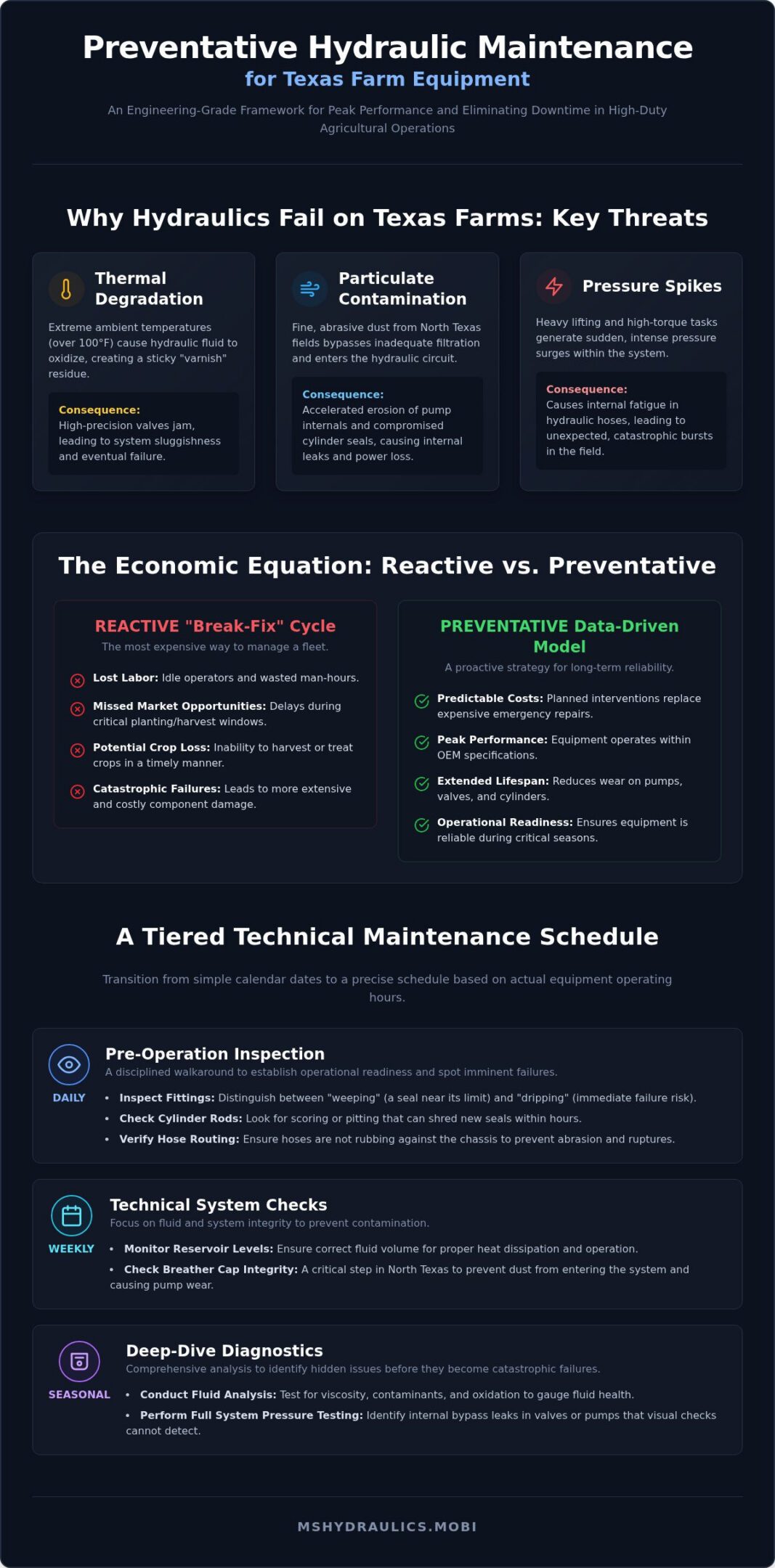
Thermal degradation is a primary threat. When ambient temperatures exceed 100°F, hydraulic fluid can reach temperatures that cause oxidation and “varnishing.” This chemical change creates a sticky residue that jams high-precision valves. Additionally, the dry, fine dust prevalent in North Texas acts as an abrasive. If this particulate matter bypasses filtration, it erodes pump internals and compromises cylinder seals. Sudden pressure spikes during heavy lifting also contribute to internal hose fatigue, leading to unexpected bursts.
The Economic Impact of Hydraulic Downtime
The financial burden of equipment failure is highest during the harvest or planting windows. When a combine or tractor sits idle, the hourly cost includes lost labor, missed market opportunities, and potential crop loss. Consistent Heavy Equipment Maintenance reduces these risks by identifying potential failure points before they manifest as downtime. Total Cost of Ownership is the cumulative financial investment in a machine’s acquisition and upkeep relative to its productive output over its entire service life.
Designing Your Technical Maintenance Schedule
Designing an effective preventative hydraulic maintenance plan for farm equipment in Texas requires moving beyond calendar-based logistics. Operating hours provide a more accurate assessment of component fatigue and fluid degradation than simple date intervals. A multi-tier schedule ensures that high-wear parts are monitored frequently while deeper technical audits occur at logical service milestones. This methodical approach transforms maintenance from a chore into a disciplined engineering practice.
Daily Pre-Operation Inspection
Operational readiness begins with a disciplined walkaround. Operators should distinguish between “weeping” (a thin film of oil) and “dripping” (active fluid loss) at fittings. Weeping often signals a seal nearing its elastic limit, while dripping indicates an immediate failure risk. Inspect hydraulic cylinders for rod scoring or pitting. Even minor surface irregularities can shred new seals within hours of operation. Verify that hose routing hasn’t shifted to prevent abrasion against the chassis, which is a common precursor to high-pressure ruptures during high-torque tasks.
Weekly technical checks must focus on reservoir levels and breather cap integrity. In North Texas, a compromised breather cap allows fine particulate matter to enter the system, leading to rapid pump wear. Seasonal deep-dives should include comprehensive fluid analysis and full system pressure testing. These tests identify internal bypass leaks in valves or pumps that visual inspections cannot detect. If you lack the specialized equipment for these diagnostics, utilizing on-site diagnostic services can provide the technical data needed to prevent harvest-time failures.
The 500-Hour Hydraulic Service Interval
The 500-hour mark is a critical threshold for fluid integrity. Replacing filters at this stage is non-negotiable. When a filter reaches capacity, the system may enter “bypass mode,” allowing unfiltered oil to circulate and damage sensitive hydraulic motors. This interval also requires a thorough cleaning of the hydraulic oil cooler. Dust accumulation on the cooling fins significantly reduces heat dissipation, accelerating the thermal oxidation of the fluid. Testing pump performance under load during this service ensures the system maintains the flow rates required for heavy implements.
- Filter Indicators: Check that bypass indicators are functional and not stuck in the “clean” position.
- Valve Responsiveness: Monitor for “spongy” controls, which suggest air ingestion or internal leakage.
- Heat Dissipation: Use an infrared thermometer to verify that the oil cooler is operating within its rated temperature delta.
Managing Fluid Integrity and Filtration in North Texas
Hydraulic fluid serves as the primary medium for power transmission while providing the lubricity required to minimize friction between high-speed moving parts. In a preventative hydraulic maintenance plan for farm equipment in Texas, maintaining fluid integrity is paramount due to the thermal and particulate stressors common in North Texas. When fluid is subjected to the extreme temperatures characteristic of the region, it undergoes thermal oxidation. This chemical breakdown results in varnish, which is a thin, insoluble film that coats internal surfaces. Varnish increases friction and can cause directional control valves to stick, leading to erratic implement behavior and lost productivity.
In high-dust environments like Alvarado or Grandbury, standard filtration often proves insufficient for maintaining system health. Fine siliceous dust can bypass primary filters if they aren’t rated for the appropriate micron level or if the filter housing seals are compromised. Utilizing On-Site Diagnostic Services allows for real-time monitoring of fluid health, ensuring that contaminants are identified before they reach critical pump internals. This proactive data collection is the cornerstone of a technically sound maintenance strategy.
Understanding Hydraulic Fluid Analysis
Professional fluid analysis provides a forensic look at the system’s internal health by measuring particle counts and moisture levels. Technicians use these reports to identify early-stage component erosion, such as elevated copper or iron levels that signal pump or motor wear. A $50 fluid analysis serves as a high-return investment when compared to the $5,000 cost of a total pump replacement and the subsequent system flushing required after a catastrophic failure. This quantitative approach removes the guesswork from your preventative hydraulic maintenance plan for farm equipment in Texas.
Choosing the Right Fluid for Texas Climates
Fluid viscosity is highly temperature-dependent and must be matched to the operational environment. While ISO VG 46 is standard for many machines, summer operations in Texas often benefit from the higher shear stability of ISO VG 68. It’s essential to use high Viscosity Index (VI) fluids. These fluids maintain a stable film thickness despite the wide temperature swings between cool spring mornings and blistering afternoons. Operators should avoid the “universal oil” trap. Specialized agricultural equipment often requires specific additive packages that multi-purpose fluids cannot provide, potentially leading to accelerated seal degradation or pump cavitation.
Critical Component Care: Hoses and Cylinders
Hydraulic hoses are the most frequent point of failure in any agricultural system due to their constant exposure to high-pressure cycles and physical abrasion. A robust preventative hydraulic maintenance plan for farm equipment in Texas must account for both visible external wear and less obvious internal degradation. Internal failure signs often include blistering, which occurs when fluid penetrates the inner tube and gets trapped under the outer cover. Other critical indicators include kinking that restricts flow and coupling slippage, where the hose begins to pull away from the metal fitting. While basic hydraulic hose repair can address minor issues, high-pressure lines usually require complete on-site fabrication to maintain safety standards.
Advanced Hose Inspection Techniques
Visual inspections alone are insufficient for high-duty machinery. Technicians often employ tactile inspection by running a gloved hand along the length of the hose to detect localized swelling or broken wire braid reinforcement. In Cleburne and Fort Worth, intense UV exposure leads to cover cracking, which allows moisture to reach the steel reinforcement and cause corrosion. When replacing these components, all hydraulic parts and fittings must match OEM specifications exactly. Using mismatched thread types or lower-rated hoses can lead to catastrophic bursts under peak load conditions.
Maintaining Hydraulic Cylinder Integrity
Hydraulic cylinders provide the mechanical force necessary for implement operation, but their performance depends entirely on seal integrity. The wiper seal is the first line of defense; if it fails, abrasive Texas dust enters the barrel and shreds the internal piston seals. This leads to “bypassing,” where fluid leaks across the piston, causing the cylinder to drift or lose lifting capacity. Rod polishing is an essential maintenance step that removes micro-abrasions that would otherwise tear new seals. If you notice persistent drifting or visible oil on the rod, it’s a sign that the component requires a professional rebuild rather than a simple field seal kit. For precision restoration, you can access specialized hydraulic cylinder rebuild services to restore your equipment to factory specifications.
Implementing a Mobile-First Support Strategy in Cleburne
Transporting a disabled tractor, combine, or drill rig to a centralized shop involves significant logistical complexity. The requirement for heavy-duty trailers and specialized transport permits often extends downtime by several days. A mobile-first strategy addresses this by bringing high-level engineering capabilities directly to the field. It’s a vital pillar of a preventative hydraulic maintenance plan for farm equipment in Texas, as it allows for technical interventions without the risks associated with moving compromised machinery.
Mobile hydraulic repair technicians operate as fully equipped field stations. They possess the tools necessary for on-site diagnostics, precision hose fabrication, and minor component repairs. By eliminating the transportation phase, operators can return equipment to service in a fraction of the time required for traditional shop-based models. This regional focus ensures that agricultural operations in North Texas maintain their schedules during high-pressure seasonal windows.
Benefits of On-Site Diagnostic Services
On-site diagnostics provide the unique advantage of troubleshooting a system under its actual operating conditions and loads. Unlike a shop environment, field testing allows a technician to observe pressure spikes and flow fluctuations as they occur during real-world tasks. This precision identifies the root cause of a failure more accurately than static testing. Immediate custom hose fabrication on-site also removes the dependency on parts delivery timelines. It’s often the difference between a simple seal change and a total pump overhaul. Field service prevents secondary damage, as attempting to drive a machine with a major hydraulic leak can lead to pump cavitation or catastrophic steering failure.
Choosing a Local Texas Maintenance Partner
Selecting a maintenance partner requires an evaluation of technical expertise, response time, and professional integrity. A technician must understand the specific environmental stressors of the DFW area to provide effective long-term solutions. Ms. Hydraulics LLC supports agricultural operations across Cleburne, Waxahachie, and Mansfield with specialized mobile units. These units are equipped to handle complex system failures and routine maintenance alike, ensuring that your fleet remains operational despite the harsh Texas climate. For a technical assessment of your system’s health, contact Ms. Hydraulics for a mobile diagnostic call today.
Securing Operational Continuity for the 2026 Growing Season
Maintaining agricultural productivity requires more than periodic inspections; it demands a disciplined engineering framework. We’ve established that managing fluid chemistry and component fatigue is essential to counter the environmental stressors of the DFW region. By shifting to an hour-based service model and prioritizing ISO cleanliness standards, you can mitigate the risk of pressure loss and thermal degradation. Establishing a comprehensive preventative hydraulic maintenance plan for farm equipment in Texas is a fundamental requirement for modern agricultural efficiency. Precision is non-negotiable when harvest windows are narrow, and for those who need a well-earned break after the season, Hillside Acres Retreat provides fully furnished cabin rentals in the heart of the Texas Hill Country.
Ms. Hydraulics LLC provides the technical support needed to execute this strategy directly in the field. Our mobile technicians serve Johnson and Tarrant Counties with capabilities that include on-site custom hose fabrication and specialized cylinder rebuilds. We focus on eliminating transportation downtime through rigorous system diagnostics and precision repairs. You can protect your capital investments and ensure zero hydraulic-related downtime during the next harvest. Request an on-site hydraulic system diagnostic in Cleburne today to secure your fleet’s performance.
Frequently Asked Questions
How often should I change the hydraulic fluid in my farm equipment?
Fluid change intervals should follow manufacturer specifications, typically ranging from 1,000 to 2,000 operating hours. However, the extreme thermal loads in Texas often accelerate fluid oxidation and additive depletion. It’s advisable to perform professional fluid analysis every 500 hours to determine the exact chemical health of the oil. This data-driven approach ensures you aren’t circulating degraded lubricants that can no longer protect high-pressure pumps and valves from internal friction.
What are the signs of hydraulic pump failure in a tractor?
Primary indicators include increased audible noise, such as whining or banging, which signals aeration or cavitation. You’ll also notice a measurable decrease in cycle times for implements and a loss of precision in directional controls. Excessive heat radiating from the pump housing suggests internal bypass leakage. Monitoring these technical parameters allows you to intervene before a total mechanical seizure occurs, saving the rest of the system from metal particulate contamination.
Can I repair a hydraulic hose myself in the field?
Field repairs using generic screw-on fittings are generally discouraged for high-pressure applications exceeding 2,000 PSI. These temporary solutions often fail under the high-torque loads common in Texas agriculture. Professional on-site hose fabrication ensures that the crimp specifications and hose ratings match the original engineering requirements. Utilizing a mobile service for precision fabrication maintains system safety and prevents the environmental hazards associated with a recurring high-pressure rupture.
Why does my hydraulic system overheat during the Texas summer?
Overheating usually results from a combination of high ambient temperatures and reduced heat dissipation. Dust accumulation on the oil cooler fins acts as an insulator, while internal component wear causes fluid to bypass seals, generating friction-based heat. Maintaining a preventative hydraulic maintenance plan for farm equipment in Texas includes regular cleaning of cooling surfaces and verifying that relief valves aren’t stuck open, which causes constant fluid circulation and rapid temperature spikes.
Is fluid analysis really necessary for older farm equipment?
Fluid analysis is critical for aging machinery because it provides a forensic record of internal component wear. By identifying elevated levels of iron or copper, you can predict pump or valve failure before it occurs. This is especially valuable for older tractors where replacement parts may have longer lead times. It’s a low-cost diagnostic tool that prevents the catastrophic expense of flushing a contaminated system after a major component failure.
What is the difference between a cylinder reseal and a full rebuild?
A reseal involves replacing elastomeric components like O-rings, wipers, and u-cups to stop external leaks. A full rebuild is a more extensive engineering process that includes honing the barrel, polishing or replacing the rod, and machining the piston if necessary. If the cylinder barrel is scored or the rod is pitted, a simple reseal will fail almost immediately. Professional rebuilds restore the component to its original pressure-holding capacity and factory tolerances.
How do I find a reliable mobile hydraulic repair service in Johnson County?
Reliability is defined by technical expertise and the ability to perform on-site diagnostics. Look for providers who offer mobile units equipped with specialized crimping tools and pressure testing equipment. In Johnson County, Ms. Hydraulics LLC provides these capabilities, ensuring that repairs meet industrial standards without requiring equipment transport. Choosing a partner with local geographical knowledge ensures faster response times and a better understanding of the specific dust and heat challenges facing regional equipment.
What should I do if a hydraulic hose bursts while I am in the field?
Immediately disengage the PTO and shut down the engine to stop fluid loss and prevent pump cavitation. Secure the implement to prevent accidental lowering and use absorbent materials to contain any environmental discharge. Don’t attempt to restart the system to move the machine, as this can cause secondary damage to expensive pumps and valves. Contact a mobile repair service to perform an on-site fabrication and system flush to ensure no contaminants entered the circuit.