Custom Hydraulic Hoses in Fort Worth: Precision Fabrication for Heavy Equipment
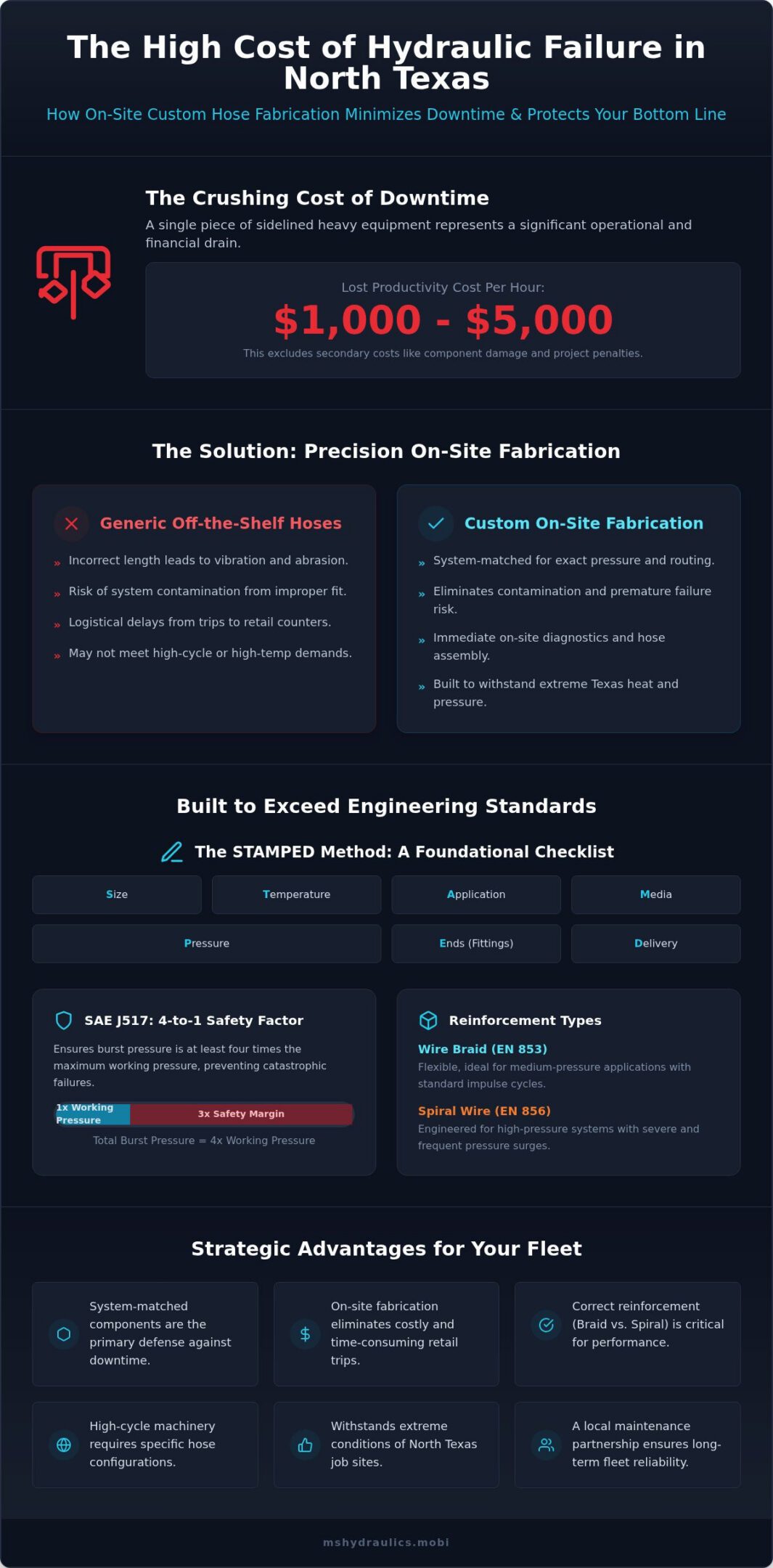
A single piece of sidelined heavy equipment can cost a contractor between $1,000 and $5,000 per hour in lost productivity. In the demanding environment of the Fort Worth metroplex, a hydraulic failure is more than a mechanical issue; it’s a significant operational bottleneck. You likely understand that a simple replacement isn’t sufficient if it doesn’t meet the rigorous demands of high-PSI applications and extreme Texas temperatures. Finding reliable custom hydraulic hoses Fort Worth technicians can fabricate on-site is the most efficient way to restore equipment functionality and protect your bottom line.
This analysis demonstrates how precision engineering and adherence to the STAMPED method ensure your assemblies exceed the 4-to-1 safety factor required by SAE J517. This guide details the latest 2026 updates to ISO 18752 and EN 856 standards, providing a framework for selecting hoses that handle increased impulse cycles and ozone resistance. You’ll gain the technical insight needed to choose a local partner capable of maintaining your fleet to international industrial benchmarks while eliminating the hidden costs of repeat component failures.
Key Takeaways
- Engineering system-matched components serves as the primary defense against the high costs of equipment inactivity on North Texas job sites.
- Technical distinctions between wire braid and spiral reinforcement layers are critical for ensuring assemblies meet SAE J517 performance benchmarks.
- On-site diagnostics and mobile fabrication of custom hydraulic hoses Fort Worth businesses utilize can eliminate the logistical delays associated with retail counter trips.
- High-cycle machinery like excavators and drill rigs requires specific hose configurations to withstand extreme environmental conditions and high-pressure demands.
- Establishing a local maintenance partnership provides strategic advantages for long-term fleet reliability across Tarrant and Johnson Counties.
Why Custom Hydraulic Hose Fabrication is Essential for Fort Worth Operations
Operational efficiency in the North Texas industrial sector depends on the immediate availability of high-performance components. When a primary line fails on a job site, the logistical challenge of sourcing a replacement often leads to extended periods of non-productivity. Utilizing custom hydraulic hoses Fort Worth technicians fabricate on-site addresses this bottleneck directly. Unlike generic, mass-produced alternatives, custom-engineered hoses are built to match the specific pressure cycles and physical routing of modern machinery. This precision reduces the risk of fluid contamination and ensures that system pressure remains within the manufacturer’s specified parameters. Standardized hoses often lack the precise fitting orientation or reinforcement layers required for high-cycle applications. When a hose is even slightly too long or short, it creates vibration and abrasion points that lead to premature failure. Custom fabrication allows for exact measurements, ensuring every assembly adheres to rigorous technical protocols.
The Economic Impact of Hydraulic Failure
Financial losses during equipment downtime are substantial. Industry data indicates that a sidelined excavator or drill rig can cost a contractor between $1,000 and $5,000 per hour in lost productivity. These figures don’t account for the potential of secondary component damage. A failed hose can introduce air or debris into the system, leading to the premature failure of expensive hydraulic pumps and valves. Custom fabrication provides a verified fit that mitigates these risks, offering a level of reliability that off-the-shelf retail components cannot match. Immediate on-site response is critical for high-stakes industrial projects where project timelines are rigid and delays result in contractual penalties. By addressing the failure at the source, technicians ensure the entire hydraulic circuit is restored to its optimal operating state.
Local Industry Demands in North Texas
The Tarrant County industrial landscape, stretching through the South DFW corridor from Fort Worth to Cleburne and Arlington, presents unique challenges for hydraulic systems. Intense North Texas heat accelerates the degradation of standard rubber compounds, making high-spec hose covers a technical necessity. Understanding Hydraulic machinery principles is essential for selecting materials that withstand these environmental stressors and the high-cycle demands of local construction and agricultural sectors. Local operations are increasingly shifting toward on-site services to avoid the inefficiencies of traditional retail counters. This mobile approach ensures that technicians perform diagnostics and fabrication at the machine’s location, eliminating the need for operators to transport failed parts across the metroplex. It’s a strategic shift that prioritizes mechanical uptime and long-term fleet health over the perceived convenience of big-box distributors.
Engineering Standards: Pressure Ratings, Fittings, and Material Selection
Engineering integrity begins with adherence to established technical protocols. The STAMPED method is a standardized engineering protocol representing Size, Temperature, Application, Media, Pressure, Ends, and Delivery, serving as the foundational checklist for selecting appropriate hydraulic components. For custom hydraulic hoses Fort Worth operators rely on, meeting SAE J517 is the minimum baseline. This standard mandates a 4-to-1 safety factor, ensuring the burst pressure is quadruple the maximum rated working pressure. Adhering to these safety margins is essential for preventing catastrophic failures in high-pressure environments. The 2026 updates to ISO 18752 further categorize hoses by constant pressure ratings across different sizes, which simplifies the selection process for high-demand systems that operate at a consistent PSI.
Choosing between wire braid and spiral reinforcement depends on the impulse cycles of the equipment. Wire-braid hoses, governed by EN 853:2026, offer the flexibility required for medium-pressure applications. Conversely, spiral-wire reinforced hoses, following EN 856:2026 standards, are engineered for high-pressure systems subjected to frequent and severe pressure surges. Using the incorrect reinforcement type leads to wire fatigue and eventual carcass failure. It’s vital to match the hose’s physical construction to the specific mechanical demands of the machinery to ensure longevity and safety.
Decoding Hose Pressure and Temperature Ratings
Operating outside of specified thermal and mechanical limits accounts for a significant percentage of premature failures. North Texas summer temperatures often push hydraulic fluid toward its upper thermal limit, which can harden the inner tube of a standard hose and cause it to crack. Selecting high-performance materials like thermoplastics or hybrid polymers provides better resistance to these fluctuations. Maintaining safe hydraulic hose assemblies requires a thorough understanding of how environmental factors influence the degradation of rubber compounds. In the rocky terrain surrounding the Fort Worth metroplex, abrasion-resistant covers are necessary to prevent external wear from constant contact with abrasive debris.
Identifying the Correct Fittings
Fitting compatibility is non-negotiable for system integrity. Modern heavy equipment from manufacturers like Caterpillar, John Deere, and Bobcat utilizes a variety of thread types, including JIC (Joint Industry Council) 37-degree flares, NPT (National Pipe Taper), and ORFS (O-Ring Face Seal). Attempting to force a connection with incorrect adapters or “making it fit” with mismatched threads creates leak points and potential safety hazards. Precision crimping is the final step in achieving a leak-free seal. It requires calibrated equipment to ensure the fitting is permanently secured to the hose reinforcement without damaging the inner tube. For those managing complex fleets, a professional mobile hydraulic repair partner can perform these technical assessments on-site to verify that every component meets the original equipment manufacturer (OEM) specifications.
Mobile vs. In-Shop Hose Assembly: Which Minimizes Your Downtime?
Choosing between a mobile service and a physical shop involves a strategic evaluation of total operational costs. For most high-stakes projects, the primary expense isn’t the component itself but the lost revenue during equipment inactivity. While a retail counter offers a controlled environment, the logistical burden of removing a failed line and transporting it through metroplex traffic often extends downtime by several hours. Utilizing the mobile fabrication of custom hydraulic hoses Fort Worth providers offer eliminates this transit time. A technician arrives with a fully equipped service vehicle, bringing industrial crimping technology and a comprehensive inventory of bulk hose and fittings directly to the sidelined machine. This approach transforms a half-day recovery process into a focused, one-hour repair.
On-site diagnostics significantly improve the accuracy of the fabrication process. When a technician views the hose in its installed environment, they can account for specific bend radii, vibration points, and potential abrasion zones that aren’t apparent at a shop counter. This context ensures the new assembly is engineered for the exact physical constraints of the machinery, reducing the likelihood of a secondary failure caused by improper routing.
The Advantages of On-Site Fabrication
The core benefit of mobile service is the elimination of the “remove and replace” delay. In a shop scenario, an operator must remove the hose, drive to the counter, wait for fabrication, and return to the site. Mobile repair collapses these steps. Once the technician fabricates the line, they can perform real-time testing under actual operating loads to verify system integrity. This visit also allows for professional inspections of related hydraulic parts, such as adapters and mounting brackets, which may have contributed to the initial failure. Addressing these peripheral issues during the initial service call prevents future interruptions and extends the mean time between failures (MTBF) for the entire hydraulic circuit.
When to Visit a Local Shop
While mobile service is superior for emergency repairs, a physical shop remains the practical choice for non-critical requirements. Shop visits are ideal for bulk orders of preventative maintenance kits or when fabricating lines for portable power units that are easily transported. For high-volume custom kitting, a shop environment allows for faster turnaround times through streamlined assembly line processes. Contractors often utilize shop services to build a stock of common hose sizes for their fleet, ensuring they have immediate replacements for minor leaks that don’t require a full service call. This dual-track approach, utilizing mobile for emergencies and shop for inventory, optimizes the maintenance budget while maintaining maximum fleet availability.
Industry-Specific Hose Solutions for North Texas Job Sites
Construction and Earthmoving Equipment
High-cycle machinery such as excavators and skid steers operates under constant mechanical strain. Boom and bucket hoses are particularly susceptible to external abrasion and internal fatigue due to rapid pressure spikes during digging and lifting cycles. Implementing a rigorous program of Heavy Equipment Maintenance is essential for identifying worn outer covers before a rupture occurs. In these high-vibration environments, secure hose routing and the use of protective sleeves prevent premature failure. Custom fabrication allows for the integration of specialized reinforcement layers that accommodate the extreme flexion required by modern earthmoving attachments.
Agriculture and Industrial Machinery
Agricultural operations in Alvarado and Granbury face different environmental stressors than urban construction sites. Long-term outdoor exposure leads to UV-induced degradation of standard rubber hoses, causing them to become brittle and prone to cracking. Weatherproofing through the use of high-performance covers is necessary for tractors, harvesters, and PTO systems. Integrating preventative On-Site Diagnostic Services helps operators catch pinhole leaks or fitting corrosion before they lead to total system failure during peak harvest windows.
For manufacturing facilities in the Fort Worth region, chemical resistance is often a primary technical requirement. Industrial hydraulic lines must be compatible with specific media to prevent inner tube erosion. The custom hydraulic hoses Fort Worth technicians assemble for these environments often utilize specialized liners to ensure long-term compatibility with synthetic fluids or chemical additives used in industrial processes. This level of specialization ensures that the hydraulic system remains a reliable asset rather than a recurring maintenance liability.
To secure your project timeline and ensure mechanical reliability, contact Ms. Hydraulics for professional Mobile Hydraulic Repair services across the metroplex.
Ms. Hydraulics: Expert On-Site Fabrication Across the Tarrant County Region
Ms. Hydraulics LLC operates with a commitment to engineering excellence and long-term client integrity. For those requiring custom hydraulic hoses Fort Worth operations can depend on, the brand provides a mobile-first solution that bypasses the inefficiencies of big-box distributors. The technical objective is to restore mechanical functionality through a methodical process of on-site diagnostics and precision fabrication. This approach ensures that every assembly is verified for system compatibility before the technician leaves the site. By positioning as a serious partner for major industrial players, Ms. Hydraulics LLC prioritizes technical accuracy over high-volume retail sales.
The standard Ms. Hydraulics LLC operational workflow follows a rigorous four-stage protocol: Diagnose, Fabricate, Install, and Test. Initially, technicians perform a comprehensive assessment to identify the root cause of the failure, ensuring that high pressure or abrasive wear hasn’t compromised adjacent components. Following the fabrication of the custom line, the assembly is installed and subjected to operational load testing. This verification step is critical for maintaining the 4-to-1 safety factor required by SAE standards. It’s this level of technical oversight that makes Ms. Hydraulics LLC the preferred choice for mobile hydraulic repair in Cleburne, TX and the broader DFW metroplex.
Serving the South DFW Corridor
The service coverage area focuses on the high-growth industrial zones within Tarrant and Johnson Counties. Rapid response times are maintained for job sites in Mansfield, Burleson, and Crowley, where heavy equipment activity is concentrated. Local expertise in the specific machinery utilized in North Texas allows for a faster diagnostic phase when fabricating the custom hydraulic hoses Fort Worth job sites demand. To schedule an emergency on-site fabrication call, clients provide the equipment type and visible fitting specifications, allowing the mobile unit to arrive with the necessary inventory. This localized focus ensures that fleet managers have a reliable partner within the South DFW corridor.
Beyond the Hose: Comprehensive Hydraulic Support
While hose failure is a common cause of downtime, it’s often symptomatic of broader system issues. Ms. Hydraulics LLC provides holistic support by integrating hose repair with specialized heavy equipment cylinder rebuilds. Technicians are equipped to perform diagnostics on hydraulic pumps and motors to ensure system-wide health and prevent future pressure surges that could damage new lines. This technical depth allows for a complete restoration of the hydraulic circuit rather than a temporary fix. Requesting a quote for custom maintenance or emergency repair involves a direct consultation with an experienced technician who understands the physical and mechanical parameters of heavy-duty machinery.
Optimizing Industrial Uptime Through Precision Engineering
The transition from reactive maintenance to an engineering-focused strategy is essential for high-cycle operations in North Texas. By prioritizing assemblies that meet exact mechanical tolerances and environmental requirements, fleet managers can significantly reduce the recurring costs of system contamination. The technical insights provided here emphasize that the reliability of custom hydraulic hoses Fort Worth businesses deploy depends on rigorous material selection and precise fitting compatibility.
Since 2021, Ms. Hydraulics LLC has served as a specialized partner for heavy equipment maintenance across Fort Worth, Cleburne, and the surrounding industrial corridor. Our technicians focus on on-site diagnostics and repair, ensuring every component is verified for performance before project timelines are impacted. Utilizing mobile fabrication allows for immediate restoration of functionality without the logistical delays of traditional retail. Contact Ms. Hydraulics LLC for Expert On-Site Hose Fabrication to maintain your fleet with industry-leading precision. Dependable fluid power is the foundation of mechanical longevity.
Frequently Asked Questions
How long does it take to make a custom hydraulic hose on-site?
Fabrication by Ms. Hydraulics LLC typically takes between 20 and 45 minutes once a technician identifies the specific requirements on-site. Complex assemblies with specialized fittings or multiple reinforcement layers may require additional time for precision crimping. This on-site approach eliminates the hours wasted traveling to a retail counter, allowing for an immediate restoration of equipment functionality and project momentum.
What information do I need to provide for a custom hose quote?
Providing the STAMPED parameters to Ms. Hydraulics LLC is the most effective way to receive an accurate quote. This includes the hose size, operating temperature, application, media type, maximum pressure, and end fittings. If these technical details aren’t available, providing the machine make and model along with the hose’s location on the equipment allows our technicians to perform the necessary on-site diagnostics.
Can you repair a hydraulic hose, or does it always need to be replaced?
Industry safety standards, including SAE J517, dictate that a compromised hydraulic hose should be replaced rather than repaired. Splicing or patching a high-pressure line introduces weak points that cannot reliably handle the 4-to-1 safety factor required for industrial operations. A full replacement ensures the assembly meets original engineering specifications and prevents catastrophic burst failures on the job site.
What are the most common causes of hydraulic hose failure in Fort Worth?
Extreme thermal fluctuations and external abrasion are the leading causes of failure for custom hydraulic hoses Fort Worth operators experience. The intense North Texas summer heat accelerates the degradation of rubber compounds, leading to tube hardening and cracking. Additionally, constant contact with rocky soil or vibrating metal components causes cover wear, eventually compromising the internal reinforcement layers.
Do you provide 24/7 emergency hydraulic hose repair in Tarrant County?
Service availability for emergency repairs in Tarrant County varies based on current technician scheduling and regional project load. While Ms. Hydraulics LLC prioritizes rapid response for sidelined heavy equipment to minimize downtime, it’s best to contact the office directly to confirm the earliest available dispatch time. We focus on providing methodical, high-precision repairs rather than rushed solutions that compromise system integrity.
What is the difference between 2-wire and 4-wire hydraulic hoses?
The primary difference lies in the reinforcement structure and pressure capacity. Two-wire hoses utilize a braided wire pattern, offering greater flexibility for medium-pressure applications. Four-wire hoses feature a spiral wire configuration, which is specifically engineered to withstand higher pressure surges and frequent impulse cycles. Choosing the correct wire count is essential for matching the hose to the machine’s specific hydraulic demand.
How do I know if my hydraulic fittings are SAE or Metric?
Determining fitting types requires measuring the thread diameter and pitch. SAE fittings typically use threads per inch (TPI) and are common on domestic machinery like John Deere or Bobcat. Metric fittings use a millimeter-based thread pitch and are found on many international brands. A thread gauge and calipers are the standard tools used by Ms. Hydraulics LLC technicians to ensure a precise, leak-free match.
Do you offer custom hose kitting for OEM equipment?
Ms. Hydraulics LLC provides custom hose kitting designed for preventative maintenance and fleet standardization. These kits include all necessary hoses and fittings for specific machine intervals, allowing for proactive replacement during scheduled downtime. This service is particularly beneficial for high-cycle excavators and drill rigs where maintaining a consistent maintenance schedule is critical for preventing unplanned operational interruptions.