Reliable Hydraulic Service in Fort Worth: A Technical Guide to Minimizing Downtime (2026)
With the mobile hydraulics segment accounting for 58.20% of industry revenue, can your current maintenance strategy withstand the technical demands of a high-pressure job site? You understand that equipment downtime isn’t merely an inconvenience; it’s a compounding financial loss driven by inconsistent repair quality and frequent component failures. Securing reliable hydraulic service Fort Worth operators trust requires a transition from reactive patching to engineering-led precision that prioritizes long-term component health and operational stability.
You need components that meet the latest ISO standards and technicians who are fully compliant with the July 1, 2026, Texas Railroad Commission deadline for pit registration. This guide provides the technical framework to identify high-precision repairs that guarantee zero-leak performance and maximize equipment lifespan. We’ll analyze the critical benchmarks for hydraulic cylinder rebuilds, mobile diagnostics, and on-site hose fabrication to ensure your operations remain efficient and fully compliant with the more stringent 2026 OSHA enforcement and record-keeping standards. By prioritizing technical accuracy over quick fixes, you’ll protect your operations within a construction sector that contributed 31.05% to the global hydraulic market last year.
Key Takeaways
- Quantify the cascading financial impact of idle machinery and how specific hydraulic failures disrupt critical labor schedules and project milestones.
- Evaluate technical benchmarks for component restoration, including micron-level tolerances and strict adherence to ISO engineering standards for maximum reliability.
- Contrast the logistical advantages of on-site “live” diagnostics with traditional shop repairs for heavy equipment exceeding 50,000 lbs.
- Secure a reliable hydraulic service Fort Worth by vetting technician certifications and verifying mobile unit capabilities for immediate, high-precision hose fabrication.
- Implement a professional maintenance framework to extend the service life of critical hydraulic pumps, motors, and valves through engineering-grade restoration.
The High Cost of Downtime: Why Reliable Hydraulic Service is Essential in Fort Worth
An idle excavator on a North Texas job site represents more than a static asset; it’s a significant financial drain that impacts labor overhead and project completion dates. For a large-scale project in the DFW Metroplex, the hourly cost of an idle 30-ton excavator often exceeds several hundred dollars when you factor in operator wages and equipment depreciation. Securing reliable hydraulic service Fort Worth fleets depend on is the only way to mitigate these compounding losses. When a primary lift cylinder fails on a drill rig, the entire sequence of operations stops. In the highly integrated construction environment of North Texas, a single hydraulic failure creates a ripple effect. Subcontractors for concrete pouring or structural steel cannot proceed if the site isn’t prepped, often resulting in contractual penalties that far exceed the cost of the repair itself.
The Economic Impact on North Texas Construction
The construction industry was a major driver of the hydraulic equipment market in 2025, contributing 31.05% to total market value. In this high-stakes environment, immediate on-site diagnostics are far more valuable than traditional towing logistics. Transporting 50,000-lb machinery to a centralized shop can cause a 6-8 hour delay before a technician even begins the assessment. Professional on-site service allows for “live” testing where the failure is observed in its working environment. By applying foundational Hydraulic machinery principles, technicians can determine if a loss of torque is due to a pump cavitation issue or a simple valve bypass. This technical precision prevents the unnecessary replacement of functional components and ensures the machine returns to service within its original performance parameters.
Environmental Stressors Unique to the DFW Metroplex
Environmental variables in Fort Worth accelerate component degradation at a rate higher than the national average. The 100°F+ summer temperatures common in North Texas cause hydraulic fluid to lose viscosity, leading to increased friction and accelerated seal hardening. When seals fail, the resulting internal leakage reduces system pressure and overall efficiency. Additionally, the high clay content in local soil creates abrasive dust that adheres to cylinder rods. Without high-quality wiper seals, this grit enters the hydraulic circuit, causing scoring on precision-machined surfaces. Standard off-the-shelf hoses often lack the UV resistance and burst pressure ratings required for high-cycle fatigue in these extreme conditions. Reliable hydraulic service Fort Worth providers understand these local stressors and utilize components designed to withstand the specific torque and pressure demands of the Texas landscape.
Opting for “budget” repairs often results in catastrophic secondary system failures. A poorly fabricated hose might introduce metal shavings into the fluid stream, eventually destroying a $15,000 hydraulic pump. Technical restoration must adhere to ISO standards to ensure the entire system remains within specified tolerances. True reliability isn’t found in a quick patch; it’s found in engineering-grade repairs that prioritize the long-term health of the machine’s hydraulic circuit.
Technical Benchmarks for Reliable Hydraulic Component Restoration
Reliability in high-pressure systems is a direct result of engineering precision and strict adherence to ISO standards. A reliable hydraulic service Fort Worth operators can depend on must move beyond basic component replacement to focus on micron-level tolerances. In a system operating at 5,000 PSI, even a ten-micron particle or a five-micron deviation in seal fitment can lead to bypass leakage and eventual pump cavitation. Engineering-grade restoration ensures that every rebuilt component meets or exceeds its original performance curve, maintaining the specific displacement and torque required for heavy industrial cycles. This methodical approach distinguishes professional hydraulic management from temporary field patches.
Cylinder Rebuilds: Beyond Simple Resealing
Effective restoration requires more than just a new seal kit. A professional heavy equipment cylinder rebuild Texas project involves a comprehensive assessment of the rod’s surface finish and the barrel’s internal diameter. Technicians must perform rod polishing and honing to remove microscopic scoring that otherwise shreds new seals within hours of operation. Once the internal geometry is verified, the cylinder undergoes technical verification through pressure testing to 100% of OEM specifications. This ensures the unit can handle peak loads without structural deformation or internal fluid bypass. If your machinery requires this level of precision, our mobile hydraulic repair units provide these diagnostic capabilities directly at your job site.
Hose Fabrication Standards for Heavy Equipment
Hose assemblies are the most frequent failure points in hydraulic circuits, yet they are often treated as commodity items. Reliable fabrication requires matching the hose reinforcement layers, whether two-wire braid or four-wire spiral, to the specific machine pressure spikes and flow rate requirements. In DFW fleets, fitting compatibility is equally critical; technicians must accurately identify JIC, ORFS, or BSPP threads to prevent cross-threading and high-pressure leaks. Hose crimp diameter is defined as the precise external measurement of the fitting sleeve after compression, serving as the primary metric for ensuring a permanent, leak-free bond between the hose and the coupling. Utilizing the wrong crimp specification is a leading cause of premature hose blowouts in the field.
Final system integrity is verified through professional fluid analysis. By measuring the ISO 4406 cleanliness code of the oil, technicians can confirm that the repair hasn’t introduced contaminants into the sensitive valve banks or motors. Adhering to the standards set by the International Fluid Power Society (IFPS) ensures that all service work aligns with the physical laws of fluid dynamics. This commitment to technical data, rather than guesswork, is what keeps Fort Worth job sites operational during high-demand project phases.
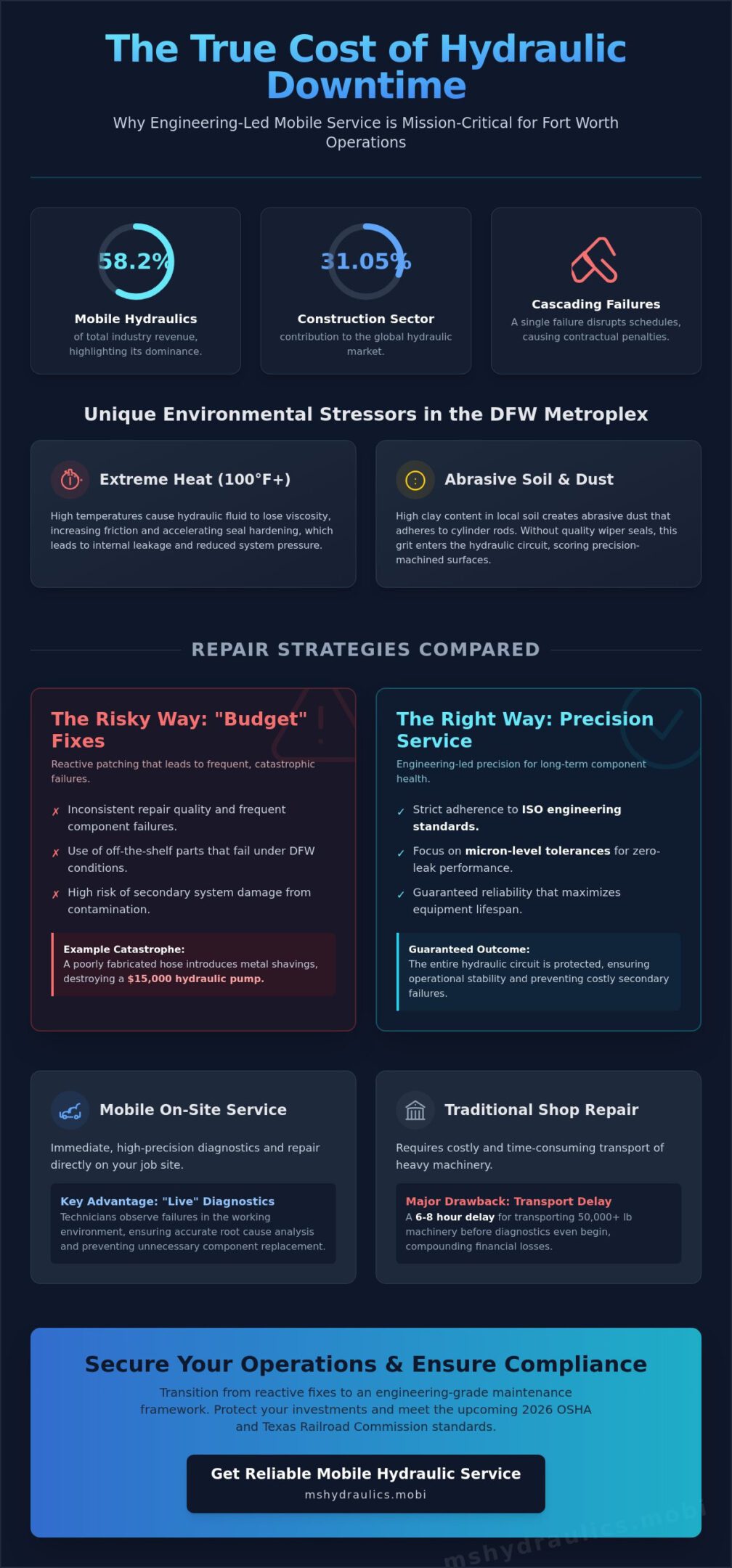
Mobile On-Site Repair vs. Traditional Hydraulic Shops in DFW
Transporting a 50,000lb excavator or drill rig across the DFW Metroplex involves more than just a hauling fee; it introduces a multi-day logistical delay. Traditional repair models require the machine to be secured, loaded onto a lowboy, and transported to a centralized facility. This process often consumes 12 to 24 hours before a technician even begins the inspection. Providing reliable hydraulic service Fort Worth fleets require means eliminating these non-productive transit windows. Mobile units function as self-contained engineering hubs, equipped to perform high-pressure hose fabrication and component diagnostics immediately upon arrival. This approach ensures that the machine remains on the job site where it is needed.
Logistical Efficiency of Mobile Hydraulic Repair
The turnaround time for mobile hydraulic repair Cleburne TX and Fort Worth service calls is significantly lower than shop-based alternatives. By bypassing the need for specialized hauling, contractors eliminate the risk of transit damage and the significant expense of heavy equipment transport. Mobile units carry a deep inventory of SAE and ISO-compliant fittings, which removes the “wait-for-parts” bottleneck that often stalls shop repairs for 48 hours or more. This immediate availability is critical for maintaining project milestones in a market where North America represented 37.65% of the global hydraulic equipment share in 2025. Eliminating the logistics of machine movement directly translates to higher equipment uptime.
The Diagnostic Edge of Field Service
Traditional shops often struggle to replicate the specific environmental and load conditions that cause intermittent hydraulic failures. Utilizing On-Site Diagnostic Services allows technicians to observe the system’s behavior while it is under actual working pressure. This “live” diagnostic approach is essential for identifying root causes like pump cavitation or valve bypass that only manifest during high-cycle operations. Real-time communication between the technician and the operator provides immediate insight into the machine’s performance history, leading to a faster and more accurate resolution. It’s a technical advantage that shop environments cannot match.
Safety remains a paramount consideration during hydraulic failure. Moving a machine with a compromised circuit, such as a failing brake valve or a leaking steering cylinder, poses significant risks to personnel and property. On-site repair stabilizes the equipment in its current position, reducing the need for dangerous maneuvers. This methodical approach ensures that the repair process itself does not introduce new risks to the job site. By choosing reliable hydraulic service Fort Worth operators can trust, you prioritize both operational efficiency and site safety.
A Fleet Manager’s Checklist for Vetting Hydraulic Technicians
Vetting a service provider requires more than a cursory glance at digital reviews; it demands a rigorous assessment of technical infrastructure and engineering competency. A reliable hydraulic service Fort Worth fleet manager selects must demonstrate proficiency in high-pressure systems where a single error in torque specification leads to catastrophic failure. Reliability is verified through the technician’s ability to provide digital data logging rather than relying on subjective analog gauge readings. Modern hydraulic systems require pressure transducers that capture transient spikes. This allows for a precise diagnosis of relief valve settings and pump efficiency during the duty cycle.
Essential Technical Qualifications
Qualified technicians must possess documented experience with the sophisticated load-sensing systems found in CAT, John Deere, and Komatsu machinery. This specialization is vital for executing comprehensive heavy equipment maintenance that aligns with 2026 OSHA record-keeping standards. Every repair should be accompanied by a technical report detailing the specific displacement parameters and pressure tests performed. This transparency ensures that the equipment remains compliant with the updated Hazard Communication Standard (HCS) published in 2024. If a provider cannot produce a detailed performance chart, they likely lack the engineering discipline required for industrial-scale operations.
The Capability of the Mobile Service Unit
A mobile unit is only as effective as its immediate inventory. You must verify that the service vehicle carries an extensive range of hydraulic parts, including high-pressure spiral hoses and metric fittings. Beyond hose fabrication, a truly reliable hydraulic service Fort Worth partner provides on-site welding and light machining to address cylinder rod scoring or bracket failures. This capability is essential for critical infrastructure projects where 24/7 availability is the baseline requirement. For immediate technical support that meets these rigorous standards, schedule a mobile diagnostic service today to secure your operational uptime.
Finally, evaluate the warranty terms as a measure of service integrity. A provider confident in their engineering precision will offer clear guarantees on both labor and components. This commitment reflects the stability and tradition expected of a market leader in the hydraulic industry. By following this technical checklist, you ensure your fleet maintenance is handled by disciplined veterans who value performance above all else. This methodical vetting process is the only way to guarantee that your equipment returns to the field with zero-leak performance and an extended service life.
Ms. Hydraulics: Engineering-Grade Mobile Solutions for Fort Worth Industries
Ms. Hydraulics operates with a disciplined focus on engineering integrity and technical precision. We provide reliable hydraulic service Fort Worth industries utilize to maintain 24/7 operational readiness in a demanding industrial landscape. Our specialized mobile fleet extends across Arlington and Mansfield, bringing high-precision diagnostics directly to the job site. We don’t merely address the symptom, such as a ruptured hose; we investigate the system parameters like displacement, pressure, and torque to identify why the failure occurred. This methodical approach prevents repetitive downtime and ensures the machine operates at peak performance. In an era where the global hydraulic equipment market is projected to reach $44.25 billion in 2026, the need for technical precision has never been greater.
Our diagnostic process utilizes advanced flow meters and pressure transducers to analyze the entire hydraulic circuit. By measuring volumetric efficiency and internal bypass rates, we pinpoint failures in pumps, motors, or valve banks without unnecessary teardowns. This technical accuracy is essential for minimizing the downtime of high-value assets like drill rigs or heavy loaders operating in the abrasive North Texas soil. We prioritize factual accuracy and engineering expertise to build long-term partnerships with global industrial players and local contractors alike.
Custom Fabrication and On-Site Execution
Our technicians utilize mobile fabrication units to produce custom hoses that match original equipment manufacturer (OEM) specifications exactly. This process includes precise reinforcement layer selection and digital crimp verification to withstand the high-pressure spikes common in modern excavators. For cylinder rebuilds, we follow a strict protocol involving rod inspection and seal compatibility testing to ensure zero-leak performance under maximum hydraulic pressure. We recognize that the mobile hydraulics segment accounted for 58.20% of industry revenue in 2025, which is why our units are fully equipped for complex field repairs. The Ms. Hydraulics 2026 service standard for North Texas integrates real-time data logging and ISO-certified cleanliness checks into every field intervention.
Partnering for Long-Term Fleet Reliability
Sustained efficiency requires more than reactive repairs. We develop custom preventative maintenance plans for Fort Worth industrial fleets, focusing on the specific duty cycles of your heavy equipment. By providing transparent technical documentation and fluid analysis reports, we establish a foundation of trust rooted in engineering data. This transparency allows fleet managers to make informed decisions regarding component replacement intervals and system upgrades. We prioritize the reliability and safety of hydraulic systems by utilizing high-pressure solutions and robust designs that meet the latest industry standards. If your machinery requires immediate, high-precision intervention, contact Ms. Hydraulics for professional mobile support that prioritizes your project’s stability and performance.
Securing Operational Excellence Through Technical Precision
Transitioning from reactive maintenance to an engineering-led reliability strategy is the most effective way to eliminate costly project delays in North Texas. By prioritizing micron-level tolerances and adhering to strict ISO standards, you ensure that every component rebuild extends the service life of your machinery. The shift toward on-site diagnostics and immediate hose fabrication allows your fleet to bypass the logistical bottlenecks of traditional shop models, maintaining the momentum of your job site. Securing a reliable hydraulic service Fort Worth depends on requires a partner who values technical data and factual accuracy over temporary field patches.
Ms. Hydraulics was founded in 2021 to provide this exact level of heavy equipment precision. Our specialized mobile units serve Fort Worth, Arlington, and Mansfield, equipped with the technology required for high-pressure cylinder restoration and precise hose fabrication. Our expert technicians focus on restoring the specific torque and displacement parameters your equipment requires for peak efficiency. Don’t let hydraulic failure compromise your production schedule. Request Emergency Mobile Hydraulic Service in Fort Worth to restore your operations with engineering-grade speed. Investing in technical integrity today ensures your fleet remains a competitive and stable asset in a demanding industrial market.
Frequently Asked Questions
How long does a mobile hydraulic hose repair take in Fort Worth?
A standard mobile hydraulic hose repair typically requires 60 to 90 minutes from the time the technician arrives on-site. This timeframe includes the removal of the failed assembly, precision fabrication of the new hose to OEM specifications, and final pressure testing. Our mobile units carry a full inventory of SAE 100R12 and 100R15 spiral hoses to ensure immediate restoration of high-pressure circuits without the need for secondary parts runs.
Can you perform hydraulic cylinder rebuilds on-site at a job site?
Most hydraulic cylinder rebuilds can be completed on-site if the failure is limited to seal degradation or minor rod scoring. Our technicians perform rod polishing and seal replacement directly on the machine to eliminate the 12-hour transit delay associated with shop repairs. However, if the cylinder barrel requires extensive honing or structural welding, we’ll coordinate the necessary logistics to ensure the component meets ISO 4406 cleanliness standards before reinstallation.
What areas of the DFW Metroplex do your mobile technicians cover?
Our mobile service units provide comprehensive coverage across the DFW Metroplex, with a primary focus on Fort Worth, Arlington, Mansfield, and Cleburne. We maintain a strategic presence in Tarrant and Johnson counties to ensure a rapid response for industrial and construction sites. This localized approach allows us to deliver reliable hydraulic service Fort Worth operators depend on for maintaining tight project schedules in high-growth corridors.
Do you provide emergency 24/7 hydraulic service for critical equipment?
Yes, we provide 24/7 emergency mobile repair for critical equipment and infrastructure projects throughout North Texas. We recognize that industrial operations don’t stop at sunset, especially with the 2026 Texas Railroad Commission deadlines approaching for waste management compliance. Our technicians remain on standby to address catastrophic pump failures or hose bursts that threaten site safety or environmental integrity at any hour of the day or night.
What information do I need to provide for a custom hose fabrication?
For accurate custom hose fabrication, you must provide the hose’s internal diameter, overall length, and the specific fitting types, such as JIC or ORFS. We also require the peak operating pressure and the fluid type to ensure the reinforcement layers and tube material are compatible with your machine’s parameters. Providing the machine’s serial number allows our technicians to verify the exact OEM specifications in our technical database before crimping the final assembly.
How do I know if my hydraulic pump is failing or if it is just a valve issue?
Distinguishing between pump failure and a valve issue requires a volumetric efficiency test using a flow meter and pressure transducers. A pump that’s failing typically shows a significant drop in flow rate as the system pressure increases, indicating internal wear. Conversely, a valve issue often manifests as a sudden loss of pressure or erratic actuator movement while the pump maintains its rated flow output. Professional diagnostics prevent the unnecessary replacement of functional pumps.
Are your technicians certified to work on major brands like CAT and Komatsu?
Our technicians are specifically trained to service the high-pressure, load-sensing hydraulic circuits found in major brands like CAT, Komatsu, and John Deere. This expertise is critical for reliable hydraulic service Fort Worth fleets require when managing Tier 4 and Tier 5 emissions-compliant machinery. We utilize specialized diagnostic software and hardware that interface with these modern systems to ensure all repairs align with original engineering tolerances and manufacturer standards.
What is the benefit of on-site diagnostics compared to a traditional shop?
The primary benefit of on-site diagnostics is the ability to perform “live” testing under actual working loads and environmental conditions. Traditional shop environments often fail to replicate the specific temperature and pressure spikes that occur during heavy excavation or drilling. Observing the system in its working environment allows our technicians to identify root causes, such as aeration or cavitation, that might remain hidden in a static shop setting, ensuring a more accurate repair.