Skid Steer Hydraulic Repair in Arlington, TX: Mobile Services & Expert Diagnostics
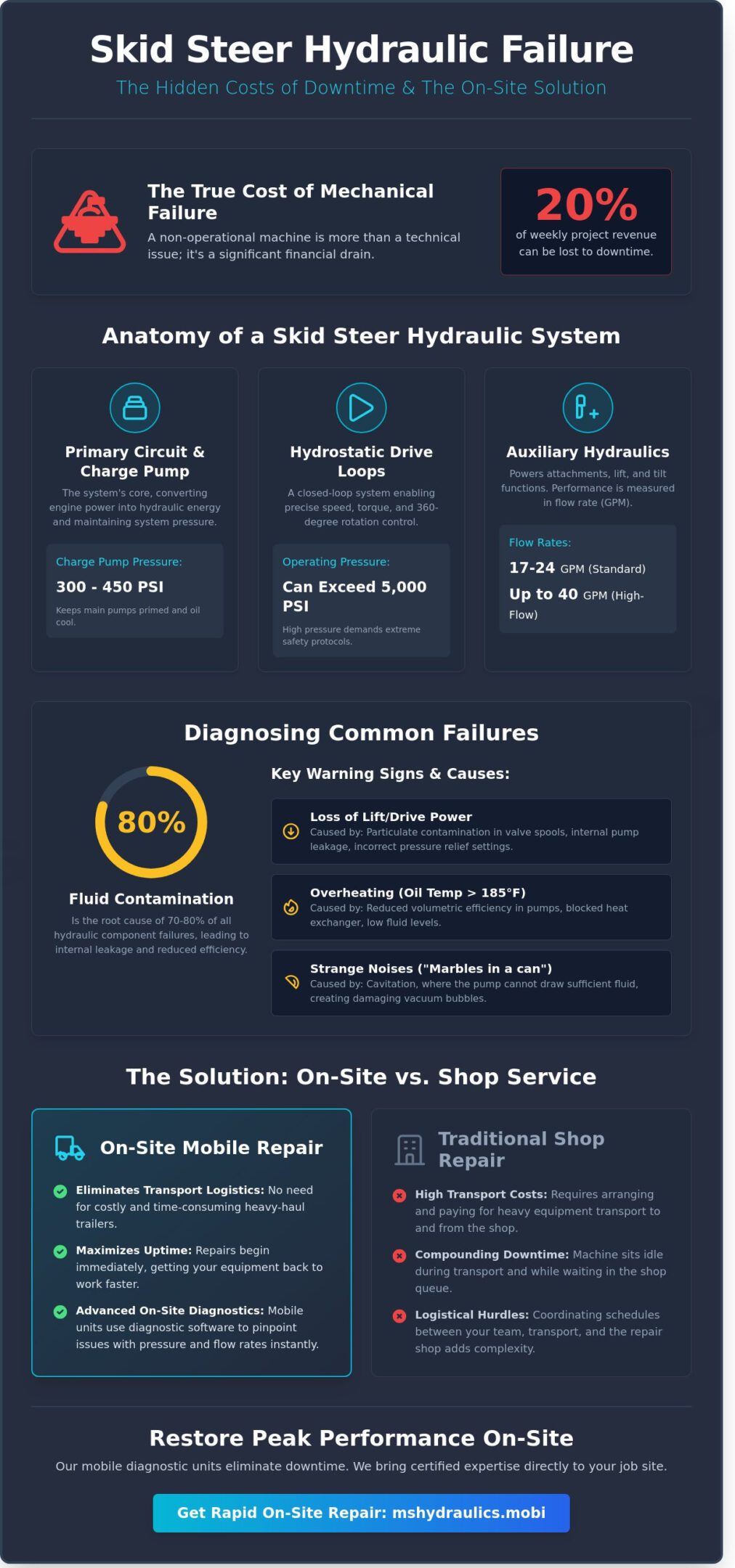
Mechanical failure in a hydrostatic drive system isn’t just a technical setback; it’s a silent drain on project margins that can cost an operator up to 20% of their weekly project revenue according to industry fleet metrics. You know that every hour a machine sits idle while waiting for a heavy-haul trailer represents a compounding loss of operational efficiency. Our team provides specialized skid steer hydraulic repair Arlington, utilizing mobile diagnostic units to eliminate the logistical burden of equipment transport. This professional approach ensures that technical variables like displacement and torque are addressed immediately where the machine operates.
This technical guide details the protocols for on-site hydraulic troubleshooting, from analyzing pressure drops to verifying flow rates against OEM specifications. We’ll show you how rapid, certified diagnostics can restore system integrity and ensure long-term reliability for your heavy equipment fleet. You’ll gain insight into the precise engineering standards required to identify pump cavitation and valve block bypass issues without leaving the job site. We’ll conclude with a look at how ISO-aligned repair standards maintain machine performance over thousands of duty cycles.
Key Takeaways
- Understand the critical engineering distinctions between hydrostatic drive loops and auxiliary hydraulic systems to accurately isolate system performance failures.
- Learn how North Texas soil conditions and extreme thermal loads impact hydraulic fluid integrity and lead to premature component degradation.
- Discover how professional skid steer hydraulic repair Arlington services utilize advanced mobile diagnostic software to restore system pressure and flow on-site.
- Identify a systematic troubleshooting methodology for addressing loss of lift and drive power caused by particulate contamination in sensitive valve spools.
- Evaluate the logistical advantages of field-based mobile engineering to maximize operational uptime and eliminate the high costs of shop transport.
Maximizing Skid Steer Uptime in Arlington’s Industrial Sector
A Skid-steer loader serves as the primary engine of productivity for Arlington construction sites. For reliable skid steer hydraulic repair Arlington operators can count on, Ms. Hydraulics LLC provides precise recalibration of system pressure, fluid flow rates, and directional control valves to restore manufacturer specifications. In the North Texas corridor
Anatomy of a Skid Steer Hydraulic System: Pumps, Motors, and Drives
The operational capacity of a skid steer depends on a sophisticated primary hydraulic circuit. This system starts at the reservoir, where hydraulic fluid is stored and de-aerated before passing through high-efficiency filtration systems. These filters are engineered to maintain fluid cleanliness levels according to ISO 4406 standards, preventing particulate matter from damaging sensitive internal surfaces. The heart of the machine consists of high-pressure axial piston pumps that convert mechanical engine power into hydraulic energy. For contractors requiring skid steer hydraulic repair Arlington, understanding that the charge pump is a frequent failure point is essential. This smaller pump maintains a consistent pressure of 300 to 450 PSI within the system to keep the main pumps primed and to facilitate the flow of oil through the heat exchanger for thermal regulation.
Hydrostatic Transmission and Drive Loops
The drive system functions through a closed-loop hydrostatic transmission. This specific engineering allows for the independent control of the left and right sides of the machine, which enables the characteristic 360-degree counter-rotation. Variable displacement piston pumps use adjustable swash plates to regulate the volume of oil sent to the drive motors, directly controlling the machine’s speed and torque. When internal leakage occurs within this loop, the machine often exhibits “tracking” issues, where it pulls to one side during operation. If the oil temperature rises above 185 degrees Fahrenheit, the volumetric efficiency of the pumps drops, leading to a noticeable loss of pushing power. Technicians must follow strict Skid-Steer Safety guidelines during diagnostics, as the high pressures in these drive loops can exceed 5,000 PSI.
Auxiliary Hydraulics and Attachment Compatibility
The auxiliary hydraulic system is a separate circuit dedicated to powering attachments and the machine’s lift and tilt functions. This system is categorized by its flow rate. Standard flow systems generally operate between 17 and 24 gallons per minute (GPM), while high-flow configurations can reach 40 GPM to power heavy-duty tools like mulchers or rock saws. Central to this circuit are the directional control valves, which use precision-machined spools to divert fluid to the lift and tilt cylinders. Hydraulic horsepower is calculated as the product of flow in GPM and pressure in PSI divided by the constant of 1714. Ensuring your machine meets these performance benchmarks is a core part of effective skid steer hydraulic repair Arlington. If the pressure relief valves are incorrectly set, the machine won’t achieve its rated breakout force, leading to decreased productivity on the job site.
Diagnosing Common Skid Steer Hydraulic Failures
A systematic diagnostic protocol is the only reliable way to address a loss of lift or drive power. Technicians begin by verifying the fluid level and inspecting the suction strainer. Approximately 70% to 80% of hydraulic component failures are caused by fluid contamination. When particulate matter enters the system, it compromises the precision-machined surfaces of valve spools and pump internals, leading to internal leakage and reduced volumetric efficiency. Professionals performing skid steer hydraulic repair Arlington use flow meters and pressure gauges to isolate whether the issue resides in the main pump, the control valve, or the individual actuators.
Visual and audible cues often signal specific mechanical distress. Cavitation produces a distinct metallic “marbles in a can” rattling sound, occurring when the pump cannot draw sufficient fluid. This creates vacuum bubbles that implode with enough force to pit metal surfaces. Aeration, conversely, usually results from air entering the suction line, causing the fluid to appear milky or foamy and making the machine’s movements feel “spongy.” Maintaining system integrity is vital, as noted in this guide on Skid-Steer Hydraulic System Safety, which highlights how mechanical failures can lead to unpredictable equipment behavior.
The most frequent misconception in the field is that a slow or weak machine automatically indicates a catastrophic pump failure. This is often inaccurate. Sluggish performance frequently stems from simpler, less expensive issues such as:
- A clogged high-pressure filter causing a significant pressure drop.
- A main relief valve that is stuck partially open or out of adjustment.
- Worn linkage or failing electronic solenoids that prevent the valve spool from reaching full travel.
- Internal bypass leakage within a drive motor or lift cylinder.
Hydraulic Hose and Fitting Failures
Hoses on a skid steer endure extreme high-cycle fatigue and constant pressure spikes. Most failures occur at the crimp point or due to external abrasion against the loader arms. When a line bursts, skid steer hydraulic repair Arlington specialists prioritize custom hydraulic hose fabrication to ensure the replacement meets exact OEM specifications for length and pressure rating. Proper routing is mandatory; even a slight misalignment can cause a hose to rub against a bracket, leading to premature failure within 100 operating hours.
Cylinder Leaks and Seal Degradation
Cylinder performance is defined by its ability to hold a load without drifting. When internal piston seals degrade, fluid bypasses the piston, causing the arm to drop under weight. Scored rods, often caused by environmental debris, will quickly destroy new wiper seals and allow contaminants into the system. For Arlington operators, a professional heavy equipment cylinder rebuild in Texas involves honing the barrel and replacing the entire seal kit with high-durometer components to restore original lifting capacities and prevent future bypass leakage.
On-Site Repair vs. Shop Service: Minimizing Downtime in Arlington
Deciding between field service and shop-based repair is a critical logistical choice for fleet managers. Field service offers a distinct advantage for large skid steer fleets by eliminating the high costs of heavy hauling and the logistical delays of transport. Mobile service units provide an immediate technical response, utilizing advanced telemetry and diagnostic software to interface with the skid steer’s Electronic Control Unit (ECU). This allows technicians to identify fault codes and hydraulic pressure spikes without moving the machine from the job site. For projects requiring skid steer hydraulic repair Arlington, this rapid deployment can save 4 to 6 hours of transport-related downtime.
Technical capabilities of modern mobile trucks have evolved. They now carry specialized tooling for on-site resealing of cylinders and the replacement of high-pressure hoses. However, some failures require a controlled environment. If a pump or motor has suffered a catastrophic internal failure, the component must be pulled for an in-house rebuild. Shop service is mandatory when ISO cleanroom standards are required to prevent particulate contamination during the assembly of sensitive internal groups. We utilize a 60% rule for the “Repair vs. Replace” framework. If the cost of an overhaul exceeds 60% of the price of a new OEM component, or if the unit has surpassed 8,000 operating hours, replacement is typically the more viable long-term investment.
The Role of On-Site Diagnostics
Precision is mandatory for effective skid steer hydraulic repair Arlington. Our on-site diagnostic services utilize high-accuracy pressure transducers to monitor system performance in real-time. Flow testing is conducted to verify the volumetric efficiency of the pump before recommending a full replacement. We also prioritize immediate fluid analysis. By checking for metallic debris or water emulsion on-site, we can prevent a localized failure from contaminating the entire hydraulic circuit.
Preventative Maintenance for Arlington Fleets
Adhering to a structured heavy equipment maintenance schedule is the most effective way to extend component life. In the fluctuating Texas climate, fluid selection is vital. We recommend ISO VG 46 or 68 hydraulic oils to maintain proper viscosity during high-temperature operations. Standard maintenance must include:
- Filter changes every 500 operating hours to maintain fluid cleanliness.
- Breather inspections every 250 hours to prevent vacuum-related pump cavitation.
- Daily inspections of rod seals for weeping, which often signals impending cylinder failure.
Establishing a proactive maintenance routine reduces the frequency of emergency repairs and ensures your equipment operates at peak performance levels. If your fleet requires immediate technical support or a comprehensive system audit, Contact MS Hydraulics to schedule a diagnostic consultation.
Ms. Hydraulics: Professional Mobile Hydraulic Repair in Arlington, TX
Ms. Hydraulics operates as the premier provider of mobile engineering solutions for the Arlington region. Our service model prioritizes technical integrity and the systematic reduction of client downtime. We understand that a stalled skid steer represents a break in the supply chain or a total halt in construction progress. By deploying rapid response units across the DFW Metroplex, we ensure that specialized mechanical expertise reaches your job site within hours. We build long-term industrial partnerships through precise diagnostics and a transparent approach to every service call.
Our Arlington Service Area and Capabilities
Ms. Hydraulics maintains a heavy presence throughout Arlington, covering industrial zones near the Great Southwest Industrial District in the north down to the commercial developments along the I-20 corridor in the south. Our mobile units function as fully equipped workshops. We carry a vast inventory of hydraulic parts to facilitate immediate component replacement. If a standard fitting is unavailable, our technicians perform custom fabrication on the go to restore system pressure. We possess deep technical knowledge of leading brands, including:
- Bobcat: S and T series loaders.
- Caterpillar: D series and XE high-performance models.
- John Deere: G-Series and E-Series equipment.
- Case: B-Series and Alpha Series skid steers.
Our expertise covers complex skid steer hydraulic repair Arlington requirements, from troubleshooting hydrostatic drive motors to repairing auxiliary high-flow circuits. We focus on the specific parameters of your machine, ensuring that displacement and torque remain within factory specifications.
Request On-Site Skid Steer Service Today
Scheduling a mobile technician requires a simple phone call to our dispatch center. To ensure the highest level of efficiency, please provide the machine’s make, model, and a detailed description of the failure symptoms. Our dispatchers will ask for specific data points, such as observed fluid leaks, unusual noises, or a total loss of lift capacity. This information allows our engineers to arrive with the correct diagnostic tools and replacement components for your skid steer hydraulic repair Arlington.
Once on-site, we perform a rigorous assessment of the system’s pressure and flow parameters to identify the root cause of the malfunction. We don’t just fix symptoms; we solve engineering problems. Contact Ms. Hydraulics for immediate skid steer hydraulic repair in Arlington to restore your equipment to its certified performance standards and get your project back on schedule.
Maximize Your Equipment Uptime in Arlington
Maintaining the high-pressure demands of modern machinery requires a disciplined approach to maintenance. Our expert technicians serve Arlington and the DFW Metroplex with specialized knowledge in hydrostatic drive systems and heavy equipment cylinder rebuilds. By performing skid steer hydraulic repair Arlington services on-site, we eliminate the 4 to 8 hours typically lost to equipment transport. We utilize precision diagnostics to identify torque inconsistencies and pressure drops; this ensures every repair meets rigorous industrial standards.
Precision engineering and rapid response are the cornerstones of our service. Our mobile units carry the equipment necessary for immediate hose fabrication and system calibration, targeting a 100% restoration of factory specifications. You don’t have to sacrifice quality for speed. Trust a team that understands the mechanical requirements of your fleet and the urgency of your project deadlines. We’re ready to restore your machinery to full operational capacity and look forward to supporting your next project.
Schedule Mobile Skid Steer Repair in Arlington
Frequently Asked Questions
How long does a typical on-site skid steer hydraulic repair take in Arlington?
A typical on-site skid steer hydraulic repair Arlington project takes between 2 and 5 hours depending on system complexity. Minor issues like fitting replacements or valve adjustments often conclude within 90 minutes. More extensive diagnostic procedures involving flow meters and pressure gauges require additional time to ensure technical accuracy. Our technicians prioritize minimizing downtime by arriving with necessary diagnostic tools for immediate assessment.
Can you fabricate custom hydraulic hoses at my Arlington job site?
We fabricate custom hydraulic hoses directly at your Arlington job site using mobile crimping stations. These units handle hose diameters ranging from 1/4 inch up to 2 inches with various PSI ratings. This onsite capability eliminates the need for multiple trips to a warehouse. We maintain a stock of 500 different fitting types to ensure compatibility with most industrial configurations.
Is it cheaper to rebuild or replace a skid steer hydraulic pump?
Rebuilding a skid steer hydraulic pump typically costs 40% to 50% less than purchasing a brand new OEM assembly. Technicians evaluate internal components like swash plates and piston groups for wear before recommending a rebuild. If the pump housing remains within tolerance, a professional rebuild restores performance to 95% of original factory specifications. This approach extends the component’s service life while optimizing maintenance budgets.
What are the signs that my skid steer’s hydrostatic drive is failing?
A failing hydrostatic drive manifests through a 15% or greater loss in tracking power or audible cavitation noises during operation. You’ll also notice hydraulic fluid temperatures exceeding 190°F, which indicates internal leakage and reduced volumetric efficiency. If the machine drifts to one side during straight travel, it’s a sign that one motor’s displacement is no longer synchronized with the pump’s output.
Do you provide emergency hydraulic repair services in Arlington on weekends?
Emergency hydraulic services are available in Arlington 24 hours a day, including weekends and holidays. Our mobile units typically reach job sites within 60 to 75 minutes of the initial service call. We understand that equipment downtime costs operators significant revenue in lost productivity. Fast response times ensure that critical projects stay on schedule despite mechanical failures.
How often should I change the hydraulic fluid in my skid steer loader?
Change your skid steer’s hydraulic fluid every 1,000 operating hours or once per year to maintain ISO 4406 cleanliness standards. You should also replace hydraulic filters every 500 hours to prevent particulate contamination from damaging sensitive valves. Regular fluid analysis identifies microscopic metal shavings that signal premature component wear. Adhering to these intervals prevents 70% of common hydraulic system failures.
What brands of skid steers do you service in the Arlington area?
We provide comprehensive skid steer hydraulic repair Arlington services for major brands including Bobcat, Caterpillar, John Deere, Case, and Kubota. Our technicians possess the technical data and specialized tools required for 15 different manufacturers. Whether you operate a New Holland or a Gehl, we maintain the specific seal kits and pressure settings required for these unique systems. We ensure all repairs meet original equipment manufacturer standards.
Can a hydraulic cylinder be resealed on-site, or does it need to go to a shop?
Technicians can reseal most hydraulic cylinders on-site if the rod is free of scoring and the barrel isn’t warped. If we detect rod damage exceeding 0.005 inches in depth, the component must go to a specialized machine shop for honing or chrome plating. On-site repairs involve replacing the gland seals, piston seals, and wipers to restore pressure integrity. This process typically takes 2 to 3 hours per cylinder.