Professional Hydraulic Cylinder Rebuild in Granbury: Precision Engineering for Heavy Equipment
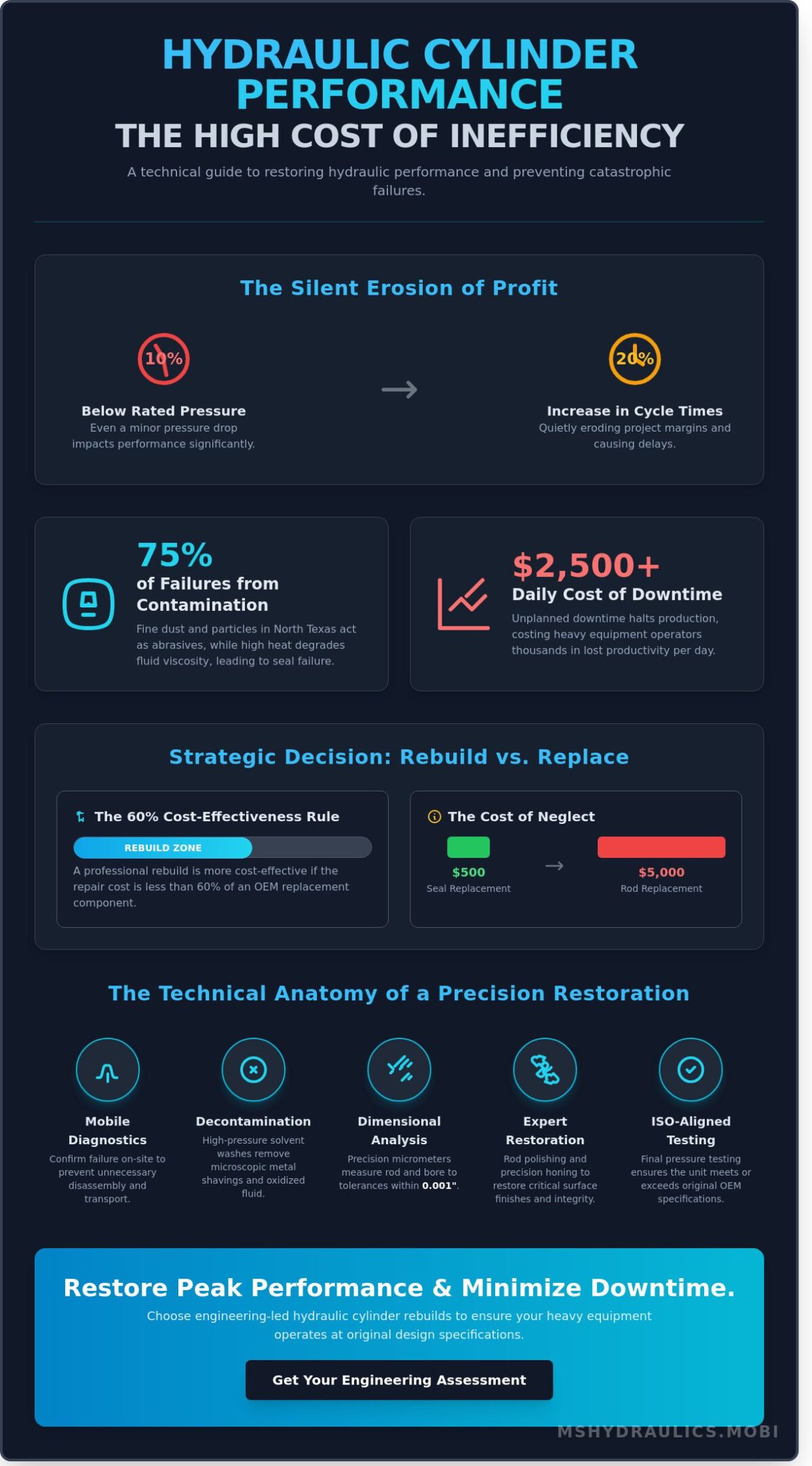
A hydraulic system operating at just 10 percent below its rated pressure can increase cycle times by up to 20 percent, quietly eroding project margins long before a catastrophic failure occurs. You recognize that in heavy-duty industrial applications, a “patch” repair is often a precursor to more extensive mechanical damage. Choosing a professional hydraulic cylinder rebuild in Granbury isn’t just about stopping a leak; it’s about restoring the precise tolerances and displacement parameters required for high-performance operation. We understand that your fleet’s reliability depends on components that meet or exceed original design specifications.
This technical guide outlines the engineering-backed process of restoring hydraulic performance while minimizing the logistical headaches of equipment downtime. We’ll examine the specific criteria for rebuild versus replace decisions, the importance of ISO-aligned testing, and how to extend the operational lifespan of your heavy machinery. From analyzing rod finishes to verifying seal compatibility, this overview ensures you have the data needed to maintain a disciplined maintenance schedule for your industrial assets.
Key Takeaways
- Learn the technical phases of precision cylinder restoration, emphasizing the use of micrometers to verify exact bore and rod dimensions.
- Apply the “60% rule” and lead-time metrics to determine when a professional hydraulic cylinder rebuild Granbury is more cost-effective than an OEM replacement.
- Discover how mobile diagnostics can confirm hydraulic failure on-site, preventing unnecessary disassembly and reducing operational overhead.
- Understand the impact of engineering-led repair standards on the reliability and performance of heavy equipment in industrial applications.
The Critical Role of Hydraulic Cylinder Rebuilds in Granbury’s Industries
Granbury’s industrial sector operates under rigorous mechanical demands. From the maintenance of critical water infrastructure at Lake Granbury to the high-torque requirements of local agricultural operations, the reliability of heavy machinery is non-negotiable. When a component fails, it’s more than a mechanical inconvenience; it’s a logistical bottleneck that halts production. A precision hydraulic cylinder rebuild Granbury service ensures that equipment returns to original equipment manufacturer (OEM) specifications, preventing the recurring failures associated with surface-level repairs. Understanding the Technical Anatomy of a Hydraulic Cylinder is essential for operators to distinguish between a temporary “patch” and a precision-engineered restoration. While a simple seal swap might stop a visible leak, it often ignores underlying issues like rod scoring or barrel ovality that lead to catastrophic failure within 200 operating hours.
Operational overhead in North Texas is closely tied to equipment uptime. According to 2023 industry data, unplanned downtime can cost heavy equipment operators upwards of $2,500 per day in lost productivity. In Granbury, where infrastructure projects must adhere to strict seasonal timelines, these delays aren’t acceptable. Engineering-led rebuilds focus on restoring the structural integrity of the cylinder, utilizing pressure testing and precision honing to ensure the unit handles its rated displacement and pressure without bypass leakage.
Common Failure Points in North Texas Heavy Equipment
Texas environmental conditions accelerate component wear. Sustained summer temperatures exceeding 105°F cause hydraulic fluids to lose viscosity, leading to seal hardening and eventual cracking. In the dusty environments typical of North Texas construction sites, fine particulate matter acts as an abrasive, scoring the chrome plating on rods. Industry studies indicate that 75% of hydraulic failures stem from fluid contamination. Identifying early warning signs like cylinder drift or erratic movement is vital. Neglecting a $500 seal replacement often results in a $5,000 rod replacement if the internal piston makes metal-to-metal contact with the barrel wall.
Local Logistics: Why Proximity Matters for Component Repair
Proximity is a strategic advantage for Granbury businesses. Shipping heavy industrial components, which often exceed 400 pounds, incurs significant freight costs and increases the carbon footprint of the repair process. By utilizing local expertise, companies reduce transit-related downtime by 48 hours or more. Leveraging on-site diagnostic services allows technicians to identify hydraulic circuit issues before the cylinder is even removed. This localized approach supports the Granbury economy and ensures that technical partnerships are built on immediate, high-standard accountability rather than distant, third-party logistics.
The Technical Anatomy of a Precision Cylinder Restoration
A successful hydraulic cylinder rebuild in Granbury begins with a systematic teardown and decontamination process. Technicians strip every component to its base substrate, removing oxidized fluid and particulate matter that accumulates during high-cycle operations. We use precision micrometers to conduct a comprehensive dimensional analysis, measuring the rod and bore to tolerances within 0.001 inches. This data-driven approach determines if a component meets the required specifications for reuse. Before proceeding with repairs, operators often perform a Strategic Evaluation: When to Rebuild vs. Replace to ensure the restoration remains cost-effective compared to new unit procurement.
Our decontamination phase utilizes high-pressure solvent washes to eliminate microscopic metal shavings. These contaminants cause catastrophic failure if they’re left in the system. We check for “barrel ballooning” by measuring the center of the tube against the ends. If the variance exceeds 0.010 inches, the cylinder barrel won’t maintain a proper seal under load. This level of scrutiny ensures that every hydraulic cylinder rebuild Granbury project we undertake meets the exact engineering standards of the original manufacturer.
Rod Polishing and Honing Procedures
Maintaining hydraulic integrity requires specific surface finishes. We apply a controlled cross-hatch pattern to the internal cylinder bore. This texture is vital for oil retention; it ensures the piston seal remains lubricated during the full stroke. Simultaneously, we polish the chrome rod to eliminate micro-abrasions. These tiny scratches act as sandpaper against new seals, causing premature leaks. If we identify scoring deeper than 0.005 inches or structural deformities, we move the component to our machining center for resurfacing or replacement.
Advanced Seal Technology and Material Science
Material selection is critical for local performance. While standard nitrile seals suffice for moderate environments, Texas summers often push hydraulic fluid temperatures beyond 210°F. In these conditions, we utilize high-temperature fluorocarbon compounds to prevent thermal hardening. We integrate glass-filled nylon wear rings and aggressive urethane wipers to block external contaminants from entering the system. The zero-leakage standard for heavy-duty actuators is defined as the complete absence of visible fluid bypass at maximum rated pressure over a 20-minute test interval.
Every completed unit undergoes rigorous pressure testing on a dedicated bench. We cycle the cylinder to 115% of its OEM pressure rating to verify seal seating and structural stability. This ensures the hydraulic cylinder rebuild Granbury professionals provide delivers peak performance in the field. We document these pressure readings as part of our quality assurance certification for every client.
Strategic Evaluation: When to Rebuild vs. Replace Your Hydraulic Components
Determining whether to invest in a hydraulic cylinder rebuild Granbury or purchase a new unit requires a technical assessment of the component’s current state and the project’s timeline. The industry standard 60% rule suggests that if repair costs exceed 60% of a new unit’s market price, replacement is the logical path. However, current market data for 2026 shows that OEM lead times for new components often stretch into months. A precision rebuild typically returns a cylinder to service three times faster than waiting for factory replacements, making it the preferred choice for active job sites where every hour of downtime impacts the bottom line.
Technical evaluation focuses on the structural integrity of the cylinder barrel and head. If the barrel exhibits deep scoring or wall thinning that exceeds safety tolerances, the unit’s pressure rating is compromised. Conversely, if the core structure is sound, restoring the internal seals and rod surface provides a performance profile identical to a new component. For discontinued machinery, a rebuild isn’t just a choice. It’s the only method to maintain operational status for legacy equipment that no longer has factory support. This approach ensures that older, reliable assets continue to perform at 100% capacity without the need for total machine replacement.
Cost-Benefit Analysis for Granbury Fleet Managers
Fleet managers must calculate the total cost of ownership rather than just the initial invoice. Downtime costs for heavy machinery can exceed several thousand dollars per day in lost productivity. Choosing a heavy equipment cylinder rebuild in Texas ensures that the asset’s value is preserved through engineering-grade restoration. High-quality rebuilds offer a superior ROI compared to cheap aftermarket cylinders, which often fail to meet the required torque and pressure specifications. Following established Hydraulic System Safety and Maintenance protocols ensures that these rebuilt units operate within their original design parameters, minimizing the risk of secondary failures in the hydraulic circuit.
Environmental Impact and Sustainability
The hydraulic industry is shifting toward a circular economy model. Rebuilding a cylinder reduces steel waste by up to 85% compared to manufacturing a new component from raw materials. This process consumes significantly less energy, as it bypasses the smelting and heavy machining stages required for new production. Companies that prioritize restoration align their operations with modern sustainability goals. A hydraulic cylinder rebuild Granbury extends the service life of heavy components, proving that industrial efficiency and environmental responsibility are compatible objectives. By focusing on component life-extension, operators reduce their carbon footprint while maintaining high-performance standards.
Mobile Diagnostics and Support for Granbury Job Sites
Field diagnostics provide the technical foundation for every hydraulic cylinder rebuild Granbury operators require. Attempting to remove a heavy-duty cylinder without verifying the failure point often leads to unnecessary labor and extended machine downtime. Our technicians utilize precision diagnostic tools to isolate faults within the circuit before a single bolt is turned. This objective data ensures that the repair strategy is based on engineering facts rather than visual assumptions.
Safety protocols are the primary priority during on-site interventions. We employ strict lockout/tagout (LOTO) procedures to ensure zero energy states before any high-pressure system isolation occurs. Handling cylinders that operate at pressures exceeding 5,000 PSI requires specialized equipment to prevent fluid injection injuries and mechanical collapses. For critical infrastructure projects near the Brazos River or local utility sites, our emergency response teams provide 24-hour support to mitigate the risks of environmental contamination or prolonged project delays.
On-Site Troubleshooting for Construction and Ag
Internal bypass occurs when hydraulic fluid leaks past the piston seals, causing a loss of holding power and significant heat generation. We use portable digital flow meters and pressure gauges to measure these drops in real-time without removing the component from the machine. Often, what appears to be a cylinder failure is actually a worn directional control valve or a pump failing to reach its rated displacement. Our technicians check for these masquerading issues to prevent a hydraulic cylinder rebuild Granbury from being performed on a functional component while the true fault remains elsewhere. We analyze fluid samples for particulate counts according to ISO 4406 standards to identify if system-wide contamination is present.
Streamlining the Logistics of Heavy Component Repair
Logistics are managed through an integrated service network that connects field operations with shop precision. This includes coordinating with mobile hydraulic repair in Cleburne, TX to provide comprehensive support for fleets moving between job sites. We handle the technical logistics of component removal, transport to our specialized facility, and professional reinstallation.
- Coordinated pickup and delivery schedules to minimize the interval between removal and re-commissioning.
- Implementation of heavy equipment maintenance schedules to detect rod scoring or seal hardening early.
- Utilization of site-specific data to adjust seal material specifications based on local Granbury environmental conditions.
- Predictive assessments that extend the interval between major rebuilds by up to 25% through proper filtration and cooling.
By integrating field diagnostics with shop-level engineering, we provide a seamless path from failure to performance. This methodical approach ensures that once a cylinder returns to service, it meets the original equipment manufacturer (OEM) specifications for pressure and torque.
Ms. Hydraulics: Engineering Excellence in Granbury Cylinder Repair
Ms. Hydraulics operates with a technical rigor that separates industrial-grade repair from simple seal replacement. Our facility in Cleburne implements ISO 9001:2015 quality management standards to ensure every component meets original equipment manufacturer (OEM) specifications. We provide a distinct advantage by merging the speed of mobile service with the precision of high-tolerance machining. This approach reduces downtime for Granbury’s heavy equipment operators while maintaining the structural integrity of the hydraulic systems. A hydraulic cylinder rebuild Granbury requires more than basic tools; it demands an understanding of fluid dynamics and material science.
Every project begins with a comprehensive teardown analysis. We don’t just fix the leak; we identify the root cause of failure, whether it’s side-loading, contamination, or thermal degradation. Our clients receive detailed reports documenting rod straightness, bore measurements, and seal condition. This transparency builds the foundation for long-term partnerships with construction and industrial leaders throughout Hood County. We value reliability and performance, positioning our firm as a serious partner for those managing complex fleets.
A Disciplined Approach to Hydraulic Performance
Our technical focus prioritizes mechanical reliability over marketing narratives. By adhering to strict engineering tolerances, we ensure your fleet operates at peak efficiency under high-pressure conditions. Our Cleburne-based facility utilizes specialized testing benches to verify performance before any unit returns to the field. This methodical process eliminates the guesswork often found in general repair shops. We’ve established a firm 2026 commitment to achieving zero-fail hydraulic restorations across all service lines.
Getting Started with Your Granbury Rebuild Project
Securing a professional hydraulic cylinder rebuild Granbury service starts with a technical assessment. Contact our engineering team to provide your cylinder’s make, model, and observed failure symptoms. Before transport, follow these preparation steps to ensure a smooth intake:
- Thoroughly clean the exterior to prevent site contamination during transport.
- Securely cap all ports to protect internal valves and bore surfaces from debris.
- Include documentation regarding the cylinder’s duty cycle and recent performance issues.
Following these protocols ensures an efficient intake process and a faster return to service. Our team handles the logistics, providing a seamless transition from the job site to our precision repair facility. Partner with MS Hydraulics for your next cylinder restoration to ensure your equipment maintains its mechanical advantage and operational longevity.
Optimize Your Heavy Equipment Performance
Maintaining heavy machinery requires more than basic maintenance; it demands a rigorous adherence to engineering standards. A professional hydraulic cylinder rebuild Granbury ensures that components meet original equipment manufacturer specifications, preventing catastrophic failure in high-pressure environments. MS Hydraulics utilizes ISO-standard aligned repair processes to restore performance levels across construction, agriculture, and industrial applications. Our technicians provide mobile diagnostic support throughout Hood County, identifying specific seal wear or rod scoring before these issues lead to total equipment downtime. By prioritizing precision over temporary fixes, operators extend the lifecycle of their hydraulic systems while maintaining strict safety protocols. We’ve built our reputation on technical accuracy and disciplined execution for every project we oversee. Reliability isn’t just a goal; it’s a standard we meet through verified engineering practices and systematic testing. It’s essential to address fluid contamination and pressure drops before they compromise your operational schedule. Trusting an industrial veteran with your hydraulic assets minimizes risk and maximizes output. We’re ready to bring our mobile engineering unit to your job site today.
Schedule a Technical Diagnostic for Your Granbury Equipment
Your equipment deserves the precision of certified hydraulic experts who understand the demands of the Texas industrial landscape.
Frequently Asked Questions
How long does a typical hydraulic cylinder rebuild take in Granbury?
A standard hydraulic cylinder rebuild Granbury project typically requires 2 to 5 business days for completion. This timeline accounts for the initial disassembly, component cleaning, and the installation of new seal kits. If custom machining for a rod or barrel is necessary, the schedule may extend to 10 business days to ensure all tolerances meet original manufacturer specifications.
Is it cheaper to rebuild or replace a hydraulic cylinder?
Rebuilding a cylinder typically saves 40% to 60% compared to the cost of purchasing a new OEM replacement. This economic advantage is most pronounced in large-bore industrial components where the structural integrity of the steel remains intact. Our engineering assessment determines if the component’s fatigue life justifies the investment in a comprehensive rebuild versus a total replacement.
What are the most common causes of cylinder failure on North Texas job sites?
Fluid contamination accounts for approximately 80% of hydraulic failures observed on North Texas job sites. The high concentration of silica dust in the local environment often bypasses worn wiper seals, leading to internal scoring. Additionally, regional temperature fluctuations that exceed 100 degrees Fahrenheit cause seal hardening, which results in a 25% increase in bypass leakage.
Can you perform a cylinder rebuild on-site at my Granbury location?
We don’t perform full rebuilds on-site because the process requires a controlled environment to prevent particulate ingress. Achieving the necessary ISO 4406 cleanliness standards is impossible in field conditions. Every hydraulic cylinder rebuild Granbury service is conducted in our specialized facility, where we utilize 5,000 PSI test benches to verify performance before the unit returns to the field.
Do you provide a warranty or performance guarantee on your rebuilds?
Every rebuild we complete carries a 12-month warranty against defects in materials and workmanship. This guarantee is backed by a rigorous quality control process where each unit undergoes static and dynamic pressure testing. We record all performance data to ensure the cylinder meets or exceeds its original rated operating pressure and cycle speed.
What information do I need to provide for a cylinder repair quote?
You should provide the equipment manufacturer’s name, the model number, and the cylinder serial number for an accurate quote. If the ID tag is missing, we require the bore diameter, rod diameter, and the closed-center-to-center length. Providing these 5 specific data points allows our team to source the correct seal kits and estimate machining hours with 95% accuracy.
How do I know if my cylinder rod needs to be replaced instead of just polished?
A cylinder rod requires replacement if it exhibits scoring deeper than 0.005 inches or if the chrome plating has peeled over more than 10% of the surface. While light oxidation can be addressed through polishing, structural bends exceeding 0.001 inches per foot of length necessitate a new rod. We use precision micrometers to verify these dimensions during our initial 15-point inspection.
Does MS Hydraulics handle large-bore industrial cylinders?
MS Hydraulics manages industrial cylinders with bores up to 24 inches and stroke lengths reaching 30 feet. Our heavy-duty overhead cranes and specialized honing equipment are designed to handle components weighing up to 10,000 pounds. This capacity ensures that large-scale mining and construction equipment receives the same engineering precision as smaller utility components.