Professional Hydraulic Cylinder Honing in Granbury: A Technical Guide to Component Longevity
Why do your hydraulic seals fail just weeks after a costly rebuild on a Granbury job site? While a simple seal replacement seems like the logical fix, failing to invest in professional hydraulic cylinder honing Granbury technicians provide often leads to recurring mechanical failure. You’re likely frustrated by the excessive downtime and the mounting costs of new OEM replacements, especially when North Texas dust and heat accelerate component wear. It’s a common challenge for industrial operations where reliability is a non-negotiable requirement for performance.
This guide demonstrates how precision honing restores your components to exact OEM specifications, ensuring your equipment can withstand demanding environments. We’ll examine the technical necessity of the cross-hatch micro-texture for lubrication retention and how proper surface finishing prevents premature seal degradation. By focusing on verified mechanical parameters and disciplined machining processes, you can extend the intervals between rebuilds and maximize the operational life of your heavy machinery. Discover the engineering principles that turn a standard repair into a long-term reliability strategy.
Key Takeaways
- Precision machining corrects cylinder bore geometry and surface texture, restoring operational efficiency to strict OEM specifications.
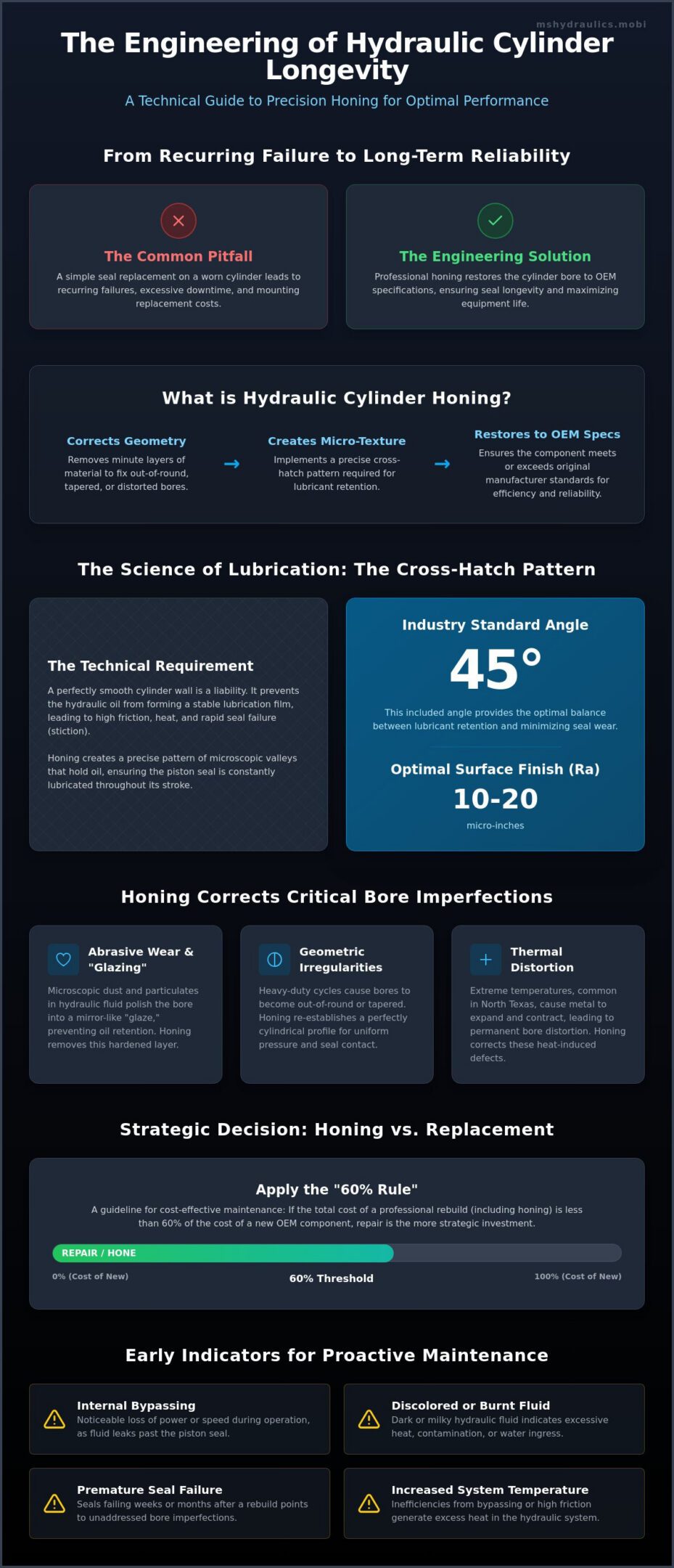
- The implementation of a 45-degree cross-hatch pattern is technically required to facilitate oil retention and maintain the lubrication film necessary for seal longevity.
- Apply the “60% Rule” to determine whether to invest in professional hydraulic cylinder honing Granbury services or proceed with full component replacement.
- Recognizing early indicators such as internal bypassing and discolored hydraulic fluid allows for proactive maintenance before catastrophic system failure occurs.
- A comprehensive failure analysis is essential for identifying the specific environmental stressors in North Texas that contribute to premature component wear.
The Role of Hydraulic Cylinder Honing in Granbury Operations
In the context of industrial maintenance, Honing (metalworking) is defined as a precision abrasive machining process that produces a controlled surface finish and corrects the internal geometry of a cylinder bore. For heavy equipment operators, hydraulic cylinder honing Granbury services are essential for maintaining the mechanical integrity of high-pressure systems. This process doesn’t simply polish the metal; it utilizes specialized stones to remove minute layers of material, ensuring the barrel remains perfectly cylindrical and possesses the necessary texture to retain hydraulic fluid.
The environmental conditions in North Texas, specifically the extreme thermal profiles, contribute significantly to bore distortion. As cylinders reach high operating temperatures during summer months, the metal expands. Over thousands of duty cycles, this thermal stress can lead to permanent geometric irregularities. Without professional honing, these distortions create uneven pressure distribution across the piston seals, leading to rapid degradation and system inefficiency. It’s a critical step that restores the component to a state that meets or exceeds original equipment manufacturer standards.
Combating Abrasive Wear in Hood County
Granbury’s active construction and agricultural sectors introduce high concentrations of abrasive particulates into the operating environment. Even with high-quality wipers, microscopic dust eventually bypasses external defenses and enters the hydraulic fluid. These particles act as an unintended abrasive, essentially sanding down the interior bore walls. Over time, this creates a “glaze”—a mirror-like, hardened surface that lacks the texture needed to hold oil. When a technician performs a simple reseal without addressing this glaze, the new seals run dry against the smooth wall. This friction-induced failure often occurs within a few hundred hours of operation, making hydraulic cylinder honing Granbury a non-negotiable part of a successful rebuild.
Correcting Geometric Irregularities
Heavy-duty cycles often cause bores to become “out-of-round” or develop a tapered profile. This means the internal diameter at the center of the stroke may differ from the diameter at the ends. Identifying these variances requires precision measuring tools and technical expertise. Correcting these irregularities is critical for several reasons:
- Seal Integrity: Seals are designed to operate within specific tolerances; geometric deviations cause them to “breathe” or lose contact, leading to internal bypassing.
- Pressure Retention: A true cylindrical bore ensures that hydraulic pressure is applied uniformly, preventing power loss during critical lifts or high-load operations.
- Component Longevity: By restoring the bore to its original specifications, the mechanical stress on the piston and rod is minimized, extending the interval between major rebuilds.
A disciplined approach to honing ensures that the cylinder can handle the rigorous demands of Granbury’s job sites without the risk of premature failure caused by bore irregularities.
The Engineering Science: Cross-Hatch Patterns and Lubrication
Precision engineering dictates that the internal surface of a hydraulic barrel must not be perfectly smooth. Instead, a controlled pattern of microscopic scratches, known as a cross-hatch, is required to facilitate oil retention. This is the primary objective of hydraulic cylinder honing Granbury technicians pursue during a professional overhaul. A 45-degree included angle is the industry standard because it provides the optimal balance between lubricant distribution and seal wear. Research detailed in this SAE Technical Paper on Cylinder Honing confirms that the depth and frequency of these microscopic “valleys” determine the stability of the oil film under high-pressure conditions.
If the bore is too smooth, the seal wipes the surface entirely dry. This creates high friction and heat, eventually causing the seal material to bond to the barrel wall in a phenomenon called stiction. Measuring surface roughness (Ra) is the primary method used to verify a successful hone. For most industrial hydraulic applications, an optimal surface roughness (Ra) value typically ranges between 10 and 20 micro-inches. Technicians use profilometers to confirm these parameters, ensuring the component meets the rigorous standards required for heavy-duty operation in North Texas.
The Mechanics of the Cross-Hatch
The pattern is created through the simultaneous rotation and vertical reciprocation of the honing head. This dual-axis motion ensures that the abrasive stones cut at opposing angles, forming the characteristic diamond pattern. During the initial operation of a rebuilt cylinder, the cross-hatch helps “seat” the new seals by wearing down the microscopic peaks of the metal while preserving the valleys for oil storage. The industry standard for industrial hydraulic cylinder bores is an Ra value range of 0.25 to 0.50 micrometers (10 to 20 micro-inches).
Lubrication Retention vs. Fluid Bypassing
Without these microscopic reservoirs, seals are subjected to dry-running, which leads to rapid thermal degradation and eventual failure. However, the pattern must be precise. If the valleys are too deep, hydraulic fluid can bypass the seal at high pressures, reducing the volumetric efficiency of the system. Proper hydraulic cylinder honing Granbury ensures that the surface finish remains within the specified Ra parameters to minimize heat generation. Achieving this exacting standard is essential for the long-term reliability of hydraulic cylinder rebuilds performed in demanding industrial environments.
Strategic Decision: Honing vs. Boring vs. Replacement
Determining the most cost-effective path for a damaged cylinder requires an objective evaluation of repair costs versus the procurement of new components. The “60% Rule” serves as the primary benchmark in this decision matrix. If the projected cost of a comprehensive rebuild exceeds 60% of the cost of a new OEM replacement, full component replacement is typically the more viable long-term investment. However, current market conditions in 2026 often involve extended lead times for new cylinders. This makes hydraulic cylinder honing Granbury an essential alternative for maintaining fleet availability and minimizing logistical delays associated with international shipping.
Honing is a surface correction method, while boring is used for dimensional correction. When deep scoring or cavitation exceeds the depth that can be safely removed by a hone, boring is required to restore the bore to a larger, uniform size. This process necessitates the use of oversized pistons and seals to maintain system pressure. If the cylinder wall thickness is compromised beyond safety standards, the integrity of the pressure vessel is at risk. In cases of rare or high-value legacy cylinders where replacements are unavailable, technicians may utilize “sleeving” to press a new liner into the existing barrel, effectively restoring the internal diameter without replacing the entire tube.
Comparing Cylinder Restoration Methods
Honing corrects surface texture and minor “out-of-round” conditions. Boring is reserved for severe structural damage that requires removing significant material. Sleeving provides a path for salvaging specialized components when the original barrel is too thin for further boring. Removing too much material from the cylinder wall reduces its ability to withstand high-pressure spikes; this creates a risk of catastrophic barrel failure during operation.
Financial Impact for Granbury Fleet Managers
The hidden costs of “cheap” repairs often manifest as premature seal failure and secondary system contamination. Utilizing hydraulic cylinder honing Granbury during a standard reseal significantly extends the Mean Time Between Failures (MTBF) for critical assets like excavators and skid steers. This proactive approach aligns with industry data showing that reactive repairs typically cost 3 to 4 times more than preventive maintenance. Determining the correct restoration path begins with professional On-Site Diagnostic Services. This initial analysis identifies whether the bore requires simple surface preparation or more intensive machining, ensuring that maintenance budgets are allocated with technical precision.
Signs Your Equipment Needs Hydraulic Cylinder Honing
Identifying the specific indicators of bore degradation is the first step in preventing catastrophic system failure. When a machine fails to hold a load or “drifts” during operation, it often suggests internal bypassing. Even with new seals, a distorted or glazed bore allows pressurized fluid to escape past the piston. This loss of volumetric efficiency is a primary reason to seek professional hydraulic cylinder honing Granbury services. Beyond performance loss, discolored hydraulic fluid serves as a clear indicator of excessive thermal oxidation or metal-on-metal wear within the barrel.
Audible and tactile feedback also provide critical diagnostic data during operation. Chattering or jerky movements during cylinder extension indicate a “stick-slip” effect, often caused by the loss of the cross-hatch pattern discussed in previous sections. Without those microscopic oil reservoirs, the seal grabs and releases the metal surface repeatedly. Visible scuffing on the cylinder rod or bore confirms that abrasive particulates have compromised the surface finish, requiring immediate technical intervention to prevent further damage.
Diagnostic Indicators in the Field
Operators can perform a simple “drift test” on a Granbury job site by extending the cylinder under load and measuring the retraction over a set period. If the drift exceeds manufacturer specifications, the bore geometry or finish is likely compromised. Another visual cue is “rainbowing” on the chrome rod; this iridescent discoloration indicates the cylinder has surpassed its thermal limits. Recurring seal leaks remain the most common indicator that the bore surface is no longer capable of maintaining a proper lubrication film, making hydraulic cylinder honing Granbury essential for a permanent fix.
Preventative Maintenance Cycles
Incorporating a detailed bore inspection into your Heavy Equipment Maintenance schedule prevents minor wear from escalating into expensive repairs. Fluid analysis is another indispensable tool. It identifies the presence of metallic particulates before they cause visible scoring. Maintaining strict fluid cleanliness standards according to ISO 4406 is the primary defense for protecting honed surfaces from abrasive degradation. Early detection through these methods allows for scheduled maintenance rather than emergency repairs.
If your machinery exhibits these symptoms, schedule a professional hydraulic cylinder rebuild to restore your equipment to peak operational efficiency.
Ms. Hydraulics: Precision Honing and Rebuilds in Granbury
Ms. Hydraulics LLC employs a disciplined, engineering-first methodology to every project. Before any material is removed from the bore, a comprehensive failure analysis is conducted to determine the root cause of the component’s degradation. This diagnostic phase ensures that the hydraulic cylinder honing Granbury technicians perform is not just a standard procedure but a targeted solution for specific mechanical issues. Our proximity to major industrial hubs allows for a rapid turnaround, serving Granbury, Cleburne, and the broader DFW metroplex with technical precision.
A successful restoration requires more than just bore correction. Our process integrates precision honing with rod polishing and the application of advanced sealing technologies. This holistic approach ensures that the entire assembly, not just the barrel, meets the high-performance requirements of international industry standards. We don’t recommend honing unless the technical data indicates a clear return on investment for your fleet. Integrity remains our primary operational value, ensuring that every repair adds measurable life to your equipment.
The Ms. Hydraulics Standard for Granbury Clients
Our Heavy Equipment Cylinder Rebuild process is specifically tailored to the unique operational challenges of North Texas. Whether managing drill rigs in the Barnett Shale or high-cycle earthmovers on construction sites, our technicians understand the impact of local environmental stressors. The final phase of our restoration involves rigorous pressure testing. This verification step confirms that the newly honed surface and seal configuration can withstand peak operating pressures without internal bypassing or external leakage. We utilize specialized instrumentation to verify that the cylinder maintains its load-holding capability under maximum stress.
Minimize Downtime with Expert Support
For operations where transporting heavy components is logistically prohibitive, our Mobile Hydraulic Repair capabilities provide a critical advantage. We offer on-site failure analysis and diagnostic services directly on Granbury job sites, allowing fleet managers to make informed decisions without unnecessary delays. To schedule a technical consultation or a diagnostic call-out in Hood County, contact our team to discuss your specific equipment requirements. Our focused expertise in hydraulic cylinder honing Granbury ensures your machinery returns to service with verified reliability and extended component longevity. By addressing the bore finish and geometry with precision, we help you avoid the recurring failures common in demanding industrial environments.
Optimizing Component Performance for Granbury’s Heavy Equipment
Maintaining the mechanical integrity of high-pressure industrial actuators requires a disciplined approach to surface preparation and geometric correction. The precision machining of the cylinder bore is the only method to ensure a stable lubrication film and prevent premature seal failure. By adhering to rigorous technical standards, operators can significantly extend the interval between major rebuilds and avoid the high costs of unplanned downtime on local job sites. This methodical focus on surface finish remains a critical parameter for long-term reliability.
Utilizing professional hydraulic cylinder honing Granbury services allows fleet managers to restore equipment to OEM specifications while navigating current logistical challenges. Since 2021, we have provided specialized on-site diagnostics across Hood County, focusing on the unique environmental stressors found in North Texas. This data-driven approach ensures that every maintenance action provides a measurable return on investment for your operation. Don’t let bore glaze or geometric irregularities compromise your system’s volumetric efficiency.
Request a Technical Quote for Cylinder Honing in Granbury today to secure the reliability of your heavy machinery. Our team is ready to assist you in achieving peak operational performance.
Frequently Asked Questions
Is hydraulic cylinder honing necessary every time I replace seals?
Professional technicians recommend light honing during every reseal to ensure the longevity of the new components. This process removes the hardened glaze that forms on the barrel walls and restores the cross-hatch pattern required for oil retention. Skipping this step often results in the new seals running against a mirror-smooth surface, which causes excessive friction and leads to premature seal failure shortly after the repair.
Can honing be performed on-site at my Granbury job site?
Precision honing is almost exclusively a shop-based service due to the scale of the machinery and the need for a controlled environment. While mobile units provide essential diagnostic services and component removal across Hood County, the actual machining requires specialized horizontal or vertical honing tanks. These facilities ensure that the bore geometry is corrected with a level of accuracy that isn’t possible in a field environment.
How much material is actually removed during the honing process?
The honing process is designed for surface correction rather than significant dimensional changes, typically removing only 0.001 to 0.005 inches of material. This minimal removal is sufficient to eliminate minor scuffing and restore the desired surface roughness (Ra). If damage is deep enough to require more substantial material removal, the cylinder may require boring to an oversize dimension to maintain structural integrity.
What is the difference between honing and deglazing a cylinder?
Honing is a comprehensive machining process that corrects geometric irregularities, while deglazing only addresses the surface finish. Deglazing uses light abrasives to break the “mirror” finish of a cylinder, but it cannot fix a tapered or out-of-round bore. Professional hydraulic cylinder honing Granbury services utilize rigid stones to ensure the barrel is perfectly cylindrical while simultaneously establishing the technical cross-hatch texture.
How long does it typically take to hone and rebuild a standard excavator cylinder?
Turnaround times for a standard rebuild including honing generally range from two to five business days depending on the extent of the internal damage. This timeline accounts for the initial failure analysis, precision machining, seal installation, and mandatory high-pressure testing. Local service providers help minimize this window by eliminating the long transit times associated with shipping components to distant OEM facilities.
What happens if a cylinder bore is too damaged to be honed?
When scoring or pitting exceeds the depth that honing can safely correct, the barrel must be bored or replaced entirely. Boring involves cutting the internal diameter to a larger size, which then necessitates the use of oversized pistons and specialized seal kits. Technicians evaluate the remaining wall thickness against safety standards to ensure the cylinder can still withstand peak operating pressures without the risk of barrel failure.
Will honing my cylinder affect the size of the seals I need to use?
Standard honing does not change the required seal size because the amount of metal removed is negligible. Since the process only clears a few thousandths of an inch, standard OEM seal kits remain compatible with the restored bore. Only in cases where boring is required to remove deep damage will the technician need to source non-standard, oversized sealing components to maintain a proper fit.
How does honing improve the cooling efficiency of my hydraulic system?
Honing improves thermal efficiency by significantly reducing the friction generated between the piston seals and the barrel wall. By establishing a consistent lubrication film via the cross-hatch pattern, the system operates with less resistance. This reduction in mechanical friction leads to lower fluid temperatures, which protects the chemical stability of the hydraulic oil and prevents the “rainbowing” often seen on overheated rods.