Non Conductive Hose Guide for DFW Utility Equipment
Non-conductivity is a perishable safety feature, not a permanent material property. While a new hose might meet dielectric standards at the time of fabrication, environmental wear and hydraulic fluid contamination can compromise its insulating capabilities without visible warning. For utility crews operating aerial lifts and drill rigs across the DFW metroplex, the distinction between a standard hydraulic line and certified non conductive hoses is often the only barrier against lethal electrical discharge.
It’s understandable that fleet managers feel pressured by the complexity of SAE J517:202007 standards and the confusion between 100R7 and 100R8 specifications. You prioritize the safety of your operators and the reliability of your equipment, yet maintaining rigorous compliance with OSHA 1910.269 requires more than just buying orange hoses. This guide will help you master the technical specifications, leakage current maximums, and maintenance protocols necessary to protect your crew in high-voltage environments. We will examine the critical differences in thermoplastic hose lifespans, clarify the latest SAE J1273-2021 recommended practices, and outline how to secure reliable, custom-fabricated assemblies in the Cleburne area to minimize your operational downtime.
Key Takeaways
- Differentiate between SAE 100R7NC and 100R8NC standards to ensure your hydraulic systems maintain the required dielectric integrity for high-voltage utility work.
- Learn why non conductive hoses utilize thermoplastic elastomer (TPE) cores and synthetic fiber reinforcement to eliminate the risk of electrical conductivity.
- Implement a rigorous inspection checklist to identify fluid wicking, cover abrasions, and other indicators of compromised dielectric performance before failure occurs.
- Leverage custom on-site fabrication and mobile diagnostic services in Cleburne and the DFW area to ensure exact assembly lengths and specialized fitting compatibility.
- Understand the specific maintenance protocols required for aerial lifts and rescue tools to remain compliant with OSHA 1910.269 and ANSI safety standards.
Understanding Non-Conductive Hydraulic Hoses and SAE Standards
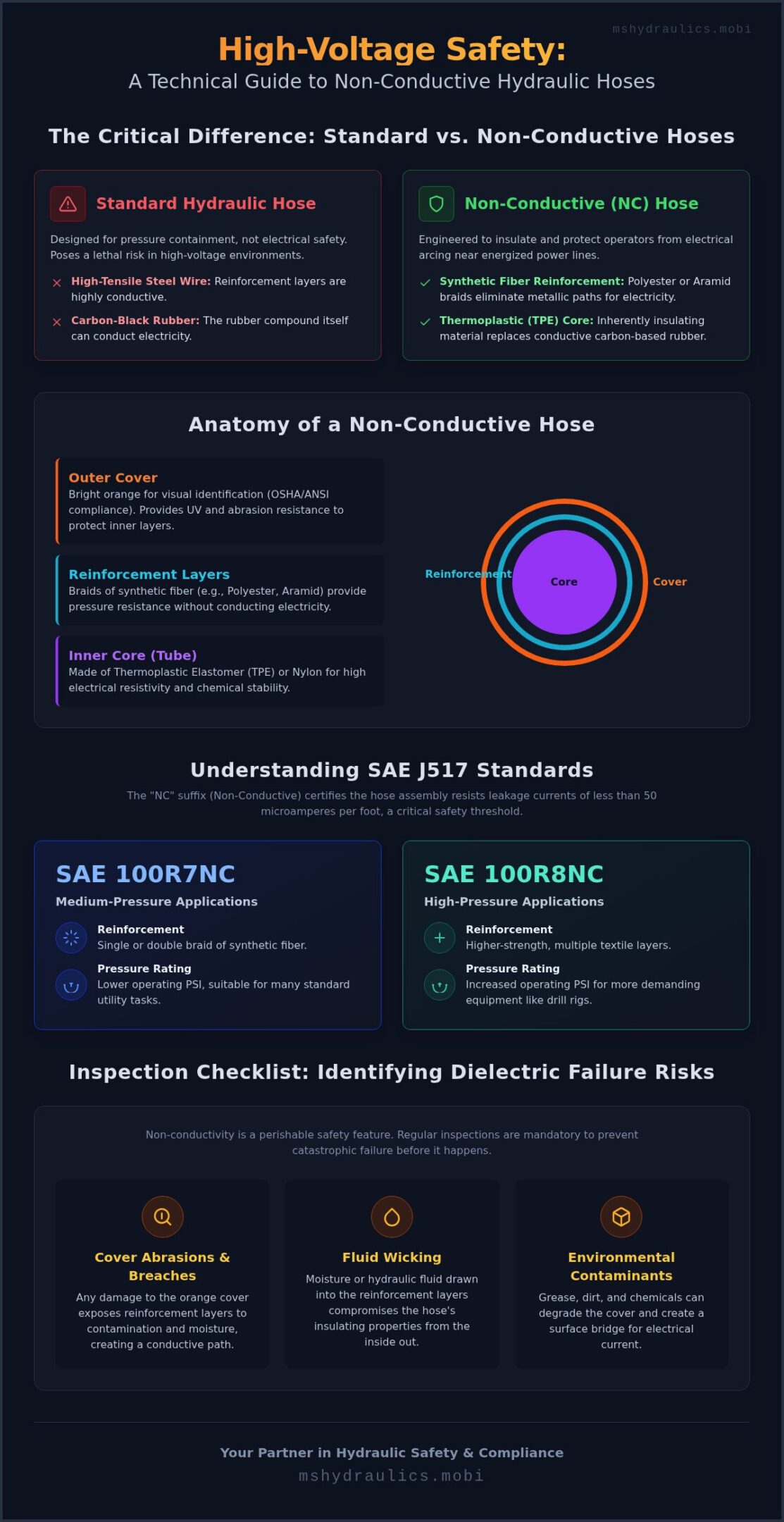
Standard Hydraulic machinery often utilizes rubber hoses reinforced with high-tensile steel wire. While effective for pressure containment, these materials conduct electricity through both the metal wire and the carbon-black used in the rubber compound. Non conductive hoses are engineered specifically for high-voltage environments where electrical arcing poses a lethal risk to operators. These specialized lines utilize thermoplastic materials and synthetic fiber reinforcements to ensure zero metallic contact between the hydraulic system and energized electrical lines.
The Society of Automotive Engineers (SAE) J517:202007 standard dictates the performance parameters for these components. The “NC” suffix stands for Non-Conductive. This designation signifies that the hose has been tested to meet specific dielectric strength requirements, typically resisting leakage currents of less than 50 microamperes per foot at a specified voltage. This verification is essential for utility fleets in the DFW area that operate near energized power lines, as it provides a documented safety threshold for dielectric performance that standard rubber hoses cannot provide.
SAE 100R7NC vs. 100R8NC: Technical Differences
The primary distinction between these categories lies in their pressure ratings and reinforcement architecture. SAE 100R7NC is a medium-pressure hose, often utilizing a single or double braid of synthetic fiber. In contrast, SAE 100R8NC is designed for high-pressure applications, featuring higher-strength textile layers that allow for increased operating PSI without sacrificing the dielectric properties required for utility work. Both standards mandate that the hose assembly maintains its insulating properties even after repeated pressure cycles. Choosing the correct standard depends on the specific hydraulic requirements of the aerial lift or drill rig being serviced by your maintenance team.
The Role of the Orange Outer Cover
The universal orange cover is not an aesthetic choice; it’s a critical safety requirement for OSHA 1910.269 and ANSI compliance. This color coding provides immediate visual verification that a hose is non-conductive, preventing the accidental installation of conductive rubber lines on bucket trucks. In the harsh North Texas environment, this cover must provide superior UV resistance and abrasion protection to prevent the core from being exposed to environmental contaminants. If the cover is breached, moisture or conductive fluids can wick into the reinforcement layers, creating a path for electricity and rendering the hose unsafe. This makes the integrity of the orange cover a primary barrier against both physical wear and electrical conductivity.
Technical Composition and Dielectric Properties
The engineering of non conductive hoses centers on the total elimination of metallic components and carbon-based materials that facilitate electrical flow. While standard hydraulic lines rely on high-tensile steel wire for pressure containment, dielectric hoses utilize synthetic fiber braids, such as polyester or aramid. This material shift ensures that the hose assembly does not act as a bridge for electricity between energized utility lines and the ground. The core of these hoses is typically constructed from Thermoplastic Elastomer (TPE), a material selected for its high electrical resistivity and superior chemical stability compared to traditional nitrile or neoprene rubbers.
Thermoplastic Elastomer (TPE) Engineering
TPE serves as the critical internal barrier in dielectric assemblies. Unlike standard rubber, which contains carbon black as a reinforcing agent, TPE is formulated to be inherently insulating. This material maintains its chemical resistance when exposed to various hydraulic fluids and environmental chemicals found on North Texas job sites. In terms of physical performance, TPE provides a consistent bend radius across a wide thermal gradient. It remains flexible during rare North Texas freezes and retains its structural integrity during triple-digit summer heat. While some high-pressure applications utilize Nylon cores for their increased tensile strength, TPE is often preferred for its balance of flexibility and long-term dielectric stability. If you require a specific material analysis for your fleet, our technicians can provide on-site diagnostic services to evaluate your current hose configurations.
Managing Leakage Current and Arcing Risks
Dielectric performance is quantified by leakage current, which SAE J517 limits to a maximum of 50 microamperes per foot when subjected to 75,000 volts per foot for five minutes. This limit exists to prevent catastrophic arcing that could endanger operators. However, these laboratory ratings assume the hose is in pristine condition. Environmental factors like high humidity or temperature fluctuations can alter the molecular behavior of the thermoplastic layers, potentially increasing the risk of conductivity. Moisture ingress is the most significant threat; if water wicks into the fiber reinforcement through a breached cover, the hose becomes a conductor rather than an insulator.
Surface contamination also poses a severe hazard. Dirt, hydraulic oil, and metallic dust can facilitate “electrical tracking” along the exterior of the assembly. This phenomenon allows current to travel across the surface of the hose even if the internal layers remain non-conductive. Maintaining the absolute cleanliness of orange hoses is a non-negotiable requirement for preserving their dielectric integrity. Adhering to these OSHA safety requirements is essential for any crew working near energized lines, as even a minor layer of grime can turn a safety component into a lethal liability.
Critical Applications for Non-Conductive Lines in North Texas
In the North Texas utility sector, the deployment of non conductive hoses is a mandatory safety protocol for equipment operating within the Minimum Approach Distance (MAD) of energized electrical lines. Bucket trucks and aerial lifts used by telecommunications and power providers represent the most frequent application. These vehicles rely on dielectric hose assemblies in the boom and outrigger systems to prevent the chassis from becoming energized during line maintenance. Beyond standard utility work, specialized “hotline” tools and live-line equipment require these hoses to maintain a high level of electrical isolation while transmitting hydraulic power to cutters, crimpers, and impact wrenches.
Emergency response operations also necessitate specialized hydraulic architecture. Hydraulic rescue tools, commonly known as the “jaws of life,” are often deployed at accident sites where damaged infrastructure or downed power lines create high-voltage hazards. Using standard wire-reinforced hoses in these scenarios could lead to catastrophic failure or operator electrocution. By adhering to the SAE J517 standard, rescue crews ensure their equipment provides the necessary dielectric barrier to operate safely in unpredictable environments.
Utility and Telecommunications Fleet Requirements
Regional utility providers in DFW manage massive fleets that require consistent heavy equipment maintenance to remain compliant with state and federal safety regulations. Boom hoses are subject to constant flexing and environmental exposure, which can degrade their non-conductive properties over time. Standardized testing intervals for these hydraulic systems usually involve annual dielectric testing to verify the leakage current remains within acceptable parameters. Fleet managers must ensure that every replacement assembly matches the original equipment manufacturer’s pressure and dielectric specifications to avoid compromising the vehicle’s safety rating.
Construction and Industrial Safety in North Texas
Construction sites in the Cleburne and Fort Worth areas often feature complex overhead and underground electrical infrastructure. Drill rigs, skid steers, and excavators operating in these zones face significant risks if a standard hydraulic line makes contact with a live conductor. Integrating non-conductive hoses into these machines adds a critical layer of protection for the operator and the equipment. Contractors often utilize on-site diagnostic services to identify high-risk hydraulic circuits that should be converted to non-conductive thermoplastic lines. This proactive approach helps meet North Texas regulatory requirements for contractors and minimizes the likelihood of high-voltage accidents during excavation or structural assembly.
Maintenance Protocols and Identifying Dielectric Failure
Maintenance of non conductive hoses is a rigorous process that goes beyond standard hydraulic safety. Because these lines serve as primary life-safety components, any degradation in material integrity is cause for immediate decommissioning. A primary threat is “wicking,” where hydraulic fluid or moisture penetrates the orange cover and saturates the synthetic fiber reinforcement. This creates an internal conductive path that can facilitate arcing, even if the exterior appears intact. Fleet managers shouldn’t wait for a visible leak to act; they must establish a replacement schedule based on the severity of the duty cycle and environmental exposure.
Surface contaminants are equally dangerous. Grease, carbon soot, and metallic dust from industrial sites in the DFW area can create a conductive film on the hose exterior. This allows electrical current to track across the surface of the assembly. Cleaning procedures should involve non-conductive solvents and lint-free cloths to ensure the orange cover remains free of particulates. If your equipment operates in high-voltage zones, consistent heavy equipment maintenance is required to verify that these protocols are being followed.
Signs of Immediate Hose Failure
Any breach in the orange cover, including deep abrasions, pinholes, or bubbling, indicates a compromised dielectric barrier. Bubbling often suggests that high-pressure gas or fluid has bypassed the core and is trapped under the cover, potentially leading to a burst. Unlike rubber, thermoplastic lines are prone to internal collapse if they’re subjected to excessive kinking or vacuum conditions. Such structural damage can shed debris into the system, contributing to hydraulic pump failure and subsequent downtime. If the synthetic reinforcement is visible, the hose must be replaced immediately.
Field Testing vs. Laboratory Dielectric Testing
Visual inspections are essential but can’t quantify leakage current. While a hose may look functional, only laboratory dielectric testing can verify it meets the 50 microampere per foot threshold. Professional testing should occur annually or whenever a hose has been subjected to significant mechanical stress. For daily operations, crews should follow this pre-shift inspection guide:
- Clean the entire length of the hose to remove conductive grime.
- Check for localized swelling that indicates core failure.
- Inspect fittings for signs of slippage or corrosion.
- Verify that the orange cover is vibrant and free of UV-induced cracking.
Ensuring your fleet remains compliant with dielectric standards requires technical precision. For expert assistance with hose inspections or to schedule a repair, contact our team for mobile hydraulic services today.
Custom Fabrication and Mobile Service in Cleburne and DFW
Utility fleets in Cleburne and the DFW metroplex can’t rely on generic, pre-cut hydraulic lines when operator safety is at stake. While some suppliers offer bulk rolls, the technical requirements for non conductive hoses demand a higher level of fabrication precision. On-site mobile hydraulic repair allows for the exact measurement of hose runs, ensuring replacement assemblies match the original equipment manufacturer’s routing exactly. This prevents mechanical interference and unnecessary abrasion that could compromise the orange dielectric cover and lead to premature failure.
Precision Fabrication for Non-Conductive Assemblies
The safety rating of an SAE 100R7NC or 100R8NC hose is only as reliable as its weakest component. Using standard conductive steel fittings on a non-conductive line can create a path for electrical arcing, effectively nullifying the dielectric properties of the thermoplastic core. Professional fabrication ensures the use of specialized non-conductive fittings designed to maintain the assembly’s insulating integrity. Additionally, crimping thermoplastic materials requires specific die sets and pressure settings to prevent internal collapse or external leaks. Proper crimping techniques are essential to prevent high-pressure blowouts, which are particularly dangerous in the elevated baskets of aerial lifts. Localized fabrication in Cleburne provides heavy equipment owners with the assurance that their assemblies meet these rigorous technical specifications without the wait times of national shipping.
Mobile Diagnostics and Rapid Response in North Texas
Downtime in the utility sector is costly and often impacts public infrastructure. Our mobile technicians provide rapid field response across Cleburne, Mansfield, Burleson, and the wider DFW area to address hydraulic failures at the job site. This service includes on-site diagnostics to verify system pressure and ensure the entire hydraulic circuit maintains its dielectric strength. Often, a hose failure is a symptom of a larger issue, such as a compromised seal or internal wear. Integrating hose replacement with hydraulic cylinder rebuilds ensures total system reliability and extends the lifespan of your specialized equipment. By performing these services on-site, we eliminate the logistical burden of transporting heavy machinery to a shop. To restore your equipment to safe operating parameters, the next step is to book a mobile hydraulic service call for a comprehensive system evaluation.
Securing Your High-Voltage Operations
Maintaining the dielectric integrity of your hydraulic systems is a non-negotiable requirement for utility fleet safety. As established, non conductive hoses must meet rigorous SAE J517 standards to prevent lethal electrical arcing. Success depends on more than just the initial purchase; it requires disciplined inspection protocols and the absolute elimination of metallic contaminants or moisture wicking. Precision in fabrication is equally vital. Utilizing the correct non-conductive fittings and exact assembly lengths ensures that your equipment remains compliant with OSHA and ANSI standards while operating near energized lines.
Ms. Hydraulics LLC provides the technical expertise necessary to maintain these specialized systems throughout Cleburne and the DFW area. Our mobile technicians deliver on-site precision diagnostics and custom fabrication of SAE 100R7NC and 100R8NC assemblies directly at your job site. This methodical approach minimizes operational downtime while guaranteeing that every component meets the documented leakage current maximums required for high-voltage environments. Request On-Site Non-Conductive Hose Fabrication & Repair to ensure your utility fleet operates with maximum reliability and safety in the field.
Frequently Asked Questions
What makes a hydraulic hose non-conductive?
A hydraulic hose becomes non-conductive through the total exclusion of metallic reinforcements and carbon-black compounds. These specialized lines utilize a Thermoplastic Elastomer (TPE) or nylon inner tube combined with synthetic fiber braids for pressure containment. This architecture prevents the hose from acting as a conduit for electrical current. Standard rubber hoses rely on steel wire, which facilitates conductivity, whereas non conductive hoses ensure zero metallic contact between the hydraulic system and energized power lines.
Can I use standard black rubber hoses on my bucket truck?
No, you should never use standard black rubber hoses on bucket trucks or aerial lifts operating near energized lines. Standard rubber hoses contain carbon black and steel wire reinforcement, both of which conduct electricity. Using these on utility equipment violates OSHA 1910.269 standards and puts operators at risk of lethal electrocution. For high-voltage environments, you must install certified orange dielectric hoses to maintain the required electrical isolation for the vehicle chassis.
How often should non-conductive hydraulic hoses be replaced?
Replacement intervals depend on the specific duty cycle and environmental exposure of the equipment. While there’s no universal expiration date, utility fleets in Cleburne and the DFW area typically perform annual dielectric testing to verify leakage current limits. If a hose fails this test or shows any signs of wicking or cover breach, it requires immediate replacement. Proactive replacement schedules help prevent catastrophic failures during critical utility maintenance tasks or emergency response operations.
What does the orange color on a hydraulic hose mean?
The bright orange color serves as a universal industry identifier for non-conductive hydraulic lines. This color coding is mandated by OSHA and ANSI safety standards to allow for immediate visual verification on job sites. It ensures that technicians and operators don’t accidentally install conductive rubber hoses on equipment requiring dielectric protection. If the orange cover becomes severely faded or discolored, it may indicate UV damage that compromises the hose’s insulating properties and overall structural integrity.
What is the difference between SAE 100R7 and 100R7NC?
The NC suffix indicates that the hose has undergone specific dielectric testing to confirm its non-conductive properties. While a standard SAE 100R7 hose may use thermoplastic materials, it hasn’t been verified to meet the leakage current maximum of 50 microamperes per foot. For high-voltage utility applications, only the 100R7NC designation ensures the assembly provides the necessary electrical resistance. Using a standard R7 hose without the NC certification is a significant safety and compliance risk.
Does dirt or grease on the hose affect its non-conductive properties?
Yes, surface contamination significantly impacts dielectric performance. Dirt, grease, metallic dust, and hydraulic oil can create a conductive path along the exterior of the hose, a phenomenon known as electrical tracking. Even if the internal thermoplastic layers remain non-conductive, a dirty hose can still facilitate an electrical arc between a live line and the ground. Maintaining clean non conductive hoses is essential for ensuring the safety of utility crews in the field.
Can non-conductive hoses be repaired or must they be replaced?
Non-conductive hoses must be replaced entirely if they’re damaged or fail testing. Per the SAE J1273-2021 updated standards, the option to repair hydraulic hose assemblies in the field has been eliminated. Attempting to patch or splice a dielectric line compromises its structural and electrical integrity. For utility fleets in Mansfield or Arlington, the safest protocol is to fabricate a new, certified assembly that meets the original manufacturer’s specifications for pressure and dielectric strength.
Are non-conductive hoses suitable for high-pressure systems?
Yes, non-conductive hoses are engineered for various pressure ranges. While SAE 100R7NC is typically used for medium-pressure applications, the SAE 100R8NC standard is designed specifically for high-pressure systems. These high-pressure lines utilize multiple layers of high-strength synthetic fiber to provide the necessary tensile strength without introducing metallic conductivity. Technicians in the DFW area can specify the correct hose standard based on the hydraulic requirements of your specific drill rig or aerial lift system.