Mobile Hydraulic Pump Rebuilds: North Texas Guide
Replacing a failed hydraulic pump with a new OEM unit is often an unnecessary expenditure that extends heavy equipment downtime by several weeks. When a primary pump fails on an excavator or drill rig, the immediate instinct is to order a replacement, yet this ignores the engineering reality that most internal components are recoverable. You’re likely dealing with the logistical nightmare of moving non-functional machinery while facing the high costs of new parts. A professional mobile hydraulic pump rebuild offers a technically sound alternative that restores volumetric efficiency to factory specifications without the lead times associated with new inventory.
We recognize that reliability and performance are the primary metrics for any industrial operation in the North Texas region. You might be wondering if your pump can be restored on-site or if it requires a controlled shop environment in Cleburne for a full teardown. This guide details the technical requirements and diagnostic steps necessary to evaluate pump health. You’ll learn how precision shop restoration, combined with local on-site diagnostics, provides a warranty-backed repair that returns your equipment to service faster. We will also analyze the cost-saving benefits of rebuilding and the specific mechanical parameters used to ensure every unit meets rigorous industry standards.
Key Takeaways
- Detect early mechanical indicators of failure, including cavitation noise and internal heat generation, to avoid the high cost of total pump replacement.
- Learn how a professional mobile hydraulic pump rebuild utilizes precision measurements and OEM-spec calibrations to restore volumetric efficiency.
- Differentiate between the benefits of on-site diagnostics and the necessity of shop-based restoration to maintain high-precision tolerances in a contaminant-free environment.
- Analyze the financial impact of rebuilding, which often reduces capital expenditure by 40% to 60% while providing a faster return to service than ordering new units.
- Explore how specialized local technicians in Cleburne and the DFW area provide a technical alternative to national repair centers for heavy equipment maintenance.
Identifying Hydraulic Pump Failure on the Job Site
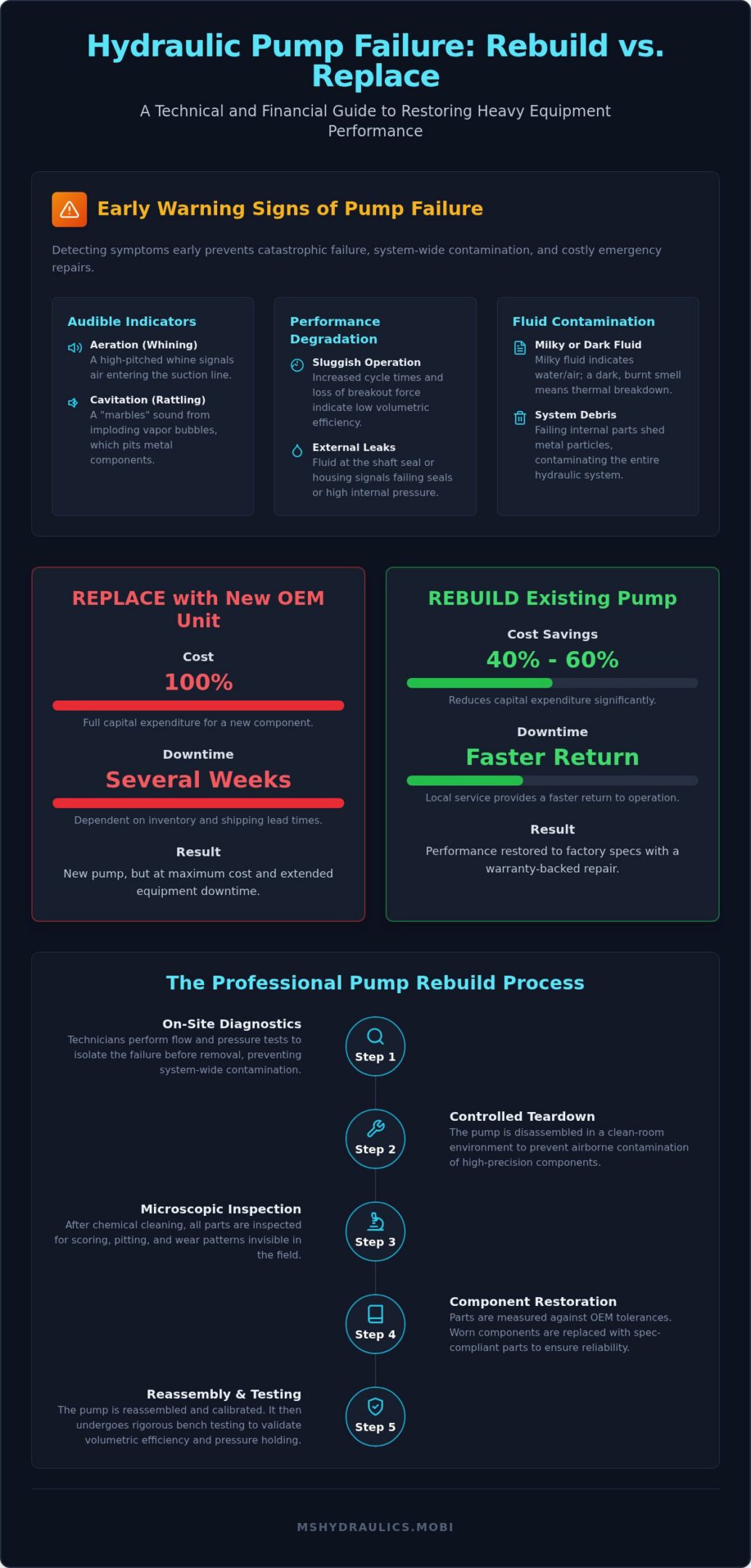
Early detection of mechanical failure is the most effective way to control maintenance costs. For operators in North Texas, where summer temperatures frequently exceed 100 degrees Fahrenheit, the thermal load on a Hydraulic pump is extreme. This heat accelerates the breakdown of fluid viscosity, often leading to internal bypass and accelerated wear. Recognizing the specific audible and physical markers of degradation allows for a scheduled mobile hydraulic pump rebuild rather than an emergency replacement following a catastrophic failure.
Audible indicators are the first line of defense. Aeration typically presents as a consistent high-pitched whining sound, signaling that air is entering the suction line. Cavitation, conversely, produces a distinct rattling noise, often described as “marbles” circulating within the pump housing. This occurs when the pump cannot pull enough fluid, causing vapor bubbles to implode against internal surfaces. These implosions pit metal components and rapidly destroy the pump’s ability to maintain pressure. If these sounds are ignored, the resulting metal-to-metal contact will eventually lead to a total seizure of the unit.
Common Symptoms of Pump Degradation
Beyond audible warnings, physical changes in machine performance indicate critical wear. You’ll often notice a significant increase in cycle times and a measurable loss of breakout force during high-load operations. If an excavator’s boom moves sluggishly or a skid steer struggles with a full bucket, the pump’s volumetric efficiency has likely dropped below acceptable tolerances. Fluid discoloration is another primary indicator. Milky fluid suggests water contamination or severe aeration, while a darkened, burnt odor indicates the fluid has exceeded its thermal limits. External leaks at the shaft seal or housing gaskets shouldn’t be ignored; these often signal internal pressure spikes or failing bearings that require a mobile hydraulic pump rebuild to rectify.
The Importance of Immediate Diagnostics
Operating a machine with a failing pump is a high-risk decision. When internal components begin to shed metallic debris, those particles travel through the entire system, potentially damaging expensive valves and cylinders. Utilizing On-Site Diagnostic Services allows technicians to perform flow testing and pressure checks to isolate the issue before the pump suffers a total “grenade” failure. Early intervention ensures that the debris is contained. This proactive approach prevents the need for a full system flush, which can add thousands of dollars to the total repair bill. In the high-demand environments of Cleburne and Alvarado, maintaining this technical oversight is essential for long-term fleet reliability.
The Technical Process of a Hydraulic Pump Rebuild
A successful mobile hydraulic pump rebuild is a methodical engineering project that requires more than a simple seal replacement. Once the pump is removed from the machine following on-site diagnostics, it must undergo a comprehensive teardown in a controlled environment to prevent airborne contamination. Every internal component is subjected to chemical cleaning to remove varnish and oxidized fluid residues. This reveals the true state of the metal surfaces, allowing for a microscopic inspection of wear patterns that are often invisible during field assessments. Precision engineering is the only way to guarantee that the restored unit can withstand the high-pressure demands of modern heavy machinery.
Disassembly and Component Inspection
Precise measurement is the foundation of a reliable rebuild. Technicians evaluate the swash plate and pistons for any signs of scoring or pitting, which indicate past cavitation or fluid contamination. The drive shaft requires inspection for spline wear and bearing journal integrity to prevent premature mechanical failure under high torque. We also examine the pump housing for structural cracks or internal erosion caused by high-velocity fluid bypass. If the housing’s internal geometry is compromised, the unit can’t be safely restored to OEM specifications. Every measurement is recorded and compared against factory tolerances to determine which parts require machining and which must be replaced.
Restoration and Quality Verification
Restoration involves lapping and resurfacing the valve plates and rotating groups to achieve a perfect hydraulic seal. This process removes surface irregularities, restoring the pump’s ability to maintain pressure without internal leakage. All high-wear components, including bearings, gaskets, and seals, are replaced with high-grade materials to ensure longevity. For complex units found in excavators or drill rigs, the rotating group may require complete replacement if precision machining can’t restore the required tolerances. Quality control is paramount during this phase to ensure every component interacts with the exact clearance required for efficient operation.
The final stage is dynamic testing on a hydraulic test stand. This phase is critical because it simulates real-world operating conditions, including peak pressure and maximum flow rates. We monitor the unit for volumetric efficiency, ensuring it meets or exceeds original factory performance data. This level of verification is why many operators choose a professional hydraulic pump repair over unverified field fixes. A mobile hydraulic pump rebuild that includes these rigorous stress tests provides the operator with a warranty-backed component ready for the demanding conditions of North Texas job sites. Final pressure testing ensures the unit is ready for immediate return to service without the risk of infant mortality or performance lag.
Mobile Diagnostics vs. Shop-Based Rebuilds: Managing Downtime
The term mobile hydraulic pump rebuild describes a specialized service delivery model rather than the physical location of the assembly process. For high-precision components like axial piston pumps, field assembly is technically irresponsible. The micron-level tolerances required for internal rotating groups cannot be maintained in the dusty, uncontrolled environments of a construction site or oil field. Particulate contamination introduced during a field rebuild will lead to immediate surface scoring and premature failure. Therefore, the most effective strategy for managing equipment downtime involves a hybrid approach: precision on-site extraction followed by restoration in a contamination-controlled shop environment.
Managing the logistics for heavy machinery like drill rigs and large-scale excavators is a significant operational challenge. By utilizing expert mobile hydraulic repair in Cleburne, operators eliminate the need for expensive heavy-haul trucking. Technicians perform the technical removal of the pump on-site, allowing the machine to remain stationary while only the failed component travels for service. This logistical efficiency is the primary driver in reducing the total cost of the repair cycle and ensuring a faster return to service.
The On-Site Service Workflow
The workflow begins with rigorous on-site diagnostics. Technicians utilize flow meters and pressure gauges to confirm that the pump is the specific cause of hydraulic system underperformance. Once failure is verified, the pump is isolated and removed. This stage requires specific environmental protocols to prevent fluid spills and protect the machine’s open hydraulic lines from debris. After the shop restoration is complete, the technician returns to perform the re-installation. This final phase includes system bleeding and pressure recalibration to ensure the mobile hydraulic pump rebuild integrates seamlessly with the machine’s existing hydraulic circuits.
Minimizing Downtime in North Texas
Downtime in the North Texas industrial sector is measured in lost production hours. Maintaining a local service presence in Cleburne and the DFW area ensures that transit times for parts and technicians are kept to a minimum. To avoid the high cost of emergency pulls, we advocate for comprehensive heavy equipment maintenance schedules. Identifying early signs of pump wear through scheduled fluid analysis and pressure testing allows for a planned rebuild during a natural project lull. This proactive approach is the most reliable method for maintaining project timelines and ensuring the long-term mechanical integrity of your fleet.
Cost-Benefit Analysis: Rebuilding vs. Replacing Industrial Pumps
The financial decision to initiate a mobile hydraulic pump rebuild versus purchasing a new OEM unit is governed by three primary variables: capital expenditure, lead time, and remaining component life. Industrially, a professional rebuild typically requires an investment of 40% to 60% of the cost of a new replacement. This price differential allows fleet managers in North Texas to allocate resources more efficiently across their maintenance schedules. Beyond the immediate invoice, rebuilding offers a technical advantage by utilizing the existing pump housing, which has already been proven structurally sound through operational cycles. Rebuilding is also the only viable path for obsolete pumps where new units are no longer manufactured, preventing the forced retirement of otherwise functional heavy machinery.
When a Rebuild is the Superior Choice
In the current industrial supply chain, lead times for new high-performance pumps can span several months. A mobile hydraulic pump rebuild bypasses these logistical delays, often returning a machine to service in a fraction of the time. This speed is critical for maintaining project timelines in the DFW construction sector. Additionally, rebuilding the original unit preserves the exact hydraulic porting and mounting configurations. This eliminates the need for field modifications to suction lines or pressure hoses, which are common when installing equivalent aftermarket units that don’t perfectly match the original footprint. From an environmental perspective, restoring a precision-machined housing is a sustainable practice that reduces industrial waste and energy consumption associated with new manufacturing.
When Replacement is Unavoidable
There are specific technical conditions where a rebuild is no longer a viable engineering solution. If a technician identifies structural cracks in the pump housing or severe erosion in the seal areas that exceed machining tolerances, the unit is classified as beyond economical repair. In these instances, the structural integrity of the casting can’t be guaranteed under high-pressure loads. For older fleets, replacing a legacy gear pump with modern, more efficient piston technology can provide long-term energy savings that justify the higher upfront cost. We also analyze the “cost of failure” for critical path machinery. If a pump has suffered multiple catastrophic failures, the fatigue life of the metal may be compromised, making a new unit the safer long-term investment. For a technical evaluation of your current equipment, contact our team for specialized Hydraulic Pump Repair services.
Factoring in the cost of core exchanges is also vital. When you choose to rebuild, you retain your original core, ensuring you know the exact history of the component. New OEM pumps often require a core charge that you may not recover if your old unit is too damaged. By rebuilding, you avoid these hidden fees and ensure that the final unit, equipped with new bearings and seals, meets the exact load requirements of your specific application.
Expert Hydraulic Pump Services in Cleburne and North Texas
Ms. Hydraulics LLC maintains a disciplined commitment to technical integrity across every industrial project. We support the construction, agriculture, and industrial infrastructure of Johnson County, providing specialized maintenance for high-pressure systems. Our mobile diagnostic capabilities extend to Alvarado, Grandbury, and Mansfield, ensuring that a mobile hydraulic pump rebuild is backed by precise field data before any components are removed. This localized approach allows us to verify system parameters under actual operating conditions, which is essential for accurate troubleshooting and long-term reliability.
Total system reliability often requires addressing multiple failure points simultaneously. We frequently integrate heavy equipment cylinder rebuilds with our pump services to perform a comprehensive overhaul. If a pump has shed metallic debris, those contaminants likely migrated into the cylinders and valves. Addressing the pump in isolation while leaving contaminated cylinders in place will lead to immediate damage to the newly restored rotating group. A holistic overhaul is the only way to guarantee the machine meets its original breakout force and cycle time specifications.
Local Expertise for DFW Heavy Equipment
Technicians based in North Texas possess a specific understanding of the mechanical stressors unique to the DFW region. High ambient temperatures and abrasive soil conditions require specific seal configurations and fluid viscosities to prevent premature degradation. As an independent, family-owned service provider, we offer a level of accountability that national centers often lack. Our rapid response for on-site diagnostics in the Cleburne area ensures that your machinery doesn’t remain non-functional while waiting for a technician from a distant metropolitan hub.
Maintaining the mechanical integrity of your support vehicles is just as critical as your heavy equipment. If you are looking for a reputable resource for automotive and collision repair, check out Universal Motorcars for professional services backed by decades of experience.
Getting Started with Your Pump Rebuild
Scheduling an on-site inspection is the first step toward restoring your machinery’s performance. When contacting Ms. Hydraulics LLC for a technical consultation, please have the pump’s make, model, and serial number available. This information allows us to cross-reference OEM tolerances and verify parts availability for your mobile hydraulic pump rebuild before we arrive on-site. A structured intake ensures we can move quickly from diagnosis to restoration.
- Identify specific failure symptoms, such as loss of breakout force or excessive heat generation.
- Provide the machine’s current hour meter reading to help assess the lifecycle stage of internal bearings.
- Confirm the site location and equipment accessibility for our service vehicle to ensure a safe extraction.
Taking these steps ensures a structured diagnostic process and a faster return to service for your heavy equipment. Our focus remains on technical excellence and providing a warranty-backed repair that stands up to the most demanding job site conditions.
Restoring Operational Efficiency for North Texas Fleets
Effective fleet management depends on the technical ability to distinguish between minor component wear and structural housing failure. By prioritizing on-site diagnostics and precision shop restoration, operators can reduce capital expenditure while maintaining the rigorous standards required for heavy machinery. This strategy addresses the logistical challenges of the DFW industrial sector by focusing on component-level recovery rather than full unit replacement. Recovering the original equipment housing also preserves system integration and avoids the lengthy lead times associated with new OEM inventory.
A professional mobile hydraulic pump rebuild ensures that critical equipment returns to service with restored volumetric efficiency and verified pressure capabilities. Our specialized technicians support all major heavy equipment brands across Cleburne, Fort Worth, and the surrounding North Texas cities. We focus on minimizing transport costs through on-site troubleshooting before moving units to our controlled facility for final assembly and stress testing. This methodical approach provides a warranty-backed solution that meets the specific demands of the Texas climate.
Schedule On-Site Hydraulic Pump Diagnostics with Ms. Hydraulics LLC to verify the mechanical health of your fleet and secure a reliable return to production. Maintaining your machinery’s technical integrity is the most effective way to ensure long-term project stability.
Frequently Asked Questions
Can a hydraulic pump be rebuilt on-site?
On-site assembly is technically irresponsible due to the high risk of airborne particulate contamination. A professional mobile hydraulic pump rebuild begins with on-site diagnostics and precision removal, but the critical assembly phase must occur in a controlled shop environment. Attempting to assemble a high-precision rotating group in a dusty field environment will lead to surface scoring and premature failure of the new components.
How much does it cost to rebuild a mobile hydraulic pump?
The cost of a rebuild is typically between 40% and 60% of the price of a new OEM replacement unit. The final expenditure depends heavily on the internal condition of the pump and whether the housing requires specialized machining. Rebuilding is a technically sound way to restore performance while significantly reducing the capital expenditure required for fleet maintenance.
How long does a typical hydraulic pump rebuild take?
Most professional rebuilds are completed within three to five business days, depending on the availability of specific internal components. This timeline is significantly faster than current OEM lead times for new pumps, which can span several weeks. This efficiency is a primary factor in minimizing heavy equipment downtime for contractors in the North Texas region.
What is the difference between a pump repair and a full remanufacture?
A repair focuses on correcting a specific failure point, such as replacing a leaking shaft seal or a worn bearing. A full mobile hydraulic pump rebuild or remanufacture involves a total teardown, chemical cleaning, and restoring all internal surfaces to original factory tolerances. This comprehensive process ensures that the pump returns to its original volumetric efficiency and peak pressure capability.
Will a rebuilt hydraulic pump have the same warranty as a new one?
High-quality rebuilds are backed by a professional warranty that covers both the replaced components and the technical workmanship. While terms vary depending on the provider, a warranty-backed rebuild offers the same level of operational confidence as a new unit. This verification is essential for machines operating in high-demand industrial or construction environments.
What are the most common causes of hydraulic pump failure in Texas?
Extreme thermal loads and particulate contamination are the leading causes of pump degradation in the Texas climate. High ambient temperatures cause hydraulic fluid to lose viscosity, which leads to internal bypass and accelerated friction. Additionally, the fine abrasive dust common in North Texas can enter the system through compromised seals, causing rapid erosion of the swash plate and pistons.
How do I know if my pump is cavitating or just low on fluid?
Cavitation creates a distinct metallic rattling sound, often described as marbles circulating inside the pump housing, while low fluid typically produces a high-pitched whining noise from aeration. Both symptoms indicate a critical failure in the suction line or fluid supply. Operators must shut down the machine immediately to prevent catastrophic internal damage and metal shedding into the hydraulic circuit.
Is it worth rebuilding an older or obsolete hydraulic pump?
Rebuilding is often the only technical solution for maintaining older machinery where new replacement pumps are no longer manufactured. It allows you to preserve the original system integration without the need for expensive modifications to hydraulic lines or mounting brackets. Restoring an obsolete unit is a sustainable engineering practice that extends the operational life of legacy heavy equipment.