Heavy Equipment Hydraulic Repair in Johnson County, TX: Expert Mobile Services
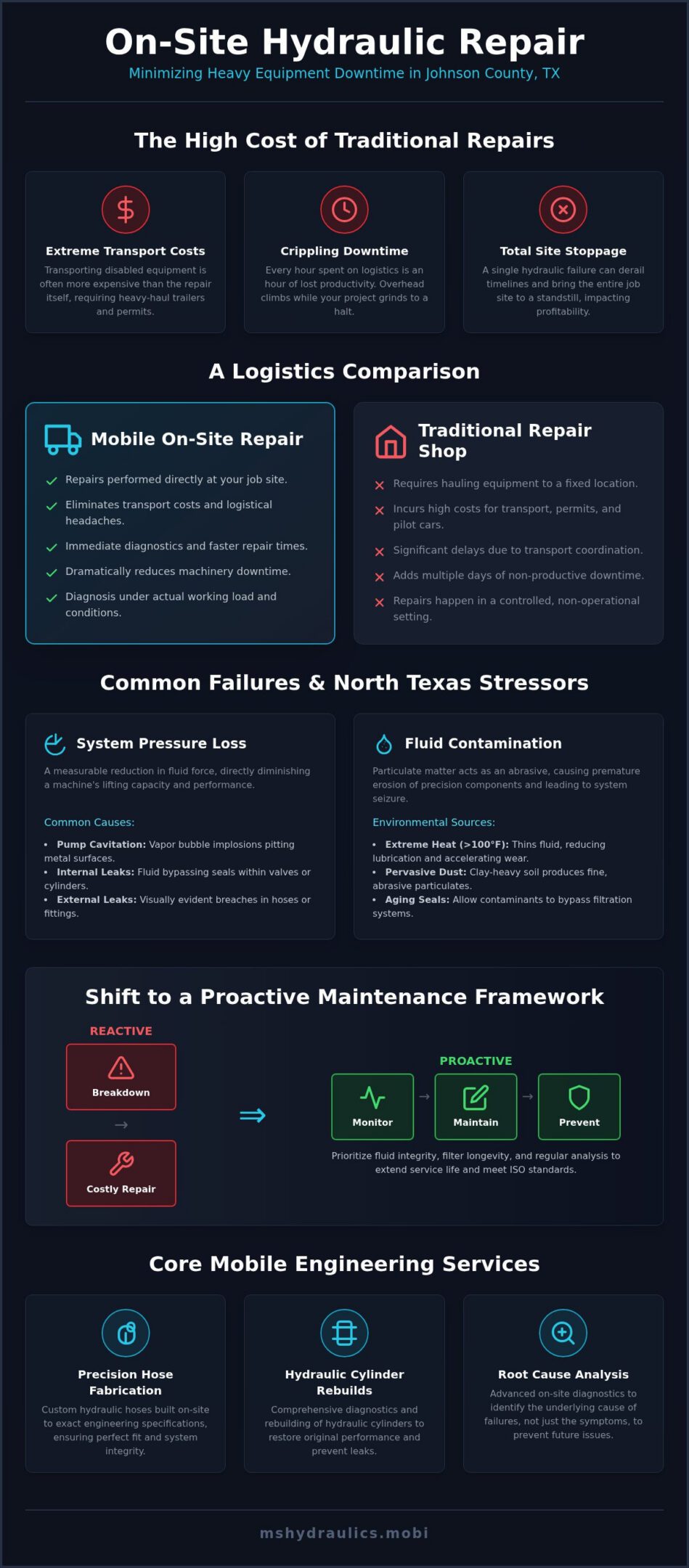
Transporting a disabled excavator or drill rig to a repair facility is often more expensive than the repair itself when you calculate lost labor hours and the logistical complexity of heavy hauling. For operators across North Texas, securing reliable heavy equipment hydraulic repair Johnson County is the difference between maintaining a profitable project timeline and facing a total site stoppage. You understand that when a skid steer’s hydraulic system fails, your overhead continues to climb while your productivity hits zero.
We provide a strategic engineering solution to these mechanical failures by delivering expert diagnostics and repairs directly to your job site. This article explains how to minimize machinery downtime through precision on-site hose fabrication, cylinder rebuilds, and technical root cause analysis. You will learn how mobile services ensure your equipment meets rigorous ISO standards without the need for costly transport. We will also examine how these field solutions help you maintain operational efficiency as Johnson County continues its rapid industrial and construction expansion through 2026.
Key Takeaways
- Understand the economic advantages of mobile heavy equipment hydraulic repair Johnson County over traditional shop-based logistics to eliminate unnecessary machinery transport costs.
- Identify the technical indicators of hydraulic system failure, including pressure loss and fluid contamination exacerbated by North Texas environmental stressors.
- Learn the precise engineering requirements for custom on-site hose fabrication and the specialized processes involved in hydraulic cylinder rebuilds.
- Shift from reactive repairs to a proactive maintenance framework that prioritizes fluid integrity and filter longevity to extend machinery service life.
- Evaluate the coverage and technical capabilities of mobile units serving Cleburne, Alvarado, and surrounding industrial hubs.
Understanding Hydraulic System Failures on Johnson County Job Sites
Hydraulic system failure represents a critical breach in the engineering parameters required to operate heavy machinery safely and efficiently. In the industrial context of North Texas, this failure typically manifests as a loss of system pressure, fluid contamination, or a mechanical breach within the high-pressure circuit. For fleet managers and owner-operators requiring heavy equipment hydraulic repair Johnson County, recognizing these symptoms early prevents secondary damage to expensive internal components. A minor leak or a slight drop in cycle time is often the first indicator that the system’s structural integrity is compromised.
The environmental conditions in Cleburne and surrounding areas present unique technical challenges for hydraulic systems. Extreme summer temperatures in North Texas frequently exceed 100 degrees Fahrenheit, which directly impacts hydraulic fluid viscosity. As fluid thins due to thermal stress, its lubricating properties diminish, leading to increased friction and accelerated wear on pumps and valves. This environmental heat, combined with the pervasive dust of local job sites, creates a high-risk environment for excavators, skid steers, and drill rigs that rely on consistent fluid parameters for precision movement.
Maintaining the integrity of the hydraulic circuit is not merely a performance issue; it’s a safety mandate. When a system operates at several thousand PSI, any structural weakness in a hose or fitting poses a significant risk of high-velocity fluid injection or sudden mechanical collapse. This is particularly dangerous for drill rigs and large excavators where boom stability is critical for site safety. Professional heavy equipment hydraulic repair Johnson County focuses on restoring these systems to their original engineering specifications to ensure both operator safety and machine reliability. Beyond mechanical maintenance, keeping a clear workspace is vital for safe operations; if you are managing sites in the Central Texas region, you can visit Leander Dumpster Rentals for professional roll-off services.
The Mechanics of Hydraulic Pressure Loss
Systemic pressure loss often originates from pump cavitation, a phenomenon where vapor bubbles form and implode within the fluid. These implosions generate localized shockwaves that pit metal surfaces and compromise the pump’s ability to maintain the necessary PSI for heavy lifting. Technicians must distinguish between external leaks, which are visually evident on the chassis, and internal leaks, where fluid bypasses seals within control valves or cylinders without exiting the system. Hydraulic pressure loss is the measurable reduction in fluid force that directly diminishes a machine’s total lifting capacity and mechanical advantage.
Contamination: The Silent Killer of Heavy Machinery
Particulate matter acts as an abrasive within the hydraulic circuit, causing premature erosion of precision-engineered valve spools and motor components. Johnson County is characterized by clay-heavy soil that produces fine, abrasive particulates when disturbed by construction or agricultural activity. These particles can bypass aging seals and overwhelm standard filtration systems if they aren’t monitored through a rigorous maintenance schedule.
Maintaining system cleanliness is a primary requirement for operational longevity. Utilizing On-Site Diagnostic Services allows for the rapid identification of these microscopic contaminants before they cause a total system seizure. Regular filter audits and fluid analysis are essential protocols for any fleet operating in the demanding terrain of North Texas, ensuring that the machinery remains within ISO cleanliness standards.
Mobile Hydraulic Repair vs. Traditional Shops: A Logistics Comparison
Transporting a 40,000-pound excavator or a specialized drill rig to a brick-and-mortar facility involves more than just a towing fee. It requires heavy-haul trailers, pilot cars for oversized loads, and the administrative labor to coordinate permits and scheduling. For operators requiring heavy equipment hydraulic repair Johnson County, the mobile service model eliminates these logistical barriers. By bringing diagnostic equipment and fabrication tools directly to the job site, the repair process begins immediately upon the technician’s arrival, rather than after several hours or days of transport coordination.
On-site diagnostics provide a technical advantage that a controlled shop environment often cannot replicate. When a technician observes a machine failing under its actual working load in the specific terrain of North Texas, they can identify intermittent pressure drops or thermal issues that might not manifest in a static shop setting. This real-world assessment ensures that the root cause is addressed, preventing the unnecessary replacement of functional components. Furthermore, mobile hose fabrication eliminates the need for maintaining a large spare part inventory on-site, as custom lines are engineered to fit the specific machine parameters in real time.
Calculating Downtime Costs in North Texas
The financial impact of a downed machine extends far beyond the repair invoice. In Johnson County, where construction growth is a primary economic driver, a single idle excavator can stall an entire crew’s progress and trigger contract penalties. Moving machinery through the increasing traffic of Cleburne and Alvarado adds hours of non-productive time to every repair cycle. Transitioning to a mobile service model typically results in a 50% to 70% reduction in total downtime by bypassing the transport phase and utilizing on-site fabrication to restore the hydraulic circuit immediately. If you’re managing a fleet, partnering with a provider for Mobile Hydraulic Repair ensures your machinery stays productive where it belongs: on the job site.
When Field Repair is the Superior Choice
Field repair is essential when a mechanical breach threatens to release hydraulic fluid into the environment. Rapid on-site containment and repair prevent costly remediation and maintain compliance with local regulations. Additionally, mobile services allow for the immediate verification of repairs under actual operating conditions. This immediate feedback loop ensures that the hydraulic system meets engineering standards before the technician leaves the site. For a deeper analysis of these field capabilities, consult our Expert Mobile Hydraulic Repair guide for more details.
The expertise required in a field environment is significantly higher than in a shop. Field technicians must possess the engineering knowledge to solve complex problems without the support of a full shop infrastructure. This level of autonomy and technical proficiency is a hallmark of high-quality heavy equipment hydraulic repair Johnson County, providing operators with the confidence that their machinery is being serviced to the highest industrial standards.
Specialized Component Repair: Hoses, Cylinders, and Pumps
Restoring a hydraulic system to peak operational efficiency requires a granular focus on component-level engineering. Unlike generic maintenance providers, specialized heavy equipment hydraulic repair Johnson County involves the precise calibration of hoses, cylinders, and pumps to meet rigorous industrial standards. Every component within the high-pressure circuit must function as a cohesive unit to maintain the mechanical advantage required for heavy excavation and drilling operations. When a single element fails, it often indicates systemic stress that needs a technical evaluation rather than a simple part replacement.
Custom Hose Fabrication and Fitting Selection
Field-based hose fabrication demands a strict adherence to material specifications and pressure ratings. Technicians must accurately distinguish between braided hoses, typically used for medium-pressure return lines, and spiral-reinforced hoses designed to withstand the high-impulse pressures of primary work circuits. The selection of fittings is equally critical, as modern machinery utilizes a variety of standards, including JIC (Joint Industry Council) 37-degree flares, ORFS (O-Ring Face Seal) for leak-free high-pressure connections, and NPT (National Pipe Thread) for specific auxiliary ports. Achieving the exact crimp diameter specified by the manufacturer is essential to prevent coupling blow-offs and ensure the structural integrity of the hose assembly under peak system pressures.
Cylinder Rebuilds: Sealing and Honing for Longevity
The restoration of a hydraulic cylinder is a methodical process that extends far beyond replacing a seal kit. It begins with a comprehensive disassembly and a technical inspection of the barrel and rod. Technicians perform rod polishing to remove micro-abrasions that can tear new seals and hone the internal barrel surfaces to ensure a perfect interface with the piston. For a detailed breakdown of these technical requirements, see our Heavy Equipment Cylinder Rebuild in Texas engineering guide. Once reassembled, cylinders undergo load testing to verify that they maintain pressure without bypass or external leakage, ensuring they meet original equipment manufacturer (OEM) performance benchmarks.
Diagnosing wear in hydraulic pumps and motors requires specialized flow and pressure testing equipment. By measuring volumetric efficiency, technicians can determine if internal wear is causing fluid to bypass the rotating group, which results in sluggish machine performance and excessive heat generation. This data-driven approach to heavy equipment hydraulic repair Johnson County allows for the identification of root causes, such as cavitation or aeration, before they lead to a catastrophic pump seizure. Whether servicing a variable displacement piston pump or a high-torque radial piston motor, every repair is executed to maintain the tight tolerances required for industrial-grade reliability.
Implementing a Preventative Maintenance Schedule for Your Fleet
Transitioning from reactive failure recovery to a proactive maintenance framework is a strategic necessity for industrial operations. In North Texas, where equipment often operates in high-dust environments, a structured approach to heavy equipment hydraulic repair Johnson County focuses on prevention. Standardizing these protocols across a diverse fleet, including Caterpillar, John Deere, and Komatsu machinery, ensures that every unit operates within its specific engineering tolerances. This methodical oversight reduces the frequency of emergency interventions and extends the operational lifecycle of high-value assets.
Fluid analysis serves as a primary predictive tool in this maintenance regime. It identifies microscopic metal shavings or chemical degradation before these issues manifest as mechanical failure. By monitoring these physical parameters and adhering to ISO 4406 cleanliness codes, operators can schedule component replacements during planned downtime. This data-driven strategy prevents the “domino effect” where a failing pump sends debris through the entire system, necessitating a total circuit flush and multiple component rebuilds. It’s a disciplined approach that treats maintenance as a technical investment rather than a recurring expense.
Daily and Weekly Hydraulic Inspection Checklists
Effective maintenance starts with consistent visual verification. Operators should inspect hoses for signs of outer cover abrasion, cracks, or fitting stress that could lead to a sudden breach. Monitoring reservoir levels is equally vital; low levels or the presence of “milky” aerated fluid indicates air ingestion or a leak that will eventually damage the pump’s rotating group. The role of the hydraulic filter is critical here, especially given the abrasive clay-heavy soil prevalent in Cleburne. For comprehensive checklists tailored to North Texas conditions, refer to our Heavy Equipment Maintenance technical guide.
Advanced Diagnostics: Pressure and Flow Testing
Periodic pressure testing provides a quantitative assessment of system health that visual inspections cannot offer. It allows technicians to identify “drifting” cylinders where internal seals have failed or control valves that no longer maintain precise flow rates. These diagnostic tools reveal performance bottlenecks that aren’t visible until they cause a significant drop in cycle times. The long-term ROI of scheduled professional inspections is realized through the avoidance of catastrophic failures and the elimination of unnecessary machinery transport. To secure your fleet’s operational readiness, schedule your Heavy Equipment Maintenance today to identify potential issues before they cause a site stoppage.
Consistent maintenance schedules allow for better budget forecasting and resource allocation. When you know the technical status of every pump and motor in your fleet, you don’t have to worry about sudden, unbudgeted repair costs. This level of organization is what separates top-tier construction firms from those constantly battling equipment downtime. Professional heavy equipment hydraulic repair Johnson County providers act as technical partners in this process, providing the engineering expertise required to keep your machinery running at peak efficiency.
Ms. Hydraulics: Engineering Excellence in Johnson County, TX
Ms. Hydraulics LLC operates as a specialized technical partner for the construction and agricultural sectors across North Texas. Based in Cleburne, our organization prioritizes mechanical integrity and engineering precision in every field intervention. We understand that heavy equipment hydraulic repair Johnson County requires more than just a functional fix; it demands a restoration of the system to its peak performance parameters. Since our founding in 2021, we’ve focused on providing mobile solutions that eliminate the logistical complexities of machinery transport while maintaining the high standards expected by industrial stakeholders.
Our service model is built on technical proficiency and a deep understanding of the machinery used in local infrastructure projects. We specialize in the high-pressure systems found in excavators, skid steers, and drill rigs, ensuring that every on-site diagnostic and repair meets rigorous safety and performance benchmarks. By delivering specialized tools and fabrication capabilities directly to your location, we provide a level of service that matches the precision of a controlled shop environment within the dynamic conditions of an active job site.
Serving the North Texas Industrial Corridor
Our operations are deeply integrated into the Cleburne community and the broader 2026 local economy. As Johnson County experiences a projected population growth of 15.6% and continued expansion in the construction sector, the demand for reliable machinery uptime has never been higher. We support heavy equipment operators across a broad service area that includes Alvarado, Granbury, Crowley, and Waxahachie. Our mobile units also provide technical support to industrial hubs from Arlington to Mansfield, serving as a dependable partner for large-scale projects that cannot afford the delays associated with traditional repair cycles. We specifically serve the Texas market, providing local expertise that understands the unique environmental stressors of the North Texas climate.
Contact Ms. Hydraulics for Immediate Support
Initiating a service call for mobile hydraulic repair is a streamlined process designed to minimize your operational downtime. To ensure the fastest on-site diagnostic results, please provide specific technical details when requesting support, such as the machine’s make and model, the observed symptoms of failure, and any relevant pressure readings. This information allows our technicians to arrive fully equipped with the necessary components for your specific hydraulic circuit, whether you require on-site hose fabrication or a complex cylinder rebuild. Our methodical approach ensures that the root cause of the failure is identified and corrected during the initial visit.
Maintaining the structural integrity of your fleet is essential for long-term profitability and site safety. When your machinery requires professional intervention, trust a provider that values engineering excellence and technical accuracy above all else. Schedule your mobile hydraulic repair today to restore your equipment to full operational capacity and ensure your project remains on schedule.
Optimizing Fleet Readiness and Mechanical Integrity
Maintaining high-pressure hydraulic systems requires more than just reactive fixes; it demands a commitment to technical precision and rigorous engineering standards. By utilizing mobile diagnostics and on-site hose fabrication, you eliminate the substantial overhead associated with machinery transport and site downtime. We’ve established that root cause analysis and proactive fluid monitoring are essential for preventing catastrophic component failure in North Texas environments. Since 2021, Ms. Hydraulics has delivered expert heavy equipment hydraulic repair Johnson County to ensure operators in Cleburne, Alvarado, and Grandview maintain peak productivity.
Our mobile units utilize specialized diagnostic tools to identify and resolve mechanical breaches directly at the source. Don’t allow a compromised cylinder or a ruptured hose to stall your project’s critical path. You can rely on our disciplined approach to restore your machinery to its original performance parameters while adhering to industrial safety protocols. Request Mobile Hydraulic Service in Johnson County to secure your fleet’s operational longevity and maintain your competitive advantage in the field. We’re ready to partner with you to ensure your equipment remains a reliable asset on every job site.
Frequently Asked Questions
How quickly can Ms. Hydraulics respond to a repair call in Johnson County?
We prioritize rapid technician dispatch to minimize your operational downtime across the North Texas industrial corridor. While specific response times depend on current service volume and technician proximity, our central location in Cleburne allows for efficient deployment to job sites throughout the county. We recommend contacting our office immediately upon detecting a system failure to secure the earliest available slot in our technical schedule.
Do you fabricate hydraulic hoses on-site or do I need to bring the old one in?
We perform all custom hydraulic hose fabrication on-site using fully equipped mobile service units. You don’t need to transport old or damaged hoses to a facility for replacement. Our technicians identify the specific pressure requirements and fitting types directly from your machinery and engineer a precision replacement in the field. This on-site capability ensures the immediate restoration of your hydraulic circuit without logistical delays.
What types of heavy equipment do you specialize in repairing?
Our technical expertise is concentrated on the high-pressure hydraulic systems found in excavators, skid steers, and drill rigs. We possess the specialized diagnostic tools and engineering knowledge required to service machinery from major manufacturers like Caterpillar, John Deere, and Komatsu. This focused specialization ensures that we can accurately address the unique mechanical parameters and hydraulic configurations of heavy-duty industrial and agricultural assets.
Can you perform a full hydraulic cylinder rebuild in the field?
We provide comprehensive hydraulic cylinder rebuilds as part of our mobile service offering for most industrial applications. Our technicians are equipped to handle disassembly, seal kit installation, and rod polishing at your location to prevent fluid bypass. If a cylinder requires extensive barrel honing or machining that exceeds field capabilities, we manage the restoration process to ensure the component meets OEM standards before reinstallation.
What areas of North Texas do you cover besides Cleburne?
Our mobile service units provide coverage for Alvarado, Granbury, Crowley, and Waxahachie in addition to our home base in Cleburne. We also support heavy equipment operators in surrounding industrial hubs such as Arlington and Mansfield. This regional reach ensures that fleet managers can access professional heavy equipment hydraulic repair Johnson County and beyond without the significant expense of hauling disabled machinery to a shop.
Do you offer emergency 24/7 hydraulic repair services for construction sites?
We provide specialized mobile repair services designed to support the standard operational cycles of construction and agricultural sites. For the most current information regarding after-hours availability or emergency response protocols for 2026, please contact our dispatch office directly. Our primary focus is delivering high-integrity technical solutions that resolve the root cause of hydraulic failure during every scheduled field intervention.
How do I know if my hydraulic pump needs a rebuild or a complete replacement?
Determining the appropriate course of action requires a technical assessment of the pump’s volumetric efficiency and internal wear patterns. If the pump housing remains structurally sound but the internal rotating group is worn, a rebuild is a viable engineering solution that restores performance. However, if cavitation has caused severe pitting or housing breaches, a complete replacement is necessary to maintain system integrity and prevent future failures.
What is the benefit of using Ms. Hydraulics over a standard dealership shop?
The primary advantage is the total elimination of machinery transport costs and the associated logistical downtime. Unlike dealerships that require equipment to be hauled to their facility, we deliver expert diagnostics and on-site fabrication directly to your job site. This mobile model provides a more efficient path to heavy equipment hydraulic repair Johnson County, offering specialized technical focus that prioritizes the rapid return of your machinery to active service. For broader logistical needs, such as moving fleet assets or commercial vehicles between locations, you can discover AutoPlex Transport Company for professional shipping services.