Fort Worth On-Site Hydraulic Repair: Minimizing Downtime with Mobile Field Service
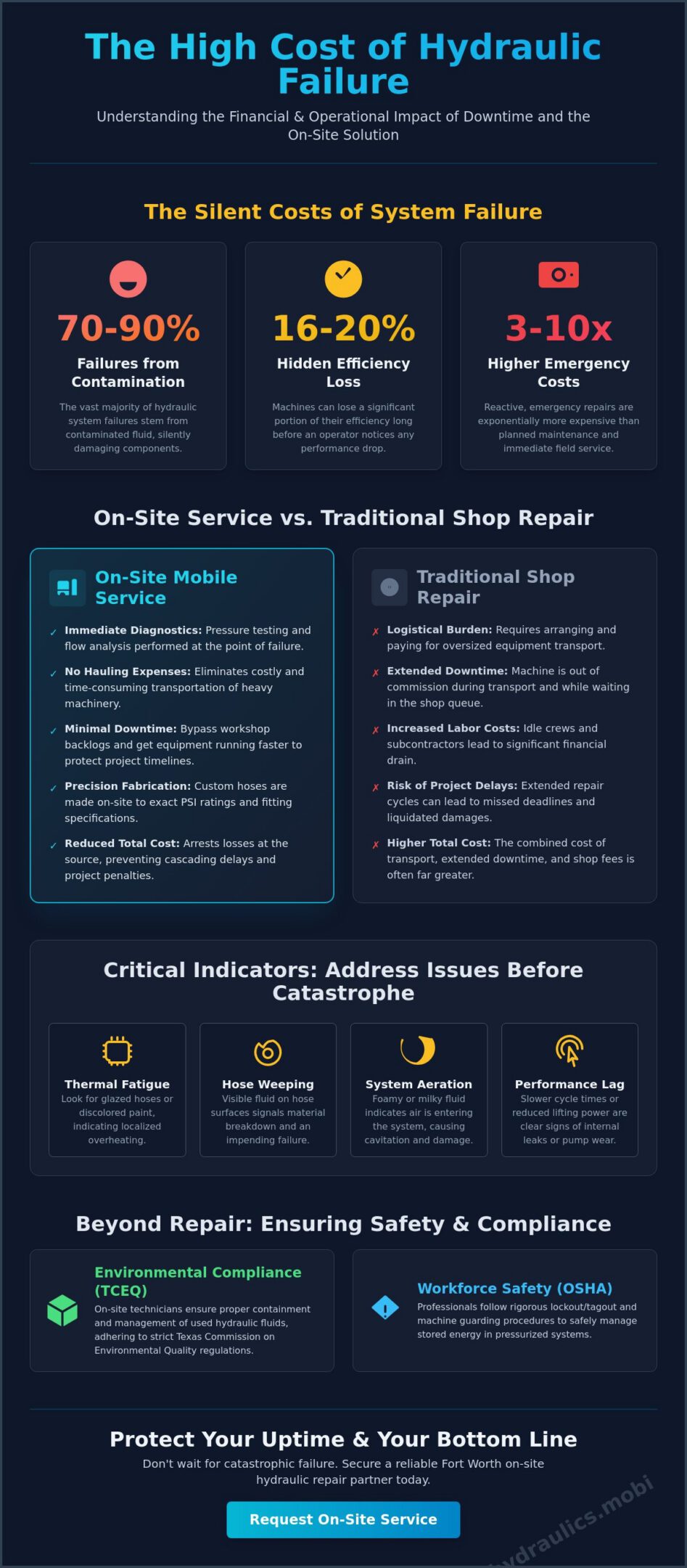
Did you know that 70% to 90% of hydraulic system failures stem from fluid contamination, often stripping 16% to 20% of a machine’s efficiency before an operator detects a performance drop? When heavy machinery fails, the logistical burden of transporting oversized equipment to a central repair shop often compounds the financial loss. You’re likely aware that idling machinery translates directly to lost revenue and potential environmental liabilities under Texas Commission on Environmental Quality regulations regarding used oil management.
Securing a reliable Fort Worth on-site hydraulic repair partner is a critical strategy for maintaining industrial uptime. This article demonstrates how professional field services reduce operational costs and restore equipment performance through precision engineering. We’ll analyze the impact of immediate on-site diagnostics, custom hose fabrication, and restored system pressure on your bottom line. You’ll also learn how mobile service helps you maintain compliance with evolving OSHA standards for machine guarding and lockout procedures.
Key Takeaways
- Analyze the total cost of machinery downtime to understand how field-based engineering protects project timelines and operational margins.
- Understand the technical advantages of Fort Worth on-site hydraulic repair, including the ability to perform pressure testing and flow analysis at the point of failure.
- Learn the precise requirements for mobile hose fabrication to ensure replacement components meet exact PSI ratings and fitting specifications.
- Compare the logistics of mobile field service against traditional shop repairs to minimize hauling expenses and bypass workshop backlogs.
- Recognize early warning signs like system aeration and hose weeping to address hydraulic issues before they result in catastrophic equipment failure.
The Economic Impact of Machinery Downtime in Fort Worth
Machinery downtime represents a direct erosion of capital. In the high-demand environment of North Texas, a stalled excavator or a compromised crane doesn’t just stop a single machine; it halts entire crews, delays subcontractors, and risks liquidated damages. Fort Worth on-site hydraulic repair serves as a specialized field engineering intervention designed to arrest these losses at the point of failure. By eliminating the logistical requirement to transport oversized equipment to a fixed facility, operators can mitigate the true cost of downtime. Industry data suggests that emergency repairs are often three to ten times more expensive than planned maintenance, making immediate field intervention a financial necessity.
Fort Worth’s Industrial Landscape and Hydraulic Reliability
The Dallas-Fort Worth Metroplex continues to experience significant industrial expansion, with Tarrant County alone managing over $128 million in procurement and contracting activities during Fiscal Year 2025. This scale of development places immense strain on Hydraulic machinery. Local conditions, specifically the extreme Texas heat and high particulate counts on construction sites, accelerate the degradation of seals and fluid viscosity. Under the current OSHA National Emphasis Program on heat, which remains in effect through April 2026, equipment reliability is a safety necessity. Rapid-response hydraulic support ensures that machinery operates within safe thermal and mechanical parameters, maintaining the integrity of the project schedule and the safety of the operators.
Environmental and Safety Risks of Field Failures
A catastrophic hose failure or a weeping cylinder isn’t merely a mechanical issue; it’s an environmental liability. The Texas Commission on Environmental Quality (TCEQ) maintains strict regulations regarding the management of used oil and hydraulic fluids. These fluids are prohibited from landfill disposal and must be managed by registered transporters and facilities. On-site technicians prioritize containment and the proper labeling of used oil containers to ensure strict adherence to these mandates.
Beyond environmental concerns, field failures introduce significant safety risks. Technicians must follow rigorous protocols, including machine guarding standards (29 CFR 1910.212) and lockout/tagout procedures (29 CFR 1910.147), to manage the stored energy inherent in pressurized systems. Utilizing Fort Worth on-site hydraulic repair ensures that these complex safety and regulatory requirements are managed by experienced professionals. This approach protects both the workforce and the surrounding ecosystem while restoring the mechanical performance required for heavy industrial operations.
Technical Process of Mobile Hydraulic Hose Fabrication and Diagnostics
Effective Fort Worth on-site hydraulic repair requires a mobile engineering laboratory capable of high-fidelity diagnostics. Technicians must quantify system performance using flow meters and pressure transducers to move beyond symptomatic fixes. This data-driven approach is essential given the economic costs of machinery downtime, where unplanned failures significantly impact manufacturing and construction profitability. By utilizing mobile diagnostic tools, a technician can isolate internal bypass in valves or identify volumetric efficiency losses in pumps without removing the components from the chassis. This level of precision is the cornerstone of modern field engineering and separates professional repair from temporary patches.
Step-by-Step Field Diagnostic Protocol
The diagnostic sequence begins with a comprehensive visual assessment to identify thermal fatigue, such as glazed hoses or discolored paint on cylinders. These physical markers often indicate localized overheating or aeration within the fluid stream. Technicians then utilize high-pressure gauges to monitor circuit behavior under load, comparing real-time data against OEM specifications. This process allows for the precise isolation of failures within pumps, motors, or directional control valves. For operators managing diverse fleets, professional On-Site Diagnostic Services ensure that the root cause of a pressure drop is identified before any parts are replaced. This methodical verification prevents the unnecessary replacement of functional components and ensures the system’s long-term reliability. It’s a disciplined process that values technical accuracy over guesswork.
Precision Hose Assembly at the Job Site
Once a failure point is confirmed, the fabrication process must meet or exceed original equipment manufacturer specifications. Mobile units carry specialized cutting and crimping equipment to produce assemblies that comply with Society of Automotive Engineers (SAE) standards. Technicians measure and cut hoses to exact lengths, ensuring proper bend radii to prevent premature mechanical wear caused by vibration or movement. The selection of fittings, whether JIC, ORFS, or BSPP, is critical for maintaining a leak-free interface under extreme operating pressures. Precision crimping ensures the hose-to-fitting bond can withstand the high-frequency pressure spikes common in heavy industrial applications. Matching the correct PSI rating and reinforcement layer is non-negotiable for safety. If you’re facing a system failure, securing a technical partner like Ms. Hydraulics LLC ensures that every Fort Worth on-site hydraulic repair meets these rigorous engineering benchmarks and restores full operational capacity.
Comparing On-Site Mobile Service vs. Traditional Hydraulic Repair Shops
Traditional repair models often rely on walk-in counter service, which is sufficient for small, portable components but fails when applied to primary industrial assets. For a fleet manager, the decision between a fixed shop and Fort Worth on-site hydraulic repair is fundamentally a logistical calculation. Moving a 50,000-pound excavator requires heavy-haul permits, specialized trailers, and significant labor hours for dismantling. These preparatory steps occur before a technician even begins the diagnostic process. The economic impact of machinery downtime is compounded by these transport requirements, which can add days to the total repair cycle. Mobile field service eliminates these secondary costs by bringing the engineering solution directly to the machine’s GPS coordinates.
Logistics and Transportation Analysis
Transporting heavy machinery introduces mechanical risks that are often overlooked. The process of loading and unloading equipment onto trailers subjects the chassis and hydraulic interfaces to structural stresses and potential impact damage. There’s also the persistent threat of contamination when lines are opened for transport without immediate resealing. By choosing on-site intervention, you keep the system closed and stable. Field repair also provides the unique advantage of testing the system under its actual working load. While a shop might use a test bench, a mobile technician observes the machine’s behavior in its specific operational environment, ensuring the repair holds up against real-world resistance. This is especially critical for projects in Alvarado, Crowley, and Mansfield, where site conditions vary significantly from a controlled shop floor.
Quality Assurance in a Mobile Environment
Technical excellence in the field depends on the sophistication of the mobile unit. A professional service vehicle isn’t just a van; it’s a shop-on-wheels equipped with heavy-duty crimpers, diagnostic computers, and a deep inventory of SAE-compliant fittings. This setup allows for complex procedures, such as a heavy equipment cylinder rebuild in Texas, to be performed with the same precision as a stationary facility. Technicians don’t just replace parts; they verify the mechanical integrity of the entire circuit. Every Fort Worth on-site hydraulic repair concludes with a rigorous operational test. Ms. Hydraulics LLC monitors system pressure, checks for thermal spikes, and ensures leak-free performance under full hydraulic load. This immediate verification provides a level of certainty that shop repairs, separated from the machine’s chassis, simply cannot match. It’s a disciplined approach that prioritizes long-term reliability over temporary fixes.
Critical Indicators Your Hydraulic System Requires Immediate Field Service
Recognizing the early degradation of hydraulic components is vital for preventing systemic failure. While some issues appear suddenly, most high-pressure systems exhibit specific mechanical markers before a catastrophic blowout occurs. Operators who monitor these variables can utilize Fort Worth on-site hydraulic repair to address minor leaks before they escalate into environmental hazards or lead to total machine seizure. In the North Texas climate, where ambient temperatures frequently exceed 100 degrees Fahrenheit, the thermal load on hydraulic fluid can cause a significant drop in viscosity. This thinning of the oil reduces the protective lubrication film between moving parts, leading to accelerated wear on internal seals, pump vanes, and piston rings.
Visual and Auditory Warning Signs
A primary indicator of imminent failure is “weeping” at hose crimp points or along the hose body. This appears as a thin film of oil that attracts dust, creating a dark, damp patch. These abrasions aren’t just cosmetic; they represent a compromise in the hose’s reinforcement layers. If the outer cover is worn down to the wire braid, the hose’s structural integrity is compromised. Auditory cues are equally critical. A high-pitched whining or a rhythmic knocking sound from the pump usually signals cavitation or aeration. Cavitation occurs when the pump can’t get enough fluid, creating vacuum bubbles that implode with enough force to pit metal surfaces. Aeration, often visible as foaming or cloudy fluid in the reservoir, indicates air is entering the suction line. This leads to “spongy” controls and erratic cylinder movement that compromises operator safety on the job site.
Operational Performance Red Flags
Sluggish performance often manifests as increased cycle times or a noticeable loss of breakout force during excavation. When a machine feels “weak” despite high engine RPMs, it’s often due to internal bypass within a valve or a failing motor. Excessive heat at specific localized points on the machine, such as a control valve bank that’s too hot to touch, points to fluid slipping past seals and converting pressure into wasted heat energy. Implementing rigorous Heavy Equipment Maintenance protocols allows teams to identify these technical trends before they require an emergency Fort Worth on-site hydraulic repair call. Consistent monitoring of fluid temperature and cycle speed is the most effective way to maintain a high-performance fleet. If your machinery exhibits erratic movement or thermal instability, it’s time to request a technical assessment. You can schedule a mobile diagnostic service to verify system integrity and prevent costly project delays.
Ms. Hydraulics LLC: Your Strategic Partner for Industrial Reliability in North Texas
Industrial reliability in North Texas requires a partner who understands the mechanical nuances of heavy machinery. Ms. Hydraulics LLC functions as a disciplined extension of your maintenance department, focusing on engineering precision rather than superficial fixes. Our approach to Fort Worth on-site hydraulic repair is rooted in the belief that factual accuracy and technical verification are the only ways to build lasting trust with international industrial players. We don’t just swap parts; we analyze the entire hydraulic circuit to ensure that every repair restores the system’s original engineering specifications. This methodical focus prevents recurring failures and ensures that each component operates within its designated mechanical parameters.
Serving the DFW Metroplex and Surrounding Counties
The logistical complexity of the Dallas-Fort Worth region demands a highly organized response system. Urban congestion and the sprawling nature of North Texas job sites can make transporting compromised machinery a significant financial drain. Our mobile units are strategically positioned to provide rapid engineering support to Granbury, Waxahachie, and Cedar Hill. This geographic reach ensures that contractors and fleet managers don’t have to wait for shop availability. We maintain a deep technical understanding of major equipment brands, including John Deere, Caterpillar, and Komatsu, ensuring that fitting types and pressure ratings are matched with total accuracy. Our specialized mobile hydraulic repair in Cleburne, TX, exemplifies this commitment to regional accessibility and technical excellence.
The Ms. Hydraulics LLC Advantage: Integrity and Expertise
Technical veterans understand that the cost of a repair is secondary to the cost of a failure. Ms. Hydraulics LLC prioritizes long-term mechanical stability over temporary solutions. We operate across diverse sectors, including high-stakes construction, large-scale agriculture, and industrial drilling rigs. Each of these environments presents unique challenges, from the high-particulate dust of a construction site to the extreme pressure requirements of a drilling operation. Our technicians are trained to identify these environmental factors and provide Fort Worth on-site hydraulic repair that accounts for localized wear patterns. This attention to detail is critical for maintaining equipment longevity in the demanding Texas climate.
Integrity is the foundation of our service model. As a locally owned and operated entity, we provide personalized technical support that larger, franchised competitors often lack. We focus on building partnerships through reliable preventative maintenance programs that align with the rigorous standards of the Tarrant County industrial sector. If your machinery requires immediate diagnostic support or a custom hose assembly, you can initiate a service call by contacting our field engineering team today. We provide the technical data and professional verification necessary to keep your operations moving forward with confidence. Restoring your system’s pressure and safety is our primary objective.
Restoring Operational Reliability Through Precision Field Engineering
Maintaining industrial uptime in North Texas requires a shift from reactive hauling to proactive field intervention. This article has detailed how on-site diagnostics and precise hose fabrication eliminate the significant logistical costs associated with transporting heavy machinery. By identifying early warning signs like pump cavitation or thermal fatigue, operators prevent catastrophic system failures and environmental liabilities. Every Fort Worth on-site hydraulic repair is an opportunity to verify system integrity and ensure compliance with evolving safety standards.
Ms. Hydraulics provides the technical expertise necessary to restore full mechanical performance at the point of failure. Our full-service mobile fleet is equipped for complex cylinder restoration and custom hose fabrication, managed by technicians with deep industrial diagnostic experience. This disciplined approach ensures your equipment returns to service with verified pressure and safety parameters. You can Contact Ms. Hydraulics for Immediate On-Site Repair to secure your fleet’s reliability and protect your project timelines. We’re ready to partner with you for long-term mechanical excellence.
Frequently Asked Questions
How much does mobile hydraulic repair cost in Fort Worth?
Total costs are calculated based on the complexity of the diagnostic process, required components, and the labor hours necessary for the repair. Utilizing Fort Worth on-site hydraulic repair eliminates the secondary expenses associated with heavy-haul transportation and equipment dismantling. You should request a technical assessment to receive a precise quote that reflects the specific mechanical requirements of your machinery and the current market rates for specialized parts.
How quickly can a technician arrive for an on-site hydraulic repair?
Arrival times are determined by current technician availability and the machine’s specific location within the North Texas region. Our mobile units are strategically positioned to optimize travel routes to job sites in Fort Worth, Arlington, and surrounding counties. When you initiate a service call, dispatchers provide an estimated arrival window based on real-time logistical data and the technical priority of the mechanical failure.
Can custom hydraulic hoses be fabricated at my job site?
Yes, our mobile service vehicles function as fully equipped fabrication laboratories. Technicians utilize on-board cutting and crimping machinery to produce custom hydraulic hose assemblies that meet or exceed original equipment manufacturer specifications. Every assembly is verified against SAE standards for pressure ratings and fitting compatibility, ensuring the new component integrates seamlessly with your machine’s existing hydraulic circuit without requiring a trip to a stationary shop.
What types of heavy equipment do you service in North Texas?
We provide comprehensive technical support for various industrial assets, including excavators, skid steers, dozers, and agricultural machinery. Our expertise extends to the hydraulic systems of major brands such as John Deere, Caterpillar, and Komatsu. We focus on the precision repair of critical components, including pumps, motors, directional control valves, and cylinders, serving the construction, manufacturing, and energy sectors throughout the DFW Metroplex.
Is it better to repair a hydraulic cylinder on-site or in a shop?
The optimal repair environment depends on the results of a technical diagnostic. Many seal replacements and minor rod repairs are efficiently managed through Fort Worth on-site hydraulic repair, which minimizes machinery downtime. However, if the cylinder barrel requires honing or the rod requires specialized machining due to deep scoring, the technician may recommend a shop-based restoration to ensure the component meets exact engineering tolerances.
Do you provide emergency 24/7 hydraulic repair services?
Service availability is generally maintained during standard industrial operating hours to ensure the highest levels of safety and technical precision. You should contact our office directly to check current scheduling for urgent mechanical issues. We focus on providing reliable, disciplined responses that prioritize the long-term integrity of your hydraulic systems rather than offering unsupported claims of around-the-clock availability.
What information should I have ready when calling for mobile service?
You should have the machine’s make, model, and serial number available, along with a detailed description of the observed failure symptoms. Providing the specific location on the job site and identifying any visible part numbers on the failed components helps our technicians prepare the correct inventory. This information allows the mobile unit to arrive with the necessary diagnostic transducers and fabrication materials for an efficient restoration.
How do I know if my hydraulic pump needs a rebuild or a replacement?
Determining the viability of a pump requires a volumetric efficiency test using flow meters and pressure gauges. If the pump fails to maintain the specified PSI or exhibits excessive internal bypass, a rebuild may be possible if the internal housing and rotating groups are within salvageable tolerances. If the internal damage is catastrophic or the housing is severely cavitated, a full component replacement is necessary to ensure system reliability.