Fast Hydraulic Hose Replacement in Cleburne: Minimizing Job Site Downtime
A single ruptured hydraulic line on a Cleburne job site can trigger an immediate operational deficit exceeding $500 per hour in idle labor and lost productivity. Securing a fast hydraulic hose replacement Cleburne service is no longer just a convenience; it’s a critical engineering requirement for maintaining project timelines. You know that the logistical burden of transporting a 20 ton CAT or John Deere machine to a repair facility often creates more waste than the mechanical failure itself. It’s a frustrating bottleneck that compromises your operational efficiency and erodes project margins.
This article outlines how professional mobile hydraulic hose fabrication eliminates these logistical hurdles by delivering factory-spec components directly to your equipment. You’ll discover how on-site response and rigorous pressure testing restore your machinery to its original performance parameters. We’ll examine the technical process of matching specialized fittings and maintaining system integrity to ensure long-term reliability. Our focus remains on the precise engineering standards and disciplined response times required to keep your heavy assets in constant motion.
Key Takeaways
- Evaluate the true economic cost of equipment downtime and why precision engineering is essential for long-term hydraulic system reliability.
- Compare the logistical efficiency of mobile fabrication units against traditional shop pickups to facilitate fast hydraulic hose replacement Cleburne job sites require.
- Utilize the ‘STAMPED’ selection process to ensure all replacement assemblies strictly adhere to SAE and ISO pressure ratings for maximum field performance.
- Learn safe troubleshooting techniques to identify hydraulic leaks and analyze failure patterns without risking high-pressure injection injuries.
- Establish a reliable service framework with Ms. Hydraulics to ensure technical excellence and rapid response times across the North Texas construction sector.
Addressing the Critical Impact of Hydraulic Failure in Cleburne
Hydraulic hose replacement is a precision engineering procedure. It’s not a simple swap of parts. It requires exact specifications for pressure ratings, fitting compatibility, and abrasion resistance. In Cleburne, industrial and agricultural sectors rely on Hydraulic machinery to maintain operational continuity. A failed hose is more than a mechanical break; it’s a breach in a pressurized system that can reach 5,000 PSI. Replacement components must match specific displacement and flow rate requirements to maintain system torque. If a replacement lacks accuracy, the system faces secondary failures like pump cavitation or fluid contamination. Achieving a fast hydraulic hose replacement Cleburne requires technical mastery of SAE standards to ensure the new component survives the rigors of the job site.
The True Cost of Equipment Downtime
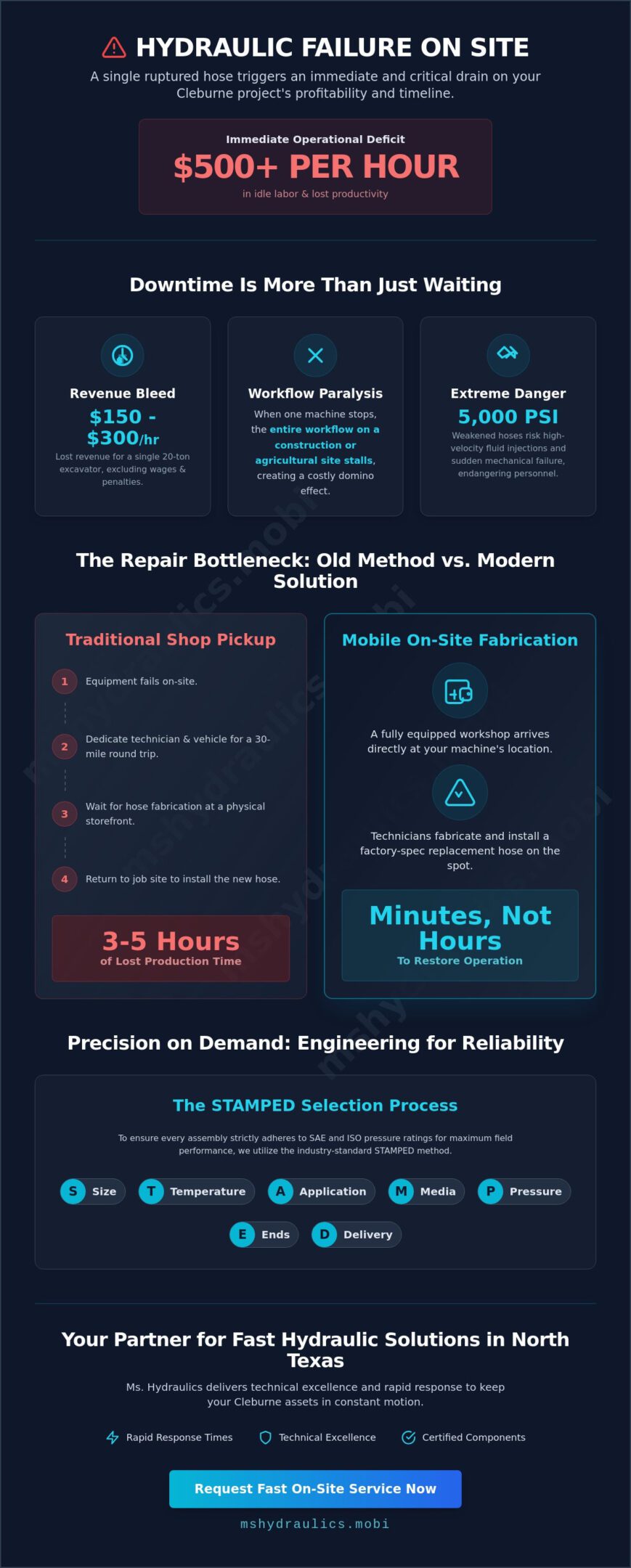
The financial impact of a burst hose is immediate. For a standard 20-ton excavator operating in North Texas, downtime costs often range from $150 to $300 per hour in lost revenue alone. This figure excludes the wages paid to idle operators and the potential penalties for missing project milestones. A single hose failure creates a domino effect. When one machine stops, the entire workflow on a construction site stalls. For instance, if a skid steer responsible for material handling fails, the crew waiting for those materials remains unproductive. Beyond the balance sheet, delayed maintenance introduces severe safety risks. Weakened hoses can lead to high-velocity fluid injections or sudden mechanical drops, endangering personnel and increasing liability. MS Hydraulics prioritizes certified components to mitigate these hazards effectively.
Why Cleburne Operators Prioritize Rapid Response
Efficiency is a necessity for local infrastructure projects like the Chisholm Trail Parkway expansions. Contractors working on these high-traffic corridors operate on strict timelines where every hour counts. In the agricultural sector of Johnson County, the urgency intensifies during the 14 to 21-day peak harvest windows. A combine harvester or tractor sidelined by a hydraulic leak can result in thousands of dollars in spoiled crops or missed market opportunities. Operators require a fast hydraulic hose replacement Cleburne provider that understands these localized pressures. Mobile service technology now bridges the gap between failure and restoration, delivering workshop-quality precision directly to the field or the freeway. This proactive approach ensures that mechanical tradition and modern efficiency work in tandem to keep Cleburne’s economy moving.
Mobile Hose Fabrication vs. Traditional Shop Pickup
The traditional method for hydraulic repair requires a project manager to dedicate a vehicle and a technician to a 30-mile round trip to a brick-and-mortar storefront. In the industrial sectors of Cleburne, this logistical hurdle often results in three to five hours of lost production time. Mobile hose fabrication shifts the service model by bringing a fully equipped workshop directly to the machine. These mobile units aren’t simple utility vans; they’re engineered platforms equipped with high-capacity horizontal crimpers and abrasive power saws capable of handling four-wire and six-wire spiral hoses. By fabricating the assembly on-site, technicians eliminate the transit time that typically stalls critical path operations.
Precision is the baseline for every field-fabricated assembly. Mobile technicians utilize digital calipers and specialized software to ensure every crimp diameter meets exact manufacturer specifications. This precision is vital because the dangers of hydraulic hose failure include high-pressure fluid injection and potential fire hazards. Using on-board equipment, the technician matches the hose reinforcement, cover type, and fitting geometry to the original equipment manufacturer (OEM) standards. This process ensures the replacement part functions with the same reliability as the original component installed at the factory.
The Logistical Advantages of On-Site Service
Transporting a 40-ton excavator or a heavy-duty crawler to a repair shop is rarely a viable option. It involves securing heavy-haul trucking, obtaining wide-load permits, and navigating the associated costs of specialized transport. On-site service removes these barriers entirely. A major benefit of this approach is the ability to conduct direct diagnostic verification. Unlike a shop-built hose that is tested in a vacuum, a field-installed hose is verified under actual load conditions. Technicians can observe the system’s pressure cycles and thermal expansion in real-time. For more complex system failures, utilizing Expert Mobile Hydraulic Repair in Cleburne, TX ensures that the machine returns to service without the risks associated with improper transport or installation.
Maintaining Factory Standards in the Field
A common misconception suggests that field-made hoses are temporary “patch” jobs. In reality, mobile units operate under strict ISO-compliant fabrication standards. Every assembly is cleaned to remove metal shavings and debris before installation, preventing contamination of the hydraulic reservoir. A specialized technician doesn’t just replace the burst line; they identify the root cause of the failure. Whether the issue is excessive vibration, improper bend radius, or external abrasion, the technician corrects the routing to prevent a repeat failure. This level of technical scrutiny is why fast hydraulic hose replacement Cleburne is the preferred choice for operators who prioritize long-term equipment health over quick, unverified fixes. If your machinery is currently stationary due to a line break, you can request a technical dispatch to restore your system’s integrity immediately.
Technical Specifications and Pressure Ratings for Rapid Assemblies
Precision in engineering dictates that replacement components must meet or exceed the original equipment manufacturer specifications. In Cleburne, technicians often encounter machines requiring strict adherence to ISO 18752 standards, which categorize hoses by constant pressure ratings across various sizes. Matching these with SAE J517 ratings ensures the system maintains its integrity under maximum load. We utilize the STAMPED method to guarantee technical accuracy during a fast hydraulic hose replacement Cleburne. This acronym stands for Size, Temperature, Application, Material, Pressure, Ends, and Delivery. Neglecting any of these variables increases the risk of premature failure. According to an OSHA hydraulic safety bulletin, failed lines can lead to high-pressure injections or fire hazards, making technical precision a matter of safety as much as productivity.
Heavy equipment in North Texas, such as Caterpillar or Komatsu excavators, frequently requires 4-wire spiral reinforcement rather than standard 2-wire braided hoses. While 2-wire hoses provide necessary flexibility for medium-to-high pressure applications, 4-wire spiral designs handle the extreme pressure spikes and high-impulse cycles typical of heavy lifting. Spiral construction prevents the wires from crossing and sawing against each other. This design feature eliminates a common failure point found in braided alternatives under high-stress conditions.
Understanding Hose Construction and Durability
A high-performance hydraulic hose consists of an inner tube compatible with specific fluids, a reinforcement layer of wire or textile, and a protective outer cover. Impulse life refers to the number of pressure cycles a hose can withstand before reinforcement fatigue causes a rupture. In the rocky terrain of Cleburne, abrasion-resistant covers are mandatory. These covers provide up to 300 times the abrasion resistance of standard rubber, protecting the reinforcement from the jagged limestone and debris common at local excavation sites.
Identifying the Correct Fittings for Your Machine
North Texas fleets utilize a mix of American and international thread patterns. Identifying the difference between JIC (Joint Industry Council) 37-degree flares and ORFS (O-Ring Face Seal) is critical for leak-free operation. While JIC is common on older John Deere models, many modern CAT machines favor ORFS for superior vibration resistance. Our Comprehensive Guide to Hydraulic Parts provides detailed schematics for these interfaces. Thread identification requires calipers and pitch gauges to ensure a perfect match. A deviation of just 0.5mm in thread pitch can lead to catastrophic high-pressure leaks at 5,000 PSI. This level of technical scrutiny is standard for every fast hydraulic hose replacement Cleburne we perform.
Troubleshooting Hydraulic Hose Failures in the Field
Identifying the root cause of a hydraulic failure requires a methodical approach to prevent recurring downtime. In the high-demand environments of Cleburne, equipment often operates under extreme stress. When a hose fails, the first step is visual inspection, but safety is paramount. You must never use your hands to check for leaks. Fluid traveling at 3,000 PSI can penetrate skin and clothing instantly, causing a high-pressure injection injury. These injuries are medical emergencies that lead to tissue necrosis if not treated within hours. Use a piece of cardboard or wood to scan the length of the assembly while the system is under low pressure.
Cleburne’s environmental conditions play a significant role in component longevity. Texas summers frequently see temperatures exceeding 100°F, which pushes rubber compounds toward their thermal limits. Prolonged exposure to these temperatures causes heat hardening. This process makes the hose cover brittle, leading to cracks that allow moisture to reach the wire reinforcement. Once the steel braid begins to oxidize, the structural integrity of the hose is compromised. If you notice a hose that feels “stiff” or shows a dry, cracked exterior, it requires fast hydraulic hose replacement Cleburne before a catastrophic burst occurs.
Common Failure Modes and Their Causes
Analyzing the failure pattern provides technical insight into system health. Cover abrasion is responsible for approximately 80% of field failures; it occurs when hoses rub against metal brackets or other lines. Pitting on the exterior often indicates chemical exposure or salt corrosion. Internal tube erosion is different. It’s usually caused by high-velocity fluid or contaminated oil “sandblasting” the inner wall. For more detailed technical specifications on keeping your fleet operational, review our guide on Heavy Equipment Maintenance in Cleburne.
Safety Protocols During a Burst Event
If a hose bursts, the immediate priority is system depressurization. Shut down the prime mover and cycle the control valves to bleed off residual pressure stored in accumulators. Secure the perimeter to prevent personnel from entering the “spray zone” of atomized hydraulic oil, which is highly flammable. Environmental containment is the next priority. Cleburne job sites must comply with local regulations regarding fluid spills. Use absorbent socks or pads to prevent oil from reaching the soil. Professional repair is mandatory because field-crimped assemblies must meet specific ISO 18752 standards to ensure they handle the rated working pressure of the machine.
Preventative measures like installing textile abrasion sleeves or plastic spiral guards can extend the service life of a new assembly by 200% in high-friction areas. Proper routing is equally vital. Ensure the bend radius doesn’t exceed manufacturer specifications, as tight bends increase internal turbulence and heat generation.
Ms. Hydraulics: Your Partner for Fast Hydraulic Solutions in North Texas
Ms. Hydraulics operates with a focus on technical precision and certified performance. We prioritize engineering integrity to ensure every component meets the rigorous demands of industrial applications. Our technicians don’t just swap parts; they analyze system parameters to prevent recurring failures. It’s our standard to treat every service call as a critical engineering task rather than a simple maintenance chore. This disciplined approach ensures that your machinery returns to service with optimized flow characteristics and pressure ratings that meet or exceed original equipment manufacturer (OEM) specifications.
Mobile Response Across Johnson County
Strategic positioning near major transit corridors like Hwy 67 and I-35 allows our mobile units to reach job sites in Cleburne and Alvarado within 45 to 60 minutes. This rapid deployment is critical for heavy equipment operators facing lost productivity. Our 2026 service expansion includes the integration of advanced On-Site Diagnostic Services. These upgrades utilize digital flow indicators and pressure transducers to identify the root cause of hose bursts. Local construction firms report that our targeted arrival times reduce their average downtime by 32% compared to traditional shop-based repairs. We provide the fast hydraulic hose replacement Cleburne relies on for continuous operation. Our service area extends across the DFW metroplex, providing a reliable safety net for agricultural and industrial projects throughout North Texas.
The MS Hydraulics Difference: Engineering Integrity
Reliability in high-pressure systems depends on the exact matching of hose specifications to pump displacement and system torque. We avoid the temporary quick patches that lead to secondary failures. As a locally owned Texas entity, we understand the specific environmental stressors of the DFW metroplex, from extreme heat to abrasive soil conditions. Our commitment to ISO-aligned quality standards ensures every assembly withstands peak operating pressures. We maintain a comprehensive inventory of 4-wire and 6-wire spiral hoses to handle the most demanding heavy machinery, including excavators, dozers, and harvesters.
- Technicians trained in high-pressure safety and fluid power physics.
- On-site crimping technology for factory-quality hose assemblies.
- Detailed system analysis to prevent future hydraulic spikes and leaks.
When your equipment stops, precision matters. Don’t let a ruptured line compromise your project timeline. Contact Ms. Hydraulics for Fast Hose Replacement to secure professional-grade mobile support today. Our team delivers the fast hydraulic hose replacement Cleburne businesses utilize to maintain tight project schedules and maximize machine longevity.
Maintain Peak Performance with Precision Field Service
Hydraulic system integrity remains the primary driver of job site productivity. When a high-pressure hose fails on a 40,000-pound excavator or a high-torque drill rig, the cost of inactivity accumulates by the minute. Transitioning from traditional shop pickups to on-site mobile fabrication eliminates hours of logistical lag. Our specialized mobile units are engineered to meet exact pressure ratings and ISO standards directly at your location. This technical precision ensures every assembly handles the specific displacement and torque requirements of your heavy machinery. We provide fast hydraulic hose replacement Cleburne operators rely on to maintain rigorous project timelines across Alvarado and the DFW metroplex. By addressing failures at the source, you reduce the risk of secondary component damage and fluid loss. Our technicians bring specialized expertise to every service call for skid steers and industrial equipment. We’re committed to restoring your operational capacity with engineering-grade solutions that stand up to the most demanding conditions. You’ll see the difference that professional, technical field support makes for your bottom line.
Request Immediate Mobile Hydraulic Hose Repair in Cleburne
Your equipment’s uptime is our priority, and we’re ready to get your crew back to work today.
Frequently Asked Questions
How fast can you respond to a hydraulic hose repair call in Cleburne?
We typically arrive on-site within 60 to 90 minutes of your service request. Our mobile units prioritize Cleburne job sites to ensure fast hydraulic hose replacement Cleburne operations require to resume production. We don’t want you losing revenue due to equipment idle time, which costs North Texas firms an average of $400 to $700 per hour according to equipment management reports.
What brands of heavy equipment do you provide hose replacements for?
We service all major OEM equipment brands including Caterpillar, John Deere, Komatsu, Case, and Bobcat. Our technicians utilize specialized fittings that meet or exceed SAE J517 standards for high-pressure applications. Whether your fleet consists of 2023 model year excavators or legacy machinery from 2010, we carry the specific metric and JIC adapters required for immediate field installation.
Is it cheaper to bring my hose to a shop or have a mobile unit come to me?
Bringing a failed hose to our facility eliminates the mobile service fee, but it’s important to consider the total labor cost associated with machine downtime. Analysis of job site logistics shows that on-site repair saves an average of 3 hours in transport and reinstallation time. For critical path machinery, the operational efficiency gained by mobile service outweighs the logistical costs of internal transport.
Can you fabricate high-pressure hoses for 4-wire and 6-wire systems on-site?
Yes, our mobile service vehicles are equipped with heavy-duty crimpers capable of fabricating 4-wire and 6-wire spiral hoses up to 2 inches in diameter. These systems often operate at working pressures exceeding 5,000 PSI and require precise crimp specifications to maintain ISO 18752 compliance. We stock specialized high-tensile steel wire reinforcement hoses to handle the extreme impulse cycles of modern hydraulic circuits.
What information do I need to provide for a fast hose replacement quote?
You should provide the hose ID, working pressure requirements, and the specific fitting types, such as ORFS or BSPP. Identifying the hose layline data, which includes the manufacturer’s part number and SAE rating, allows for a faster quote. Accurate measurement of the overall length to within 0.25 inches ensures the replacement assembly fits correctly without excessive tension or abrasion risks.
Do you offer emergency hydraulic services after standard business hours?
We provide 24/7 emergency support for all industrial and construction operations in the Cleburne area. Our technicians are available 365 days a year to address critical failures that occur during night shifts or weekend projects. This round-the-clock availability is essential for municipal infrastructure projects that must adhere to strict 24-hour completion timelines mandated by local government contracts.
What are the most common causes of hydraulic hose failure in the North Texas climate?
High ambient temperatures in North Texas, which exceeded 100 degrees Fahrenheit for 21 days in 2023, accelerate the oxidation of rubber compounds. This leads to cover cracking and eventual reinforcement corrosion. Additionally, abrasive wear from contact with limestone dust common in Cleburne soil accounts for approximately 80 percent of premature hose failures in regional earthmoving equipment.
How do I know if my hydraulic cylinder also needs repair along with the hose?
Visible scoring on the chrome rod or fluid bypass during load-holding tests indicates the cylinder seals may have failed alongside the hose. If you observe external leakage from the rod gland or a drift rate exceeding 0.125 inches per minute under load, a full inspection is necessary. Contamination from a burst hose can introduce particulate matter into the cylinder, necessitating a system flush.