Expert Hydraulic Pump Repair in Waxahachie: Minimizing Industrial Downtime
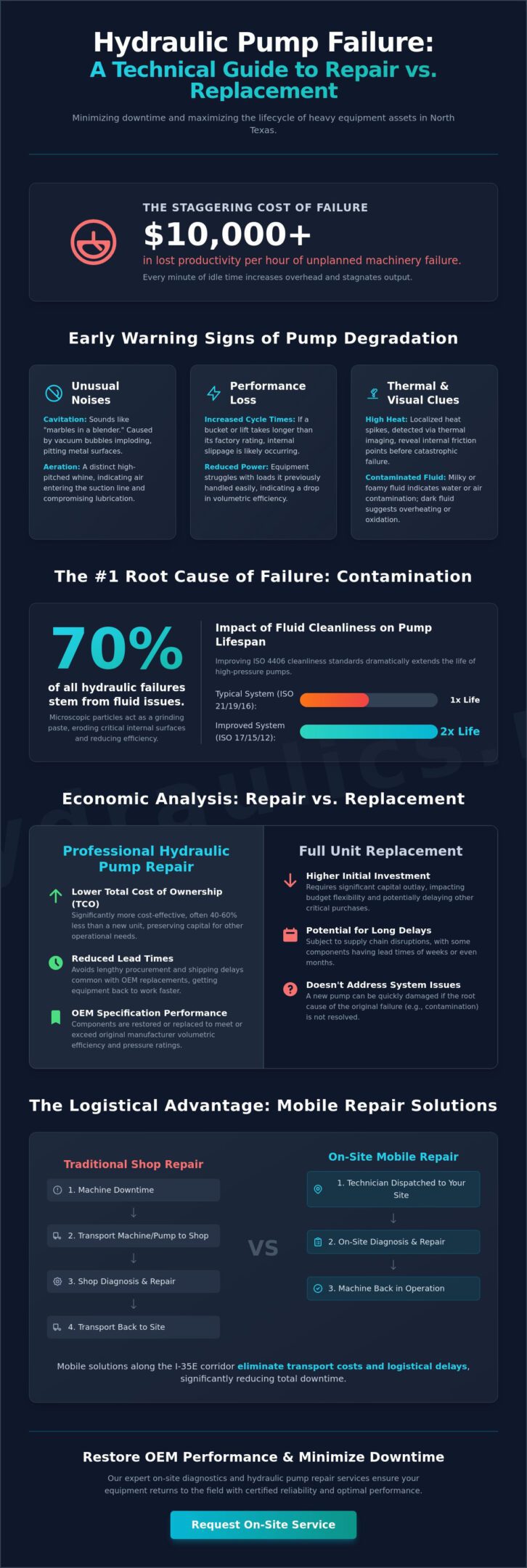
A single hour of unplanned machinery failure can cost an industrial operation upwards of $10,000 in lost productivity and missed deadlines. You likely recognize that every minute a backhoe or industrial press sits idle, your operational overhead increases while your output stagnates. Maintaining peak volumetric efficiency and system integrity isn’t just a maintenance goal; it’s a critical financial necessity for heavy equipment operators in North Texas.
This technical guide outlines the precise engineering steps for hydraulic pump repair Waxahachie to restore your machinery to OEM specifications without the lead times of new procurement. We’ll analyze diagnostic data regarding pressure drops and cavitation, provide an objective cost-benefit analysis of component-level restoration versus full unit replacement, and detail how mobile technical support eliminates the logistical delays of traditional shop repairs. By focusing on measurable performance metrics like displacement, torque, and fluid contamination levels, we ensure your equipment returns to the field with certified reliability and optimal performance. This methodical approach provides the technical clarity needed to minimize downtime and maximize the lifecycle of your hydraulic assets.
Key Takeaways
- Learn to identify early indicators of component failure to restore OEM volumetric efficiency and protect the hydraulic circuit’s integrity.
- Analyze the specific mechanical requirements of gear, vane, and piston pumps, focusing on critical parameters like displacement and maximum PSI.
- Compare the Total Cost of Ownership (TCO) between replacement and professional hydraulic pump repair Waxahachie services to significantly reduce lead times.
- Understand the rigorous technical repair process, utilizing on-site flow meters and pressure gauges for precise diagnostic isolation of the pump.
- Discover the logistical advantages of mobile repair solutions along the I-35E corridor that eliminate the need for transporting heavy industrial machinery.
Identifying Hydraulic Pump Failure in Waxahachie’s Heavy Equipment
Professional Hydraulic pump repair is a precise engineering process involving the complete disassembly, microscopic inspection, and restoration of internal components to meet original equipment manufacturer (OEM) volumetric efficiency. The pump serves as the heart of any hydraulic circuit. It’s the primary component responsible for converting mechanical power into the hydraulic flow required to move heavy loads. In machinery like excavators and skid steers, the pump must maintain exact tolerances to function. When these tolerances drift, the impact on operational overhead is immediate. Project timelines in Waxahachie slip as equipment loses the power needed for grading, lifting, or trenching.
Securing timely hydraulic pump repair Waxahachie services is vital for maintaining industrial productivity. A pump operating at only 80% efficiency might still move, but it consumes more fuel and generates more waste heat than a healthy unit. This inefficiency translates directly into higher daily operating costs and accelerated wear on secondary components like control valves and cylinders. Without intervention, a minor drop in pressure often leads to a total system seizure.
Early Warning Signs of Pump Degradation
Operators should remain vigilant for unusual acoustic signatures during operation. Cavitation often sounds like marbles rattling in a blender; this occurs when fluid doesn’t fill the pump’s chambers correctly, creating vacuum bubbles that implode and pit metal surfaces. Aeration produces a distinct high-pitched whining, indicating that air is entering the suction line and compromising lubrication. Increased cycle times provide another clear indicator of trouble. If a bucket takes two seconds longer to cycle than its factory rating, internal slippage is likely occurring. Technicians often use thermal imaging to identify localized heat spikes, which reveal internal friction points before they cause a catastrophic failure.
Environmental Factors Impacting Waxahachie Job Sites
North Texas environmental stressors accelerate component fatigue in ways that standard maintenance schedules might not predict. Rapid temperature swings affect hydraulic fluid viscosity; fluid that’s too thin fails to provide a protective film, while fluid that’s too thick causes pump starvation during morning starts. Local soil contains fine particulates that act as abrasives if they bypass filtration systems. These particles score the surfaces of pump vanes and pistons, leading to a permanent loss of displacement pressure. Scheduling regular On-Site Diagnostic Services allows for the detection of these contaminants before they ruin a pump. Expert hydraulic pump repair Waxahachie ensures that equipment remains resilient against these specific regional challenges.
Technical Breakdown: Common Pump Types and Failure Mechanisms
Industrial machinery across North Texas relies on three primary architectures: gear, vane, and piston pumps. Each design operates under specific technical parameters including displacement, maximum pressure ratings, and torque requirements. High-pressure piston pumps often operate at levels exceeding 5,000 PSI, requiring microscopic tolerances to maintain volumetric efficiency. When these tolerances degrade, the system’s overall performance drops. Professional hydraulic pump repair Waxahachie services focus on restoring these exact engineering specifications to ensure long-term reliability.
The science of contamination explains why most systems fail prematurely. Data from the Noria Corporation indicates that 70% of all hydraulic failures stem from fluid issues. Microscopic particles act as grinding paste, eroding internal surfaces. Maintaining ISO 4406 cleanliness standards is the most effective way to extend pump life. For example, moving from an ISO 21/19/16 rating to a 17/15/12 rating can often double the life expectancy of a high-pressure pump by reducing the concentration of abrasive silt.
Piston Pump Failure Modes
Piston units are highly susceptible to slipper foot wear and swashplate scoring. These failures usually happen when the hydrodynamic lubricant film breaks down due to heat or aeration. High case drain pressure is another critical failure point. If housing pressure exceeds 25 PSI, it compromises the shaft seal integrity, leading to leaks and air ingestion. Restoration isn’t just about replacing parts. It requires precision lapping of the cylinder block and valve plate to a flatness measured in light bands. This ensures a perfect metal-to-metal seal that prevents internal bypass.
Gear and Vane Pump Considerations
Gear pumps frequently suffer from “tracking,” where the gear teeth cut into the housing walls. This increases internal clearances and reduces volumetric efficiency, often dropping it below the standard 90% threshold. In vane pumps, the cam ring surface finish is the most vital factor. Vane tip wear occurs rapidly if the fluid viscosity is incorrect for the operating temperature. Many issues identified during hydraulic pump repair Waxahachie involve side loading. This occurs when the drive shaft is misaligned, putting uneven stress on the bearings and shortening the component’s service life. Operators should regularly check their performance catalogs to ensure their pumps are operating within the manufacturer’s original design curves.
Economic Analysis: Hydraulic Pump Repair vs. Replacement
Industrial operators must evaluate the total cost of ownership (TCO) when a critical system fails. Selecting hydraulic pump repair Waxahachie services often results in a 40% to 60% cost reduction compared to purchasing new components. This financial advantage stems from the retention of the pump housing, which constitutes a large portion of the unit’s value. By eliminating the “core charge” associated with new assemblies, facilities preserve capital while receiving a component restored to its original performance curves. It’s a pragmatic approach that prioritizes engineering value over simple procurement.
Lead time is the most critical variable in this economic equation. Current market data indicates that OEM backorders for specific high-pressure pumps can extend to 4 weeks or more. A precision 48-hour repair turnaround reduces potential downtime by over 90%. This speed ensures that production lines remain active, preventing the revenue losses associated with prolonged industrial halts. Every hour of idleness carries a fixed cost, making the speed of a local rebuild far more valuable than the perceived security of a factory-new unit. We focus on ensuring the repaired pump meets or exceeds the original volumetric efficiency and pressure setpoints.
When to Choose Professional Repair
Technicians prioritize the 50% rule during the evaluation phase. If the cost to restore a pump to ISO standards is less than half the price of a replacement, repair is the standard industrial preference. This process requires a detailed inspection of the structural integrity of the pump housing and the main drive shaft. Beyond direct savings, restoration supports industrial sustainability. It reduces waste by keeping high-quality iron and steel in service rather than sending complex castings to a scrap yard. If the housing is cracked or the shaft is warped beyond 0.002 inches, replacement becomes the necessary path.
The Risks of “Off-the-Shelf” Generic Replacements
Procuring a low-cost, generic pump often leads to technical complications. These units frequently suffer from compatibility issues regarding mounting flanges or port configurations, which adds hours of labor to the installation process. Aftermarket pumps often fail to meet the rigorous duty cycle requirements of heavy machinery, leading to premature failure within the first 500 hours of operation. Utilizing a mobile hydraulic repair Cleburne TX specialist provides the security of a local warranty and verified performance data. This ensures the hydraulic pump repair Waxahachie project meets the exact torque and displacement specifications required for your specific application.
The Professional Repair Process: From On-Site Diagnosis to Testing
Executing a high-standard hydraulic pump repair Waxahachie requires a methodical, engineering-first approach. When industrial machinery fails, the priority isn’t just a quick fix; it’s identifying the root cause to prevent a repeat failure. Technicians begin by isolating the pump from the rest of the hydraulic circuit using calibrated flow meters and pressure gauges. This step ensures that system-wide issues, such as clogged filters or failing valves, aren’t misidentified as pump failure. Approximately 70% of hydraulic component failures originate from system contamination or improper fluid maintenance, making this initial isolation critical.
On-Site Diagnostic Protocols
Technicians perform a case drain flow test to quantify internal bypass leakage. If the case drain flow exceeds 10% of the pump’s rated output, it’s a definitive indicator of internal wear in the cylinder block or valve plate. We utilize portable analysis kits to check hydraulic fluid for metallic particles, providing an immediate snapshot of wear debris. Additionally, suction lines are inspected for air leaks. Even a minor leak can cause aeration, which leads to cavitation and the rapid destruction of internal pump components. These field tests provide the technical data needed to determine if an on-site adjustment is possible or if a full shop overhaul is required.
Once the pump is in the shop, we perform a controlled disassembly. Every component of the internal rotating group is documented in its “as-found” condition. This forensic analysis helps us understand if the failure was due to fatigue, heat, or contamination. Component restoration involves precision machining and lapping of valve plates and cylinder blocks to tolerances within 0.000011 inches. We replace all seals using high-performance Viton kits, which offer superior thermal stability and chemical resistance compared to standard nitrile options.
Precision Reassembly and Bench Testing
The final assembly of piston groups occurs in clean room conditions to prevent particulate ingress that could compromise the 5,000 PSI tolerances of modern pumps. Technicians set compensator pressures and flow limiters to match the specific requirements of the machine. We document all performance data, including volumetric efficiency and torque ratings, for the client’s Heavy Equipment Maintenance records. This documentation ensures a technical trail for future preventative maintenance cycles.
Before a pump leaves the facility, it undergoes dynamic bench testing. We subject the unit to full-load conditions to ensure it holds pressure without leakage or excessive heat generation. A repaired pump must meet or exceed 95% of its original OEM volumetric efficiency before it’s cleared for installation. This rigorous validation process minimizes the risk of post-installation downtime and ensures the longevity of the repair.
Mobile Hydraulic Pump Solutions for Waxahachie Job Sites
Ms. Hydraulics prioritizes rapid response times for industrial operations situated along the I-35E and Highway 287 corridors. Transporting a 50,000lb machine to a repair facility for a pump issue is a logistical nightmare that halts production and drains resources. Our mobile service units eliminate this burden by bringing precision engineering directly to your field site. We’ve equipped our specialized service trucks with high-capacity rigging and diagnostic flow meters to facilitate on-site pump removal and installation. This capability ensures that hydraulic pump repair Waxahachie remains efficient and cost-effective. We don’t just swap components. Our technicians analyze system parameters to ensure the replacement pump operates within its specific displacement and pressure requirements.
Our mobile units act as a literal extension of our main facility. We carry the necessary tools to perform high-pressure testing and fluid contamination analysis on the spot. This immediate data allows us to make informed decisions about your hardware without the delay of traditional shop transport. We value performance above all else. When a machine is down, every hour lost impacts your bottom line. We provide the technical expertise needed to restore your equipment to its full operational capacity with minimal delay.
Serving Waxahachie and Ellis County
Our coverage area extends from the high-density Waxahachie Business Park to remote rural job sites where infrastructure is limited. We provide critical support for a wide range of assets, from municipal vacuum trucks to private sector drill rigs. Our team coordinates with local contractors to integrate preventative inspections into their scheduled maintenance cycles. By identifying wear patterns in pump housings or internal gears before they lead to a total system shutdown, we maximize machine uptime. Data indicates that 78% of premature pump failures are avoidable through these scheduled field evaluations. We focus on the industrial community’s long-term stability by providing consistent, high-quality service across the entire county.
Why Ms. Hydraulics is the Trusted Partner
The same technical rigor applied to heavy equipment cylinder rebuild Texas projects is applied to every pump system we service. We maintain a no-nonsense approach to diagnostics. Our technicians identify the exact failure point and explain the mechanical reason behind it. Whether it’s a seal failure due to excessive heat or a bearing collapse from fluid aeration, you’ll receive a factual report. This commitment to integrity ensures you aren’t paying for unnecessary parts. We focus on quality and certified results to maintain our position as a leading service provider. Our goal is to provide a permanent fix that stands up to the rigors of heavy industrial use. Contact Ms. Hydraulics for an on-site pump evaluation today.
Securing Operational Continuity in North Texas
Maintaining peak mechanical efficiency requires a methodical approach to component maintenance and technical oversight. Since 2021, MS Hydraulics has provided specialized support across Waxahachie, Cleburne, and the broader North Texas region. Our mobile technicians arrive on-site to address pressure drops and volumetric inefficiencies, ensuring your equipment meets original equipment manufacturer specifications. It’s critical to prioritize expertise in ISO-standard hydraulic restoration over total replacement to extend the service life of your machinery while maintaining strict safety parameters. Professional hydraulic pump repair Waxahachie services eliminate the logistical delays associated with transporting heavy components to off-site facilities. We focus on technical precision to restore optimal torque and displacement ratios immediately. Our team stands ready to deploy to your job site to resolve critical system failures before they impact your bottom line. Don’t let mechanical degradation compromise your project deadlines or operational safety. We’re here to ensure your heavy equipment remains a reliable asset for years to come.
Request an On-Site Hydraulic Pump Diagnosis in Waxahachie
Frequently Asked Questions
How do I know if my hydraulic pump is failing or if it’s just a clogged filter?
Distinguishing between a clogged filter and internal failure requires a flow meter test to identify specific performance drops. If the system experiences a 15% reduction in flow but pressure remains stable, the filter is likely the culprit. Pump failure typically manifests as internal bypass where heat increases by 10 degrees or more above standard operating parameters. We utilize ISO 4406 contamination analysis to determine if particulate matter has breached the internal components.
Can a hydraulic pump be repaired on-site at my Waxahachie job site?
Our technicians provide on-site diagnostics and minor component replacements across industrial sites in the local area. While a full hydraulic pump repair in Waxahachie often requires a controlled environment to meet ISO 9001 standards, we can swap seals or adjust pressure compensators in the field. This immediate response reduces downtime by up to 4 hours compared to transporting the entire unit for simple adjustments. We focus on getting your machinery back to 100% capacity quickly.
How much does a typical hydraulic pump repair cost compared to a new one?
Rebuilding a unit typically costs 45% to 55% of the price of a new replacement. This economic advantage is most visible in large displacement piston pumps where new lead times can exceed 12 weeks. By choosing a rebuild, you maintain the original housing and replace only high-wear components like brass plates and cylinder blocks. This approach preserves your capital budget while restoring the unit to 100% volumetric efficiency without the cost of a full replacement.
What is the average turnaround time for a hydraulic pump rebuild?
Standard turnaround for a comprehensive rebuild is 3 to 5 business days. This timeframe includes complete disassembly, ultrasonic cleaning, and component inspection. Every unit undergoes 2 hours of rigorous bench testing on our 300-horsepower test stand to ensure it meets original factory specifications. We prioritize emergency repairs to help facilities resume operations within 24 to 48 hours when critical parts are in stock. Our goal is to minimize your production stops.
Why is my hydraulic pump making a loud whining noise?
High-pitched whining usually indicates aeration where air enters the suction line at a rate exceeding 0.1% of the fluid volume. This creates bubbles that implode when reaching the pressure side, causing metal erosion and vibration. If the noise is more of a rattling sound, it’s likely cavitation caused by a restricted inlet. Both conditions will destroy a pump’s internal surfaces within 50 operating hours if they aren’t corrected immediately by a technician.
What happens if I continue to run a machine with a cavitating pump?
Running a cavitating pump causes vapor bubbles to collapse with enough force to pit steel components. This process releases microscopic metal debris into the entire hydraulic circuit, which can contaminate valves and cylinders. Within 10 to 20 hours of operation, the pump’s volumetric efficiency will drop below 70%. Eventually, the internal rotating group will seize. This leads to a repair bill that is often 3 times higher than an early intervention and requires a full system flush.
Do you provide warranties on repaired hydraulic pumps?
We provide a 12-month warranty on all hydraulic pump repair Waxahachie services, covering both parts and labor. This guarantee reflects our confidence in our ISO-certified assembly processes and precision machining. Every repaired unit is shipped with a certified test report showing its flow and pressure performance across its full operating range. This documentation ensures the pump meets or exceeds the 95% efficiency rating required for industrial applications. It’s our commitment to your long-term reliability.
What brands of hydraulic pumps do you repair in Waxahachie?
Our engineering team services a wide range of manufacturers including Bosch Rexroth, Vickers, Parker Hannifin, and Eaton. We maintain a deep inventory of technical specifications for the Rexroth A10V series and Vickers PVH series pumps. Whether it’s a fixed displacement gear pump or a complex variable displacement piston pump, we apply the same technical rigor to every brand. Our facility is equipped to handle units with flow rates up to 500 liters per minute with absolute precision.