Expert Hydraulic Hose Shop Services in Granbury: A Technical Guide to Hose Fabrication
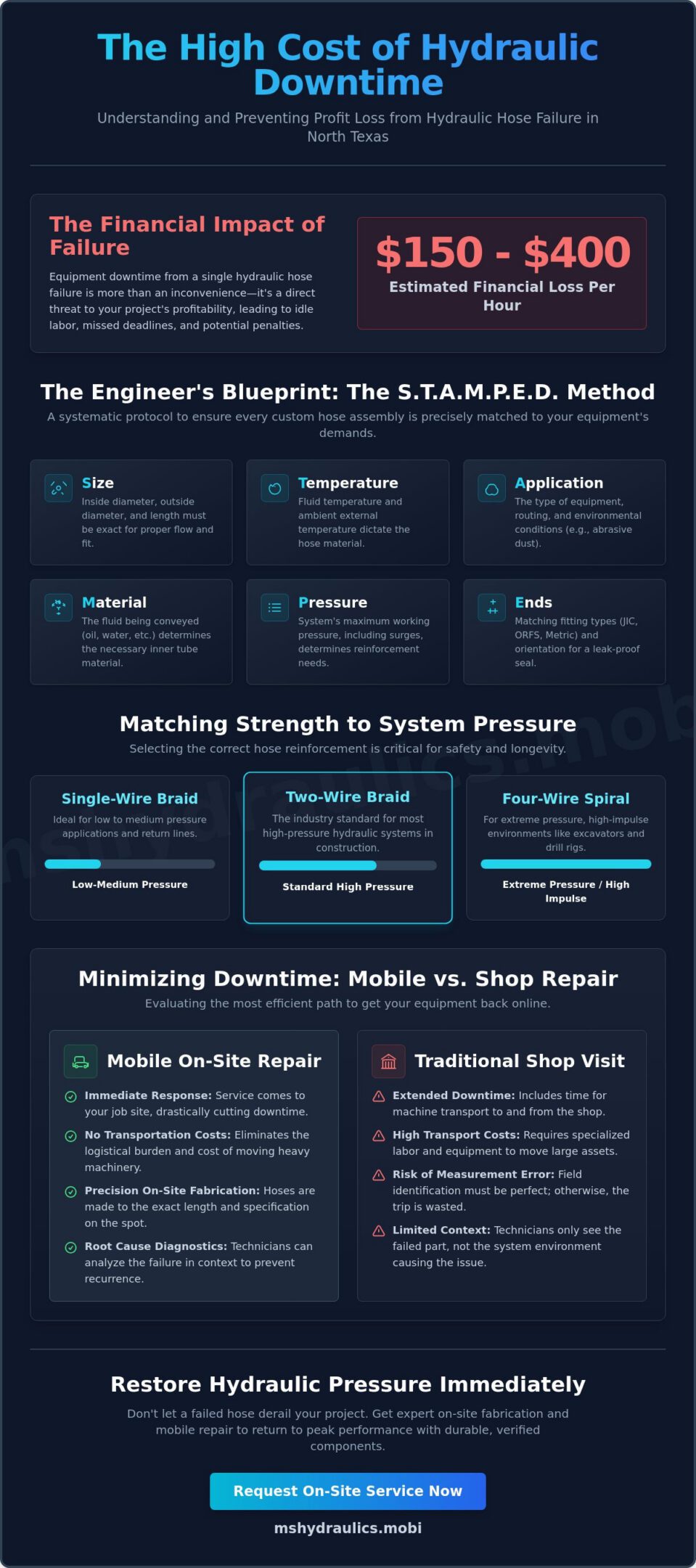
Equipment downtime due to hydraulic hose failure results in financial losses estimated between $150 and $400 per hour. For operators in North Texas, these costs accumulate rapidly when a machine sits idle because of a blown seal or an unidentified metric fitting. You likely understand that waiting for a replacement part isn’t just an inconvenience; it’s a direct threat to your project’s profitability. Finding a reliable hydraulic hose shop in Granbury that provides immediate, high-precision fabrication is essential for maintaining operational continuity.
This technical guide explores how to secure expert fabrication and mobile repair services designed to restore hydraulic pressure immediately. We’ll examine the critical importance of adhering to SAE J517 and ISO 1436:2026 standards to ensure your assemblies withstand rigorous high-pressure environments. By prioritizing a correct fitting match on the first attempt, you can bypass the logistical burden of transporting heavy machinery and return to peak performance with durable, verified components.
Key Takeaways
- Learn to apply the STAMPED method to ensure every custom hose assembly meets the precise size, pressure, and temperature requirements of your specific industrial application.
- Compare the logistical efficiency of mobile hydraulic repair against traditional shop visits to minimize the hidden costs of equipment transportation and specialized labor.
- Master field identification techniques, including accurate methodology for measuring hose length, to facilitate faster communication with a hydraulic hose shop Granbury.
- Understand how on-site diagnostic services identify the root causes of component failure in high-value assets like excavators and drill rigs to prevent recurring downtime.
The Critical Role of Local Hydraulic Hose Support in Granbury
Granbury’s infrastructure and industrial sectors rely on high-pressure fluid power systems. From residential construction near Lake Granbury to large-scale agricultural operations, hydraulic machinery serves as the backbone of local productivity. When a primary line fails on a 30-ton excavator or a specialized drill rig, the financial consequences are immediate. Industry data suggests that equipment downtime can cost operators between $150 and $400 per hour. These losses aren’t limited to idle labor; they include missed project milestones and potential contractual penalties. Reliable support isn’t a luxury; it’s an operational necessity for any Hood County contractor managing high-value assets.
Generic, off-the-shelf hose assemblies often lack the reinforced specifications required for North Texas job sites. Standard components frequently fail because they don’t account for local environmental stressors like extreme thermal cycling and abrasive caliche dust. A dedicated Hydraulic hose construction must prioritize durability and precise fitment to prevent premature degradation. Engaging a specialized hydraulic hose shop Granbury ensures that every assembly is engineered for the specific pressures and mechanical loads of the local terrain. This level of technical verification is what separates a temporary fix from a long-term engineering solution.
Granbury’s Industrial Landscape and Hydraulic Demand
Heavy equipment used in Hood County land clearing and civil engineering projects operates under severe duty cycles. In these environments, hydraulic systems must maintain integrity despite constant exposure to grit and high ambient temperatures. Proximity to a technical service provider is critical. High-pressure applications leave no margin for error. Using a hose with an incorrect pressure rating can lead to catastrophic system failure. Precision fabrication ensures that the inner tube, reinforcement layers, and outer cover are perfectly matched to the machine’s specific hydraulic requirements.
Why Proximity Matters for Emergency Hose Fabrication
The logistics of sourcing a custom hose assembly significantly impact the total downtime equation. Choosing a local hydraulic hose shop Granbury reduces the “travel time” variable that often extends machinery outages. Unlike pre-assembled parts found at general hardware retailers, custom-fabricated hoses utilize specific North Texas fittings like JIC, ORFS, or various metric standards. A local partner maintains a deep inventory of these specialized ends. This allows for immediate restoration of hydraulic pressure without the delays associated with shipping or long-distance transport. This responsiveness is vital for maintaining the steady rhythm of industrial operations.
Technical Standards of Custom Hydraulic Hose Fabrication
Custom hydraulic hose fabrication is a precision engineering process that ensures system integrity under extreme mechanical stress. It’s not a mere assembly task; it requires a disciplined approach to material selection and mechanical tolerances. Technicians at a high-quality hydraulic hose shop Granbury utilize the STAMPED method to verify every parameter before production begins. This systematic protocol stands for Size, Temperature, Application, Material, Pressure, Ends, and Delivery. Adhering to these established hydraulic hose standards minimizes the risk of catastrophic failure in the field, especially when dealing with the high-impulse cycles common in construction and industrial machinery.
The structural integrity of a hose depends heavily on its reinforcement layer. Single-wire braid hoses are typically reserved for low to medium pressure applications, while two-wire braid designs offer increased strength for standard high-pressure systems. For extreme pressure environments or equipment subject to severe pressure spikes, four-wire spiral reinforcement is required. Unlike braided wire, spiral layers remain parallel, providing superior resistance to wire fatigue during high-impulse operations. Selecting the incorrect reinforcement type for a specific application often leads to premature hose expansion and eventual burst failure.
Material Science: Choosing the Right Hose for the Job
Material selection is dictated by the fluid type and environmental exposure. Synthetic rubber remains the industry standard for general hydraulic oils due to its flexibility and wide temperature range. In contrast, thermoplastic hoses are preferred for non-conductive applications or when high chemical resistance is necessary. The outer cover plays a critical role in protecting the reinforcement from UV radiation, ozone, and mechanical abrasion. SAE J517 standards establish the minimum construction, dimensional, and performance requirements for the most common hydraulic hoses used in mobile and stationary equipment. For critical systems, utilizing professional fabrication services ensures that these material specifications are strictly followed.
Pressure Ratings and Safety Factors
Understanding the distinction between working pressure and burst pressure is vital for operator safety. The working pressure is the maximum pressure at which the hose is designed to operate continuously. Burst pressure, usually four times the working pressure, is the point of total structural failure. Matching a hose requires looking beyond the inner diameter; it involves verifying that the entire assembly, including the fittings, can handle the system’s peak output. Even the highest quality hose will fail if the crimping process is flawed. Precise crimp diameters must be maintained to prevent fitting blow-offs, which is why a reputable hydraulic hose shop Granbury uses calibrated equipment to secure every connection.
Mobile Repair vs. Shop Visits: Evaluating the Most Efficient Path
The decision between transporting a machine to a facility or requesting field service involves a complex ROI analysis. Traditional “pull and bring” methods require an operator to disassemble the failed component, transport it to a hydraulic hose shop Granbury, and then reverse the process for installation. This workflow introduces multiple variables that extend machinery outages. Modern mobile fabrication units eliminate these logistical bottlenecks by bringing precision engineering directly to the job site. Equipped with calibrated on-site crimpers and diagnostic tools, these units ensure that every assembly adheres to safe hydraulic hose assembly practices without the machine ever leaving its position. This technical agility is essential for projects with tight deadlines where a four-hour delay can disrupt an entire crew’s schedule.
The Downtime Cost Calculation
Quantifying the hourly loss of a non-operational skid steer or excavator is the first step in choosing a service path. As previously noted, industrial downtime averages between $150 and $400 per hour depending on the asset’s role. If a DIY hose removal and shop visit consumes five hours of total labor and travel, the hidden costs far exceed the price of the component. Mobile repair services mitigate this by collapsing the timeline. By choosing expert mobile hydraulic repair in Cleburne, TX or surrounding Granbury areas, operators trade a modest service fee for hours of regained productivity. This approach is particularly effective for single-line failures where the root cause is visible and accessible. It’s often more efficient to pay for the expertise of a technician who can identify and replace a blown line in sixty minutes than to lose half a day to logistics.
When to Visit a Physical Hydraulic Shop
Certain technical requirements make a shop environment the superior choice for equipment longevity. Large-scale fleet orders and bulk hose fabrication benefit from the high-volume throughput of a stationary facility. When a system requires a complex overhaul, such as a full valve bank replacement or a pump rebuild, shop-grade pressure testing benches are indispensable. These benches allow technicians to verify performance under simulated load conditions that are difficult to replicate in the field. Integrating these critical repairs with comprehensive heavy equipment maintenance ensures that all hydraulic components meet peak operational standards. For projects involving multiple failures or contaminated systems, the controlled environment of a physical hydraulic hose shop Granbury provides the necessary infrastructure for total system restoration and thorough diagnostic verification.
Field Identification: Preparing for Your Hose Replacement
Accurate field identification is the primary factor in reducing secondary downtime. When an operator provides precise technical data to a hydraulic hose shop Granbury, the fabrication process begins immediately upon arrival or technician dispatch. Before attempting any removal, strictly follow safety protocols to prevent injury. Hydraulic systems operate under extreme pressure; never use your hands to check for leaks, as fluid injection injuries are life-threatening. Ensure the system is completely depressurized and all components have cooled to ambient temperature before handling the lines.
Measuring hose length correctly is a frequent point of technical error. The industry standard for replacement is Overall Length (OAL), which includes the fittings at both ends of the assembly. If you only measure the visible hose between the crimp collars, the resulting part will be too short to accommodate the machine’s necessary range of motion. Providing the OAL ensures the new assembly maintains the original engineering tolerances of the equipment.
Identifying Hydraulic Fittings and Threads
High-pressure systems in North Texas utilize three primary fitting types: JIC, NPT, and Flat Face (ORFS). JIC fittings utilize a 37-degree flare to create a seal, while NPT fittings rely on tapered threads that wedge together. Parallel threads, found on ORFS fittings, use an O-ring to prevent fluid bypass. Using calipers to measure the outside diameter and a thread gauge to determine the pitch is the only way to ensure a correct match. In hydraulic systems, “close enough” is never acceptable; even a minor mismatch in thread pitch will lead to catastrophic failure under load.
Gathering Information for the Technician
Before contacting a service provider, compile a comprehensive data set to streamline the fabrication process. This checklist should include the machine make and model, the specific function of the failed hose, and any visible part numbers on the hose jacket. High-resolution photos of the failure point and the machine’s data plate provide essential context for the technician. A JIC 37-degree flare fitting is visually identified by its prominent cone-shaped seating surface on the male end and a corresponding flared seat on the female swivel. For immediate restoration of your equipment’s hydraulic integrity, contact Ms. Hydraulics for on-site diagnostic and fabrication services. This preparation ensures the hydraulic hose shop Granbury can verify component availability and prepare the necessary tooling before service begins.
Ms. Hydraulics: Precision Fabrication for Granbury and Beyond
Ms. Hydraulics LLC operates with a disciplined focus on engineering integrity and technical excellence. We provide specialized support for the North Texas industrial sector, where the demand for high-pressure fluid power remains constant. Choosing a dedicated hydraulic hose shop Granbury ensures that your equipment receives components that meet or exceed the latest industry specifications, including the ISO 1436:2026 standards. Our approach integrates precision fabrication with advanced diagnostics to address the systemic causes of hose failure rather than just the immediate symptoms. This methodical verification process is essential for maintaining the reliability of major international machinery brands operating in Hood County.
Our technical capabilities extend beyond simple hose replacement to provide a holistic view of fluid power health. There is a critical synergy between precision hose fabrication and heavy equipment cylinder rebuilds. A blown hose often indicates underlying pressure spikes or seal degradation within the cylinder or valve bank. By addressing these issues simultaneously, we ensure the long-term integrity of your hydraulic circuits. We maintain a broad service area coverage that includes Granbury, Cleburne, and the greater DFW region, providing the technical infrastructure required for complex field repairs and system overhauls.
Why Granbury Operators Choose Ms. Hydraulics
Operators in the Hood County area prioritize Ms. Hydraulics because we focus on minimizing downtime through rapid response and expert fabrication. Our technicians possess the specialized training required to handle diverse industrial machinery, from agricultural harvesters to heavy civil engineering equipment. We’ve successfully executed numerous field repairs across the region, restoring hydraulic pressure in environments where traditional shop transport was logistically impossible. This focus on modern efficiency aligns with the projected growth of the mobile hydraulic equipment market, which is valued at approximately $19.87 billion in 2026. We don’t just provide a part; we deliver an engineering solution that stands up to the rigors of the North Texas landscape.
Getting Started with Your Repair
Initiating a repair requires a structured communication process to ensure accuracy. When you request a mobile service call or shop-based fabrication, providing the specific data points discussed in our field identification guide accelerates our response time. Before a technician arrives on your job site, please ensure the machine is positioned on stable ground and the work area is clear of significant debris. This preparation allows for a more efficient diagnostic phase and a safer environment for component installation. For a comprehensive analysis of your equipment’s hydraulic health, contact Ms. Hydraulics for On-Site Diagnostic Services today. Our goal is to provide a durable, verified repair that keeps your operations moving without the risk of recurring failure.
Optimizing Hydraulic Performance and Equipment Continuity
Maintaining the integrity of high-pressure fluid systems requires a disciplined approach to both fabrication and diagnostics. By prioritizing technical standards like SAE J517 and utilizing precise field identification techniques, you can effectively eliminate the trial-and-error cycle that often extends machinery outages. Whether you require the immediate restoration of a single line through mobile repair or a comprehensive system overhaul in a controlled environment, the strategic selection of a hydraulic hose shop Granbury is the most critical factor in your operational ROI calculation.
Ms. Hydraulics has provided specialized support for heavy equipment across North Texas since 2021. Our expert technicians utilize on-site diagnostic capabilities to identify root causes of failure in high-pressure systems, ensuring every assembly meets rigorous mechanical parameters. Don’t let preventable component failure disrupt your project schedule. Request Custom Hose Fabrication or Mobile Repair to secure the engineering expertise your equipment requires for peak performance. Professional support ensures your machinery returns to service with the durability needed for the most demanding job sites.
Frequently Asked Questions
How much does it cost to have a hydraulic hose made in Granbury?
Total costs for a custom assembly depend on specific mechanical parameters such as hose diameter, length, and the complexity of the required fittings. Technical factors like the number of reinforcement layers and the material composition of the outer cover also influence the final price. Operators should provide their STAMPED specifications to a local provider to receive an accurate quote for their specific application.
Can you repair a hydraulic hose instead of replacing it?
Industry safety standards generally prohibit the repair of a failed hydraulic hose. Splicing a damaged section or re-crimping used fittings introduces significant structural weaknesses that can lead to catastrophic failure under high pressure. Full assembly replacement is the only verified method to ensure the safety of the operator and the long-term integrity of the hydraulic circuit.
What is the most common cause of hydraulic hose failure on Granbury job sites?
External abrasion and improper routing are the primary drivers of hose failure in North Texas industrial environments. Constant contact with machine frames or adjacent lines wears through the protective outer cover, exposing the wire reinforcement to corrosion and mechanical stress. Local environmental factors, including extreme heat and UV exposure, also accelerate the degradation of synthetic rubber components.
How do I know if my hydraulic hose is JIC or NPT?
Identification requires a visual inspection of the seating surface and thread type. JIC fittings utilize a 37-degree flare on the male end and parallel threads, while NPT fittings use tapered threads that seal via metal-to-metal interference as they are tightened. Using a thread gauge and calipers is the most reliable way to distinguish between these standards at a hydraulic hose shop Granbury.
Do you offer 24/7 emergency hydraulic hose repair in Granbury?
Service availability for emergency repairs depends on current technician scheduling and specific operational hours. While mobile units provide rapid response to minimize downtime, it’s essential to verify current availability when requesting on-site diagnostic services. Most specialized providers prioritize urgent field failures to restore machinery to peak performance as quickly as possible.
What information do I need to provide when ordering a custom hose?
Providing data based on the STAMPED acronym ensures an accurate fabrication. This includes the internal diameter (Size), operating and ambient Temperature, the specific Application, the fluid type (Material), working and surge Pressure, and the required fitting Ends. Including the machine’s make and model further assists the technician in verifying technical tolerances.
Can a mobile technician make a 4-wire spiral hose on-site?
Modern mobile repair units are equipped with high-capacity, calibrated crimping tools designed to handle multi-wire spiral reinforcement. These units can fabricate 4-wire and even 6-wire assemblies directly at the machine’s location. This technical capability allows for the immediate restoration of high-pressure systems in excavators and drill rigs without the need for equipment transport.
How long does it take to fabricate a custom hydraulic hose?
The physical fabrication of a standard assembly typically requires 15 to 30 minutes once the technical specifications are confirmed. For mobile service, the total duration includes travel time and the on-site diagnostic process to identify the failure’s root cause. A well-stocked hydraulic hose shop Granbury maintains the inventory necessary to complete these fabrications within a single visit.