Expert Excavator Hydraulic Pump Repair in Cleburne & North Texas (2026)
When an unplanned failure strikes a job site in North Texas, the financial impact often exceeds $1,000 per hour in lost productivity and cascading project delays. You likely understand that a sudden loss of breakout force or sluggish cycle times isn’t just a minor technical nuisance. It’s a critical indicator of internal wear that, if left unaddressed, leads to catastrophic failure. Finding a qualified technician for excavator hydraulic pump repair in Johnson County shouldn’t be as difficult as the repair itself. You need a solution that prioritizes mechanical precision over high-margin OEM replacements.
This article provides the technical framework to master the nuances of diagnosing and repairing excavator hydraulic pumps to restore system pressure and eliminate machine downtime. We’ll explore why professional rebuilding can save 40% to 60% compared to new units while maintaining strict SAE standards. You’ll learn how to identify root causes like cavitation or contamination to prevent recurrence. We also preview how specialized mobile diagnostic services in Cleburne provide a faster, more cost-effective alternative to hauling heavy equipment to a distant shop. This structured approach ensures your machinery returns to peak performance with verified reliability.
Key Takeaways
- Differentiate between axial piston and gear pump failures by identifying specific audible indicators like metallic knocking or growling.
- Master the technical phases of excavator hydraulic pump repair, including ultrasonic cleaning and the precision measurement of internal components against OEM specifications.
- Reduce project downtime by utilizing mobile diagnostic services to identify hydraulic failures on-site across Cleburne and the DFW area.
- Achieve significant cost savings of 40% to 60% by opting for professional pump restoration rather than high-cost OEM replacements.
- Implement proactive maintenance strategies, such as regular oil analysis, to detect early-stage wear and maintain consistent breakout force.
Architecture of Main Excavator Hydraulic Pumps
The main hydraulic pump functions as the heart of an excavator’s power delivery system. It converts the mechanical torque generated by the diesel engine into high-pressure fluid flow. This conversion allows the machine to perform heavy lifting and precise movements. Most modern excavators utilize variable displacement axial piston pumps rather than simpler gear pumps. While gear pumps are reliable for fixed-flow applications, they lack the efficiency required for complex digging cycles. Understanding this architecture is the first step in effective excavator hydraulic pump repair.
Inside the pump, several critical components work in unison. The cylinder block rotates, carrying a series of pistons. These pistons follow the angle of a swash plate. As they move, they draw in and expel hydraulic fluid. Piston slippers provide the necessary interface between the piston and the swash plate, ensuring smooth operation under extreme pressure. This mechanical interaction is central to all Hydraulic machinery used in the heavy equipment sector. When these components lose their tolerances, the pump can no longer maintain the pressure required for full breakout force.
Variable Displacement vs. Fixed Displacement Systems
Modern excavators prioritize fuel efficiency through variable displacement systems. In these configurations, the angle of the swash plate changes based on the hydraulic demand. When the operator isn’t moving the joysticks, the swash plate flattens, reducing fluid flow and engine load. This load-sensing capability prevents energy waste. However, these systems introduce technical complexity. Common failure points often occur within the load-sensing hydraulic circuits, where sensitive control valves or pistons can stick due to fluid contamination or internal wear. This complexity makes professional excavator hydraulic pump repair essential for restoring factory performance.
The Impact of the North Texas Climate on Pump Longevity
The environmental conditions in Cleburne and North Texas present unique challenges for hydraulic systems. High ambient temperatures, often exceeding 100 degrees Fahrenheit in the summer, directly affect hydraulic fluid viscosity. As the fluid thins, its lubricating properties diminish. This leads to increased friction between the piston slippers and the swash plate. Thermal degradation is a leading cause of premature internal wear. Maintaining the cooling system is vital for pump protection. A clogged radiator or a failing fan drive can quickly lead to an overheated pump, causing internal scuffing and eventual system failure.
Identifying Symptoms of Excavator Hydraulic Pump Failure
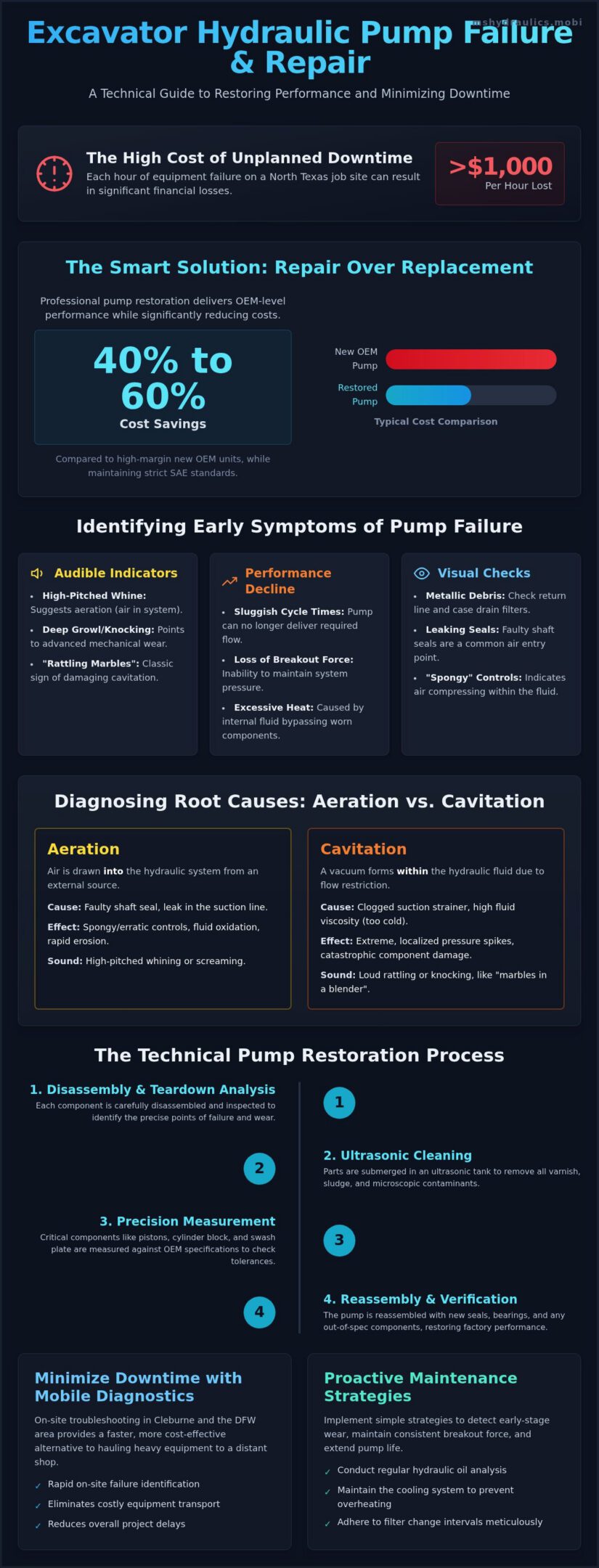
Early identification of mechanical distress prevents the high costs associated with complete system contamination. An excavator hydraulic pump rarely fails without prior warning. Operators should remain vigilant for specific audible and operational shifts. Increased noise levels often serve as the first indicator of internal damage. A high-pitched whining usually suggests aeration; a deep growling or metallic knocking points toward advanced mechanical wear or component interference.
Operational efficiency also provides a clear diagnostic window. A significant drop in cycle times for boom, arm, and bucket functions indicates that the pump can no longer deliver the required flow. When internal clearances expand due to wear, fluid bypasses the pistons, leading to excessive heat generation. If the hydraulic reservoir or pump casing feels abnormally hot, the pump’s volumetric efficiency has likely plummeted. In these instances, checking the return line filters or the case drain for visible metallic debris is a critical step before proceeding with excavator hydraulic pump repair.
Diagnosing Aeration and Cavitation
Distinguishing between aeration and cavitation is essential for accurate troubleshooting. Aeration occurs when air enters the system through a leak in the suction line or a faulty shaft seal. This results in “spongy” or erratic control responses as the air compresses within the fluid. Cavitation, conversely, happens when a vacuum forms at the pump inlet, often due to a clogged suction strainer or cold fluid. It produces a distinct sound similar to marbles rattling in a blender. Both conditions cause rapid erosion of the cylinder block and valve plate, necessitating professional excavator hydraulic pump repair to restore internal surfaces.
Loss of System Pressure and Breakout Force
A loss of breakout force doesn’t always mandate a pump overhaul. It can also stem from a malfunctioning main relief valve. Technicians use precision pressure gauges to isolate the fault. If the system reaches peak pressure at low temperatures but fails as the oil thins, internal leakage (slippage) is the likely culprit. This slippage occurs when fluid escapes past the piston-to-bore clearances. Testing the pump flow under load confirms the degree of mechanical degradation. For heavy equipment owners in North Texas, scheduling on-site diagnostic services can pinpoint these issues without the need for premature machine disassembly.
The Technical Process of Hydraulic Pump Restoration
Restoring a failing unit to factory specifications requires a methodical sequence of disassembly, decontamination, and precision engineering. The process begins with a complete breakdown of the pump housing to expose the rotating group. Technicians use ultrasonic cleaning to remove microscopic debris and oxidized fluid film that standard solvent washes often miss. This level of cleanliness is vital. It allows for an accurate assessment of the base metal without the interference of surface contaminants. Every stage of excavator hydraulic pump repair must adhere to strict cleanliness standards to prevent immediate re-contamination during reassembly.
Component Inspection and Metrology
Technicians conduct a rigorous metrological evaluation once the components are clean. They use calibrated micrometers and dial indicators to measure tolerances against original equipment manufacturer (OEM) specifications. The inspection focuses on several high-wear areas:
- Piston-to-Bore Clearance: Excessive play here leads to internal slippage and a loss of volumetric efficiency.
- Swash Plate Surface: Technicians check for scuffing or “smearing” of the bronze material, which indicates a lubrication failure.
- Center Pin and Spring Assembly: These components must maintain specific tension to keep the cylinder block seated against the valve plate.
Precision is especially critical during the restoration of the valve plate and cylinder block interface. Lapping remains a critical manual skill in this process. By using progressively finer abrasive compounds on a precision-ground lapping plate, technicians restore the microscopic flatness of these mating surfaces. This ensures a liquid-tight seal that can withstand operating pressures often exceeding 5,000 PSI. If these surfaces aren’t perfectly flat, the pump will suffer from high case drain flow and reduced breakout force.
Repair vs. Replace: The Financial Breakdown
The decision to proceed with a rebuild often hinges on the condition of the main pump casing. If the housing shows signs of cavitation erosion or structural cracking, a repair may not be technically viable. However, in most instances, a professional excavator hydraulic pump repair is the most fiscally responsible choice. Industry data suggests that a professionally rebuilt and tested pump generally costs 40% to 60% less than a new OEM unit. Most fleet managers consider a rebuild financially sensible as long as the total cost remains below the 50% to 60% threshold of a new replacement. For operations requiring immediate uptime, utilizing remanufactured units provides a faster turnaround while still offering the reliability of a fully verified component.
Mobile Pump Diagnostics: Minimizing Downtime in North Texas
Relying on off-site facilities for excavator hydraulic pump repair often introduces unacceptable project delays. Shipping a multi-hundred-pound component to a distant shop can sideline a machine for weeks. Mobile diagnostics eliminate this logistical bottleneck by bringing engineering expertise directly to the job site. This on-site capability is essential for operations in Cleburne, Alvarado, Fort Worth, and Arlington. By performing diagnostics before removal, technicians can verify if the pump is truly the source of the failure or if the issue lies within a control valve or a ruptured internal seal. This targeted approach prevents the unnecessary expense of pulling a healthy pump.
On-site pressure testing serves as a definitive tool for avoiding guesswork. Technicians utilize high-pressure gauges and flow meters to evaluate the pump’s performance under actual operating loads. This data-driven approach ensures that every repair recommendation is based on verifiable mechanical parameters. Coordinating these efforts with specialized On-Site Diagnostic Services allows fleet managers to receive a comprehensive health report of the entire hydraulic circuit. Given that unplanned downtime can cost between $500 and $1,000 per hour, the ability to diagnose issues in the field is a significant operational advantage.
Emergency On-Site Troubleshooting
When a technician arrives at a Johnson County job site, the priority is a rapid return to service. The process begins with a visual inspection for external leaks followed by an assessment of the case drain flow. Excessive flow here is a primary indicator of internal pump wear. Technicians use field flow testing tools to measure the pump’s output against its rated displacement. If a failure occurs mid-operation, the operator should immediately neutralize all controls and shut down the engine. This prevents metallic debris from migrating through the entire system, which would significantly increase the complexity of the eventual excavator hydraulic pump repair. Immediate intervention protects downstream actuators from contamination.
Integrating Pump Repair with System Maintenance
A pump failure is rarely an isolated event. It often introduces contaminants into the hydraulic reservoir and downstream valves. Simply installing a rebuilt pump without a thorough system flush is a recipe for premature failure. Technicians prioritize replacing contaminated hoses and fittings during the service to ensure system integrity. For a detailed look at long-term care strategies, operators should consult the Heavy Equipment Maintenance Guide. If your machine is experiencing sluggish performance or unusual noise, you can request a mobile hydraulic diagnostic technician to prevent a total system shutdown.
Preventative Maintenance to Avoid Future Pump Failure
Establishing a rigorous preventative maintenance protocol is the most effective method for extending the service life of heavy machinery. While professional excavator hydraulic pump repair restores a unit to factory specifications, long-term reliability depends on the environment in which the pump operates. Industry standards suggest that approximately 75% of hydraulic system failures result from fluid contamination. Maintaining a clean system requires more than just following the manufacturer’s fluid change intervals. It involves a proactive approach to filtration, cooling, and real-time monitoring of internal wear indicators.
Oil analysis serves as a primary diagnostic tool for detecting early-stage pump wear before a catastrophic failure occurs. Spectrometric analysis identifies the presence of metals like copper, lead, or iron, which signal the degradation of internal components like piston slippers or valve plates. Additionally, monitoring case drain flow provides a direct measurement of a pump’s volumetric efficiency. An increase in case drain flow indicates that internal clearances are expanding, allowing high-pressure oil to bypass the rotating group. Catching these trends early allows for scheduled maintenance rather than emergency repairs.
Fluid Cleanliness and Filtration Standards
Adhering to ISO 4406 cleanliness codes is essential for modern high-pressure systems. These codes quantify the number of particulate contaminants per milliliter of fluid. It is a common misconception that new hydraulic oil arriving in a barrel is clean enough for immediate use. In reality, new oil often contains particulate matter that exceeds the tight tolerances of an axial piston pump. All fluid should be pre-filtered through a 10-micron or finer element before entering the reservoir. Furthermore, water contamination must be strictly controlled. Even small amounts of water can lead to hydrogen embrittlement in bearings and rapid corrosion of precision-ground surfaces.
Operator Training and System Awareness
Operator behavior directly impacts the longevity of hydraulic components. Training should emphasize the dangers of “deadheading” the system, which occurs when a cylinder reaches the end of its stroke while the operator continues to apply full joystick pressure. This creates massive pressure spikes that can crack pump housings or damage seals. In the North Texas climate, proper warm-up procedures are also vital. During cold winter mornings in Cleburne, hydraulic fluid viscosity is too high for immediate full-load operation. Running the machine at low idle allows the oil to reach an optimal operating temperature, ensuring proper lubrication of the swash plate and pistons. For fleet owners looking to optimize their equipment’s lifespan, you can contact Ms. Hydraulics LLC for a custom maintenance plan tailored to your specific operational needs.
Restoring Operational Reliability in North Texas
Maintaining the technical integrity of your heavy equipment requires a disciplined approach to hydraulic health. Successful excavator hydraulic pump repair is not merely about component replacement. It involves a rigorous cycle of precision metrology, contamination control, and proactive monitoring. By identifying early indicators like increased case drain flow or thermal degradation, you can prevent the catastrophic downtime that sidelines major projects in Johnson County. Professional restoration ensures your machinery returns to peak breakout force without the logistical delays of off-site shipping.
Ms. Hydraulics LLC maintains an expert team of technicians and a 24/7 mobile hydraulic repair fleet to support North Texas contractors. Our capabilities include comprehensive cylinder, hose, and pump services focused on engineering excellence and system verification. Prioritizing mechanical accuracy and validated performance protects your long-term investment. Request an On-Site Hydraulic Pump Diagnostic in Cleburne to restore your machine’s efficiency today. Your fleet’s stability is within reach through expert technical support.
Frequently Asked Questions
How do I know if my excavator hydraulic pump is bad?
High-pitched whining or metallic knocking often indicates advanced mechanical distress within the rotating group. You’ll observe a significant decrease in cycle speeds for the boom and bucket functions, alongside a loss of breakout force. Excessive heat at the pump casing or reservoir suggests internal slippage where high-pressure fluid bypasses worn pistons. Checking the case drain for metallic debris is a definitive diagnostic step to confirm internal component disintegration.
Can a hydraulic pump be repaired on-site, or does it have to go to a shop?
Technical diagnostics and minor adjustments occur on-site, but a comprehensive excavator hydraulic pump repair requires a controlled shop environment. Internal restoration involves ultrasonic cleaning and precision lapping of mating surfaces, which are impossible to perform accurately in the field. However, mobile technicians can perform flow and pressure testing at your Cleburne job site. This identifies if the pump needs removal or if the fault lies elsewhere in the circuit.
What is the average cost of an excavator hydraulic pump repair?
The cost of a professional rebuild is generally 40% to 60% less than the price of a new OEM replacement unit. This makes restoration a fiscally responsible choice for most fleet managers in North Texas. The final investment depends on the extent of damage to the rotating group, valve plate, and swash plate. Choosing a rebuild over a new unit provides significant savings while maintaining high performance standards through rigorous verification testing.
How long does a typical hydraulic pump rebuild take?
A standard restoration typically requires several business days, depending on parts availability and the complexity of the specific unit. The process includes complete disassembly, ultrasonic decontamination, metrological inspection, and precision reassembly. Every unit must undergo verification testing to ensure it meets original flow and pressure specifications. For operations requiring immediate uptime, utilizing remanufactured units can help minimize the financial impact of equipment downtime on your project schedule.
Why is my hydraulic pump making a loud whining noise?
A loud whining noise is usually caused by aeration or cavitation within the hydraulic circuit. Aeration occurs when air enters the suction line, often through a faulty shaft seal or loose fitting. Cavitation happens when the pump is starved of fluid, creating vacuum bubbles that implode against internal metal surfaces. Both conditions lead to rapid erosion of the cylinder block and valve plate. Immediate shutdown is required to avoid catastrophic internal damage.
Should I replace my hydraulic filters after a pump failure?
You must replace all hydraulic filters and perform a full system flush following any pump failure. When a pump experiences mechanical breakdown, it sends metallic particulates through the return lines and into the reservoir. Reinstalling a rebuilt pump without cleaning the entire circuit leads to immediate re-contamination and premature wear. Technicians also recommend inspecting the case drain filter specifically, as it often captures the first signs of internal component disintegration.
What causes a hydraulic pump to lose pressure suddenly?
Sudden pressure loss often stems from a sheared drive shaft, a failed swash plate control piston, or a malfunctioning main relief valve. In variable displacement systems, the load-sensing circuit may also be compromised by debris, preventing the pump from up-stroking during heavy loads. Technicians use flow meters to differentiate between a mechanical pump failure and a control issue. If the pump cannot maintain pressure as the oil temperature rises, internal slippage is likely occurring.
Is it better to repair an old pump or buy a remanufactured one?
The choice depends on the condition of the pump housing and your project timeline. If the casing is structurally sound, a professional excavator hydraulic pump repair is often the most cost-effective solution. However, if the housing is heavily cavitated or cracked, a remanufactured unit is necessary. Remanufactured pumps offer the advantage of immediate availability, which is critical when project delays in North Texas incur high hourly costs due to unplanned downtime.