Expert Bucket Truck Repair in Dallas & Fort Worth
What if the most expensive component of your bucket truck repair isn’t the hydraulic cylinder rebuild, but the logistical burden of transporting the machine to a service center? In the Dallas and Fort Worth region, towing oversized aerial equipment often incurs excessive fees and extended downtime that disrupts critical utility or tree care schedules. You’ve likely dealt with the frustration of long lead times at major manufacturers while worrying about the safety risks of hydraulic drift or boom failure. These delays don’t just cost money; they jeopardize your compliance with federal safety regulations.
Maintaining an aerial fleet requires a disciplined approach to the ANSI/SIA A92.2 standards, which mandate rigorous inspection cycles. This article provides a technical overview of hydraulic maintenance requirements and demonstrates how specialized mobile repair services eliminate the “towing tax” for North Texas operators. You’ll discover how to manage the 13-month inspection window and the 2021 mandate for 15-year major structural inspections. We will also detail how on-site hose fabrication and immediate hydraulic diagnostics ensure your equipment remains ANSI-compliant and operational without the need for off-site transport.
Key Takeaways
- Identify critical hydraulic failure points, such as PTO malfunctions and valve body erosion, to prevent catastrophic boom failure and ensure operator safety.
- Reduce operational downtime and eliminate expensive transport fees by leveraging mobile bucket truck repair for on-site diagnostics and hydraulic hose fabrication.
- Master the technical requirements for ANSI A92.2 compliance, including the mandatory 13-month inspection cycle and major structural assessments for equipment in service over 15 years.
- Extend the viable service life of legacy aerial lifts through precision cylinder rebuilds and the sourcing of custom-fabricated components for obsolete models.
Understanding Bucket Truck Hydraulic Systems and Common Failure Points
The operational efficiency of an aerial work platform (AWP) depends entirely on the integrity of its hydraulic circuit. At the center of this system is the Power Take-Off (PTO), a mechanical gearbox attached to the truck’s transmission that drives the hydraulic pump. This pump converts mechanical energy into hydraulic flow, providing the force necessary to articulate the boom. When a system requires bucket truck repair, the diagnostic process often begins here to ensure the pump is receiving sufficient torque and maintaining specified pressure levels. If the PTO fails to engage or the pump output drops below technical specifications, the entire lift becomes inoperable.
Hydraulic fluid contamination remains a primary threat to system longevity. Even microscopic particulates can lead to valve body erosion, where the precise tolerances of spool valves are compromised. This degradation results in internal bypass, causing sluggish response or “drifting” booms. A drifting boom occurs when internal cylinder seals fail, allowing fluid to leak past the piston under load. To mitigate the risk of a sudden boom drop, the holding valve acts as a critical safety component. It locks fluid within the cylinder if a hose ruptures or pressure is lost, ensuring the platform remains stationary during an emergency.
The Anatomy of an Aerial Lift Hydraulic Circuit
Aerial lifts utilize distinct primary and secondary circuits to manage various functions. The primary circuit handles high-pressure boom articulation, while the secondary circuit typically manages lower-pressure tasks like outrigger deployment or hydraulic tool operation at the bucket. Continuous rotation models employ a collector ring; this specialized swivel joint allows fluid and electrical signals to pass from the stationary pedestal to the rotating turntable without tangling lines. The hydraulic reservoir serves as the system’s thermal regulator, dissipating heat generated during high-duty cycles to prevent fluid thinning and component wear.
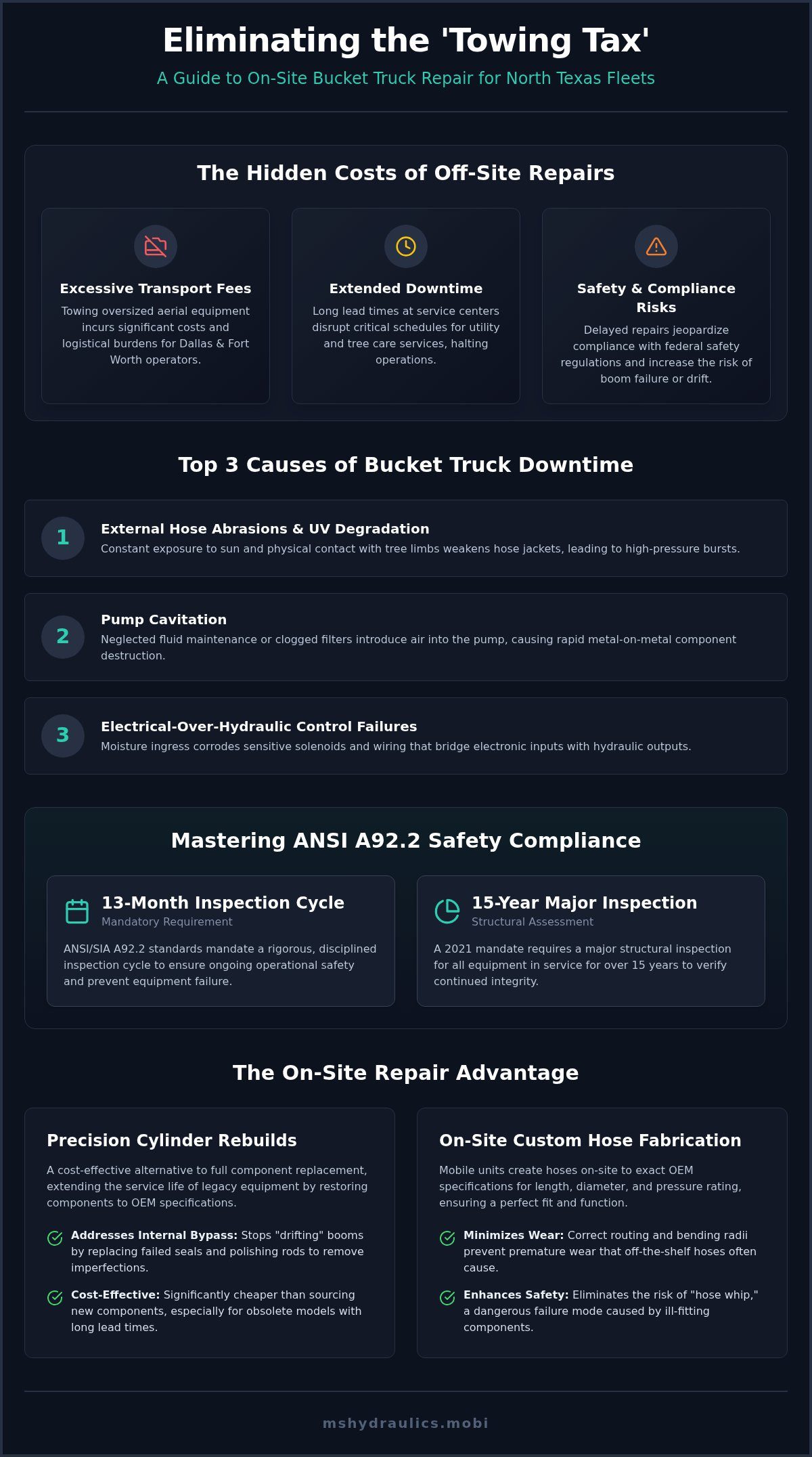
Top 3 Causes of Bucket Truck Downtime
- External hose abrasions and UV degradation: Constant exposure to the North Texas sun and physical contact with tree limbs weaken hose jackets, eventually leading to high-pressure bursts.
- Pump cavitation: Neglected fluid maintenance or clogged suction filters introduce air into the pump, causing metal-on-metal contact and rapid component destruction.
- Electrical-over-hydraulic control failures: Modern bucket truck repair frequently involves troubleshooting the solenoids and wiring that bridge electronic inputs with hydraulic outputs, as moisture ingress can corrode these sensitive interfaces.
Technical Solutions: Cylinder Rebuilds and Hose Fabrication
Effective bucket truck repair transitions from diagnostic identification to mechanical restoration. Precision is mandatory. Off-the-shelf hoses rarely meet the exact routing requirements of complex aerial booms, leading to premature wear from improper bending radii. Custom on-site fabrication ensures that every line matches the original equipment manufacturer (OEM) specifications for length, diameter, and pressure rating. This approach minimizes the risk of “hose whip,” a dangerous phenomenon where a failed fitting allows a pressurized line to flail uncontrollably under load.
Cylinder Rebuilds vs. Replacement
For many North Texas fleets, a professional heavy equipment cylinder rebuild Texas represents the most efficient path to restoration. The engineering process involves complete disassembly, microscopic inspection of the barrel walls, and precision rod polishing to remove surface imperfections that compromise seal integrity. While simple resealing addresses minor leaks, machining becomes necessary when the rod exhibits pitting or scoring. This restorative process adheres to OSHA and ANSI safety standards, ensuring the component handles its rated load without internal bypass. Rebuilding provides a cost-effective alternative to full component replacement, especially for legacy machines where new parts may have long lead times.
The Precision of Custom Hose Fabrication
Mobile fabrication units bring the machine shop directly to the job site in Dallas or Fort Worth. Technicians match PSI ratings to the specific requirements of the aerial lift circuit, often utilizing multi-wire braided hoses for high-pressure lift and extension functions. Proper fitting selection is vital for durability in extreme North Texas heat, where ambient temperatures exceeding 100°F can cause standard carbon-steel fittings to weep. High-pressure stainless-steel or specialized plated fittings provide the necessary resistance to corrosion and pressure spikes. A comprehensive bucket truck repair also includes a thorough evaluation of the hydraulic fluid’s condition after the lines are replaced.
After installation, rigorous pressure testing protocols verify system integrity, confirming that no leaks exist under maximum operational load. Operators can maintain their project timelines by utilizing on-site diagnostic services to identify failing components before they cause a total system shutdown.
The Benefits of Mobile Repair for North Texas Utility Fleets
North Texas utility operators face a significant logistical challenge when an aerial lift malfunctions. Transporting a non-functional unit to a fixed facility requires heavy-duty towing, often costing hundreds or thousands of dollars before the actual bucket truck repair begins. Mobile field service eliminates this “towing tax” by deploying technicians directly to the job site. This approach minimizes disruption in high-traffic areas like Arlington, Mansfield, and Cleburne, where keeping equipment stationary on the shoulder or in a utility easement is both a safety risk and a project bottleneck. By repairing equipment where it stands, fleets maintain momentum on critical infrastructure tasks.
Emergency response is vital for utility fleets during storm damage or widespread outages. While fixed-location shops often operate on standard business hours, mobile technicians provide the flexibility needed to address urgent hydraulic failures in the field. This immediate intervention prevents minor leaks from escalating into total system failures that could violate safety protocols or delay power restoration efforts. Mobile technicians act as an extension of your maintenance department, ensuring that every bucket truck repair adheres to the rigorous safety requirements demanded by modern utility work.
Strategic Service Coverage in the DFW Metroplex
Rapid response times are essential for maintaining the pace of infrastructure projects across the region. Dedicated support for municipalities in Alvarado, Granbury, and Crowley allows local fleets to remain operational with minimal transit time. In developing areas like Waxahachie and Cedar Hill, where construction and utility expansion are constant, having a reliable partner for mobile hydraulic repair Cleburne TX ensures that heavy equipment downtime doesn’t derail strict completion dates. This localized presence provides a level of responsiveness that major manufacturer service centers often can’t match due to their centralized locations and high volume of backlogged units.
On-Site Diagnostics: Technology in the Field
Modern mobile repair units are equipped with sophisticated instrumentation that mirrors the capabilities of a traditional shop. Technicians utilize digital flow meters and high-precision pressure gauges to perform real-time troubleshooting under actual load conditions. This data-driven approach prevents “parts cannon” repair tactics, where components are replaced based on guesswork rather than verified failure data. By providing accurate On-Site Diagnostic Services, technicians can isolate faults in valve bodies, pumps, or motors immediately. This precision ensures the repair is completed correctly the first time, saving the client from unnecessary part costs and repeated service calls.
Servicing Legacy Equipment: Beyond the 25-Year Manufacturer Limit
A significant shift occurred in the aerial lift industry as of January 1, 2025, when several major manufacturers officially phased out service support for units exceeding 25 years of age. This policy change forces many North Texas businesses to face premature equipment retirement or high-capital replacement costs. However, an arbitrary age limit does not necessarily reflect the operational safety of a machine. Specialized bucket truck repair focuses on the measurable parameters of structural and hydraulic integrity. If the fiberglass boom and steel pedestals pass non-destructive testing (NDT), the unit remains a candidate for continued service through precision hydraulic restoration.
The lifespan of legacy equipment is governed by the ANSI A92.2 standard. This regulation requires a Major Structural Inspection for aerial lifts once they reach 15 years in service, with subsequent inspections every 10 years. By adhering to these rigorous verification processes, operators can justify the continued use of older Hi-Ranger or Terex models. Maintaining these units requires a move away from manufacturer catalogs and toward engineering-based solutions. Upgrading older hydraulic controls to modern, more responsive valving can also bring vintage equipment closer to current safety and performance benchmarks.
The Viability of Boom Transfers
When a truck chassis reaches the end of its reliable life but the aerial device remains sound, a boom transfer is a technically viable solution. This process involves evaluating the mounting plates and subframe for fatigue before installing the legacy boom on a new chassis. During the transfer, technicians perform a comprehensive hydraulic re-plumbing. This ensures that all hoses and fittings meet modern pressure ratings and that the interface between the new Power Take-Off (PTO) and the older pump is optimized for flow efficiency. Safety verification steps, including stability testing and dielectric certification, are mandatory to confirm the unit’s field readiness.
Troubleshooting Hard-to-Find Hydraulic Components
Sourcing components for obsolete systems requires specialized technical expertise. When original equipment parts are no longer available, custom machining becomes necessary to restore valve bodies or fabricate specialized pins and bushings. Technicians often adapt modern, high-performance seal kits to fit vintage cylinders, ensuring a leak-free interface that exceeds the original specifications. This restorative approach relies on physical measurements and mechanical parameters rather than part numbers. If you are managing an older fleet that has been “orphaned” by manufacturer support, you can secure reliable mobile hydraulic repair to keep your legacy assets ANSI-compliant and productive on the job site.
Ensuring Safety: ANSI Inspections and Preventative Maintenance
A reactive maintenance model often leads to unpredicted downtime and significant safety liabilities. Shifting toward a disciplined, predictive program ensures that every bucket truck repair is a planned event rather than an emergency response. Operators should execute a 5-step daily hydraulic inspection before beginning work:
- Visual verification of all fittings for signs of weeping or active leaks.
- Inspection of hose jackets for UV degradation, bulging, or external abrasions.
- Confirmation of hydraulic fluid levels and visual assessment of fluid clarity.
- Operational testing of outrigger deployment and safety interlocks.
- Inspection of the pedestal and boom for structural deformation or loose mechanical fasteners.
Beyond daily checks, the ANSI A92.2 standard mandates specific inspection intervals that fleet managers must track with precision. Frequent inspections are required every three months or 150 operating hours, whichever occurs first. Annual inspections must be completed no later than 13 months after the previous certification date. These evaluations include dielectric testing for insulated booms and a comprehensive review of the hydraulic circuit’s pressure settings. Integrating fluid analysis into these cycles provides a “blood test” for the system, identifying wear metals or moisture before they cause a catastrophic pump or motor failure.
The Preventative Maintenance Framework
Utility trucks operating in high-duty cycles require shortened filter replacement intervals to maintain fluid ISO cleanliness codes. Contaminants trapped in the return line filter can cause backpressure, leading to premature seal failure in the control valve. Regular maintenance also includes greasing rotation bearings to prevent turntable binding and inspecting leveling cables for fraying or tension loss. For a deeper technical overview of these protocols, refer to our guide on Heavy Equipment Maintenance.
Maintaining ANSI Compliance in North Texas
Accurate documentation is the foundation of fleet safety records. In the event of an OSHA audit or a mechanical incident, having a verifiable history of every bucket truck repair and inspection is legally essential. During hydraulic service, technicians also look for structural cracks or weld fatigue, particularly in high-stress areas like the knuckle or the rotation gear. Identifying these issues early prevents the need for major structural restoration. To ensure your fleet remains operational and safe, Schedule your mobile bucket truck inspection with Ms. Hydraulics to receive professional on-site verification.
Maximizing Fleet Reliability through Technical Precision
Maintaining the structural and hydraulic integrity of an aerial fleet requires a methodical commitment to ANSI A92.2 standards. By identifying early warning signs like boom drift or valve erosion, operators can avoid the technical failures that lead to expensive downtime. Specialized bucket truck repair shouldn’t be a logistical burden. It should be a precise, engineering-driven process that prioritizes efficiency and safety. Utilizing mobile diagnostics ensures that your equipment remains operational on the job site rather than sitting in a manufacturer’s backlog.
Ms. Hydraulics provides the technical expertise necessary to keep your fleet compliant, offering specialized cylinder rebuilds for all major brands and immediate on-site hydraulic hose fabrication to eliminate wait times. Serving the entire DFW and Johnson County region, our technicians focus on minimizing your total cost of ownership through field-service excellence. Don’t let towing fees or obsolete part catalogs dictate your project timelines. Contact Ms. Hydraulics for Expert Mobile Bucket Truck Repair and ensure your equipment meets the highest industrial standards for performance and reliability.
Frequently Asked Questions
How often should a bucket truck undergo a hydraulic safety inspection?
ANSI A92.2 standards require annual inspections to be completed at intervals not exceeding 13 months. Additionally, frequent inspections are mandatory every three months or after 150 hours of operation, whichever occurs first. These cycles ensure the structural and hydraulic integrity of the machine. Adhering to these rigorous standards is critical for maintaining safety compliance and preventing mechanical failure in North Texas utility and tree care sectors.
Can you repair my bucket truck on-site if the boom is stuck in the air?
Yes, mobile technicians perform on-site diagnostics and repairs for aerial devices with compromised articulation. If a boom is immobilized, technicians utilize specialized pressure gauges and flow meters to isolate the hydraulic or electrical fault. Many stuck-boom scenarios involve holding valve malfunctions or solenoid failures. Our service vehicles carry the necessary equipment to address these issues in the field across the Dallas and Fort Worth metroplex.
What are the signs that my aerial lift cylinder needs a rebuild?
Primary indicators include “drift,” where the boom slowly loses altitude under load, and visible fluid bypass at the rod seals. You should also inspect the cylinder rod for scoring, pitting, or chrome degradation. These physical parameters signal internal seal failure or mechanical wear. A professional hydraulic cylinder rebuild restores these components to OEM specifications, preventing catastrophic pressure loss during high-elevation tasks and ensuring smooth operation.
Do you service older bucket truck brands like Hi-Ranger or Teco?
Our technicians specialize in servicing legacy equipment from manufacturers like Hi-Ranger, Teco, and older Terex models. While some major manufacturers have phased out support for units older than 25 years, we focus on the measurable integrity of the hydraulic and structural systems. We can source or fabricate custom components for obsolete valve bodies and cylinders to keep these machines operational and safe for North Texas businesses.
How long does a typical on-site hydraulic hose repair take?
Most on-site hydraulic hose repairs are completed within one to two hours, depending on the accessibility of the failed line. Mobile units feature integrated fabrication equipment to manufacture custom hoses immediately. This process eliminates the wait times associated with sourcing pre-made parts. Rapid intervention is essential for minimizing downtime on utility projects in areas like Mansfield, Arlington, and Cleburne, where equipment must return to service quickly.
Is it cheaper to rebuild a hydraulic cylinder or replace it entirely?
Rebuilding is generally more cost-effective than full component replacement, particularly for large-diameter or specialized aerial cylinders. A rebuild involves resealing, rod polishing, and pressure testing, which often costs significantly less than procuring a new OEM unit. This approach is especially valuable for legacy bucket truck repair where new replacement cylinders may have extended lead times or high capital costs that exceed the machine’s value.
What areas of North Texas do your mobile repair trucks cover?
Mobile service coverage extends across the DFW metroplex and Johnson County. This includes Cleburne, Dallas, Fort Worth, Alvarado, and Granbury. Technicians also provide rapid response to Crowley, Arlington, Mansfield, Waxahachie, and Cedar Hill. This localized presence allows us to support utility infrastructure projects and municipal fleets throughout the region without the logistical burden and expense of transporting heavy equipment to a fixed service facility.
Can you fabricate high-pressure hoses for insulated bucket trucks?
We fabricate high-pressure hoses specifically engineered for the dielectric requirements of insulated aerial devices. These hoses must maintain specific non-conductive properties to ensure operator safety during live-line work. Our mobile units utilize multi-wire braided materials and high-pressure fittings that meet or exceed industry safety standards. Proper hose selection and precision fabrication are critical components of professional bucket truck repair for utility providers throughout North Texas.