Excavator Hydraulic Repair in DFW: Minimizing Downtime with Mobile Service
Unplanned downtime on a North Texas construction site can cost between $2,000 and $10,000 per day in idle labor and missed project milestones. When a high-pressure hose fails or a hydraulic pump loses prime, the logistical hurdle of transporting heavy machinery often proves more expensive than the mechanical fix itself. You likely recognize that waiting on a heavy-haul trailer and navigating extensive shop backlogs in the Metroplex is a recipe for project delays. Professional excavator hydraulic repair DFW provides a technical alternative that prioritizes on-site precision and mechanical integrity over traditional transport-based methods.
It’s possible to achieve shop-level results without the “tow and wait” cycle that drains your quarterly maintenance budget. This article details how expert on-site diagnostics and mobile hose fabrication eliminate unnecessary transport costs while keeping your fleet in peak operational condition. We’ll examine the advantages of field-based cylinder rebuilds and the impact of OEM-quality repairs on long-term system reliability. You’ll learn how to restore system pressure and minimize downtime through disciplined, technical field service that keeps your machines at the work face where they belong.
Key Takeaways
- Quantify the financial impact of unplanned delays and learn how mobile diagnostics mitigate losses by addressing mechanical failures directly at the project site.
- Understand how specialized excavator hydraulic repair DFW eliminates the requirement for heavy-haul transport, reducing both logistics costs and shop lead times.
- Evaluate the technical benefits of on-site hose fabrication and cylinder rebuilds that meet high-pressure OEM specifications to ensure long-term system reliability.
- Identify the structured diagnostic and site stabilization steps required to perform safe and precise hydraulic interventions in a field environment.
- Recognize the importance of local expertise and integrity-driven diagnostics in maintaining the peak operational health of heavy equipment fleets across North Texas.
The Economics of Excavator Downtime in the DFW Metroplex
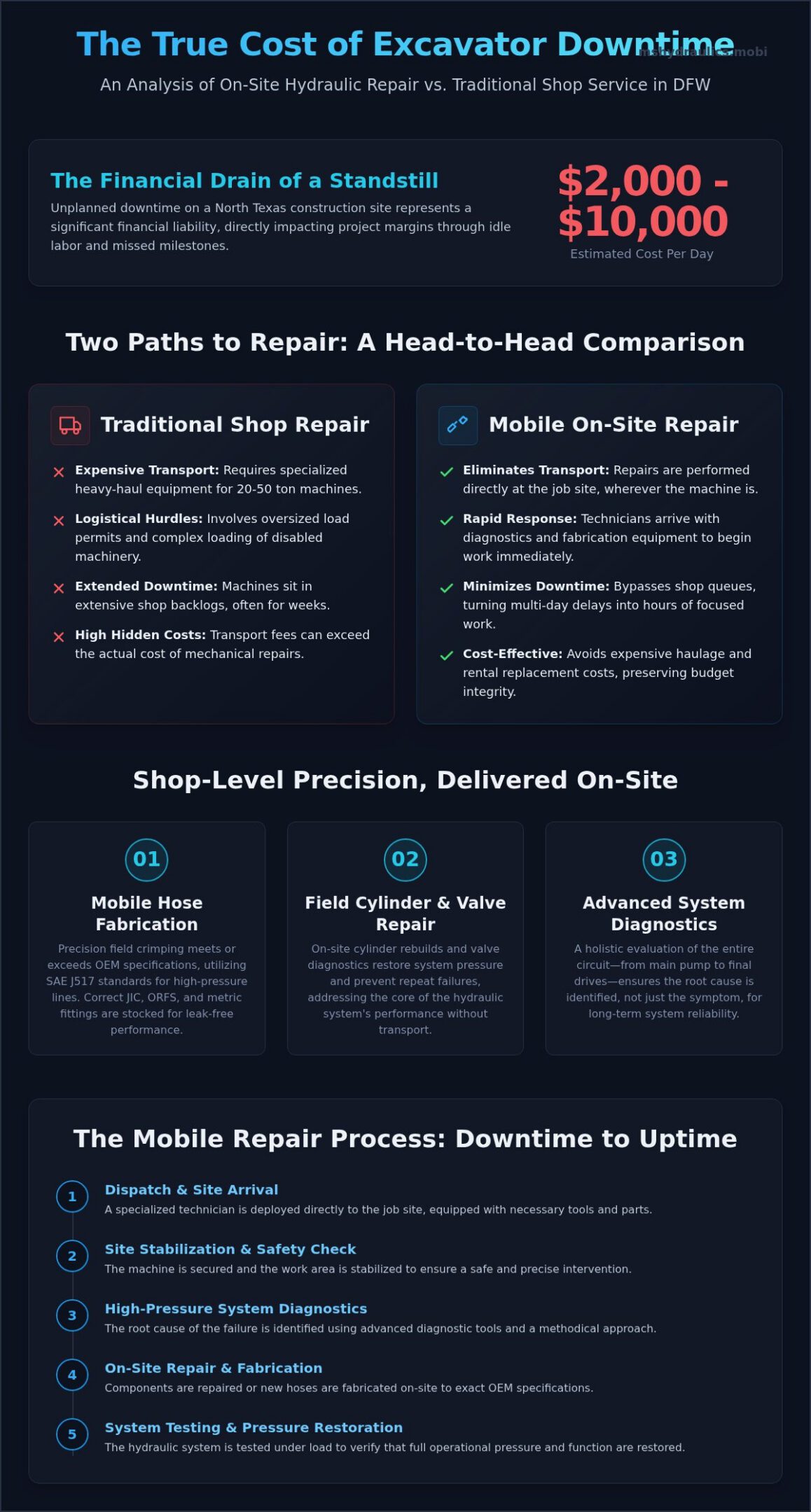
Mobile excavator hydraulic repair involves deploying specialized diagnostics and high-pressure fabrication equipment directly to the job site. This methodology eliminates the logistical burden of transporting non-functional heavy machinery to a stationary facility. For contractors in North Texas, a stalled machine represents more than a mechanical failure; it’s a direct financial drain on project margins. According to industry data from May 2026, unplanned downtime on a construction site can cost between $2,000 and $10,000 per day in idle labor and missed project milestones. Understanding how hydraulic machinery works is essential for recognizing why field-based interventions are often more efficient than traditional shop cycles.
When an excavator’s hydraulic system fails, the machine often becomes a static obstacle. Moving a 30-ton excavator with a locked-up hydraulic circuit requires specialized heavy-haul equipment and often necessitates additional rigging to load the disabled unit. These hidden costs, including heavy-haul permits and transport fees, frequently exceed the cost of the actual mechanical repair. Choosing excavator hydraulic repair DFW services allows project managers to bypass these logistical hurdles entirely. By performing repairs in the field, technicians address the root cause while the machine remains in its working position, preserving the integrity of the project site.
Calculating the Total Cost of Transport
Moving machinery in the 20-ton to 50-ton range involves significant overhead. Beyond the flat transport fee, contractors must account for the time spent securing oversized load permits and the inherent risk of loading a machine with compromised control systems. Shop wait times across the Metroplex can stretch into weeks due to current labor shortages, whereas a mobile unit provides immediate on-site diagnostics. This approach maintains site productivity and eliminates the need for expensive rental replacements while the primary machine sits in a shop queue. Field service technicians bring the shop to the machine, ensuring that system pressure is restored without the “tow and wait” cycle.
Rapid Response in the North Texas Corridor
Construction activity in high-growth areas like Mansfield, Arlington, and Waxahachie demands a responsive maintenance partner. Local proximity is critical when a primary boom seal or high-pressure hose fails during a critical excavation phase. Mobile technicians stabilize the machine on-site, perform the necessary high-pressure diagnostics, and execute repairs without disrupting the broader site workflow. This strategic presence across the North Texas corridor ensures that emergency failures don’t escalate into multi-day project delays. By utilizing excavator hydraulic repair DFW, operators ensure that technical expertise arrives at the machine’s exact location, protecting both the project timeline and the company’s bottom line. For homeowners and property owners in the Metroplex who need to protect their structural investments from soil-related damage, you can find out more about professional foundation and slab stabilization.
Technical Capabilities: Excavator-Specific Hydraulic Solutions
Precision in excavator hydraulic repair DFW requires more than a simple visual inspection. It demands a methodical approach to high-pressure fluid power systems. The high cost of equipment downtime serves as a constant reminder that industrial repairs must be executed with engineering accuracy. When an excavator loses power or exhibits erratic movement, the technician must evaluate the entire circuit, from the main pump to the swing motors and final drives. This holistic view ensures that a single component failure doesn’t mask deeper systemic issues that could lead to repeat failures.
Mobile Hose Fabrication Standards
Excavator boom and bucket lines operate under extreme cyclic loading and constant vibration. Field technicians must accurately distinguish between JIC, ORFS, and various metric fitting standards to ensure a leak-free interface. We utilize SAE J517 standards for high-pressure spiral and braided hose specs, ensuring every replacement assembly meets or exceeds original equipment performance. Precision field crimping is essential; even a minor deviation in crimp diameter can lead to premature failure or catastrophic coupling blowouts during heavy excavation. Carrying the correct inventory for these high-pressure specs is what separates professional field service from temporary patches.
Cylinder and Valve Precision in the Field
Cylinder performance is the cornerstone of excavator productivity. On-site cylinder rebuilds include the careful disassembly of the unit, rod polishing to remove minor scoring, and the installation of premium seal kits. This field-based precision extends to the machine’s control architecture. Technicians troubleshoot directional control valves and adjust relief settings to restore the machine’s factory-rated lift and breakout force. Implementing On-Site Diagnostic Services allows for the identification of internal bypass and pressure drops that are often invisible during a standard walk-around.
System contamination control is the final, critical step in any high-pressure repair. After a hose or seal failure, metallic particles and degraded fluid can migrate through the system, threatening the longevity of the main pump and valve banks. Methodical flushing protocols are employed to clear these contaminants, ensuring the new components operate in a clean environment. This level of technical rigor is essential for effective excavator hydraulic repair DFW, providing a reliable alternative to shop-based service for operators across the Metroplex. If your fleet requires technical intervention, Expert Mobile Hydraulic Repair in Cleburne ensures your machinery returns to service without the logistical delay of transport.
Mobile Repair vs. Traditional Shop Service: A Comparison
The decision between shop-based and mobile excavator hydraulic repair DFW often hinges on the distinction between hourly labor rates and total project impact. Verified 2025 data shows median labor rates for heavy equipment mechanics at $149 per hour. While field service typically carries a 20-30% premium over in-shop work, this figure is deceptive when isolated from logistical costs. A traditional shop cycle involves a multi-day queue, transport fees, and the labor required to secure a disabled machine for transit. Mobile service bypasses these variables by delivering technical expertise directly to the machine’s location, allowing for immediate intervention and verification.
Quality assurance in a field environment provides a distinct advantage: the ability to test repairs under actual working loads. When a technician replaces a high-pressure hose or reseals a bucket cylinder on-site, the machine’s own hydraulic circuit serves as the test bench. This immediate verification ensures that system pressure is maintained and that no secondary leaks exist before the technician leaves the site. Managing these high-pressure systems requires strict safety protocols, especially given the volatile North Texas climate. Technicians must account for ambient temperatures and humidity levels that affect hydraulic fluid viscosity and seal integrity during the repair process.
When Mobile Service is the Only Logical Choice
Emergency hose bursts on critical-path projects demand an immediate response to prevent cascading delays across the job site. In many instances, a mechanical failure leaves the excavator in a position where it’s physically impossible to load onto a trailer. Stuck cylinders or failed final drives can immobilize a 40-ton machine in a trench or on unstable grade. Mobile repair is the only viable solution in these scenarios. Additionally, for large fleets operating in remote areas of the Metroplex, scheduled on-site maintenance prevents the logistical nightmare of rotating multiple machines through a distant shop facility.
The Limits of Field Repair
While most hydraulic issues are resolvable on-site, certain failures require the controlled environment of a machine shop. If a cylinder rod has deep scoring that necessitates heavy machining or industrial honing, a hybrid strategy is often the most efficient path. Technicians perform the field removal of the compromised component, transport it for specialized shop service, and return for on-site installation and testing. This approach utilizes heavy equipment cylinder rebuild technical data to determine whether a component can be safely restored or if a full replacement is required to maintain system safety standards.
The Mobile Diagnostic and Repair Process
Executing a technical excavator hydraulic repair DFW requires a structured approach that mirrors the rigorous standards of a fixed facility. This process is designed to eliminate guesswork and ensure that the root cause of a hydraulic failure is addressed, rather than just the visible symptoms. A disciplined field service technician follows a specific five step sequence to restore machine functionality safely and efficiently.
- Step 1: Dispatch and Machine Assessment – Technicians gather critical model data and serial numbers before arrival. This preliminary data ensures the mobile unit is stocked with the correct seals, fittings, and fluid specifications.
- Step 2: Site Stabilization – High pressure systems demand a secure environment. Technicians verify the machine is on level ground with the boom and bucket properly supported to prevent accidental movement during component removal.
- Step 3: Advanced Diagnostics – Utilizing calibrated flow meters and pressure gauges, the technician pinpoints internal bypass or pump inefficiencies that visual inspections often miss.
- Step 4: Precision Field Repair – Hoses are fabricated to exact OEM lengths and crimp diameters using the mobile unit’s on board inventory. Cylinders are resealed using technical rod polishing techniques to ensure a long lasting interface.
- Step 5: Load Testing and Verification – The system is cycled through its full range of motion. Technicians monitor for pressure drops and thermal spikes to verify the repair holds under maximum operational load.
Preparing Your Site for the Technician
Project managers can accelerate the repair timeline by establishing a safe perimeter around the disabled excavator. Clearing debris and providing easy access to the machine’s service panels allows the technician to begin diagnostics immediately upon arrival. Having the operator present is equally valuable; their first hand account of the failure sequence can often save significant diagnostic time. If technical manuals are available, they should be accessible to verify specific relief valve settings or torque parameters during the reassembly phase.
Post-Repair Documentation and Maintenance
Every field intervention concludes with a detailed service report that identifies the components replaced and any secondary wear patterns observed. This documentation is essential for updating your heavy equipment maintenance schedules. Technicians also look for early warning signs of pump cavitation or fluid contamination, which are common precursors to catastrophic failure. For high duty cycle excavators, scheduling follow up inspections ensures that minor leaks don’t escalate into project stopping events. If your machinery shows signs of pressure loss, you should schedule an on-site diagnostic assessment to prevent unplanned downtime.
The Ms. Hydraulics Advantage: Local DFW Expertise
Ms. Hydraulics LLC, established in 2021, operates as an independent, locally owned entity based in Cleburne. This local foundation is critical for providing excavator hydraulic repair DFW that accounts for the specific environmental stressors of North Texas. High ambient temperatures and abrasive dust levels in the Metroplex accelerate seal degradation and fluid oxidation. Technicians who understand these regional variables can implement more effective preventative measures, such as selecting specific seal compounds or recommending filtration upgrades for machines operating in high-dust excavation zones. This level of technical specificity ensures that repairs aren’t merely temporary fixes but long-term engineering solutions.
Integrity-driven diagnostics form the core of the service model. Instead of proposing the most expensive component replacement, the focus remains on precise technical intervention. Whether the machine requires a simple high-pressure hose fabrication or a complex hydraulic pump repair, the objective is to restore OEM-level performance with minimal disruption. This disciplined approach builds trust with both major international players and local contractors, positioning the brand as a dependable partner in the industrial sector. By prioritizing factual accuracy and engineering expertise, we ensure that every machine returns to the field in peak operational condition.
Supporting the North Texas Construction Economy
Choosing a local independent business ensures that maintenance expenditures remain within the DFW economy. Local technicians possess a granular understanding of the equipment utilized across Texas terrain, from the heavy clay of North Dallas to the rocky substrates found in the southern corridor. These specialists don’t just perform a repair; they build technical partnerships with fleet managers. For project managers who also need to source high-quality glass from specialists like Armstrong’s Glass & Mirror, you can find out more about their local fabrication and installation options. By maintaining a consistent service history for a specific fleet, technicians can identify recurring failure patterns and suggest adjustments to improve machine uptime. This collaborative model supports the overall stability and efficiency of the North Texas construction sector.
Contact Ms. Hydraulics LLC for DFW Excavator Repair
The service reach extends across the primary North Texas corridors, including Cleburne, Alvarado, Mansfield, and Fort Worth. Rapid response times in areas like Arlington are prioritized to mitigate the high costs of project stagnation described in previous sections. Fleet operators can request a technical quote for scheduled maintenance or emergency excavator hydraulic repair DFW through our primary digital portal. Ensuring your excavator fleet remains operational requires a partner that values precision and mechanical legacy. Contact Ms. Hydraulics LLC for Mobile Excavator Repair to secure professional on-site support for your heavy equipment.
Advancing Fleet Reliability Through Technical Precision
Transitioning from reactive, transport-based maintenance to a mobile-first strategy is a critical step for maintaining project profitability in North Texas. By utilizing specialized excavator hydraulic repair DFW, fleet managers eliminate the secondary costs associated with heavy-haul permits and multi-day shop backlogs. This approach prioritizes immediate diagnostic accuracy and on-site verification, ensuring that every hydraulic circuit meets factory-rated pressure before the machine returns to the work face. It’s an efficient methodology that aligns mechanical integrity with the rapid pace of Metroplex construction schedules.
Ms. Hydraulics LLC has served the DFW construction and agriculture sectors since 2021 with a focus on technical integrity. As a local independent business, we specialize in excavator cylinder rebuilds and mobile hose fabrication designed for the specific environmental demands of the region. Our technicians provide the engineering expertise required to maintain high-duty cycle machinery without the logistical delays of traditional repair models. Ensuring your equipment remains operational is our primary objective.
Schedule Your Mobile Excavator Hydraulic Repair with Ms. Hydraulics to restore your fleet’s operational capacity today. Professional field service is the most reliable path to sustained site productivity.
Frequently Asked Questions
How quickly can a mobile technician arrive at my DFW job site?
Response times are determined by current technician proximity and the existing dispatch queue. We prioritize emergency calls in high growth areas such as Mansfield, Arlington, and Fort Worth to mitigate the financial impact of idle labor. Providing accurate GPS coordinates and machine model data during the initial contact helps streamline the deployment of our mobile units.
Can you fabricate high-pressure excavator hoses on-site?
Yes, our mobile units are equipped with industrial fabrication tools to manufacture custom hoses at the machine’s location. We maintain an inventory of spiral and braided hoses that meet SAE J517 standards, along with JIC, ORFS, and metric fittings. This capability ensures that excavator hydraulic repair DFW is executed with OEM level durability, bypassing the delays associated with ordering pre-made assemblies.
Do you repair excavator cylinders in the field or just hoses?
We perform comprehensive cylinder rebuilds in the field in addition to hose fabrication. Our technicians manage the disassembly, rod polishing, and resealing of boom, arm, and bucket cylinders on-site. This specialized service allows for the restoration of hydraulic integrity without the logistical requirement of transporting 20 to 50 ton machinery to a stationary shop.
What brands of excavators do you service in North Texas?
Our technical expertise extends to all major excavator brands operating on Texas construction and drilling sites. We service Caterpillar, Komatsu, John Deere, Case, and Volvo machinery, among others. Technicians utilize serial number specific data to ensure that all replacement seals, fittings, and relief valve settings comply with the original manufacturer’s engineering specifications.
Is mobile hydraulic repair more expensive than taking it to a shop?
While field labor rates typically carry a 20-30% premium over in-shop work, the total cost of ownership is often lower. Mobile repair eliminates the expenses of heavy haul permits, transport fees, and the labor required to secure a disabled machine. By reducing unplanned downtime, which can reach $10,000 per day, mobile service protects the project’s overall margin.
What information do I need to provide when calling for excavator repair?
Providing the machine’s make, model, and serial number is the first step in ensuring a successful field intervention. It’s also helpful to describe the failure sequence, such as a sudden loss of breakout force or visible fluid contamination. This data allows the technician to arrive with the specific diagnostic tools and components required for your excavator hydraulic repair DFW.
Do you offer emergency 24/7 hydraulic service in Dallas-Fort Worth?
Availability is governed by current technician schedules and dispatch volume. We prioritize emergency failures to minimize site disruption, but you should contact our office directly to verify the current response window for your location. We focus on delivering high precision, integrity driven repairs that ensure long term mechanical reliability for your fleet.
Can you diagnose a drop in hydraulic pressure without moving the machine?
Yes, we utilize calibrated flow meters and pressure gauges to perform advanced on-site diagnostics while the machine remains static. These instruments allow us to identify internal bypass in directional control valves or pump inefficiencies that visual inspections cannot detect. This methodical approach ensures that we address the root mechanical failure before any components are replaced.