Heavy Equipment Diagnostics in Cleburne, TX: A Technical Guide to On-Site Troubleshooting
Every hour an excavator or drill rig remains stationary on a Cleburne job site represents a measurable erosion of project profitability. Industrial operators frequently encounter the frustration of “parts-swapping” diagnostics, where expensive components are replaced based on surface-level symptoms rather than a verified root cause. This trial-and-error methodology often leads to recurring failures and the logistical burden of hauling heavy machinery to specialized shops in the Dallas or Fort Worth metroplex. High-precision heavy equipment diagnostics Cleburne TX must prioritize technical accuracy over convenience to ensure long-term mechanical reliability.
We understand that maintaining a fleet requires more than just reactive repairs; it requires engineering-grade insight into hydraulic and mechanical systems. This technical guide provides the framework to master the process of identifying pressure drops and flow inconsistencies before they lead to catastrophic component failure. By implementing rigorous on-site troubleshooting protocols, you can minimize downtime and avoid the expense of unnecessary replacements. We will examine the specific tools and data-driven methods used to generate accurate diagnostic reports, ensuring your machinery returns to service with its operational integrity fully verified and documented for your maintenance records.
Key Takeaways
- Analyze how North Texas environmental variables, including extreme heat and regional dust, impact hydraulic system longevity and component wear rates.
- Implement a structured methodology for heavy equipment diagnostics Cleburne TX using calibrated gauges to differentiate between pump malfunctions and relief valve issues.
- Quantify the efficiency gains of on-site mobile diagnostics, which eliminate the logistical expenses of transporting drill rigs or excavators to distant repair facilities.
- Recognize early mechanical warning signs, such as hydraulic cavitation and cycle time degradation, to intervene before total system failure occurs.
- Establish comprehensive maintenance records through technical diagnostic reports that prioritize root cause identification over inefficient parts-swapping practices.
The Critical Role of Heavy Equipment Diagnostics in North Texas
Technical diagnostics within the industrial sector represent a systematic methodology for identifying faults across mechanical, hydraulic, and electronic systems. Unlike superficial inspections, professional heavy equipment diagnostics Cleburne TX utilize quantitative data to isolate the root cause of performance degradation. Diagnostics serves as the technical bridge between the observation of a machine symptom and the execution of a precision repair. By prioritizing this analytical phase, operators can interrupt the “catastrophic failure chain” where a minor hydraulic inefficiency eventually destroys an entire pump or motor. Moving from reactive repairs to a diagnostic-led strategy ensures that every intervention is based on verified mechanical data rather than technician intuition.
Environmental Stressors in Cleburne and Johnson County
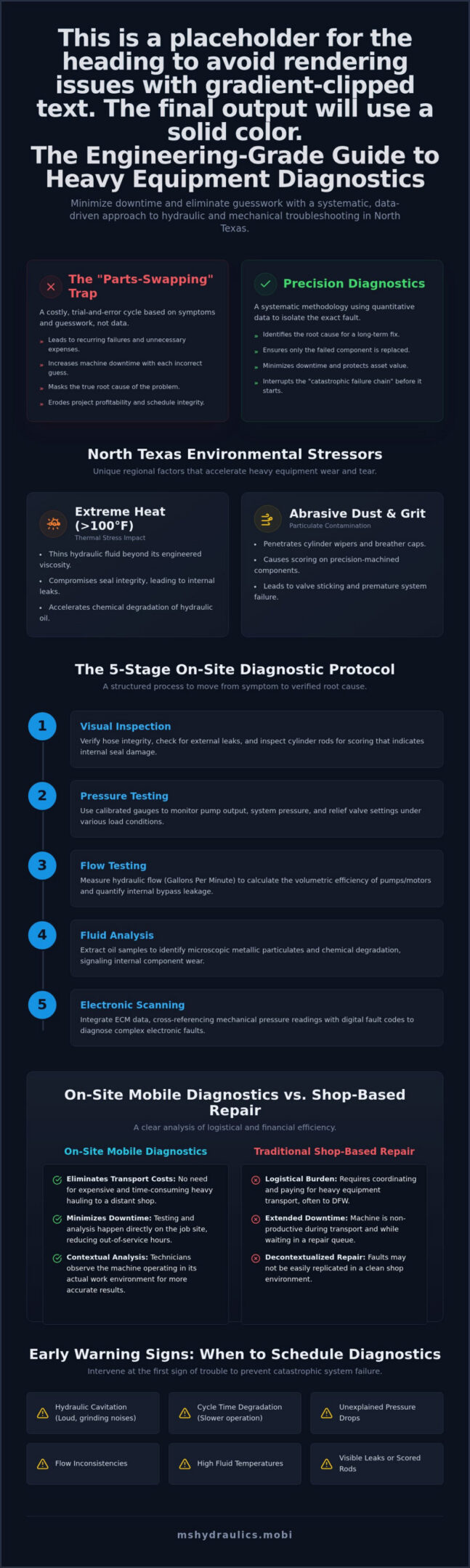
The operational environment in North Texas presents specific challenges for heavy equipment. High ambient temperatures, often exceeding 100 degrees Fahrenheit during summer months, directly impact hydraulic fluid viscosity. When fluid thins beyond its engineered parameters, seal integrity is compromised and internal bypass leakage increases. This thermal stress is compounded by the high concentration of particulate matter and dust characteristic of Johnson County job sites. These abrasives can penetrate cylinder wipers and breather caps, leading to accelerated component scoring and valve sticking. For drill rigs and excavators, this combination of heat and grit creates a high risk for premature system failure. Regular diagnostic testing allows technicians to identify fluid contamination levels and thermal degradation before these stressors lead to a total machine shutdown.
Economic Impact of Precision Troubleshooting
The financial consequences of machine downtime extend far beyond the immediate repair bill. Lost production hours on a major construction project can result in liquidated damages and significant revenue gaps. Precise heavy equipment diagnostics Cleburne TX eliminate the “parts-swapping” trap; this is an inefficient practice where technicians replace expensive components based on guesswork. Accurate pressure and flow testing ensure that only the failing part is serviced, which preserves the original equipment’s integrity and reduces unnecessary expenditures. To maintain these standards, many regional fleets integrate Heavy Equipment Maintenance in Cleburne & North Texas into their standard operating procedures. This proactive approach ensures that minor hydraulic drift is corrected before it necessitates a total system rebuild, ultimately protecting the asset’s long-term value and operational safety.
The Technical Process of On-Site Hydraulic Diagnostics
Executing professional heavy equipment diagnostics Cleburne TX requires a methodical sequence of operations to isolate specific mechanical failures within complex systems. Technicians don’t rely on intuition; they follow a structured protocol designed to verify the operational parameters of every hydraulic circuit. This systematic approach ensures that the root cause of a malfunction is identified before any components are removed or replaced. The diagnostic process typically follows these five critical stages:
- Visual inspection: Verification of hose integrity, external leakage points, and cylinder rod scoring that indicates internal seal damage.
- Pressure testing: Utilization of calibrated gauges to monitor pump output and relief valve set points under various load conditions.
- Flow testing: Measurement of gallons per minute (GPM) to calculate internal bypass and the volumetric efficiency of pumps and motors.
- Fluid analysis: Extraction of oil samples to identify microscopic metallic particulates and chemical degradation that signal internal wear.
- Electronic scanning: Integration of ECM data to diagnose complex faults by cross-referencing mechanical pressure data with digital fault codes.
By combining physical measurements with electronic data, technicians can build a comprehensive profile of the machine’s health. This multi-layered strategy is particularly vital for modern excavators and drill rigs where electronic control systems interact directly with hydraulic pilot circuits. Identifying the exact point of failure prevents the costly “parts-swapping” cycle that often plagues less rigorous repair attempts.
Hydraulic Pressure and Flow Analysis
Field diagnostics distinguish between static and dynamic pressure testing. Static tests verify the system’s ability to hold pressure under no-load conditions, while dynamic testing evaluates performance during active machine cycles. Identifying drifting cylinders requires precision flow measurement to determine if fluid is bypassing internal piston seals. This data allows a technician to differentiate between a failing main pump and a faulty control valve spool. If your equipment exhibits inconsistent cycle times or a loss of breakout force, scheduling an on-site diagnostic evaluation can prevent a minor leak from becoming a major system failure.
Advanced Fluid and Contamination Testing
Relying on fluid color as a diagnostic indicator is technically insufficient for industrial machinery. While darkened oil may suggest thermal oxidation, only laboratory-grade analysis can confirm the presence of specific chemical breakdowns or particulate counts. On-site operation also allows for the detection of air aeration and cavitation, which manifest as “spongy” controls or distinct mechanical noise. ISO 4406 cleanliness codes provide the standardized quantitative data necessary to guide diagnostic conclusions regarding hydraulic system health.
Mobile Diagnostics vs. Shop-Based Repair: A Logistics Analysis
The decision to transport non-operational machinery to a fixed facility involves significant logistical variables that often outweigh the perceived benefits of a shop environment. For operators in Johnson County, hauling a large excavator or a specialized drill rig to a Dallas-based facility requires heavy-haul permits, specialized transport equipment, and a multi-hour commitment of labor. These factors introduce substantial overhead costs before the actual heavy equipment diagnostics Cleburne TX even begin. Moving a machine with compromised hydraulic integrity also increases the risk of environmental spills or secondary mechanical damage during the loading and unloading process.
Mobile diagnostics provide a more efficient alternative by addressing the failure at its source. Professional Mobile Heavy Equipment Mechanics utilize fully equipped service vehicles that carry the same calibrated pressure gauges and flow meters found in a traditional shop. This capability allows for an immediate transition from identification to resolution, often bypassing the multi-day lead times common at large regional dealerships. By keeping the asset on-site, fleet managers maintain better control over the repair timeline and eliminate the liability associated with transporting damaged heavy assets over public infrastructure.
The Advantage of Field-Testing Under Load
A primary limitation of shop-based repair is the difficulty of replicating real-world operational stress. Many hydraulic failures, such as pump cavitation or relief valve drift, only manifest when the system reaches peak operating temperature under a full work load. Performing heavy equipment diagnostics Cleburne TX in the field allows technicians to observe machine behavior in the specific terrain and soil conditions where the malfunction occurred. This real-time data is invaluable for identifying intermittent electronic faults or heat-related hydraulic inefficiencies. Once the root cause is isolated, the success of the repair can be verified immediately through on-site re-testing, ensuring the machine is fully operational before the technician leaves the site.
Minimizing Project Delays in North Texas
In the fast-paced North Texas construction and drilling sectors, an idle machine is a direct drain on project capital. Utilizing Expert Mobile Hydraulic Repair in Cleburne enables fleet managers to make informed, data-driven decisions within hours of a failure. This speed is critical when coordinating with other site activities, such as concrete pours or scheduled drilling phases. Following a diagnostic breakthrough, mobile technicians can often perform immediate corrective actions, such as on-site hydraulic hose fabrication. This integrated approach ensures that the path from technical failure to full operational status is as direct as possible, keeping project schedules on track and minimizing the economic impact of equipment downtime.
Warning Signs: When to Schedule Heavy Equipment Diagnostics
Recognizing the early physical indicators of mechanical distress is essential for maintaining high fleet availability. Professional heavy equipment diagnostics Cleburne TX are most effective when initiated at the first sign of performance variance rather than after a total system shutdown. Auditory cues often provide the first warning. The distinct “marbles in a can” sound indicates pump cavitation, while a high-pitched shrieking suggests that a relief valve is failing to seat correctly or is set to an improper pressure. These sounds represent the physical erosion of precision-machined surfaces and require immediate technical intervention.
Performance degradation typically manifests as increased cycle times or a noticeable loss of breakout force during excavation or drilling operations. If controls feel “spongy” or unresponsive, the system is likely experiencing air entrainment or significant internal bypass. Thermal warnings are equally critical; excessive heat radiating from hydraulic reservoirs or cylinders indicates that the system is converting energy into friction rather than mechanical work. Visual cues, such as clouded fluid indicating water contamination or a metallic sheen in the oil, confirm that internal components are actively shedding material.
Identifying Hydraulic Component Fatigue
Differentiating between a failing main pump and hydraulic motor fatigue requires technical precision. In skid steers, motor wear often manifests as asymmetrical tracking or a loss of power in one drive circuit, whereas pump failure affects the entire machine’s output. Internal leakage within a valve bank can cause hydraulic drift, where an attachment fails to maintain its position under load. This gradual loss of pressure is often overlooked until it compromises operational safety. For a comprehensive evaluation of your machine’s health, you can utilize our technical checklist for On-Site Diagnostic Services for Heavy Equipment.
Mechanical and Structural Red Flags
Not all performance issues originate within the hydraulic circuit. Excessive pin and bushing wear can create mechanical “slop” that mimics hydraulic instability or unresponsive controls. Structural cracks in booms or frames alter the machine’s response to operator input and must be identified before they lead to catastrophic failure. Modern digital dashboards often trigger “limp mode” or recurring error codes when sensors detect parameters outside of engineered tolerances. These digital warnings should be cross-referenced with physical pressure and flow data to ensure the electronic control system is functioning correctly. If your machinery exhibits any of these red flags, request a mobile diagnostic evaluation to isolate the root cause before secondary damage occurs.
Ms. Hydraulics: Specialized Diagnostic Solutions in Cleburne
Ms. Hydraulics LLC, positioned at 3670 Hwy 67 EAST in Cleburne, delivers specialized heavy equipment diagnostics Cleburne TX that meet the rigorous demands of the North Texas industrial sector. Our technical team operates with a diagnostics-first philosophy. This dictates that no component is removed or replaced until its failure is verified through physical measurement and data analysis. This disciplined approach is critical for the complex hydraulic circuits found in drill rigs, excavators, and heavy industrial machinery. By focusing on root cause analysis, we maintain the engineering integrity of your machinery and prevent the cascading failures that result from misdiagnosis. This diagnostic phase is frequently the catalyst for necessary on-site Heavy Equipment Cylinder Rebuild or precision hose fabrication, ensuring a seamless transition from fault detection to mechanical restoration.
Custom Field Diagnostic Reports
Every on-site evaluation results in a detailed technical report that provides fleet managers with actionable data. These reports include quantitative pressure readings across multiple circuits, flow meter results, and laboratory-grade fluid analysis findings. We prioritize transparent communication by explaining the physical parameters that justify our repair recommendations. This documentation does more than guide immediate repairs; it builds a verifiable maintenance history for your equipment fleet. By tracking these metrics over time, you can identify recurring wear patterns and implement more effective preventative maintenance schedules that extend the service life of your high-value assets.
Contact Ms. Hydraulics for On-Site Support
Operators in Cleburne, Alvarado, and Granbury can access our mobile diagnostic units 24/7 for emergency service requirements. To ensure the most efficient response, we ask that clients provide specific machine model details and a summary of recent performance symptoms. This information allows our technicians to arrive with the specific calibrated gauges and diagnostic software versions required for your specific equipment. Our goal is to provide a rapid, engineering-grade resolution that returns your machinery to service with documented verification of its performance. Schedule your on-site diagnostic service with Ms. Hydraulics to secure a technical partner dedicated to your fleet’s operational excellence.
Securing Fleet Reliability through Technical Diagnostic Precision
Maintaining operational continuity in the North Texas industrial sector requires a transition from reactive repairs to a data-driven diagnostic framework. Operators who don’t prioritize root cause analysis often face recurring downtime and inflated maintenance budgets. Professional heavy equipment diagnostics Cleburne TX allow for the verification of hydraulic pressure and flow parameters under actual job site loads. This ensures that every repair is backed by quantitative evidence. This technical approach preserves the engineering integrity of your assets while eliminating the high costs associated with transporting non-road-legal machinery.
Ms. Hydraulics LLC provides the specialized expertise required to navigate these complex systems. As a locally owned and operated entity in Cleburne, TX, we deploy specialized mobile diagnostic units equipped to handle the specific requirements of drill rig and excavator hydraulics. Our technicians provide the technical transparency and detailed reporting necessary to build a sustainable maintenance history for your fleet. We’ve optimized our mobile services to provide the reliability your operations demand.
Request Expert On-Site Diagnostics from Ms. Hydraulics LLC today to ensure your machinery remains a productive asset on the job site. We look forward to supporting your next project with engineering-grade precision.
Frequently Asked Questions
What is the most common cause of hydraulic failure in Cleburne heavy equipment?
Particulate contamination and thermal degradation of hydraulic fluid are the primary causes of failure in this region. The environmental conditions in Johnson County introduce high levels of dust and grit into the system, which leads to accelerated component scoring and seal failure. Professional heavy equipment diagnostics Cleburne TX identify these contaminants early, preventing a catastrophic seizure of pumps or motors during peak summer temperatures.
Can you diagnose an excavator that won’t start on-site?
Yes, our mobile technicians perform comprehensive on-site diagnostics for non-starting excavators and other heavy machinery. We evaluate the starting circuit, battery health, and fuel delivery systems while scanning the ECM for active fault codes. This on-site capability is essential for equipment that is currently immobilized, as it eliminates the significant logistical challenges and costs associated with hauling a dead machine to a shop.
How long does a typical heavy equipment diagnostic call take?
A standard diagnostic evaluation generally requires between two and four hours to complete. This timeframe allows our technicians to perform a systematic review of the machine’s hydraulic, mechanical, and electronic systems. The exact duration depends on the complexity of the failure and the number of circuits requiring pressure and flow testing. We focus on accuracy to ensure the root cause is identified during the initial visit.
Do I need to haul my drill rig to a shop for pressure testing?
No, we perform all necessary pressure and flow testing directly at your job site in Cleburne or the surrounding DFW area. Our mobile units carry calibrated gauges and flow meters specifically designed to test drill rigs and excavators under actual load conditions. This field-testing approach provides more reliable data than a static shop test and saves you the expense of heavy-haul transport permits.
What information should I have ready before calling for diagnostics?
Please have the machine’s make, model, and serial number available, along with a summary of the observed symptoms. It’s helpful to know if the issue is intermittent or if it occurs only after the hydraulic fluid reaches operating temperature. Providing this data upfront allows our technicians to ensure they have the correct diagnostic software versions and testing adapters ready for your specific equipment upon arrival.
Is hydraulic fluid analysis included in your diagnostic service?
We provide fluid analysis as a key part of our technical diagnostic and maintenance services. This process involves extracting oil samples to detect microscopic metallic shavings and chemical oxidation that indicate internal component fatigue. By identifying these particulates, we can determine the health of your pumps and motors without needing to disassemble the system, which supports more informed maintenance decisions for your fleet.
Can you diagnose electronic sensor issues on modern skid steers?
Yes, our technicians utilize specialized scanning tools to diagnose electronic sensor failures and ECM communication issues on modern skid steers. We integrate this digital data with physical hydraulic testing to verify if a fault code is caused by a failed sensor or an actual mechanical pressure drop. This dual-layered approach is critical for modern machinery where electronic controls and hydraulic actuators are deeply integrated.
What happens if the diagnostic reveals a custom hose is needed?
If the diagnostic process identifies a failed or compromised hose, we can provide on-site hydraulic hose fabrication immediately. Our mobile service vehicles are equipped with a full inventory of hoses and fittings, along with professional crimping equipment. This allows us to resolve the issue identified during the heavy equipment diagnostics Cleburne TX without requiring a secondary service call or a trip to a parts warehouse.