Expert Hydraulic Motor Repair in Cleburne, TX: Minimizing Heavy Equipment Downtime
The assumption that a sluggish hydraulic motor requires a total replacement is often an expensive fallacy that overlooks the precision of modern field diagnostics. When heavy equipment loses torque or exhibits abnormal heat generation, the immediate challenge is identifying whether the issue is a simple seal failure or internal component wear. For contractors and site managers, securing expert hydraulic motor repair Cleburne TX is essential to avoid the logistical burden of transporting machinery to a fixed shop. We recognize that downtime on a critical project isn’t just an inconvenience; it’s a measurable loss in operational output.
In the following sections, you’ll learn to identify the technical indicators of motor failure and understand how on-site diagnostics restore volumetric efficiency. We provide a structured approach to evaluating mechanical parameters, offering a clear cost-benefit analysis for repair versus replacement. By utilizing mobile diagnostic technology, you can achieve rapid verification of system health and return your equipment to peak performance without unnecessary capital expenditure. This methodical look at hydraulic maintenance ensures your fleet remains reliable under the most demanding North Texas conditions.
Key Takeaways
- Identify early mechanical indicators such as torque loss and cavitation to prevent catastrophic component failure in heavy machinery.
- Leverage precise on-site diagnostics and case drain measurements to quantify internal leakage during professional hydraulic motor repair Cleburne TX.
- Apply a structured technical framework to evaluate the cost-efficiency of a rebuild versus the procurement of a new OEM motor.
- Reduce project downtime by utilizing mobile repair services that eliminate the logistical challenges of transporting heavy equipment to a fixed shop.
- Understand how extreme North Texas environmental factors, including temperature fluctuations and dust, impact motor seal integrity and fluid viscosity.
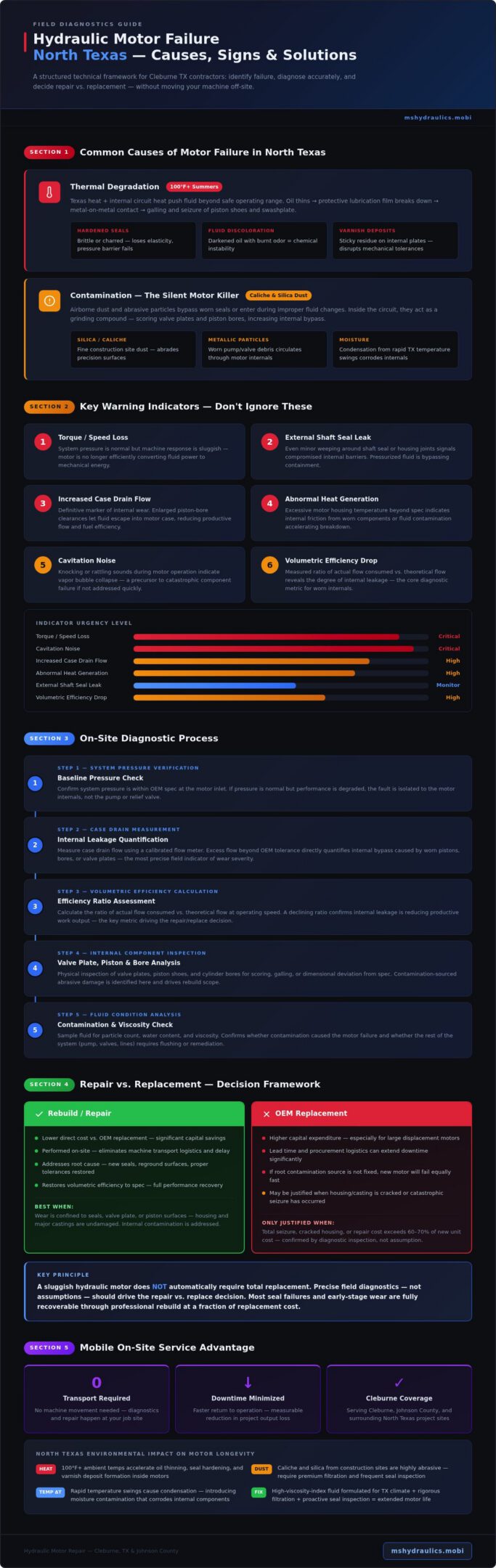
Common Causes of Hydraulic Motor Failure in North Texas Environments
Environmental factors in Cleburne, TX, significantly influence the lifecycle of heavy equipment components. While a hydraulic motor is engineered for thousands of hours of operation, the specific conditions of the North Texas plains often accelerate component degradation. Understanding these stressors is the first step in implementing a proactive maintenance strategy that minimizes the need for emergency hydraulic motor repair Cleburne TX.
Thermal Degradation and Fluid Viscosity
Texas summers frequently involve ambient temperatures exceeding 100°F. This external heat, combined with the internal heat generated by high-pressure hydraulic circuits, often pushes fluid temperatures beyond the optimal operating range. As fluid temperature rises, its viscosity decreases. This thinning of the oil compromises the hydrodynamic lubrication film between critical moving parts, such as the piston shoes and the swashplate. Without this protective barrier, metal-on-metal contact occurs, leading to galling and eventual seizure.
Operators should monitor for the following visual indicators of thermal damage during routine inspections:
- Hardened Seals: Heat-damaged seals often appear brittle or charred, losing the elasticity required to maintain a positive pressure barrier.
- Fluid Discoloration: Oxidized hydraulic oil typically darkens and develops a distinct “burnt” odor, signaling a loss of chemical stability.
- Varnish Deposits: High temperatures cause fluid breakdown, leaving a sticky residue on internal motor plates that interferes with precise mechanical tolerances.
Selecting a high-viscosity index fluid specifically formulated for the North Texas climate is a technical necessity. This ensures the fluid maintains sufficient film strength even when the machinery is under heavy load in extreme heat.
Contamination: The Silent Motor Killer
Cleburne job sites are often characterized by high concentrations of airborne dust and abrasive caliche. These fine particles can bypass worn wipers or enter the system during improper fluid changes. Once inside the hydraulic circuit, particulate matter acts as a grinding compound that erodes the precision-machined surfaces of the motor internals. Abrasive wear refers to the progressive removal of material from a component’s surface caused by the mechanical action of harder particles or protuberances sliding against it.
Common contaminants found in local machinery include:
- Fine silica and caliche dust from construction sites.
- Metallic wear particles from pump or valve degradation.
- Moisture from condensation during rapid temperature shifts.
When these particles reach the motor, they cause scoring on valve plates and piston bores. This damage increases internal bypass, which manifests as a loss of torque and overall system inefficiency. Maintaining rigorous filtration standards and securing timely hydraulic motor repair Cleburne TX when seals are compromised is the only way to prevent total motor failure.
Key Indicators Your Equipment Needs Hydraulic Motor Repair
Early detection of hydraulic motor degradation prevents the cascading failure of associated pump and valve components. While environmental stressors initiate the wear process, operational symptoms provide the most immediate data for fleet managers. A primary indicator for hydraulic motor repair Cleburne TX is a measurable decrease in torque or rotational speed while system pressure remains within OEM specifications. This performance gap suggests that the motor is no longer converting fluid power into mechanical energy efficiently, leading to sluggish machine response.
External leakage around the shaft seal or housing joints is another clear signal of compromised integrity. While a minor weep might seem negligible, it often indicates that pressurized fluid is bypassing internal barriers. More critically, an increase in case drain flow serves as a definitive technical marker of internal wear. When internal clearances between the piston and bore or the valve plate and cylinder block increase, fluid escapes into the motor case. This bypass reduces the volume of fluid doing work, which directly impacts the machine’s overall productivity and fuel efficiency.
Detecting Volumetric Efficiency Loss
Volumetric efficiency is the ratio of actual flow consumed to the theoretical flow required. A motor might continue to rotate under no-load conditions, yet stall completely when resistance is applied. This occurs because internal leakage paths become the path of least resistance for the high-pressure fluid. Operators should monitor cycle times on repetitive tasks as a performance metric. If a machine’s rotation speed or drive power slows by 10% to 15% under identical load conditions, a professional mechanical assessment is required to quantify the internal bypass.
Acoustic Diagnostics: What Your Motor is Telling You
Auditory changes often precede total mechanical seizure. A high-pitched whining usually indicates cavitation, where vapor bubbles collapse violently against internal surfaces, or aeration, where air enters the intake. While they sound similar, cavitation is often caused by restricted inlet lines, whereas aeration stems from seal leaks on the suction side. Rhythmic clunking or grinding suggests a bearing failure or a broken piston assembly. For complex cases, utilizing On-Site Diagnostic Services provides the acoustic and pressure testing necessary to isolate the fault without removing the motor from the chassis.
The Technical Diagnostic Process for Hydraulic Motors
The transition from identifying symptoms to implementing a technical solution requires a methodical diagnostic protocol. Guesswork in hydraulic motor repair Cleburne TX leads to unnecessary component replacement and extended downtime. Our process begins with a comprehensive visual inspection of external seals and mounting surfaces to identify obvious mechanical failures or structural compromises. We then utilize thermal imaging technology to detect localized hot spots across the motor housing. These temperature spikes often indicate excessive internal friction or a breakdown in the lubrication film, pinpointing specific failure zones before a total teardown is necessary. This non-invasive step allows for a more targeted repair strategy, focusing on the specific internal groups that have sustained damage.
Case Drain Analysis
The case drain line serves as a primary diagnostic window into the internal condition of a hydraulic motor. While all piston motors exhibit some degree of internal bypass for lubrication and cooling, excessive flow indicates significant wear. We measure the actual flow rate in gallons per minute (GPM) under specific load conditions and compare this data against the original manufacturer’s specifications. If the case drain flow exceeds these parameters, it confirms that volumetric efficiency has dropped below acceptable thresholds. High case pressure is equally concerning; it often leads to catastrophic shaft seal failure and can indicate a blockage in the return circuit or excessive internal wear. Monitoring these pressures helps prevent secondary damage to the shaft and bearings.
In-Field Pressure and Flow Testing
Accurate diagnosis requires isolating the motor from the rest of the hydraulic circuit to ensure the primary pump and control valves are delivering the required flow. We use calibrated flow meters and pressure gauges to verify system input versus motor output. This step is critical because a “weak” motor is sometimes the result of a failing pump or a leaking relief valve rather than a motor fault. By performing these tests on-site, we provide a definitive assessment of the entire drive loop without the need for equipment transport. For detailed information on our diagnostic capabilities, view our Expert Mobile Hydraulic Repair in Cleburne services. This technical approach ensures that we address the root cause of the failure, restoring the machine to its designed operating parameters with precision and speed. Every test is documented to provide a clear baseline for future maintenance cycles.
Repair vs. Replacement: A Decision Framework for Fleet Managers
The decision to rebuild a component or procure a new OEM unit is a critical determination for any maintenance program. This choice involves more than a simple price comparison; it requires a technical analysis of lead times, equipment lifecycle, and the current state of the motor core. For many operators seeking hydraulic motor repair Cleburne TX, the primary goal is restoring system integrity without the extended lead times often associated with new part procurement from overseas manufacturers. A professional rebuild can frequently provide a significant reduction in capital expenditure while meeting original performance specifications.
When evaluating a failing motor, we prioritize the salvageability of the housing and rotating groups. If the internal cast components remain within OEM tolerances, a rebuild is almost always the technically superior path. However, the age of the machine also plays a role. If a piece of equipment is nearing the end of its service life, a focused repair on “soft parts” may be more appropriate than a full system overhaul. Conversely, for a primary production unit like a drill rig or excavator, a comprehensive rebuild ensures long-term reliability on the job site.
When a Rebuild Makes Financial Sense
Rebuilding is highly effective when the failure is limited to “soft parts” such as seals, O-rings, and gaskets. These components naturally degrade over time due to thermal cycling and pressure spikes. In many cases, internal wear on shafts or pistons can be addressed through precision polishing or lapping of the valve plates. This process restores the flat, mirror-like surfaces required for a proper hydraulic seal. This engineering approach is similar to the methodology used in Heavy Equipment Cylinder Rebuild in Texas, where the focus is on restoring precise mechanical tolerances rather than simply replacing parts.
Identifying Non-Repairable Damage
There is a definitive “point of no return” where a motor core is classified as scrap. Severe cavitation damage, which manifests as deep pitting in the housing or swashplate, often makes a rebuild non-viable. Once the structural integrity of the high-pressure zones is compromised, the risk of a catastrophic second failure becomes too high. Our technicians use a specific checklist to determine if a motor is a candidate for hydraulic motor repair Cleburne TX:
- Housing Integrity: Are there cracks or significant erosion in the high-pressure ports?
- Rotating Group Condition: Have the piston shoes separated or the bores sustained deep scoring?
- Shaft Splines: Is there evidence of torsional twisting or excessive wear on the drive splines?
- Valve Plate: Is the wear too deep to be removed through standard lapping procedures?
If your equipment is exhibiting signs of failure, contact our technicians for a comprehensive core evaluation to determine the most cost-effective path forward.
Mobile Hydraulic Motor Services in Cleburne and Johnson County
Transporting a 40-ton excavator or a specialized drill rig for a motor fault is an inefficient use of capital and time. Mobile hydraulic motor repair Cleburne TX provides a technical alternative that eliminates freight costs and the secondary rigging requirements associated with shop-based repairs. We focus on the industrial, agricultural, and construction sectors across Johnson County, ensuring that critical machinery returns to service without leaving the project site. Our field technicians are equipped with the specialized tooling necessary to perform the high-pressure diagnostics and case drain analysis required for precise troubleshooting, maintaining a high standard of professional decorum and engineering accuracy.
Our commitment to technical integrity ensures that every field service call is treated as a precision engineering task. We recognize that a motor failure is often a symptom of a larger system issue, such as fluid contamination or pump degradation. By addressing the root cause on-site, we prevent the “parts-swapping” cycle that leads to repeat failures and unnecessary expenses. This disciplined approach to field service is designed to support the rigorous demands of North Texas infrastructure and energy projects.
Serving the Cleburne Industrial Corridor
Our service footprint extends beyond the city limits of Cleburne to include the surrounding industrial hubs of Alvarado, Granbury, and Mansfield. We specialize in the complex hydraulic circuits found in heavy-duty excavators, skid steers, and drill rigs used in local development and resource extraction. Because these machines often operate in remote or high-traffic areas where transport is difficult, on-site support is a logistical necessity. To maintain long-term reliability between service calls, operators are encouraged to review our Heavy Equipment Maintenance in Cleburne guide. This integration of preventative strategy and rapid response ensures that equipment lifecycle is maximized under local environmental stressors.
Why Choose Ms. Hydraulics for Motor Repair?
Ms. Hydraulics LLC distinguishes itself through a commitment to technical verification and operational transparency. We don’t just replace components; we analyze the specific failure mode to prevent recurrence. Our mobile units integrate multiple service capabilities, including on-site hydraulic hose fabrication and cylinder repair, providing a holistic solution for system-wide failures. This comprehensive approach reduces the need for multiple vendors and streamlines the recovery process for fleet managers. If your machinery shows signs of volumetric loss or mechanical noise, contact Ms. Hydraulics for an immediate on-site consultation. We prioritize technical integrity to build lasting partnerships with North Texas operators through reliable performance and factual accuracy.
Optimizing Fleet Performance Through Technical Integrity
Maintaining a competitive edge in North Texas industrial sectors requires a transition from reactive parts replacement to a data-driven maintenance model. By utilizing case drain analysis and thermal imaging, you can identify internal bypass before it results in a total system stall. This methodical approach to hydraulic motor repair Cleburne TX ensures that your excavators and drill rigs return to peak volumetric efficiency without the high costs of equipment transport. Our commitment to technical verification means every diagnosis is based on physical parameters rather than mere speculation.
Since 2021, Ms. Hydraulics has provided specialized mobile repair services that eliminate the logistical burden of moving heavy machinery. Our on-site diagnostics are specifically designed to provide rapid verification of system health, allowing for informed repair vs. replacement decisions that protect your capital. Contact Ms. Hydraulics today for expert on-site motor diagnostics in Cleburne. Implementing these rigorous standards will secure your project timelines and stabilize your long-term operational costs with confidence.
Frequently Asked Questions
Can a hydraulic motor be repaired without removing it from the machine?
On-site technicians can perform external seal replacements and diagnostic testing while the motor remains mounted. However, a comprehensive internal hydraulic motor repair Cleburne TX usually necessitates removal to ensure a clean environment for rebuilding the rotating group. Our mobile service focuses on providing an accurate field diagnosis first. This prevents the unnecessary removal of functional components and allows for a targeted repair strategy that addresses the root cause of the performance loss.
What are the signs of a failing hydraulic motor shaft seal?
A failing shaft seal typically manifests as a visible oil film or “weeping” at the output shaft. Over time, this leak attracts North Texas dust, creating a thick, abrasive grime that can further damage the shaft surface. Increased case drain pressure is often the underlying cause of seal failure. If left unaddressed, the seal will eventually blow out completely, leading to a rapid loss of system pressure and potential environmental contamination on the job site.
How much does hydraulic motor repair typically cost in Cleburne?
The investment required for a professional rebuild depends entirely on the extent of the internal damage and the specific components required, such as seal kits or new piston assemblies. Labor hours are calculated based on the complexity of the machinery and the diagnostic time involved. Because every failure mode is unique, we provide a detailed technical assessment after our on-site inspection. This ensures you receive a factual cost-benefit analysis before any major mechanical work begins.
What is the difference between a hydraulic pump and a hydraulic motor failure?
A hydraulic pump failure typically results in a total loss of power or erratic behavior across all machine functions because it is the primary flow source. In contrast, a hydraulic motor failure is localized to a specific function, such as a single track drive or a swing gear. If one motor is sluggish while other functions operate at full power, the issue is likely isolated to that specific motor’s internal volumetric efficiency rather than the main pump.
How long does a typical on-site hydraulic motor diagnostic take?
A standard on-site diagnostic session generally requires between one and three hours of technician labor. This timeframe allows for a visual inspection, pressure testing, and case drain flow measurement. Complex systems with multiple motors or integrated valving may require additional time to isolate the specific failure point. Our goal is to provide a definitive technical report as quickly as possible to minimize project downtime and facilitate a rapid return to service for your fleet.
Is it better to rebuild an Eaton or Parker motor or buy a new one?
Rebuilding high-quality components from manufacturers like Eaton or Parker is often the preferred engineering choice. A professional rebuild restores the motor to OEM specifications at a lower cost than a full replacement unit. Additionally, rebuilding avoids the long lead times often associated with sourcing new international parts. If the core housing remains within tolerance, a rebuild provides a reliable, long-term solution that maximizes the return on your initial equipment investment.
Does Ms. Hydraulics offer emergency 24/7 motor repair in Johnson County?
Ms. Hydraulics LLC provides mobile field service across Johnson County, including Cleburne, Alvarado, and Mansfield. While we prioritize rapid response to minimize client downtime, you should contact us directly to confirm current technician availability for urgent or after-hours service requests. Our mobile units are fully equipped to handle diagnostics and repairs on-site, providing a critical resource for construction and drilling operations that cannot easily transport heavy equipment to a fixed repair facility.
How can I prevent hydraulic motor cavitation on my heavy equipment?
Preventing cavitation requires a focus on the suction side of the hydraulic circuit. You should regularly inspect intake lines for cracks that could allow air into the system and ensure that filters are changed according to the manufacturer’s maintenance schedule. Using the correct fluid viscosity for the Texas climate is also essential. If the oil is too thick during cold starts or too thin in extreme heat, it can lead to the vapor bubbles that cause cavitation damage.