Custom Hydraulic Hoses in Cleburne: On-Site Fabrication for Heavy Equipment
For heavy equipment operators in North Texas, a single ruptured line does more than stall a project; it triggers a financial bleed that often exceeds $1,000 per hour in lost productivity. You understand that waiting for a specialized fitting to arrive from a distant warehouse isn’t just a logistical headache, it’s a threat to your operational integrity. When your machinery is sidelined, the immediate availability of custom hydraulic hoses Cleburne becomes the difference between a minor delay and a catastrophic loss. The intense regional heat accelerates the degradation of standard rubber components, leading to premature failures that original OEM specifications often fail to prevent.
This article demonstrates how precision-engineered, on-site fabrication eliminates these delays while providing assemblies that outperform original factory standards. We will examine the technical advantages of mobile diagnostics and the critical role of NAHAD and SAE J1273 standards in hose routing. You’ll discover how localized engineering ensures your fleet remains operational despite extreme environmental stressors, shifting the focus from reactive repair to long-term system reliability and mechanical excellence.
Key Takeaways
- Precision-matched hose assemblies prevent the frequent failures associated with off-the-shelf components in high-demand Johnson County construction and agricultural applications.
- Adherence to international standards, including EN 856 and the SAE 100R series, ensures that reinforcement layers are correctly specified for your equipment’s specific duty cycle.
- Mobile on-site fabrication eliminates the logistical bottlenecks of traditional shop repairs, allowing for immediate restoration of massive machinery like drill rigs and excavators.
- Utilizing the STAMPED method provides a structured approach to measuring dash sizes and accounting for North Texas temperature extremes when ordering custom hydraulic hoses Cleburne.
- On-site diagnostics and engineering-led fabrication prioritize long-term mechanical integrity over temporary fixes, which significantly reduces the risk of premature system failure.
The Critical Need for Custom Hydraulic Hoses in Cleburne Operations
Custom hydraulic hose fabrication is the disciplined process of matching hose materials, reinforcement architectures, and specialized fittings to the specific mechanical parameters of a machine. Unlike generic, off-the-shelf alternatives, a custom assembly is engineered to survive the exact pressure spikes and impulse cycles inherent to heavy Hydraulic machinery. For operators sourcing custom hydraulic hoses Cleburne, this precision ensures that the replacement component doesn’t just fit the connection points but actually supports the long-term integrity of the entire hydraulic circuit. In the demanding environments of Johnson County, where excavators and drill rigs operate under high-stress conditions, the technical failure of a non-optimized hose is almost a certainty.
Downtime Impact on Local Projects
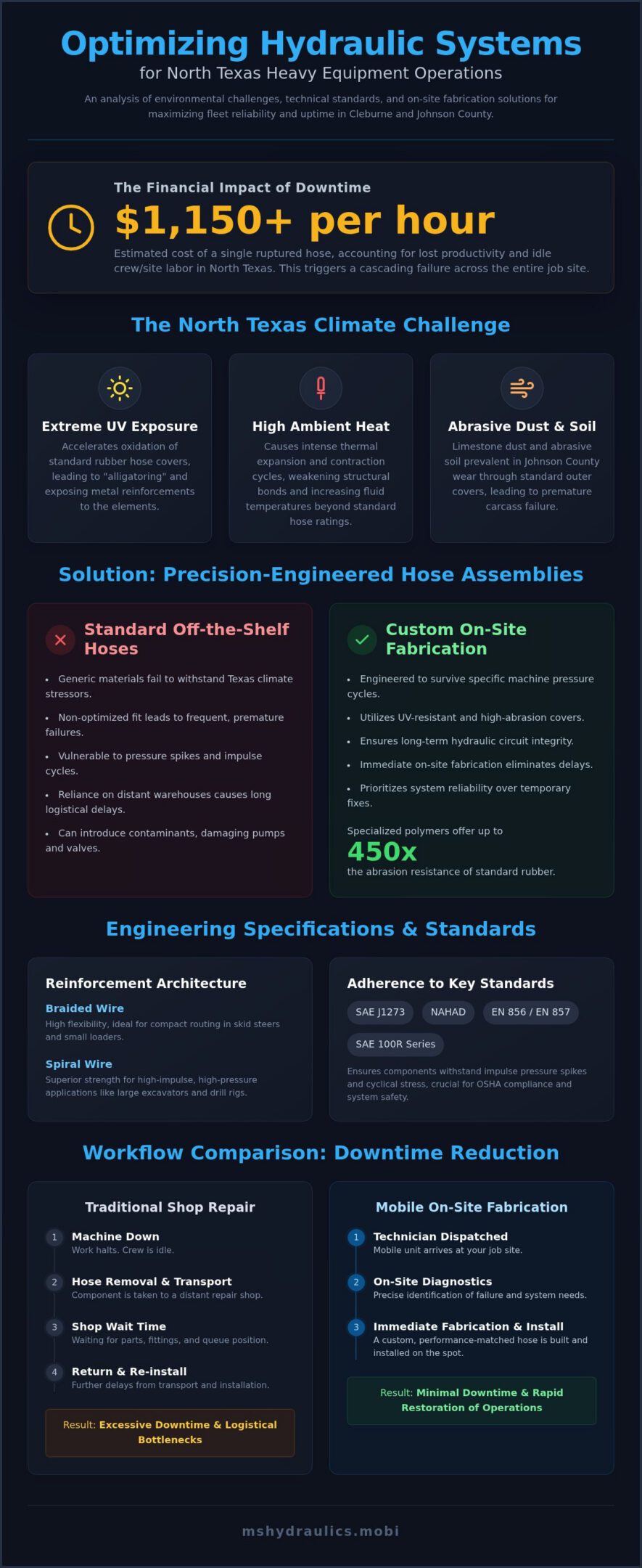
The economic consequences of a hose failure on a Cleburne job site extend far beyond the cost of the replacement part. When a primary machine like a large excavator or skid steer stops, it often idles an entire crew and secondary equipment, creating a cascading loss of productivity. Beyond the immediate halt in work, a sudden hose rupture can introduce air and abrasive contaminants into the system, which leads to the cavitation of expensive hydraulic pumps or the scoring of sensitive valve spools. Based on 2026 industrial economic analysis, the average hydraulic downtime cost for heavy equipment in the southern United States is estimated at $1,150 per hour when accounting for lost productivity and idle site labor. Investing in engineered assemblies prevents these massive financial leaks and protects the high-value internal components of your fleet.
Texas Climate and Hose Longevity
The North Texas environment presents unique stressors that standard rubber compounds aren’t designed to withstand. Cleburne’s extreme UV exposure and ambient heat accelerate the oxidation of standard hose covers, leading to “cracking” or “alligatoring” that exposes the metal reinforcement to the elements. This degradation is worsened by the thermal expansion cycles typical of North Texas summers, where hoses must expand and contract under intense heat without losing their structural bond. In areas like Alvarado and Granbury, where limestone dust and abrasive soil are prevalent, standard hoses often suffer from external abrasion that wears through the outer carcass. Effective material selection for these environments includes:
- High-Abrasion Covers: Utilizing specialized polymers that offer up to 450 times the abrasion resistance of standard rubber.
- UV-Resistant Compounds: Selecting materials specifically formulated to prevent ozone-related cover degradation.
- Thermal Stabilization: Ensuring the hose is rated for the elevated fluid temperatures caused by high ambient Texas heat.
By focusing on these physical and mechanical parameters, custom fabrication provides a level of reliability that generic replacements cannot match in the local climate.
Engineering Specifications: Reinforcement and Pressure Standards
Engineering custom hydraulic hoses Cleburne requires a rigorous adherence to mechanical parameters that exceed basic fitment. Modern high-pressure systems must comply with current international standards, including EN 856 and EN 857 for spiral architectures, alongside the foundational SAE 100R series. Simply matching a hose to a machine’s maximum operating pressure is an incomplete strategy. Engineers must account for impulse pressure—the rapid, high-frequency spikes that occur during valve actuation. These surges often exceed nominal pressure ratings and are the primary cause of wire fatigue. Adhering to OSHA safety standards for fluid power systems requires selecting reinforcement that can withstand these cyclical stresses without compromising the hose carcass.
Braided vs. Spiral Wire Reinforcement
The choice between braided and spiral reinforcement is dictated by the machine’s duty cycle and routing constraints. Two-wire braided hoses provide the high degree of flexibility necessary for the compact engine compartments of skid steers and small loaders. Conversely, large-scale excavators and high-pressure drill rigs demand four- or six-wire spiral construction. In spiral hoses, the wire layers remain parallel, which allows the assembly to manage massive surge loads and high-impulse cycles without the internal friction and heat generation found in braided designs. Technicians must strictly observe the minimum bend radius; exceeding this limit causes wire displacement and significantly accelerates the timeline for a catastrophic rupture.
Fitting and Coupling Precision
Field identification of specialized fittings is a critical technical hurdle. Technicians must distinguish between JIC 37-degree flares, O-Ring Face Seals (ORFS), and BSPP (British Standard Pipe Parallel) connections, often under suboptimal field conditions. Misidentifying a thread pitch or seat angle leads to persistent leaks and potential thread stripping. To ensure certified high-pressure safety, it’s vital to use matched hose and fitting brands that have been verified through rigorous crimp-tolerance testing. Furthermore, couplings used in North Texas industrial environments should meet ISO 9227 standards for corrosion resistance to prevent structural degradation from environmental exposure. If your machinery operates under extreme duty cycles, you can request a technical assembly review to ensure your components meet these precise engineering benchmarks.
Mobile On-Site Fabrication vs. Traditional Shop Repair
The traditional shop-based repair model introduces a significant logistical bottleneck into heavy equipment operations. This process requires a multi-stage cycle: hose removal, round-trip transport to a physical location, and reinstallation. Each stage adds to the total downtime, often extending a simple repair into a six-hour ordeal. This inefficiency is compounded by the labor costs of the transport driver and the fuel consumed during transit. Additionally, communicating specialized fitting data over the phone is prone to error, especially when dealing with complex international thread standards. By utilizing Expert Mobile Hydraulic Repair in Cleburne, TX, operators bypass these delays entirely while ensuring mechanical precision.
The Logistics of Shop-Based Repair
Hidden costs are a defining characteristic of shop-based repair strategies. Beyond the invoice for the hose itself, firms must account for the extended idle time of the machine and the secondary labor required for logistics. There’s also a technical risk associated with remote fabrication; without the machine present, it’s impossible to account for subtle changes in hose routing that may have caused the original failure. Relying on a shop to copy a damaged assembly often results in a replacement that inherits the same routing flaws. Adhering to SAE J517 hose standards requires a level of detail that is best achieved when the fabrication equipment is physically adjacent to the hydraulic system.
Mobile Fabrication Advantages
For massive machinery such as drill rigs and large excavators, mobile fabrication isn’t just a convenience; it’s a technical necessity. Fabricating custom hydraulic hoses Cleburne directly at the machine allows for precise on-site verification of hose routing. Technicians can adjust lengths to the millimeter to prevent kinking or abrasive contact with the machine’s frame. This level of precision is impossible to achieve when copying a failed hose in a remote shop. Additionally, mobile fabrication minimizes the window for environmental contamination. Leaving hydraulic circuits exposed to Cleburne’s abrasive dust for several hours during a shop run risks internal component scoring.
Mobile service trucks provide a controlled environment where hoses are cut, crimped, and cleaned immediately before installation. When combined with On-Site Diagnostic Services, the technician can confirm system integrity through immediate pressure testing post-installation. This structured approach reduces the total repair window from a six-hour shop cycle to a two-hour on-site intervention. By sourcing custom hydraulic hoses Cleburne through a mobile provider, you effectively restore productivity four hours sooner than traditional methods allow.
The STAMPED Method: Specifying Your Custom Assembly
The STAMPED method is the industry-standard protocol for ensuring the mechanical integrity of custom hydraulic hoses Cleburne. Each letter represents a critical parameter that must be verified to prevent premature assembly failure. Precision starts with Size (S), where technicians measure the dash size and internal diameter (ID) to ensure fluid velocity remains within engineered limits. Excessive velocity causes turbulence and heat generation, while insufficient ID can lead to system cavitation. Temperature (T) must account for both the internal hydraulic fluid and the ambient North Texas environment, which frequently exceeds 100°F during summer operations. Application (A) identifies the duty cycle and routing requirements, ensuring the assembly can withstand the external abrasion risks common on local construction sites.
Material (M) selection focuses on identifying an elastomer that is chemically compatible with the specific hydraulic fluid in use, whether mineral-based or synthetic. Pressure (P) ratings must match the system’s maximum working pressure while maintaining the standard 4:1 safety factor established by SAE J517. For instance, a hose with a 4,000 PSI working pressure must have a minimum burst pressure of 16,000 PSI to ensure operator safety and system stability under high-impulse loads.
Ends and Delivery Specifications
The final stages of the STAMPED process involve Ends (E) and Delivery (D). Identifying the correct thread type—such as JIC, ORFS, or NPT—and ensuring proper orientation is vital for a leak-free seal. The “E” in STAMPED prevents catastrophic field leaks by ensuring that the fitting geometry and seat angle are perfectly matched to the system port. Delivery (D) refers to the technical requirements for cleanliness and protection. In 2026, assemblies must meet stringent ISO 4406 cleanliness standards to prevent the introduction of particulates into sensitive valve banks. This includes the use of heat-shrink caps or plugs to seal the assembly immediately after fabrication, protecting the internal bore during transport and installation.
Visual Inspection Checklist
A technical visual inspection is the first line of defense against catastrophic failure. Operators should look for “weeping” at the coupling interface, which indicates a compromised crimp or internal tube degradation. Blistering of the outer cover suggests that fluid has bypassed the inner tube and is attacking the reinforcement layers. Exposed reinforcement wire is a critical failure point, as it allows moisture to cause oxidation and rapid structural weakening. Integrating the STAMPED method into a regular Heavy Equipment Maintenance schedule allows for the identification of these stressors before they result in downtime. Establishing a proactive replacement schedule based on duty cycles ensures that high-cycle lines are retired before they reach the end of their fatigue life. To verify the integrity of your current assemblies, you can schedule a professional on-site inspection with a qualified technician.
Ms. Hydraulics LLC: Precision Hose Fabrication in Cleburne
Ms. Hydraulics LLC operates with a focus on engineering integrity, providing a technical alternative to traditional shop-based repair models from our facility at 3670 E. US-67, Cleburne, TX 76031. Our mobile service fleet is equipped with high-precision crimping and cutting equipment, enabling the fabrication of custom hydraulic hoses Cleburne directly at the machine’s location. This mobile capability isn’t merely about convenience; it’s a commitment to maintaining the long-term health of heavy machinery by ensuring every assembly meets rigorous international standards. Our technicians possess the specialized expertise required to identify complex fittings in the field without relying on part numbers, which is essential for older or modified equipment. Every mobile unit functions as a localized engineering hub, ensuring that replacement components are verified against the machine’s actual duty cycle before installation.
Serving the North Texas Industrial Corridor
Our mobile units maintain a steady operational presence across the North Texas industrial corridor, providing rapid response services to the construction, agriculture, and mining sectors. We cover a broad geographic range, including Cleburne, Alvarado, Granbury, Crowley, and the wider DFW industrial hub. Local businesses rely on our on-site diagnostic precision and the immediate availability of custom hydraulic hoses Cleburne to resolve failures that off-the-shelf components cannot address. For critical failures, we offer emergency on-call services throughout 2026 for Johnson County, ensuring that downtime remains a controlled variable rather than an open-ended financial loss. This localized expertise allows us to provide faster, more accurate repairs than providers outside the immediate region, focusing on the specific environmental stressors found in North Texas soil and climate.
Beyond the Hose: Comprehensive Hydraulic Care
While hose fabrication is a core competency, our technical scope extends to full-system restoration. We integrate our on-site fabrication with specialized expertise in Heavy Equipment Cylinder Rebuild and the repair of hydraulic pumps, valves, and motors. Our diagnostic-first approach ensures that we don’t just replace a failed component but identify the underlying system stressors that caused the failure. This methodical process prevents repeat failures and protects high-value components from secondary damage caused by contamination or pressure imbalances. By addressing the entire hydraulic circuit, we ensure that your fleet operates at peak mechanical efficiency. You can Schedule your on-site hydraulic service today to secure professional diagnostic support for your machinery.
Optimizing Fleet Reliability through Engineered On-Site Fabrication
Maintaining the mechanical integrity of heavy equipment in North Texas requires a technical approach that moves beyond reactive repairs. By utilizing the STAMPED method and adhering to rigorous international pressure standards, operators ensure their fluid power systems survive extreme ambient heat and high-impulse duty cycles. Mobile on-site fabrication effectively removes the financial risk of extended downtime by bringing engineering precision directly to the machine’s location. This methodical approach identifies underlying system stressors before they lead to catastrophic component failure, ensuring that every assembly is optimized for its specific environment.
When your operations require custom hydraulic hoses Cleburne, selecting a partner with specialized expertise in excavators, skid steers, and high-pressure drill rigs is a critical operational decision. Ms. Hydraulics LLC has provided mobile diagnostics and on-site fabrication across the North Texas industrial corridor since 2021, focusing on long-term machinery health and mechanical excellence. You can Contact Ms. Hydraulics LLC for On-Site Hose Fabrication to restore your equipment’s performance with assemblies that meet or exceed original factory specifications. Securing your machinery’s integrity today ensures predictable performance and reliability for the most demanding projects ahead.
Frequently Asked Questions
How long does it take to fabricate a custom hydraulic hose on-site?
Fabrication typically requires 20 to 30 minutes per assembly once the technician is on-site and has accessed the machine. This timeframe includes the precision cutting, crimping, and cleaning of the internal bore to meet ISO cleanliness standards. While the total intervention time depends on the complexity of the routing and the number of failed lines, mobile service significantly reduces the hours lost to part removal and transport.
Can you identify my hydraulic fittings if I do not have the original part number?
Our technicians utilize precision calipers and thread gauges to identify specialized fittings without the need for an original part number. We accurately distinguish between JIC 37-degree flares, O-Ring Face Seals, and various international thread standards like BSPP or metric DIN. This field-level identification ensures that your custom hydraulic hoses Cleburne feature the exact coupling geometry required for a leak-free, high-pressure seal.
Do you provide emergency hydraulic hose repair in Cleburne outside of business hours?
Ms. Hydraulics LLC maintains emergency on-call availability throughout 2026 to support critical industrial and construction operations in Johnson County. We recognize that hydraulic failures often occur outside of standard operational windows and require immediate technical intervention to prevent project delays. Our mobile units are staged to provide rapid response across Cleburne and the surrounding North Texas region, focusing on immediate system restoration.
Is mobile hose fabrication more cost-effective than visiting a hydraulic shop?
Mobile fabrication is more cost-effective when you calculate the total cost of downtime and logistical labor. While a physical shop might offer a lower component price, the hours lost to machine idling and transport often exceed $1,000 per hour in lost productivity. Mobile service eliminates these hidden expenses by restoring your equipment’s functionality on-site, which provides a significantly better return on investment for high-value machinery.
What types of heavy equipment do you provide hose services for in North Texas?
We provide comprehensive hydraulic services for a wide range of heavy machinery, including excavators, skid steers, and specialized drill rigs. Our technicians are experienced with the high-impulse duty cycles of earthmoving equipment and the extreme pressure requirements of industrial drilling. We also service loaders, dozers, and agricultural machinery, ensuring that every custom hydraulic hoses Cleburne assembly is matched to the specific mechanical stressors of the machine.
How do I determine if my hydraulic hose needs replacement or a simple repair?
Hydraulic hoses are safety-critical components that must be replaced rather than repaired when their structural integrity is compromised. You should schedule an immediate replacement if you observe weeping at the couplings, blistering of the outer cover, or exposed reinforcement wire. These signs indicate that the hose can no longer maintain its engineered safety factor, which places both the operator and the hydraulic system at risk of a catastrophic failure.
Do you offer custom hydraulic hoses for high-pressure drill rig applications?
We specialize in the fabrication of ultra-high-pressure hoses specifically engineered for the demanding duty cycles of drill rigs. These applications require multi-layer steel-wire spiral reinforcement that complies with EN 856 or EN 857 international standards. Our mobile units carry the specialized inventory necessary to build these heavy-duty assemblies on-site, ensuring your high-pressure systems maintain their integrity under the most grueling geological conditions in North Texas.
What specific areas around Cleburne do your mobile service trucks cover?
Our mobile service trucks provide comprehensive coverage across Johnson County and the surrounding North Texas industrial corridor. This includes primary service areas such as Cleburne, Alvarado, and Granbury, as well as Crowley and the DFW industrial hub. By maintaining a localized presence, we ensure rapid response times for on-site diagnostics and fabrication, allowing local operators to minimize their logistical complexity and restore their machinery’s performance quickly.