Excavator Hydraulic Repair in Cleburne: The Engineering Guide to Minimizing Downtime
The most expensive component of a hydraulic failure isn’t the replacement pump or cylinder; it’s the logistical nightmare of moving a paralyzed 40-ton machine to a repair facility. When a primary boom or swing motor fails on a job site, project managers often face a choice between exorbitant hauling fees and mounting liquidated damages. You’ve likely experienced the frustration of “parts swapping” diagnostics that fail to address the root cause of pressure loss or fluid contamination. Professional excavator hydraulic repair Cleburne requires more than a standard wrench set. It demands a rigorous engineering approach that prioritizes precision and physical data over guesswork.
We understand that every hour an excavator sits idle represents a direct hit to your operational margins and project deadlines. This guide provides a technical framework for mastering hydraulic diagnostics while demonstrating how mobile repair services eliminate the friction of transport logistics. You’ll learn the specific parameters of on-site cylinder rebuilds, the importance of field-fabricated hoses, and how data-driven assessments ensure a rapid restoration of machine functionality. By the end of this article, you’ll have a clear roadmap for minimizing downtime through disciplined, mobile-first maintenance strategies.
Key Takeaways
- Calculate the true cost of machinery downtime by evaluating the financial impact of hauling fees against the efficiency of mobile on-site diagnostics.
- Master the engineering relationship between hydraulic pressure and flow to differentiate between pump failures and subsystem blockages.
- Implement technical protocols for on-site cylinder rebuilds and custom hose fabrication to restore machine functionality without leaving the job site.
- Optimize your excavator hydraulic repair Cleburne strategy by adjusting maintenance schedules to account for the impact of North Texas thermal cycles on fluid viscosity.
- Utilize data-driven preventative maintenance to mitigate the risk of liquidated damages caused by catastrophic hydraulic component failure.
The Economics of Excavator Hydraulic Repair in Cleburne
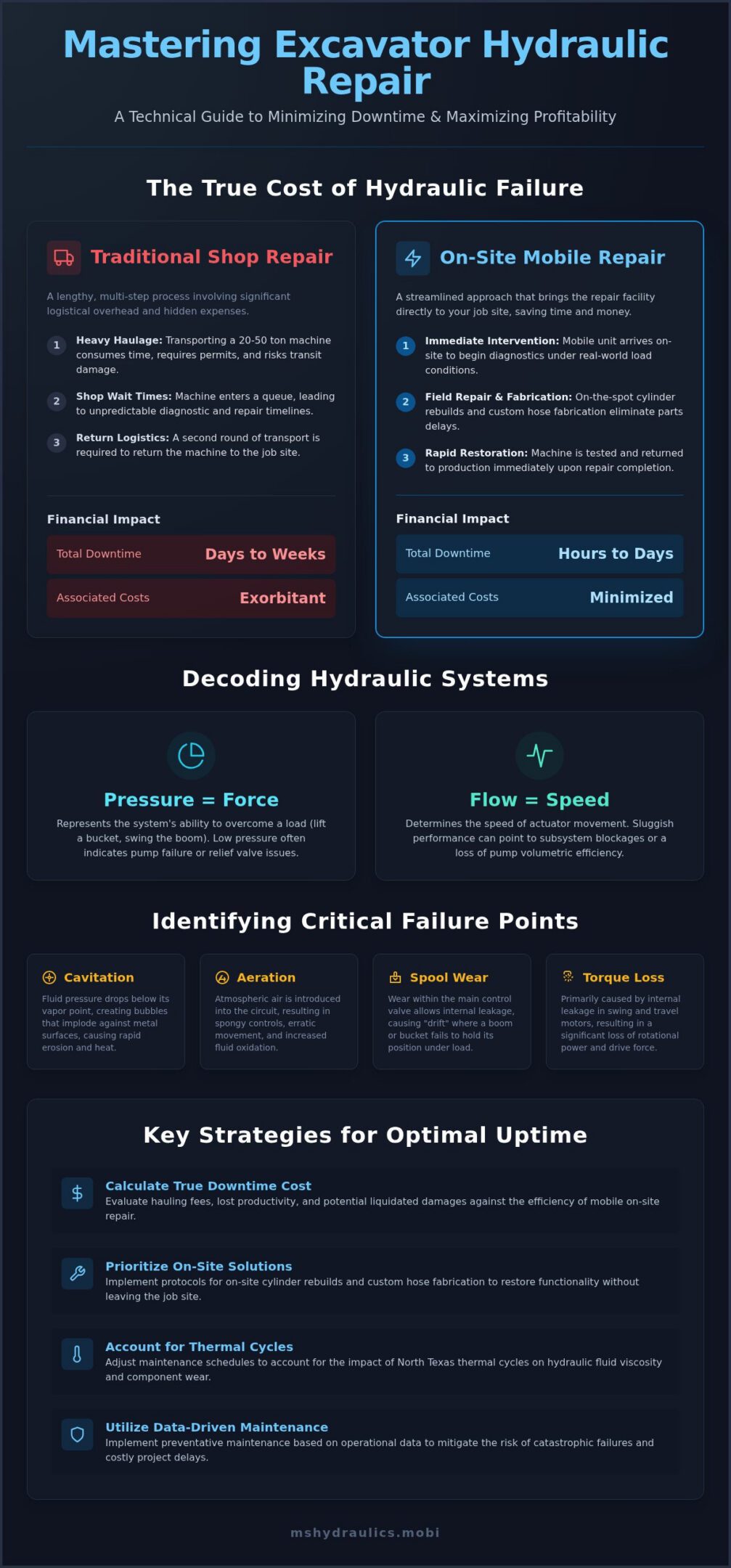
Project profitability in North Texas hinges on asset utilization. With Texas leading the nation in commercial construction spending at nearly $90 billion annually, the pressure on Cleburne job sites is immense. When an excavator’s hydraulic system fails, the immediate instinct is often to haul the machine to a fixed facility. However, the true cost of downtime includes more than the repair invoice. It encompasses lost operator productivity, potential liquidated damages from missed milestones, and the substantial expense of heavy haulage. Choosing a local partner for excavator hydraulic repair Cleburne allows operators to bypass these logistical hurdles and focus on technical restoration at the point of failure.
The Hidden Costs of Heavy Equipment Hauling
Transporting a 20-ton to 50-ton excavator requires specialized trailers and often involves oversized load permits. In Johnson County, the logistical window for loading and securing a machine can consume half a work day before the asset even leaves the site. This doesn’t account for the physical risks inherent in transport. High-frequency vibrations during transit can stress compromised fittings or lead to secondary damage in sensitive hydraulic machinery principles. By the time a machine reaches a shop in a distant city, the project schedule has already suffered a significant setback that’s difficult to recover.
Mobile Service: Rapid Restoration of Field Functionality
Mobile hydraulic repair functions as a high-precision field hospital for heavy machinery. Specialized mobile units equipped with computer diagnostics and hose fabrication tools arrive at the Cleburne or Alvarado site to begin immediate intervention. This approach offers a critical engineering advantage: the ability to test hydraulic pump or valve performance under real-world job-site loads. Ms. Hydraulics prioritizes on-site diagnostic services to verify pressure and flow parameters in the machine’s actual working environment. This disciplined methodology ensures that once a repair is completed, the machine is immediately ready for production. This preserves project margins and maintains the integrity of the construction schedule across Granbury and the wider North Texas region.
Technical Diagnostics of Excavator Hydraulic Subsystems
Effective excavator hydraulic repair Cleburne begins with a fundamental understanding of the relationship between hydraulic pressure and flow. Pressure represents the system’s ability to overcome a load, while flow determines the speed of actuator movement. When a technician encounters a machine with degraded performance, they must isolate whether the issue stems from a volumetric efficiency loss in the pump or a mechanical restriction within the control network. Modern excavators utilize complex pilot systems to modulate main control valves; a failure in this lower-pressure “brain” can manifest as unresponsive or erratic machine behavior. Diagnosing these systems requires high-precision gauges to monitor the interaction between the main pump and the pilot circuit.
Differentiating between pump configurations is essential for accurate troubleshooting. In closed-loop systems, fluid returns directly to the pump inlet, whereas open-loop systems return fluid to a reservoir. Diagnosing these requires different pressure-testing configurations to accurately identify pump slip or internal bypass issues. Adhering to fluid power industry standards ensures that field repairs meet the same rigorous specifications as factory assembly, preventing premature component failure in the demanding North Texas environment.
Main Pump and Control Valve Interaction
High-pressure pumps are susceptible to cavitation and aeration, both of which cause rapid internal erosion and heat generation. Cavitation occurs when fluid pressure drops below its vapor pressure, creating bubbles that implode against metal surfaces. Conversely, aeration introduces atmospheric air into the circuit, leading to spongy controls and erratic boom movement. Spool wear within the main control valve often results in “drift,” where a boom or bucket fails to maintain its position under load. Load-sensing hydraulics utilize a feedback loop to match pump output precisely to the actuator’s demand, significantly reducing parasitic power loss and improving fuel efficiency.
Swing Motors and Travel Drives: Specialized Troubleshooting
Internal leakage is the primary cause of torque loss in swing motors. Technicians look for “swing drift” on slopes as a key indicator of seal failure or plate wear. Travel drives, or final drives, require precise synchronization to ensure straight-line tracking. Diagnostic protocols for on-site diagnostic services include flow testing each motor to identify discrepancies in output. When conducting excavator hydraulic repair Cleburne, verifying the integrity of the center swivel joint is also necessary, as a bypass in this component can mimic motor failure by starving the travel drives of necessary pressure. This methodical approach identifies the specific failure point before any parts are removed or replaced.
On-Site Hose Fabrication and Cylinder Rebuilds
Restoration of hydraulic systems in the field requires the same technical rigor as shop-based operations. For operators seeking excavator hydraulic repair Cleburne, the ability to fabricate high-pressure hoses and rebuild cylinders on-site is a critical advantage. This eliminates the delay of waiting for OEM parts or the logistical burden of transporting components to a fixed facility. Field-based service ensures that assets return to production within hours rather than days. It bypasses the supply chain friction often found in traditional repair models.
Custom Hose Fabrication in the Field
High-pressure hydraulic hoses on modern excavators must withstand pressures often exceeding 5,000 PSI. Field technicians must match hose ratings precisely to the system’s working parameters, including wire reinforcement layers and burst pressure margins. Selection of fittings such as JIC (Joint Industry Council), ORFS (O-Ring Face Seal), or heavy-duty Flange types is dictated by the specific manufacturer’s design. A primary benefit of on-site fabrication is the mitigation of environmental debris. By opening and resealing the circuit immediately at the point of failure, technicians support a total systems cleanliness approach. This prevents the ingress of North Texas dust and particulate matter. These contaminants are leading causes of premature valve and pump wear. On-site crimping ensures that each assembly meets exact length and orientation requirements for the specific excavator model.
Mobile Cylinder Restoration Strategies
Large boom and bucket cylinders are the primary actuators of an excavator’s mechanical force. When these components leak, it’s often due to seal degradation or rod scoring. On-site disassembly techniques allow for a thorough inspection of the rod’s surface integrity and the cylinder’s internal bore. Ms. Hydraulics employs a disciplined heavy equipment cylinder rebuild Texas process that includes resealing and pressure testing in the field. Technicians identify scoring patterns that might indicate hydraulic fluid contamination or mechanical misalignment. If the rod remains within tolerance, a mobile restoration restores the hydraulic seal without the machine ever leaving the job site. This immediate restoration of field functionality ensures that hydraulic line repair near me becomes an asset-preserving action rather than a temporary fix. Professional seal kit installation and proper torque of the cylinder head are verified before the machine is returned to service.
Preventative Maintenance for North Texas Excavator Fleets
Maintaining fleet health in Cleburne requires a disciplined approach that accounts for regional climate extremes. Effective Heavy Equipment Maintenance shifts the focus from reactive repairs to predictive intervention. For operators, this strategy is the most reliable method to avoid the high costs of unexpected excavator hydraulic repair Cleburne. Fluid analysis serves as the technical baseline. It allows technicians to detect microscopic metal shavings or chemical breakdown before a catastrophic pump failure occurs. Regular sampling ensures that the system’s chemical composition remains within the parameters required for high-pressure operation.
Environmental Factors in Johnson County
Construction sites across Johnson County and the DFW metroplex generate significant particulate matter. These fine dust particles act as abrasive media if they bypass filtration, leading to accelerated valve erosion and internal scoring. North Texas temperature swings also challenge fluid stability. Selecting a high-viscosity index (HVI) oil is necessary to maintain film strength during 100°F summer days while ensuring flow during winter cold snaps. Maintaining hydraulic oil temperature between 110°F and 130°F ensures maximum seal longevity and optimal viscosity. Excessive heat accelerates the hardening of nitrile and Viton seals, leading to the “weeping” symptoms often seen on boom cylinders. When seals lose elasticity, they can’t effectively contain the high-pressure surges required for heavy digging.
The Maintenance Checklist for Operators
Daily protocols should include visual inspections for hose abrasions and weeping seals at every pivot point. These small leaks are often early indicators of pressure loss or seal degradation. Operators must also utilize On-Site Diagnostic Services to perform periodic pressure testing. This verifies that the main pump is delivering output within OEM specifications. Identifying a minor drop in volumetric efficiency early allows you to schedule a controlled repair rather than reacting to a field failure. This methodical oversight preserves the mechanical integrity of the machine and protects the project’s financial margins from the impact of liquidated damages. To secure your project timeline, contact Ms. Hydraulics to schedule Mobile Hydraulic Repair for your North Texas fleet.
The Ms. Hydraulics Advantage for Cleburne Operators
Ms. Hydraulics positions itself as a disciplined industrial veteran in the North Texas heavy equipment sector. We prioritize technical accuracy and engineering excellence over the generic “parts-swapping” approach common in the industry. For project managers and fleet owners, excavator hydraulic repair Cleburne is a matter of restoring physical parameters to OEM specifications under field conditions. Our organization functions as a serious partner for operators who value reliability and performance. By integrating rigorous diagnostic protocols with immediate field intervention, we eliminate the logistical friction that traditionally compromises project timelines.
Equipped for the North Texas Field
Our mobile units are engineered to serve as fully functional field extensions of a high-precision hydraulic shop. Each vehicle carries specialized diagnostic computers and industrial-grade fabrication equipment—including professional-grade boring and welding systems from Bore Repair Systems, Inc.—capable of handling the high-pressure requirements of 40-ton machinery. We maintain a deep proficiency in both industrial and agricultural hydraulic systems, ensuring that our technical responses are tailored to the specific mechanical demands of the asset. Our operational footprint extends throughout Johnson County and Tarrant County, providing rapid response services to Cleburne, Granbury, and Mansfield. This local presence ensures that a technician with the correct verification tools is never more than a short transit away from your job site.
The primary objective of our service model is the reduction of the total cost of ownership (TCO) for your excavator fleet. We achieve this by providing accurate, data-driven diagnostics that prevent the recurrence of component failure. Rather than simply treating symptoms, we identify root causes such as fluid contamination or mechanical misalignment. For emergency intervention or scheduled maintenance, you can rely on our expertise for mobile hydraulic repair Cleburne TX. We also offer technical system audits to evaluate the health of your hydraulic circuits before they reach a failure state. This proactive engineering oversight is a hallmark of our legacy in the North Texas region. We invite you to contact us to discuss your specific fleet requirements and establish a maintenance protocol that aligns with your operational milestones.
Securing Your Project Milestones with Precision Field Service
Minimizing equipment downtime is a function of engineering discipline and logistical efficiency. By prioritizing on-site diagnostics and field-based component restoration, fleet operators bypass the high costs of heavy hauling and the risk of liquidated damages. A technical approach to excavator hydraulic repair Cleburne ensures that every pump adjustment and cylinder seal meets factory-level performance standards. This methodical oversight, combined with a rigorous preventative maintenance schedule, preserves the mechanical integrity of your assets in the demanding North Texas climate.
Ms. Hydraulics has been serving Johnson County since 2021, providing the technical expertise required for complex industrial repairs. Our mobile units are equipped for on-site custom hose fabrication and certified mobile computer diagnostics to restore your machinery’s functionality at the point of failure. Don’t let hydraulic failure compromise your production schedule. Request Expert Mobile Excavator Repair in Cleburne to maintain your operational momentum. We look forward to supporting your next project with professional excellence.
Frequently Asked Questions
How do I know if my excavator’s hydraulic pump is failing?
Indicators that you require excavator hydraulic repair Cleburne include increased cycle times, excessive noise such as aeration or cavitation, and a noticeable loss of breakout force. If the machine struggles to maintain pressure under load or if you detect high-frequency vibrations in the hydraulic lines, the pump’s volumetric efficiency is likely compromised. We recommend immediate on-site diagnostics to verify flow rates and pressure stability before internal components suffer catastrophic failure.
What is the average cost of excavator hydraulic repair in Cleburne?
Excavator hydraulic repair Cleburne pricing is determined on a per-job basis, as costs vary depending on the failure point and component complexity. Total expenses are influenced by the severity of the damage, required parts, and the labor hours necessary for precision restoration. Mobile service often reduces the total project expense by eliminating the exorbitant hauling fees associated with transporting 40-ton machinery to a fixed facility for shop repairs.
Can you fabricate high-pressure hydraulic hoses on-site?
Yes, our mobile units provide custom hydraulic hose fabrication directly at your job site. We carry specialized crimping equipment and a comprehensive inventory of high-pressure hoses and fittings, including JIC, ORFS, and Flange types. This capability allows us to restore machine functionality immediately. It ensures that new assemblies match OEM specifications while preventing environmental contaminants from entering the open circuit during the repair process in the field.
How long does a typical hydraulic cylinder rebuild take in the field?
A typical on-site cylinder rebuild can be completed within a few hours to a full work day, depending on the cylinder’s size and the extent of rod scoring. The process involves disassembly, thorough inspection of the bore and rod, and the installation of professional seal kits. Because we perform these services in the field, we eliminate the multi-day delays often caused by shop backlogs and complex transportation logistics.
Is mobile hydraulic repair available for all excavator brands like Cat, Komatsu, and John Deere?
Mobile hydraulic repair is available for all major heavy equipment brands, including Cat, Komatsu, John Deere, and Volvo. Our technicians utilize diagnostic protocols that are compatible with the specific hydraulic architectures of these manufacturers. Whether your fleet consists of standard excavators or specialized industrial machinery, our engineering-first approach ensures that repairs are executed according to the original equipment manufacturer’s technical standards and verification parameters.
What are the most common causes of hydraulic system overheating in North Texas?
Hydraulic system overheating in North Texas is primarily caused by extreme ambient temperatures, fluid contamination, and degraded oil viscosity. When hydraulic fluid breaks down under heat, it loses its ability to lubricate components and dissipate thermal energy effectively. Other factors include clogged coolers and internal leakage in pumps or valves. Regular maintenance is necessary to ensure that the system operates within the optimal thermal range for seal longevity.
Do you provide emergency 24/7 hydraulic service for Cleburne job sites?
Ms. Hydraulics focuses on providing reliable mobile repair during standard operational hours for Cleburne and Johnson County job sites. While we prioritize rapid response for field failures to minimize project delays, you should contact our office directly to confirm current technician availability for your specific location. We aim to restore machine functionality as efficiently as possible to help you avoid liquidated damages and maintain project momentum.
How often should I perform hydraulic fluid analysis on my excavator?
We recommend performing hydraulic fluid analysis every 500 to 1,000 operating hours as part of a technical maintenance protocol. In high-dust environments like North Texas construction sites, more frequent sampling may be required to monitor for particulate ingress and chemical degradation. This data-driven approach allows you to identify early warning signs of component wear, such as microscopic metal shavings, before they lead to a catastrophic system-wide failure.