Heavy Equipment Fluid Analysis: The Engineering Guide to Predictive Maintenance
What if the particulate matter suspended in your hydraulic system wasn’t just waste, but a precise mechanical biography of your machine’s internal wear? Most fleet managers view oil changes as a binary task, either completed or overdue. This approach often ignores the critical data points that prevent catastrophic component failure. Utilizing heavy equipment fluid analysis moves your operation away from the high costs of unscheduled downtime and toward a disciplined, engineering-led maintenance strategy.
You likely understand the frustration of a machine failing in the field without warning, or the uncertainty of discarding expensive synthetic fluids that might still have thousands of hours of service life. It’s a common pain point that stems from a lack of granular data. This guide will demonstrate how technical fluid analysis transforms these reactive repairs into a surgical process that extends equipment lifespan and secures your resale value. We’ll examine how to interpret specific contaminant signatures, the impact of ASTM standards like D7705, and the specific regulatory requirements for used oil management in Texas.
Key Takeaways
- Identify specific component wear patterns through elemental analysis to prevent catastrophic mechanical failure before it occurs.
- Utilize the “traffic light” alert system to differentiate between acceptable operating parameters and critical maintenance requirements.
- Implement standardized sampling protocols to ensure your heavy equipment fluid analysis provides accurate, actionable data without the risk of cross-contamination.
- Map wear metals like iron and lead to specific internal parts to perform surgical repairs rather than broad, costly component replacements.
- Build a comprehensive, data-backed maintenance record that extends machine longevity and optimizes long-term resale valuation.
Understanding Heavy Equipment Fluid Analysis as a Diagnostic Tool
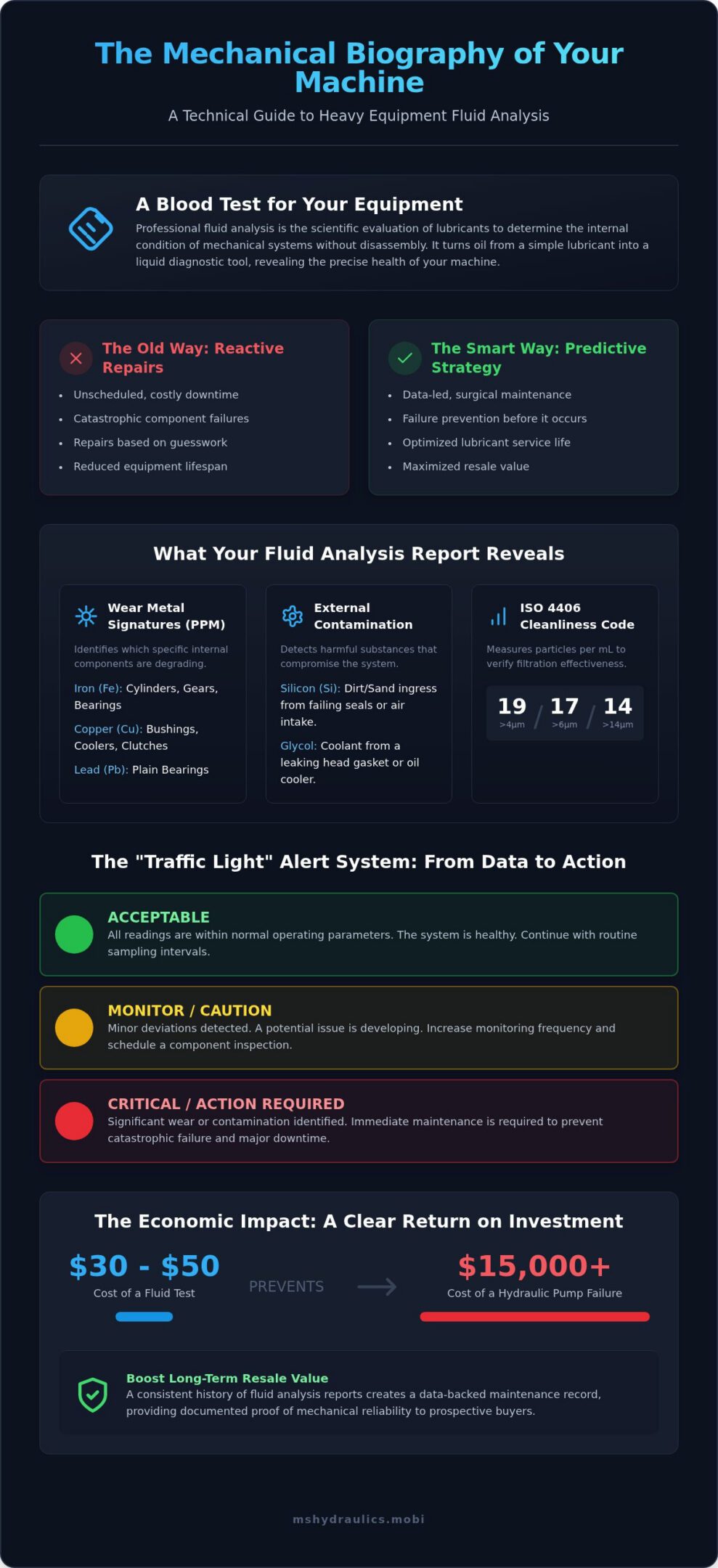
Professional heavy equipment fluid analysis is the scientific evaluation of lubricants, coolants, and fuels to determine the internal condition of mechanical systems without disassembly. This process serves as the foundation for modern predictive maintenance. It moves away from traditional, schedule-based intervals toward a model governed by actual component health. By utilizing spectrometry to identify wear metals and chromatography to analyze chemical degradation, engineers gain a transparent view of the machine’s operational integrity. This technical approach ensures that maintenance decisions are based on empirical data rather than visual estimation or mere hours of operation.
The industry frequently utilizes the “blood test” analogy to describe this diagnostic discipline. Just as a medical professional examines biological markers to identify systemic issues, a technician uses fluid chemistry to detect early-stage component wear. Every hydraulic pump, valve, and cylinder leaves a distinct chemical signature in the oil as it operates. When these signatures deviate from established baselines, it indicates a specific mechanical pathology. This allows for targeted Heavy Equipment Maintenance that addresses the root cause of potential failure before it manifests as a field breakdown.
The Objectives of Regular Fluid Testing
The primary goal of routine testing is the identification of abnormal wear patterns. By monitoring the concentration of metals such as iron, copper, and lead in parts per million (ppm), technicians can pinpoint which internal components are degrading. Additionally, the process optimizes lubricant service life. Instead of discarding oil based on a fixed calendar date, operators can extend drain intervals safely when the data confirms the fluid’s additive package remains intact. This reduces environmental waste and operational costs. Finally, analysis verifies the effectiveness of filtration systems. It measures the ISO cleanliness code of the fluid, ensuring that filters are successfully removing contaminants under heavy industrial loads.
The Economic Impact of Predictive Maintenance
The financial justification for fluid diagnostics is found in the significant return on investment. A standard industrial fluid analysis package typically costs between $30 and $50 per sample. This minor expenditure stands in stark contrast to the high costs of a $15,000 hydraulic pump replacement or the secondary damage caused by a catastrophic engine failure. For construction and industrial fleets, reducing the total cost of ownership (TCO) requires minimizing unscheduled downtime. Furthermore, a consistent history of heavy equipment fluid analysis reports creates a data-backed maintenance record. This verification of excellence significantly increases the secondary market value of the equipment, as it provides prospective buyers with documented proof of mechanical reliability and disciplined care.
Technical Breakdown: What Fluid Analysis Reveals
Modern heavy equipment fluid analysis relies heavily on the ISO 4406 standard to quantify particulate contamination. This international benchmark provides a three-number code, such as 19/17/14, which represents the quantity of particles larger than 4, 6, and 14 microns per milliliter of fluid. For high-pressure hydraulic systems, maintaining these levels is critical for performance. Even microscopic silt, invisible to the naked eye, can cause “stiction” in sensitive valves or lead to accelerated wear in piston pumps. By monitoring these codes, fleet managers can verify that their filtration systems are operating within the manufacturer’s specified parameters.
A comprehensive heavy equipment fluid analysis also monitors for external ingress that can compromise the lubricating film. Contamination monitoring detects the presence of glycol, which indicates a leaking head gasket or oil cooler, and silicon, which signals a breach in the air intake or a failing seal. Detecting these elements early prevents the formation of sludge and the abrasive wear that follows external debris entry.
Wear Metal Identification and Source Mapping
Elemental analysis utilizes Inductively Coupled Plasma (ICP) to detect wear metals in parts per million (ppm). Iron and steel concentrations typically track wear in cylinders, planetary gears, and anti-friction bearings. Elevated levels in these categories often signal a need for On-Site Diagnostic Services to prevent a total system seizure. Copper and brass findings usually indicate the degradation of thrust washers, bushings, or hydraulic heat exchanger cores. Chromium serves as a specific marker for the wear of piston rings or the degradation of the hard-chrome plating on hydraulic rods.
Chemical and Physical Property Shifts
Physical property testing identifies how the fluid’s molecular structure changes over time. The viscosity index measures a fluid’s resistance to flow at specific temperatures. In the extreme heat of North Texas, hydraulic oil can undergo mechanical shearing; this is where long-chain polymers break down and the fluid loses its load-bearing capacity. Total Acid Number (TAN) is another vital metric. It measures the concentration of acidic byproducts, where a rising TAN indicates the fluid is oxidizing. This leads to varnish formation and component corrosion. Finally, water content analysis via the Karl Fischer titration method detects moisture ingress. It’s a critical check because even 500 ppm of water can reduce the fatigue life of a rolling-element bearing by up to 75%.
Interpreting the Report: From Raw Data to Actionable Repairs
Raw laboratory data requires a structured interpretation framework to be useful for fleet operations. Most industrial laboratories utilize a standardized “Traffic Light” system to categorize the severity of findings. A Green status indicates that all physical and chemical parameters remain within the acceptable range for the specific machine model and its cumulative hours. Yellow signals a caution state where a parameter has deviated from the established baseline, requiring shortened sampling intervals to monitor the progression. Red signifies a critical condition that demands immediate mechanical intervention. When a report reaches this critical threshold, integrating On-Site Diagnostic Services is essential to verify the lab findings through physical pressure testing and system inspection.
The transition from data to action depends on the technician’s ability to correlate chemical markers with mechanical functions. For example, a Red alert for chromium and iron in a hydraulic circuit is a primary indicator that a Heavy Equipment Cylinder Rebuild is necessary to prevent bypass and system-wide contamination. Without this interpretation, a laboratory report is merely a list of numbers; with it, the report becomes a roadmap for surgical repair.
Trend Analysis vs. Spot Testing
A single heavy equipment fluid analysis report offers a static snapshot, but the true diagnostic value lies in trend analysis. The rate of change in wear metal concentration is significantly more critical than the absolute ppm value. For instance, a high-hour excavator may naturally show 80 ppm of iron. If this value has remained stable over several thousand hours, the machine is in a steady state of “normal” wear. However, a sudden jump from 20 ppm to 60 ppm over a single 500-hour interval indicates an accelerating wear event. Tracking this delta allows engineers to use historical data to predict the remaining useful life of high-value components like hydraulic pumps, facilitating planned replacements rather than emergency failures.
Identifying the Root Cause of Contamination
Effective interpretation must distinguish between external ingress and generated wear. External contamination, often indicated by high silicon levels, suggests a breached seal or a poor service environment during oil top-offs. In contrast, generated wear particles are the result of internal mechanical stress and friction. Distinguishing between “built-in” debris, common in new or recently repaired systems, and “generated” wear is vital for accurate diagnostics. There is also a direct relationship between fluid health and the frequency of Hydraulic Hose Repair. When fluid degrades or becomes contaminated, it can lead to increased internal heat and pressure spikes that accelerate the failure of hose liners and fittings.
Field Best Practices: Sampling Procedures for North Texas Operators
The integrity of a heavy equipment fluid analysis depends entirely on the quality of the sample collected. If the sample is contaminated during the extraction process, the resulting data is invalid, leading to false alerts or missed mechanical failures. Professionals adhere to the “Cleanliness is King” rule, which dictates that every piece of sampling hardware must be factory-sealed and used only once. For the most accurate results, samples should be taken from the return oil line, upstream from the filter. This captures the most representative debris profile before it is removed by the filtration system. Technicians target turbulent flow zones, such as elbows in the piping, where particles remain in suspension rather than settling in laminar flow areas.
Safety is the priority when accessing pressurized hydraulic systems. Technicians must never crack a fitting under pressure to obtain a sample. Instead, use dedicated sampling valves designed for high-pressure extraction. Adhering to ASTM D7705 guidelines ensures that the procedure remains standardized and repeatable across the entire fleet, providing the baseline necessary for effective trend analysis.
Environmental Factors in Cleburne and DFW
The North Texas climate presents unique challenges for Heavy Equipment Maintenance. During summer months, ambient temperatures frequently exceed 100°F, accelerating the oxidative breakdown of hydraulic fluids. This thermal stress reduces the fluid’s viscosity index faster than in temperate regions. Additionally, the high-wind, dusty conditions in Cleburne can lead to significant dust ingress if a reservoir is opened even briefly. Local operators should consider tighter testing intervals, often every 250 to 500 hours, to account for these environmental stressors and the high-stress nature of Texas construction sites.
Step-by-Step Field Sampling Technique
- Step 1: Bring the machine to its normal operating temperature, typically 40 to 60°C for mineral-based oils, to ensure representative flow and particle suspension.
- Step 2: Thoroughly clean the sample valve or the area around the dipstick tube before using a vacuum extraction pump to prevent external contamination.
- Step 3: Flush the sampling hardware by drawing at least 100ml of fluid into a waste container to remove stagnant oil from the dead-leg of the valve.
- Step 4: Fill the sample bottle to approximately 80% capacity and label it immediately with the machine ID, precise hour meter reading, and the current date.
For precise data collection that withstands industrial scrutiny, schedule On-Site Diagnostic Services to have your samples pulled by a qualified mobile technician.
Integrating Fluid Analysis into a Professional Maintenance Strategy
A sophisticated heavy equipment fluid analysis program serves as the analytical backbone of a comprehensive Heavy Equipment Maintenance schedule. While many operators rely on generic mail-in kits, these isolated data points often lack the necessary mechanical context. A professional strategy integrates laboratory results with real-world operational parameters. This method ensures that maintenance actions aren’t just reactions to a report, but strategic interventions designed to maximize the service life of high-value assets. By centralizing this data, fleet managers move from a state of repair-driven chaos to a disciplined, engineering-led model that prioritizes reliability and performance.
Technical transparency is a core benefit of this data-driven approach. When a technician recommends a Hydraulic Pump Repair or a Hydraulic Motor Repair, the fluid analysis provides the empirical evidence required to justify the expenditure. For instance, if a report indicates a high concentration of bronze and iron particles alongside a drop in volumetric efficiency, the need for a pump overhaul becomes an objective fact rather than a subjective suggestion. This level of integrity builds trust between fleet owners and service providers, ensuring that every repair is necessary and accurately targeted.
The Ms. Hydraulics Approach to Fleet Health
Ms. Hydraulics LLC differentiates its service by providing mobile, on-site diagnostics that bridge the gap between the laboratory and the job site. Unlike standard mail-in services, on-site diagnostics allow technicians to perform immediate pressure testing and visual inspections of critical components like excavators, skid steers, and drill rigs. Serving Cleburne, Granbury, and the wider DFW metroplex, this approach minimizes machine downtime by identifying issues while the equipment is still in the field. By combining heavy equipment fluid analysis with expertise in hydraulic system pressure testing and filter management, we provide a holistic view of machine health that mail-in kits simply can’t match.
Next Steps for Fleet Managers
Implementing a predictive maintenance model begins with a thorough audit of current maintenance logs to identify gaps in fluid monitoring. Managers should look for machines with high unscheduled downtime or those operating in the high-stress environments typical of North Texas construction sites. A pilot sampling program for critical path machinery allows for the establishment of wear baselines without overwhelming the maintenance budget. Once these baselines are set, the data dictates the optimal intervals for intervention. For immediate assistance with diagnostics or to address a critical failure identified in a recent report, contacting a professional for Mobile Hydraulic Repair ensures that your fleet remains operational and efficient.
Maximizing Asset Longevity Through Data-Driven Diagnostics
Transitioning from reactive repairs to a predictive maintenance model is a fundamental requirement for modern fleet management. By implementing routine heavy equipment fluid analysis, you gain the technical transparency needed to identify internal component wear before it results in a field failure. This disciplined approach ensures that every maintenance action is supported by empirical data, protecting both your operational uptime and the long-term resale value of your machinery. Whether you’re managing excavators or drill rigs, standardized sampling remains the most effective way to monitor system health in the harsh North Texas environment.
The principles of proactive maintenance extend beyond heavy machinery to all critical infrastructure; for those managing residential or commercial properties in Central Texas, Austin Air Pros provides specialized AC and heating services to ensure climate control systems remain reliable in the face of similar environmental stressors.
Ms. Hydraulics LLC has provided expert on-site diagnostics for diverse industrial equipment across Cleburne and the DFW metroplex since 2021. Our mobile technicians combine technical fluid analysis with system pressure testing to deliver precise, data-driven repair recommendations for all makes and models. Don’t wait for a mechanical failure to dictate your schedule. Schedule Professional On-Site Diagnostics with Ms. Hydraulics to secure your fleet’s reliability today. Your equipment is a significant investment; protect it with professional engineering oversight.
Frequently Asked Questions
How often should I perform fluid analysis on my heavy equipment?
Sampling intervals should align with the severity of the application. For standard operations, a frequency of every 500 operating hours is sufficient. However, for high-stress Texas construction sites, intervals of 250 hours are recommended to account for extreme heat and dust. Consistency is more important than frequency; maintaining a steady schedule allows for the trend analysis required to identify abnormal wear patterns before they manifest as mechanical failures.
Can fluid analysis tell me if my hydraulic pump is about to fail?
Yes, technical fluid analysis identifies the early stages of pump failure by monitoring wear metals such as iron, copper, and bronze. A sudden spike in these concentrations indicates that internal rotating groups or thrust plates are degrading. When combined with volumetric efficiency tests, heavy equipment fluid analysis provides a reliable prediction of a pump’s remaining useful life, allowing for planned repairs rather than emergency field service.
What is the most common contaminant found in North Texas hydraulic systems?
Silicon, in the form of airborne dust and sand, is the most prevalent contaminant in North Texas systems due to the regional soil composition and windy conditions. Water is the second most common issue, often entering through condensation or failing reservoir seals. Both contaminants accelerate abrasive wear and the oxidative breakdown of the fluid, necessitating more frequent filter management and seal inspections to maintain system integrity.
Is fluid analysis necessary if I change my filters regularly?
Regular filter changes are essential, but they don’t provide data on the chemical health of the lubricant or the rate of internal component wear. Filters remove particulate matter but cannot stop the depletion of additive packages or the increase in Total Acid Number (TAN). Fluid analysis serves as the only method to verify that the fluid’s molecular structure remains intact and capable of providing the required load-bearing capacity.
How long does it typically take to receive a fluid analysis report?
Most professional laboratories provide a standard turnaround time of 24 to 48 hours once the sample is received. Some specialized facilities offer same-day processing for critical samples. Including the transport time from North Texas to the lab, fleet managers should expect actionable results within three to five business days. Digital reporting platforms allow for immediate notification as soon as the data is verified.
What does a high silicon reading in my oil sample indicate?
A high silicon reading typically indicates an ingress of external dirt or dust into the system. This often occurs through a breached breather, a failing cylinder rod seal, or poor handling practices during oil top-offs. Because silicon is highly abrasive, it leads to “silt wear” that can destroy sensitive hydraulic valves and pumps. Identifying the entry point is a priority to prevent accelerated degradation of the entire circuit.
Can fluid analysis help extend the life of my hydraulic hoses?
Yes, monitoring the oxidative state of the fluid helps prevent the premature failure of hydraulic hose liners. As fluid oxidizes, it becomes acidic and forms varnish, which can chemically attack the elastomers within hoses and seals. By maintaining fluid health through regular heavy equipment fluid analysis, you ensure that the internal environment does not accelerate the cracking or hardening of hose materials, thereby extending the service life of the entire assembly.
Do I need special equipment to take a fluid sample in the field?
Proper field sampling requires a vacuum extraction pump, a clean sample bottle, and a flushing container. For machines equipped with dedicated sampling valves, a probe and tubing assembly are necessary to draw fluid from turbulent flow zones safely. Using specialized hardware ensures that the sample remains representative of the system’s internal condition and prevents the introduction of external contaminants that would invalidate the laboratory results.