On-Site Hydraulic Cylinder Resealing in Cleburne: Technical Guide
The decision to transport a multi-ton hydraulic cylinder to a specialized facility often results in unnecessary operational delays and compounding logistical costs. For project managers in Johnson County, the traditional “pull and ship” method is frequently a significant disruption to the critical path of construction and agricultural projects. You recognize that every hour a machine sits idle due to a blown seal represents lost revenue and a potential environmental liability from fluid discharge.
Professional on-site hydraulic cylinder resealing Cleburne services provide a technically sound alternative that matches shop-quality standards without the logistical burden. By performing the rebuild at the machine’s location, expert technicians restore hydraulic integrity and eliminate the risks associated with cylinder removal and shipping. This specialized approach ensures that your heavy equipment returns to peak performance levels while preventing secondary damage to internal components. This guide details the precision engineering steps involved in mobile resealing, from initial diagnostic verification to the final pressure testing protocols. We’ll examine the specific mechanical parameters required to ensure a long-lasting seal and the advantages of keeping your machinery in the field.
Key Takeaways
- Identify the mechanical indicators of seal degradation to mitigate environmental risks and fluid loss before catastrophic failure occurs.
- Understand the technical methodology of on-site hydraulic cylinder resealing Cleburne, including the use of specialized gland nut wrenches for field-level precision.
- Evaluate component wear parameters to determine when mobile service provides the most efficient path to machine restoration versus a full shop rebuild.
- Implement pre-operational inspection protocols designed to protect wiper seals against the abrasive soil and dust conditions prevalent in North Texas.
- Leverage mobile diagnostic and repair capabilities to minimize equipment downtime for high-demand machinery such as excavators and skid steers.
The Critical Role of On-Site Hydraulic Cylinder Resealing in Cleburne
In Cleburne’s demanding industrial sectors, the integrity of hydraulic systems is non-negotiable. Identifying the early indicators of seal degradation is the first step in preventing systemic failure. Technicians often observe “weeping” at the rod gland or a thin film of oil on the cylinder rod. While these might appear minor, they signal that the primary pressure seals are no longer maintaining an airtight barrier. For operators in Johnson County, on-site hydraulic cylinder resealing Cleburne services offer a proactive solution to these issues before they escalate into environmental liabilities or costly fluid loss events. Mobile service removes the logistical burden of transporting heavy components, allowing repairs to happen exactly where the machine is positioned.
Common Failure Points in Field Environments
The North Texas climate presents unique challenges to hydraulic cylinder components. Intense UV exposure and high thermal cycles cause polyurethane seals to lose elasticity, eventually leading to cracking. In Cleburne, the local soil composition consists of fine particulates that easily bypass worn wiper seals. Once inside the system, these contaminants act as an abrasive paste, scoring internal surfaces and contaminating the entire hydraulic circuit. Heavy equipment like excavators or drill rigs frequently experiences pressure spikes during high-torque operations. These spikes can deform internal piston seals, resulting in an immediate drop in system efficiency and increased pump wear.
Why Delaying Resealing Leads to Catastrophic Failure
Neglecting a minor leak typically leads to a total seal blowout under peak load. When internal seals fail, the resulting metal-on-metal contact between the piston and the barrel causes permanent scoring. This damage often necessitates a full cylinder replacement rather than a simple reseal. Beyond physical damage, internal bypass causes “drift,” where the cylinder fails to hold its position despite the valves being closed. This presents a significant safety hazard on active job sites where load stability is critical. Utilizing on-site hydraulic cylinder resealing Cleburne allows for the immediate restoration of machine functionality. This ensures that minor maintenance needs don’t evolve into a catastrophic mechanical failure that sidelines your equipment for weeks.
Technical Standards for Mobile Hydraulic Cylinder Resealing
Mobile resealing is defined by the extraction of the internal rod assembly while the cylinder barrel remains anchored to the machine’s frame. This method eliminates the need for heavy lifting equipment and specialized transport. To execute on-site hydraulic cylinder resealing Cleburne to industrial standards, technicians utilize specialized tooling such as adjustable gland nut wrenches and precision seal pullers. These tools prevent damage to the cylinder head and ensure the integrity of the gland threads. Using high-specification OEM or equivalent seal kits is mandatory. These components are designed to withstand the specific operating pressures and temperature ranges of the host machine. Field environments are inherently contaminated, so establishing a “clean zone” is a critical technical requirement. Technicians use industrial-grade lint-free wipes and specialized cleaning agents to ensure no grit enters the barrel during the open-system phase.
The Step-by-Step Mobile Resealing Workflow
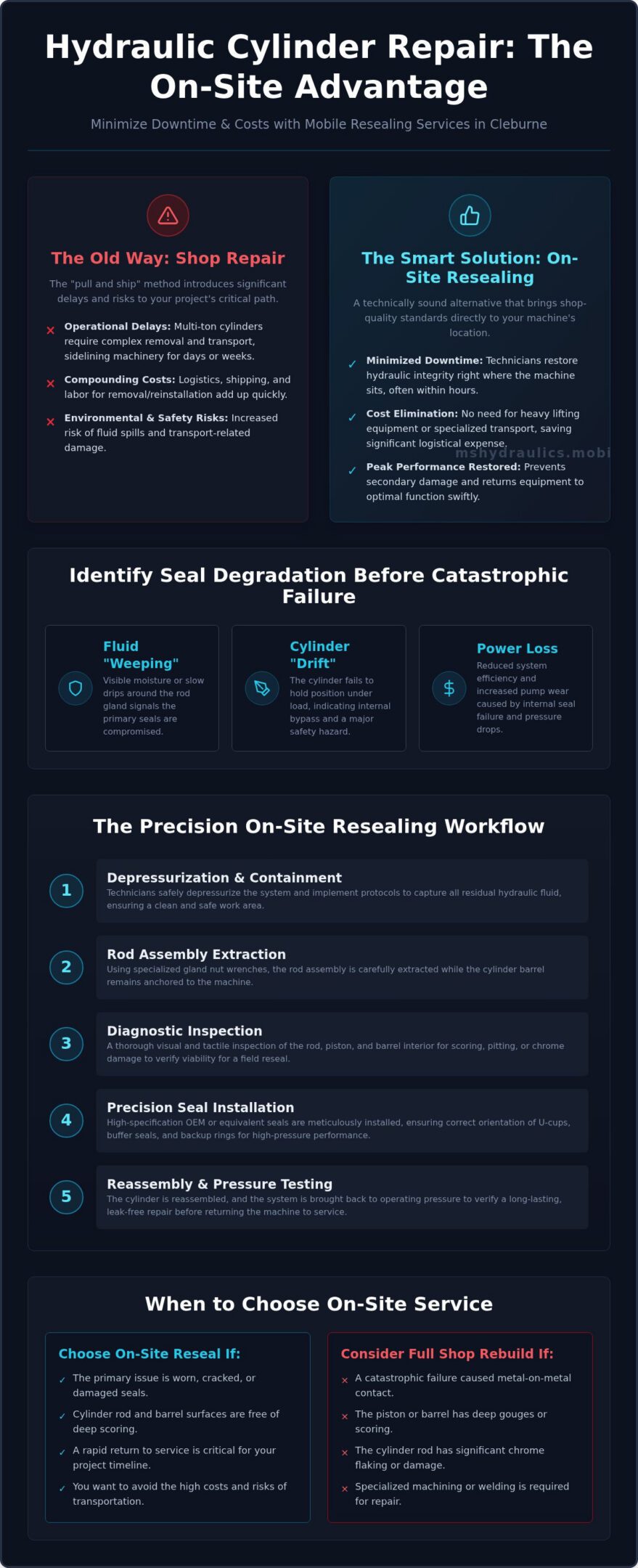
The process begins with full system depressurization to ensure technician safety and prevent fluid discharge. Technicians implement containment protocols to capture residual hydraulic oil. Once the gland is loosened using high-torque wrenches, the rod assembly is extracted. A thorough visual and tactile inspection follows. We check the rod for scoring, the piston for wear, and the barrel’s internal surface for pitting. If the rod shows significant chrome damage, further mobile hydraulic repair may be required to prevent immediate seal failure. This diagnostic phase determines if the cylinder’s structural integrity supports a field-level reseal.
Precision Installation and Reassembly
Reassembly requires meticulous attention to the orientation of dynamic seals. U-cups and buffer seals must face the high-pressure side to function correctly. Backup rings are positioned to prevent seal extrusion under load. Every fastener, including the piston nut and cylinder head, is tightened to specific torque parameters to prevent loosening under vibration. Finally, the system is bled to remove trapped air. This step is vital to prevent cavitation, which can erode metal surfaces and destroy new seals within hours of operation. Following these rigorous standards ensures that the repaired unit meets or exceeds the reliability of a shop-rebuilt component.
On-Site Resealing vs. Full Shop Rebuild: A Decision Framework
Determining the appropriate service path requires a disciplined evaluation of the cylinder’s mechanical condition. While on-site hydraulic cylinder resealing Cleburne offers maximum efficiency, it’s reserved for units where the primary failure is elastomeric degradation rather than structural or metallurgical damage. Project managers must weigh the immediate mobile labor costs against the compounding expenses of equipment transport, shop wait times, and extended machine downtime. For a standard seal failure on an excavator, skid steer, or loader, the logistical burden of removal and shipping often exceeds the cost of a precision field repair. A field repair typically restores a machine to service within hours, whereas a shop visit can sideline equipment for several days due to transit and queueing.
Criteria for Successful On-Site Repair
A successful field reseal depends on three primary physical parameters. First, the rod integrity must be verified. Technicians check for straightness and ensure the chrome surface is free of deep pitting or abrasive wear that would immediately compromise new seals. Second, the barrel condition is inspected using high-intensity lighting to ensure the bore is free of longitudinal grooves. If the internal surface is smooth and within tolerance, new seals will provide an effective pressure barrier. Finally, seal availability determines the timeline. Mobile specialists typically stock high-spec kits for common brands like Cat, Deere, and Case. If these criteria are met, the cylinder can be restored to full functionality without leaving the job site, maintaining the project’s critical path.
When a Shop Rebuild is Unavoidable
Certain mechanical “red flags” indicate that a cylinder has exceeded the scope of field service. Severely scored or bent rods require a full heavy equipment cylinder rebuild Texas to restore the shaft’s original specifications through machining or replacement. Similarly, if the cylinder barrel exhibits deep grooves or “washout” near the ports, it requires honing or replacement in a controlled shop environment. Some welded cylinder designs also lack the bolted glands necessary for field disassembly, requiring specialized cutting and re-welding equipment. In these instances, attempting an on-site repair is counterproductive; the unit must be pulled and sent to a facility equipped with heavy-duty lathes and honing machines. Recognizing these limitations early prevents wasted labor and ensures a reliable solution that doesn’t fail prematurely.
Maximizing Seal Life in the North Texas Climate
North Texas presents a rigorous operating environment for hydraulic systems. The fine particulate matter found in Cleburne’s soil acts as an abrasive medium that can quickly degrade the primary wiper seal. When this seal fails, contaminants enter the cylinder barrel, leading to internal erosion and premature failure. Effective heavy equipment maintenance is essential to mitigate these local environmental risks. Beyond dust, the extreme summer temperatures in Johnson County accelerate the thermal degradation of polyurethane and nitrile seals. Managing hydraulic fluid temperatures is critical. Fluid that consistently operates at elevated temperatures causes seals to undergo a chemical change known as “heat set.” This results in the seal becoming brittle and losing its ability to conform to the rod surface. This loss of elasticity is a primary driver for on-site hydraulic cylinder resealing Cleburne, as brittle seals cannot maintain a pressure-tight interface during high-torque operations.
Preventative Care for Field Equipment
Daily pre-operational inspections should focus on the rod surface and the condition of the wiper seal. Operators should look for “polishing” on one side of the rod, which indicates a side-loading issue. Maintaining rod cleanliness is a technical requirement. Rods should be inspected for abrasive buildup or “baked-on” mud which can tear a wiper seal during the retraction stroke. Proper lubrication of cylinder pins and bushings is equally vital. Worn bushings allow for excessive side loading, which places uneven pressure on the gland seals and leads to “oval” wear patterns in the cylinder head. Monitoring fluid clarity is also necessary. If the oil appears cloudy or dark, it indicates oxidation or contamination that will erode new seals from the inside out.
The Importance of Pressure Testing
Following any on-site hydraulic cylinder resealing Cleburne procedure, a comprehensive pressure test is performed. This verification step ensures the seals perform under full operational load and identifies micro-leaks that may not be visible at idle. It’s also an opportunity to verify that system pressure relief valves are set to the manufacturer’s specifications. Incorrectly set valves can cause pressure spikes that exceed the seal’s design parameters, leading to immediate failure. Brittle seals are unable to compensate for the micro-deflections of the rod under load, which leads to immediate fluid discharge. If your equipment is exhibiting signs of thermal stress or fluid bypass, contact our team to schedule an on-site diagnostic service.
Expert Mobile Cylinder Service in Cleburne and Johnson County
Ms. Hydraulics LLC serves as a specialized technical partner for the construction and agricultural sectors across Johnson County. We recognize that heavy equipment is the primary driver of project timelines; therefore, our service model is built around mechanical precision and rapid field deployment. A core component of our operational capability is on-site hydraulic cylinder resealing Cleburne, which allows us to restore system pressure without the need for off-site transport. Our mobile units are equipped with the specialized tooling required to service a diverse range of equipment profiles. Whether your operation utilizes compact skid steers or high-tonnage excavators, our technicians possess the engineering expertise to perform complex seal replacements in the field. This commitment to mobile hydraulic repair Cleburne TX ensures that your machinery remains on the job site, maintaining the critical path of your project.
Our Local Service Commitment
Reliability in the hydraulic sector is defined by consistent performance and transparent communication. We provide rapid response times for job sites in Cleburne, Alvarado, and Grandbury, ensuring that a specialist is on-site to assess mechanical failures promptly. Our approach is rooted in technical integrity. We provide a thorough analysis of repair viability, advising when a field reseal is the most efficient solution and when structural damage necessitates more extensive intervention. This objective, engineering-first perspective builds long-term trust with our clients, moving beyond simple repairs to become a dependable partner in your fleet maintenance strategy.
Getting Your Machinery Back to Work
Initiating a repair begins with a comprehensive on-site diagnostic service. To expedite the process, please provide our team with specific technical details, including the machine’s make and model, as well as the exact location of the hydraulic leak. This information allows our technicians to prepare the necessary seal kits and specialized tooling before arriving at your location. Once the diagnostic phase is complete, we move directly into the resealing process, utilizing the rigorous standards detailed in this guide. By choosing a specialist in on-site hydraulic cylinder resealing Cleburne, you ensure that your equipment is restored to its original operating parameters with minimal disruption to your schedule. Contact our team today to schedule an inspection and secure the mechanical integrity of your hydraulic systems.
Securing Operational Continuity for Johnson County Heavy Equipment
On-site hydraulic cylinder resealing Cleburne represents a strategic transition from traditional, transport-intensive repair models to proactive field restoration. By implementing rigorous technical standards and addressing the specific environmental stressors of the North Texas climate, operators can significantly extend the lifecycle of their hydraulic components while mitigating fluid loss. Professional mobile service ensures that machine integrity is restored without the compounding costs of equipment transport or extended shop wait times. This approach prioritizes mechanical precision and operational uptime for construction and agricultural projects alike.
Since 2021, Ms. Hydraulics LLC has delivered specialized mobile diagnostics and expert technical support for heavy equipment across Cleburne and North Texas. Our technicians utilize industry-standard protocols to ensure every seal replacement meets high-performance specifications. Maintaining your fleet’s hydraulic performance requires a partner who understands the granular mechanical demands of field-based operations. Schedule On-Site Hydraulic Resealing in Cleburne Today to restore your equipment’s hydraulic integrity and resume machine operations with total confidence in your system’s reliability.
Frequently Asked Questions
Can all hydraulic cylinders be resealed on-site in Cleburne?
Most standard industrial and mobile cylinders can be serviced in the field. However, welded designs lacking bolted glands or units with severe structural damage require shop intervention. On-site hydraulic cylinder resealing Cleburne is ideal for tie-rod or threaded-gland cylinders where the barrel remains mounted. Technicians assess the cylinder’s mechanical design during the initial diagnostic phase to determine if field service is technically viable.
How long does a typical on-site hydraulic cylinder resealing take?
A standard field reseal generally requires two to four hours of active labor per cylinder. This timeline fluctuates based on the machine’s configuration and the cylinder’s accessibility. Larger excavators or complex drill rigs may require additional time for system depressurization and fluid containment. This process is significantly faster than the multi-day downtime associated with removing, transporting, and queuing a cylinder at a remote facility.
What is the difference between resealing and a full cylinder rebuild?
Resealing focuses on the replacement of elastomeric components like U-cups, wipers, and O-rings to restore pressure integrity. A full rebuild involves restorative machining, such as rod re-chroming or barrel honing, to correct structural wear. While on-site hydraulic cylinder resealing Cleburne addresses fluid bypass and external leaks, a rebuild is necessary when the metal surfaces of the piston or rod have been compromised by scoring or deformation.
Will an on-site seal replacement last as long as a shop repair?
Field repairs match the reliability of shop-based services provided the rod and barrel surfaces are within manufacturer tolerances. Technicians utilize high-specification OEM kits and maintain a “clean zone” to prevent contamination during reassembly. When executed with precision tooling and correct torque specifications, the longevity of the repair depends primarily on the quality of the seal materials and the cleanliness of the hydraulic circuit.
How much does it cost for mobile hydraulic cylinder resealing?
Costs are determined by the specific machine model, the complexity of the cylinder’s location, and the required seal kit specifications. While mobile service includes a dispatch fee, it often yields a lower total expenditure by eliminating the high costs of logistical transport and machine downtime. We provide transparent communication regarding labor requirements and material costs after the initial on-site hydraulic cylinder resealing Cleburne diagnostic phase is completed.
What brands of heavy equipment can you service on-site?
Our technicians possess the specialized expertise to service all major heavy equipment brands. This includes manufacturers like Caterpillar, John Deere, Komatsu, and Case, as well as specialized brands for drill rigs and skid steers. We maintain access to technical specifications and seal kits for a broad spectrum of industrial machinery. This ensures that the replacement components meet or exceed the original engineering standards for your specific equipment.
Do you provide emergency hydraulic repair in Johnson County?
We offer rapid response mobile hydraulic repair for urgent equipment failures across Cleburne and the surrounding Johnson County area. Our mobile units are equipped to perform on-site diagnostics and immediate repairs to minimize operational disruptions. While we prioritize emergency situations for construction and agricultural clients, availability depends on current technician dispatch schedules. Providing your machine’s specific location and symptoms ensures a faster response from our team.
What happens if the cylinder rod is damaged during the on-site inspection?
If our technicians discover rod scoring, pitting, or bending during the disassembly phase, they’ll advise on the best corrective action. Minor surface imperfections can sometimes be polished in the field, but deep grooves require a full shop rebuild. In these cases, we assist with the transition to a more extensive repair path. This prevents the premature failure of new seals and ensures a long-term, reliable solution for your equipment.