On-Site Hydraulic Hose Fabrication: The Engineering Guide to Hose Selection (2026)
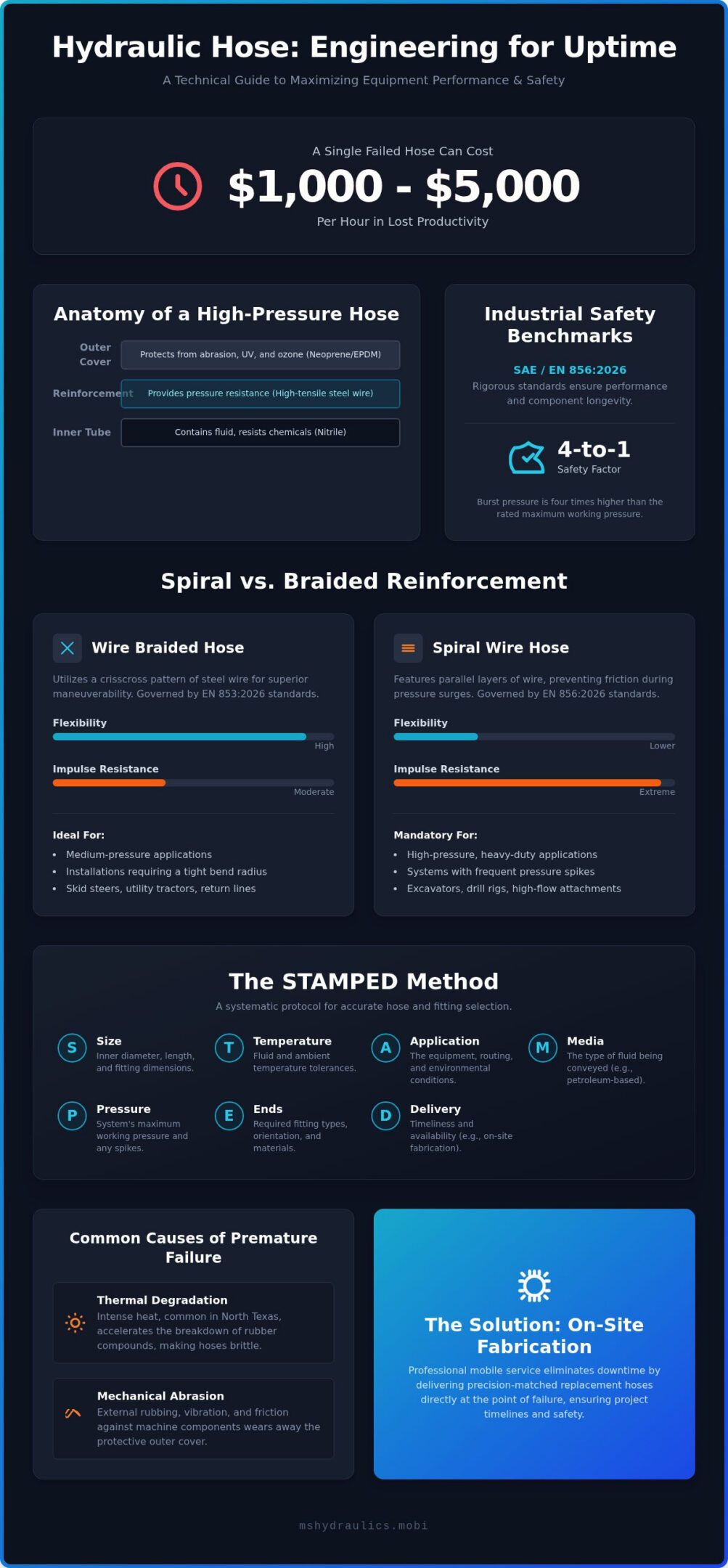
A single excavator sidelined by a failed hydraulic hose can cost a contractor between $1,000 and $5,000 per hour in lost productivity. For operators in North Texas, this financial impact is frequently compounded by intense heat, which accelerates the degradation of standard rubber compounds. Utilizing professional on-site hydraulic hose fabrication has become a critical strategy for maintaining rigorous project timelines and ensuring job site safety.
You likely recognize that understanding the complexities of SAE ratings and the updated EN 856:2026 standards is essential for long-term machine reliability. This engineering guide will enable you to master technical specifications and hose construction types to maximize equipment uptime. We’ll examine the root causes of premature bursts and provide a structured framework for selecting the correct pressure ratings and fittings. By the end of this analysis, you’ll understand how to apply the STAMPED method to ensure every replacement meets the highest industrial safety benchmarks.
Key Takeaways
- Understand the multi-layered architecture of hydraulic hoses and the significance of the 2026 EN standards for ensuring long-term system integrity.
- Differentiate between braided and spiral reinforcement to align hose flexibility and impulse resistance with the specific mechanical requirements of high-pressure machinery.
- Apply the STAMPED selection protocol to accurately identify critical parameters, including Dash System sizing and temperature tolerances for extreme climates.
- Learn how professional on-site hydraulic hose fabrication eliminates the significant financial impact of equipment downtime by providing precision-matched pattern hoses at the point of failure.
- Identify the primary external factors, such as mechanical abrasion and thermal degradation, that lead to premature hose failure to implement better preventative maintenance.
Understanding Hydraulic Hose Construction and Standards
A hydraulic hose functions as a multi-layered flexible pressure vessel. It is the primary conduit for fluid power transmission in modern industrial systems. Precision in material selection is non-negotiable. During on-site hydraulic hose fabrication, technicians must verify that the hose construction aligns with the specific chemical and mechanical demands of the machine. Failure to match the material to the medium often leads to internal liner swelling, premature tube erosion, or catastrophic seal failure. It’s essential to view the hose not as a commodity, but as a critical engineering component.
The Anatomy of a High-Pressure Hose
The inner tube serves as the primary barrier. It must maintain chemical stability when exposed to pressurized fluids. Nitrile is the industry standard for petroleum-based hydraulic fluids because of its high resistance to oil degradation. Surrounding this tube is the reinforcement layer. This component consists of high-tensile steel wire or textile braid. It dictates the maximum working pressure of the assembly. Finally, the outer cover protects the internal structure from external threats. Materials like Neoprene or EPDM are frequently utilized to resist UV radiation, ozone exposure, and the mechanical abrasion common on active job sites. High-quality cover materials ensure the reinforcement layer remains dry and free from corrosion, which is vital for maintaining the assembly’s structural integrity over long service cycles.
SAE Ratings and Industrial Certifications
The Society of Automotive Engineers established the SAE J517 standard to provide clear performance benchmarks. These ratings, ranging from SAE 100R1 to 100R15, allow for rapid field identification of hose capabilities. For instance, a 100R2 hose features two layers of steel wire braid, while a 100R15 hose utilizes multiple layers of spiral steel for extreme impulse applications. These standards rely on Hydraulic machinery principles to ensure that every assembly maintains a 4-to-1 safety factor. This ratio means the burst pressure is four times higher than the rated working pressure. In heavy industrial or underground environments, MSHA certification is also required. This verification ensures the outer cover is flame-resistant, preventing catastrophic fires if a line fails near an ignition source. Reliable on-site hydraulic hose fabrication depends on adhering to these rigorous engineering certifications to ensure operator safety and component longevity. Adherence to the latest 2026 EN standards further guarantees that replacements meet modern industrial performance requirements.
Spiral vs. Braided Reinforcement: Choosing for Performance
The reinforcement layer is the structural backbone of any hydraulic assembly. Selecting between braided and spiral construction is a critical engineering decision that directly impacts the “Impulse Life” of the hose. This term refers to the number of pressure cycles a hose can withstand before the reinforcement wire suffers from fatigue and eventual failure. During on-site hydraulic hose fabrication, technicians must evaluate whether the machine’s hydraulic circuit operates with steady pressure or is subject to high-frequency surges. Failure to account for these impulses often leads to internal wire breakage long before the hose reaches its theoretical service life.
When to Use Wire Braided Hoses
Wire braided hoses, such as those meeting the EN 853:2026 standard (Types 1SN and 2SN), are the preferred choice for applications requiring high flexibility. These hoses utilize a crisscross pattern of high-tensile steel wire. This construction allows for a tighter bend radius, which is essential for routing within the compact engine compartments of skid steers and utility tractors. While they offer superior maneuverability, braided hoses are generally restricted to medium-pressure applications. A typical 2-wire braided hose might handle up to 5,000 PSI depending on the diameter, but its impulse resistance is lower than spiral alternatives. They are ideal for return lines and auxiliary circuits where space is limited but pressure spikes are predictable.
The Strength of Spiral Wire Reinforcement
For heavy-duty applications involving excavators, drill rigs, and high-flow attachments, spiral reinforcement is mandatory. Unlike the braided design, spiral hoses (governed by EN 856:2026) feature layers of wire wrapped in parallel around the tube. This configuration, often found in 4-wire and 6-wire variants, prevents the wires from crossing and rubbing against one another during pressure surges. This design significantly reduces wire fatigue and allows the assembly to manage extreme impulse loads without structural degradation. Integrating high-performance spiral hoses into your Heavy Equipment Maintenance protocols ensures that your machinery can handle the rigorous demands of Texas job sites.
Spiral hoses are heavier and less flexible than braided types, but their ability to withstand constant pressure hammering makes them indispensable for primary drive systems. When mechanical failure occurs in the field, mobile technicians provide precision on-site diagnostic services to determine if a spiral upgrade is necessary to prevent repeat bursts. Matching the reinforcement style to the machine’s duty cycle is the most effective way to eliminate unplanned downtime and extend the service life of your hydraulic components.
The STAMPED Method for Accurate Hose Selection
Successful on-site hydraulic hose fabrication requires a methodical approach to component identification. The STAMPED protocol serves as the definitive engineering framework for this process. This acronym stands for Size, Temperature, Application, Media, Pressure, Ends, and Delivery. It eliminates the guesswork that frequently leads to premature failures and safety hazards on industrial job sites. By following this structured sequence, technicians ensure that every replacement assembly meets or exceeds the original equipment manufacturer’s specifications.
The Dash System is the standard method for identifying hydraulic hose diameters, where the size is expressed in 1/16th inch increments of the inside diameter. Beyond sizing, temperature considerations are paramount. Technicians must account for two distinct thermal variables. The internal fluid temperature must remain within the hose’s rated operating range to prevent the inner tube from hardening and cracking. Simultaneously, the ambient Texas heat can accelerate the degradation of the outer cover, necessitating materials with high thermal resistance. Application analysis involves evaluating the mechanical environment, including abrasion risks and minimum bend radii. Material selection ensures the hose liner is chemically compatible with the specific hydraulic fluid, while pressure ratings must align with the system’s maximum relief settings.
Ends and Delivery: Fittings and Logistics
Proper fitting identification is critical for preventing high-pressure leak paths in heavy machinery. Common thread types encountered during field service include JIC, ORB, NPT, and Flat Face (ORFS) fittings. High-vibration equipment requires precise torque and exact fitting compatibility to maintain system integrity. For non-standard lengths or specialized configurations, custom hydraulic hose fabrication ensures the replacement matches the original routing requirements exactly. This precision prevents the hose from rubbing against sharp chassis edges or other moving components.
Calculating System Pressure and Surge
A hose’s rated working pressure must always meet or exceed the maximum relief valve setting of the hydraulic system. Selecting a hose based on “average” operating pressure is a common engineering error that leads to catastrophic failure in high-impulse systems. Pressure surges occur during valve actuation or sudden load shifts. These spikes can momentarily exceed nominal ratings by significant margins. Professional mobile hydraulic repair services utilize on-site diagnostic tools to verify these peak pressures. This data ensures the new assembly is engineered for the machine’s actual duty cycle rather than its theoretical average. Adhering to these rigorous standards is the only way to guarantee job site safety and machine uptime.
Common Causes of Hydraulic Hose Failure
External abrasion remains the most frequent catalyst for hose failure on mobile job sites. Constant vibration and mechanical movement cause the outer cover to rub against sharp metal edges or adjacent lines. This friction eventually compromises the reinforcement layer. When on-site hydraulic hose fabrication is performed, technicians must evaluate these high-wear areas to determine if additional protection is required. Fluid incompatibility also presents a significant risk. If the inner liner is not matched to the specific chemical properties of the fluid, it may swell or pit. This degradation leads to restricted flow or internal blockages that compromise system efficiency.
Improper assembly remains a hidden danger in field repairs. Utilizing a crimp die that does not match the specific hose and fitting combination results in an insecure attachment or a crushed inner tube. Mismatched fittings create high-pressure leak paths that compromise the entire hydraulic circuit. Precision tooling and calibrated equipment are the only ways to verify that crimp diameters meet the manufacturer’s exact tolerances. High-quality on-site hydraulic hose fabrication relies on these technical verifications to ensure the assembly can withstand its rated working pressure.
Environmental Impact: UV and Ozone Damage
Identify surface cracking, known as crazing, as a primary indicator of UV and ozone damage. The intense solar radiation and high ambient temperatures characteristic of DFW summers accelerate the oxidation of rubber compounds. This process makes the hose brittle and prone to failure under pressure. Utilizing nylon sleeves or plastic spiral guards on exposed lines provides a necessary barrier against environmental degradation. These protective measures are essential for maintaining the integrity of the assembly throughout its intended life cycle, especially in the harsh North Texas climate.
Mechanical Failures and Routing Errors
Adhering to the “Minimum Bend Radius” rule is critical for preventing internal reinforcement fatigue. Forcing a hose into a tighter curve than specified causes the wire layers to stress and eventually snap. Similarly, torsion or twisting during installation creates internal shear forces that lead to premature bursts. These routing errors are often subtle but catastrophic. Professional On-Site Diagnostic Services are necessary to identify these root causes before replacing a failed line. Without a proper diagnosis, a new hose will likely fail in the same manner. If you are experiencing repeated hose bursts, request a technical diagnostic evaluation to secure your equipment’s reliability.
Mobile Fabrication: The Solution to Equipment Downtime
Professional on-site hydraulic hose fabrication provides an immediate solution to the logistical bottleneck of component procurement. While e-commerce platforms may offer competitive unit pricing, they cannot mitigate the operational loss incurred during 48-hour shipping windows. A standard on-site replacement typically concludes within 30 to 90 minutes. This efficiency ensures that the machine returns to service during the same shift. Technicians utilize the failed component as a “pattern hose” to ensure the new assembly matches the exact length and fitting orientation. This precision eliminates the risk of incorrect routing, which remains a primary cause of premature wear in high-vibration systems.
Mobile services also prioritize environmental containment and system cleanliness. Technicians capture residual fluids and clean the system interfaces before installing new assemblies to prevent contamination. This level of field service integrates seamlessly with complex restoration projects, such as Heavy Equipment Cylinder Rebuilds. By addressing both the hose and the cylinder simultaneously, operators achieve a full restoration of hydraulic system integrity without the need to move the machine to a fixed facility. This holistic approach ensures that all interconnected components meet the same rigorous performance standards.
The Economic Impact of Reduced Downtime
The financial consequences of equipment failure are severe. An idle excavator can cost a contractor between $1,000 and $5,000 per hour in lost productivity. When compared to the investment in mobile repair, the return on investment is immediate. On-site service eliminates the logistical burden and significant expense of transporting heavy machinery to a brick-and-mortar shop. Additionally, professional field service includes on-site pressure testing. This verification ensures the assembly is secure before the operator resumes high-pressure tasks. It’s a critical safety protocol that prevents secondary failures and protects site personnel from the risks associated with hose bursts.
Expert Fabrication in Cleburne and DFW
Ms. Hydraulics LLC delivers integrity-based field service tailored to the specific needs of the construction and agricultural sectors. We maintain an extensive inventory of specialized fittings to support diverse industrial machinery across Johnson County and the broader DFW area. This technical readiness allows our teams to resolve complex hydraulic issues in Cleburne, Alvarado, Arlington, and Mansfield with minimal delay. Our commitment to engineering excellence ensures that every repair meets the rigorous standards required for long-term reliability. Request on-site hydraulic hose fabrication to restore your machinery today.
Securing Machine Integrity and Site Safety
Mastering the engineering parameters of hydraulic hose selection is the most effective way to eliminate unplanned downtime. By applying the STAMPED method and selecting reinforcement types based on impulse life, you ensure your machinery operates within its design limits. Recognizing the specific impact of the North Texas climate on rubber degradation allows for proactive maintenance that prevents catastrophic field failures. It’s critical to treat every hose as a precision-engineered safety component rather than a simple commodity.
This principle of precision maintenance extends to other critical infrastructure as well. For those requiring a professional plumber Eagle County CO, Davis Plumbing offers expert repair and maintenance services to ensure property systems remain as reliable as industrial machinery.
Professional on-site hydraulic hose fabrication provides the technical precision required to match pattern hoses exactly. This process ensures system integrity is restored without the delays of traditional procurement. Ms. Hydraulics LLC offers expert on-site diagnostics and repair for heavy equipment throughout Cleburne, Dallas, and Fort Worth. Our technical expertise in high-pressure hydraulic systems ensures that every replacement assembly meets rigorous industrial standards. Don’t let a minor component failure compromise your project’s critical path.
Get On-Site Hydraulic Hose Fabrication Now to secure your equipment’s performance and ensure your fleet remains productive on the job site.
Frequently Asked Questions
What is the difference between working pressure and burst pressure?
Working pressure is the maximum pressure a hose is designed to withstand during normal operation, while burst pressure is the point of total structural failure. Industry standards like SAE J517 typically require a 4-to-1 safety factor for hydraulic assemblies. This ratio ensures that the burst pressure is four times higher than the rated working pressure to accommodate unexpected pressure surges or impulse spikes within the system.
How long does a typical hydraulic hose last in the Texas climate?
A hydraulic hose typically maintains a service life of three to five years, though the North Texas climate often accelerates this timeline. Intense UV radiation and high ambient temperatures cause rubber compounds to lose elasticity and develop surface crazing. Regular inspections are necessary to identify this thermal degradation before it leads to a catastrophic burst on an active job site.
Can I reuse hydraulic hose fittings on a new custom hose?
Reusing permanent crimp fittings on a new hose is not recommended because it compromises the assembly’s structural integrity. During the initial fabrication, the metal shell is permanently deformed to grip the hose reinforcement. Attempting to re-crimp these components leads to an insecure connection. This increases the risk of a fitting blow-off under pressure, which presents a severe safety hazard to operators.
What is the dash system for measuring hydraulic hoses?
The dash system is an industry-standard nomenclature where the hose’s inside diameter is expressed in sixteenths of an inch. For example, a -08 hose has an inside diameter of 8/16″, which equals 1/2 inch. This system allows for rapid and accurate component identification during on-site hydraulic hose fabrication, ensuring the replacement assembly matches the flow requirements of the machinery.
How do I know if my hydraulic hose is about to fail?
Visual indicators of impending failure include exposed wire reinforcement, localized bubbling on the outer cover, or oil weeping at the fitting interface. You should also monitor for “stiffening” of the hose, which indicates advanced heat aging. If the hose no longer exhibits its original flexibility during operation, the internal liner has likely become brittle and is highly prone to internal cracking.
Why is my new hydraulic hose leaking at the fitting?
Leaks at new fittings are typically the result of incorrect torque, mismatched thread types, or damaged O-rings at the connection point. If the leak persists after verifying the connection, the issue may stem from an improper crimp diameter that failed to create a sufficient seal. Professional diagnostics help identify if the assembly was fabricated to the manufacturer’s exact crimp specifications for that specific hose type.
Do you offer emergency on-site hydraulic hose fabrication in Cleburne?
We provide mobile hydraulic repair services throughout Cleburne and the broader DFW area to resolve urgent equipment failures. Our technicians arrive with the specialized tooling and inventory required to perform on-site hydraulic hose fabrication directly at your location. This mobile capability is designed to eliminate the logistical delays associated with transporting heavy machinery to a fixed repair facility.
What information do I need to provide for a custom hose assembly?
You should provide the STAMPED parameters: Size, Temperature, Application, Media, Pressure, Ends, and Delivery. Providing the failed “pattern hose” is the most effective way for technicians to verify these details. This allows us to match the exact length, pressure rating, and fitting orientation required to restore the machine to its original operating specifications.