Bulldozer Hydraulic Repair in North Texas: Expert Mobile Service & Cylinder Rebuilds
Hauling a downed bulldozer to a repair shop isn’t just inconvenient, it’s one of the most expensive decisions a North Texas contractor can make. Between the heavy-haul permits, transport logistics, and the days your machine sits idle on someone else’s lot, the cost of moving the equipment often rivals the cost of fixing it. If you’ve ever faced a blown cylinder or a failing hydraulic system on a job site in the Dallas-Fort Worth area, you already know this reality firsthand.
The good news is that bulldozer hydraulic repair in Texas doesn’t have to start with a phone call to a flatbed company. Mobile on-site service has changed the equation entirely for construction operators across North Texas, and the difference in downtime is significant. Ms. Hydraulics LLC brings diagnostic capability, hose fabrication, and cylinder rebuild expertise directly to your machine, wherever it sits.
This article walks through how to identify the most common bulldozer hydraulic failures, explains what a proper field diagnosis involves, and outlines why mobile repair is the most cost-effective path to getting your equipment back under load without the logistics overhead of a traditional shop visit.
Key Takeaways
- Bulldozer hydraulic systems operate under extreme pressure across multiple components, and understanding which element is failing is the critical first step before any repair decision is made.
- On-site diagnostics eliminate the guesswork that drives unnecessary parts replacement, because real-world load testing can only be performed with the machine under actual operating conditions.
- Professional bulldozer hydraulic repair in Texas through a mobile service provider removes the hidden costs of heavy-haul transport, permits, and idle time that compound rapidly when a dozer leaves the job site.
- Cylinder rebuilds are frequently the more engineered and cost-effective solution compared to full replacement, provided the work meets the high-cycle performance standards that bulldozer applications demand.
- Contractors across the Dallas-Fort Worth area, including Mansfield, Burleson, and Arlington, have access to field-ready mobile hydraulic service that prioritizes getting equipment back under load with minimal operational disruption.
Understanding Bulldozer Hydraulic Systems and Common Failure Points
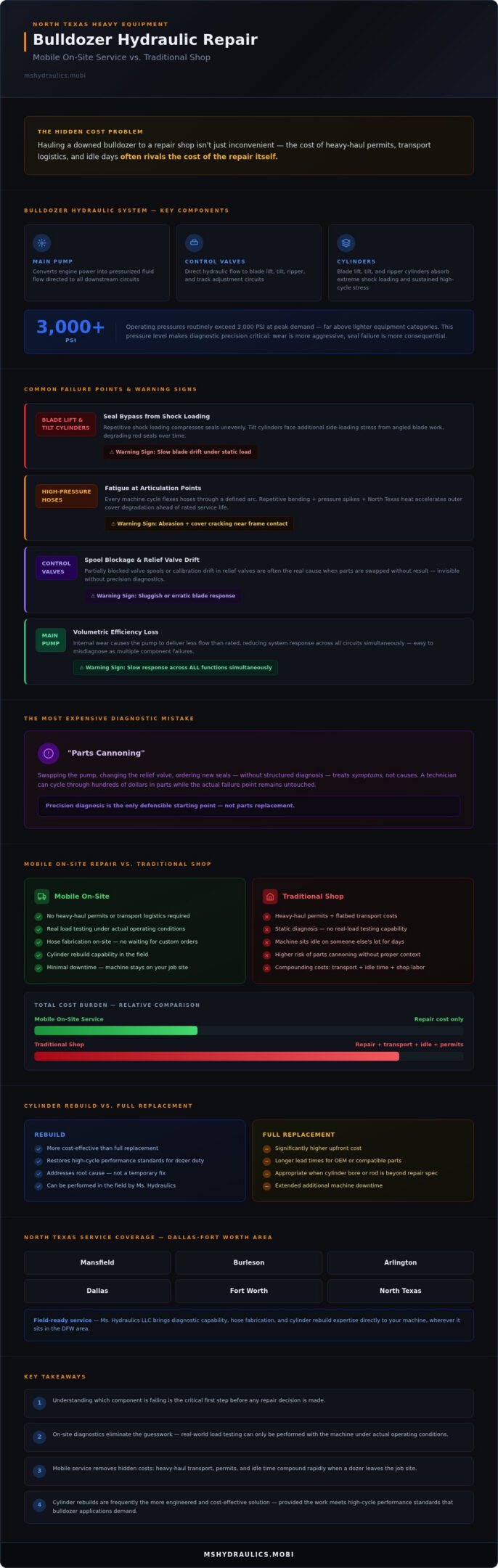
Bulldozer hydraulic systems aren’t simply scaled-up versions of what you’d find on a skid steer or agricultural tractor. They’re purpose-engineered, high-pressure circuits designed to generate and sustain extreme mechanical force across multiple simultaneous functions. At the core of any modern dozer is a main hydraulic pump that converts mechanical energy from the engine into pressurized fluid flow, directing that force to the blade lift cylinders, tilt cylinders, ripper circuits, and track adjustment systems. Understanding the architecture of these hydraulic machinery systems is the prerequisite to accurate diagnosis, and it’s the foundation of effective bulldozer hydraulic repair in Texas.
Operating pressures in bulldozer systems routinely exceed 3,000 PSI at peak demand, with some modern machines pushing relief valve thresholds considerably higher during combined load operations. That pressure differential separates bulldozer hydraulics from lighter equipment categories and directly explains why component wear is more aggressive, seal failure is more consequential, and diagnostic precision matters more.
Modern dozers typically use open-loop hydraulic circuits for blade and ripper functions. In an open-loop configuration, fluid travels from the reservoir through the pump, out to the actuating cylinders or motors, and returns to the tank rather than cycling back to the pump inlet directly. This architecture keeps heat more manageable under sustained load but places the pump, control valves, and return filtration under continuous demand during active grading cycles.
Blade Lift and Tilt Cylinder Stress Factors
The lift and tilt cylinders on a bulldozer absorb punishment that most hydraulic cylinders never encounter. Repetitive shock loading during grading operations compresses seals unevenly, accelerating bypass before any visible external leakage appears. Tilt cylinders are particularly vulnerable to side-loading, where lateral forces during angled blade work create rod misalignment that degrades the rod seal and wiper assembly over time. Early bypass in a lift cylinder typically presents as slow blade drift under static load, a symptom that’s easy to dismiss but signals measurable internal seal wear that will worsen under continued operation.
The Vulnerability of High-Pressure Hoses
Articulation points on a bulldozer are the highest-risk zones for hose failure. Every machine cycle flexes these hoses through a defined arc, and the combination of repetitive bending, hydraulic pressure spikes, and the intense heat generated by North Texas job site conditions accelerates outer cover degradation well ahead of the hose’s rated service life. Abrasion from contact with the machine frame compounds the problem, particularly where routing tolerances are tight. In the context of 2026 bulldozer duty cycles, hydraulic hose fatigue refers to the progressive structural breakdown of reinforcement layers caused by cumulative cyclic pressure loading, ultimately reducing burst resistance below safe operating thresholds.
Recognizing these failure patterns early is what separates a field repair from a full system failure. Contractors pursuing bulldozer hydraulic repair in Texas benefit most from a diagnostic approach that evaluates each of these stress points under actual operating conditions, not in a static shop environment.
The Critical Role of On-Site Diagnostics for Heavy Equipment
When a bulldozer goes down, the instinct is to start replacing parts. Swap the pump. Change the relief valve. Order new seals. This approach, sometimes called “parts cannoning,” is one of the most expensive habits in heavy equipment maintenance because it treats symptoms rather than causes. Without a structured diagnostic process, a technician can cycle through hundreds of dollars in components while the actual failure point, a partially blocked valve spool or a calibration drift in the relief valve, remains untouched. Precision diagnosis isn’t optional; it’s the only defensible starting point for any credible bulldozer hydraulic repair in Texas.
The deeper problem with shop-based diagnosis is the absence of real operating conditions. A cylinder that holds pressure on a static test bench may bypass immediately under the combined lateral and compressive loading of an active grading pass. Pump performance that reads acceptable at idle may fall below OEM flow specifications the moment the system reaches thermal equilibrium under full duty cycle demand. These failure modes are invisible in a controlled shop environment. They only reveal themselves when the machine is working, which is precisely why on-site diagnostic services for heavy equipment produce fundamentally more accurate findings than any off-site alternative.
Pressure Testing and Flow Analysis
A trained technician approaching a hydraulic fault starts with quantitative measurement, not assumption. Digital flow meters connected inline at the pump outlet establish whether the unit is meeting its rated output in gallons per minute under load. If flow is within OEM specification but pressure is erratic, attention shifts to the relief valve, which controls the maximum system pressure threshold. An improperly set or worn relief valve allows the system to over-pressurize during peak demand cycles, accelerating seal degradation across every downstream component simultaneously.
Isolating a leaking valve bank follows a systematic circuit-by-circuit process:
- Baseline system pressure is recorded with all functions at neutral to establish a reference point.
- Each circuit is actuated individually while pressure and flow readings are logged, identifying which function produces anomalous readings.
- The suspect valve section is isolated using gauge ports or inline testers to confirm whether the pressure drop originates at the valve spool, the cylinder, or the connecting hose assembly.
- Load-hold tests are performed under actual blade or ripper weight to detect internal bypass that static testing cannot replicate.
This structured methodology is what separates qualified heavy equipment service technicians from generalist mechanics. The diagnostic sequence produces a documented fault location, not a probability, before any repair work begins.
Identifying Contamination in Hydraulic Fluid
Fluid analysis functions as a blood test for the entire hydraulic circuit. A sample drawn from the reservoir and evaluated for particulate content, viscosity, and water presence tells a technician what’s happening inside components that can’t be visually inspected without disassembly. The presence of ferrous metal shavings in the fluid indicates active wear in either the pump or a hydraulic motor, and the concentration of those particles indicates how far that wear has progressed. Catching this early converts what would become a catastrophic pump seizure into a scheduled component service.
Water contamination deserves specific attention in North Texas operating environments. Humidity, temperature cycling, and condensation inside improperly sealed reservoirs introduce water into hydraulic fluid, which reduces lubricity, promotes internal corrosion, and can cause cavitation damage in pump components during startup. Fluid that appears milky or shows a lower-than-specified viscosity reading is a reliable indicator of water ingress, and it warrants immediate system flushing before any other repair work proceeds.
Contractors who want a diagnostic process that matches the precision of their equipment should connect with a mobile service provider built around field measurement. Ms. Hydraulics LLC’s mobile diagnostic capability brings the instrumentation and methodology described here directly to your job site, so your machine is evaluated under the exact conditions that exposed the fault in the first place.
Mobile Repair vs. Shop Repair: Cost-Benefit Analysis
The decision to haul a bulldozer to a repair facility looks straightforward until you start adding up every cost that doesn’t appear on the repair invoice. Transport logistics for a D6 or D8 class machine require a permitted heavy-haul carrier, a lowboy trailer rated for the machine’s operating weight, and in many cases a pilot vehicle depending on the route and load width. In North Texas, those transport arrangements represent a real expenditure before a single wrench turns on the actual hydraulic fault. Then the machine sits in a shop queue, and the job site it left behind loses a productive asset for however long that queue runs.
Mobile service eliminates that entire cost category. When a technician drives to the machine rather than the machine driving to the technician, the heavy-haul permit requirement disappears, the loading and unloading time disappears, and the queue disappears. The repair begins when the service unit arrives, not when a shop scheduler finds an available bay. For contractors managing tight project timelines across the Dallas-Fort Worth corridor, that difference in response structure is the difference between a half-day interruption and a multi-day operational gap.
Eliminating Hauling Costs and Logistics
Loading a dozer for transport isn’t a quick process. Securing the machine, coordinating the carrier, obtaining the appropriate oversize load permits for Texas highways, and physically transporting the unit to a facility each consume time that doesn’t count toward the repair itself. Once the machine arrives, unloading and staging add more hours before diagnosis even begins. Mobile bulldozer hydraulic repair in Texas removes every one of those steps from the equation, keeping the machine on the job site and available for re-entry into service the moment the repair is complete.
For contractors in the Cleburne and South Fort Worth area, expert mobile hydraulic repair in Cleburne represents a structurally faster path to getting equipment back under load, precisely because the service comes to the fault location rather than requiring the fault location to come to the service.
On-Site Hose Fabrication
Custom hose fabrication performed at the machine’s location produces a more precise result than any hose built from a written description or a technician’s memory of the routing. Fitting selection, hose length, and bend geometry are confirmed against the actual installation point, eliminating the routing errors that occur when a shop builds a hose based on estimated measurements. Field-fabricated hoses reduce secondary failure risks by ensuring that pressure ratings, end configurations, and routing clearances are validated against the specific machine before the hose ever sees system pressure.
That level of precision matters in bulldozer hydraulic repair in Texas because a misrouted or incorrectly specified hose doesn’t just fail early; it can abrade adjacent components or create pressure drop conditions that mask the original fault entirely.
Bulldozer Cylinder Rebuilds and Component Restoration
Replacing a bulldozer cylinder outright sounds like the definitive solution, but it’s rarely the most defensible one from an engineering or cost standpoint. A quality rebuild performed to OEM dimensional tolerances restores the cylinder to its original mechanical specification, and in many cases extends service life beyond what a replacement unit from secondary supply channels would deliver. The decision between rebuild and replacement hinges on the condition of three components: the barrel bore, the rod surface, and the end cap threads. When all three are within recoverable tolerances, a rebuild is the engineered answer. When the barrel is scored beyond the threshold for honing or the rod has suffered structural pitting, replacement becomes the correct call. Anything short of that systematic evaluation is guesswork, not engineering.
For contractors pursuing bulldozer hydraulic repair in Texas, the rebuild decision also carries a practical advantage: lead times. Sourcing an OEM replacement cylinder for a D6 or D8 class machine through a dealer supply chain can extend downtime considerably. A field-capable rebuild, executed with precision and the correct seal specification, gets the machine back under load on a timeline that replacement logistics rarely match.
The full technical framework for this process is documented in the heavy equipment cylinder rebuild engineering guide, which covers restoration standards across multiple equipment categories.
Disassembly and Inspection Standards
Every rebuild begins with a dimensional audit, not a visual scan. Barrel bore diameter is measured at multiple points along its length using calibrated bore gauges to identify taper, out-of-round conditions, or localized scoring from contaminated fluid. Rod diameter is measured against OEM specifications to confirm that surface wear hasn’t reduced the cross-section below the minimum threshold for safe pressure loading. Chrome peel deserves specific attention in North Texas operating environments. The combination of fine silica soil, abrasive caliche, and the thermal cycling that comes with extreme summer temperatures accelerates chrome layer delamination on rods that operate partially extended for extended periods. A rod with peeled chrome doesn’t just fail its own seal; it destroys the replacement seal within hours of return to service. Identifying this condition before resealing is non-negotiable.
Precision Machining and Resealing Protocols
Seal selection for bulldozer cylinders operating in North Texas requires more than matching the OEM part number. Ambient temperatures on a Dallas-Fort Worth job site during peak summer months place sustained thermal demand on elastomeric seals that standard Buna-N compounds aren’t engineered to sustain. High-temperature Viton seals maintain their dimensional stability and compression set resistance under conditions that degrade conventional seal materials, making them the appropriate specification for Texas operating environments rather than an upgrade.
Rod polishing to a controlled surface finish, typically measured in microinches of Ra (roughness average), is the step that determines seal longevity after the rebuild. A rod returned to service with surface irregularities outside the OEM finish specification will abrade the new seal from the first cycle. Final pressure testing at or above the circuit’s operating relief setting, with all ports capped and load held for a defined duration, confirms zero-leak performance before the cylinder is returned to the machine.
Contractors across the Dallas-Fort Worth area can connect with Ms. Hydraulics LLC to evaluate whether a cylinder rebuild is the right path for their specific equipment condition.
Partnering with Ms. Hydraulics for North Texas Bulldozer Services
Every service decision at Ms. Hydraulics LLC starts from the same position: the client’s equipment needs to be back under load as quickly as accurate repair allows. That commitment shapes how the mobile fleet is equipped, how technicians approach diagnosis, and how repair scope is determined. There’s no incentive to replace components that can be restored, and no incentive to delay a return-to-service when the work is complete. For contractors managing active job sites, that operational integrity is the foundation of a long-term service relationship.
The mobile service units are configured specifically for heavy equipment hydraulic work, carrying field instrumentation for pressure and flow measurement, hose fabrication tooling with a range of fitting configurations, cylinder rebuild capability, and the seal inventory appropriate for the thermal demands of North Texas operating environments. Contractors pursuing bulldozer hydraulic repair in Texas through Ms. Hydraulics aren’t waiting for parts to arrive from a shop’s supplier; the service unit arrives prepared to address the most common failure categories on-site. For a broader view of how this capability integrates with ongoing equipment care, the heavy equipment maintenance technical guide for North Texas outlines the full scope of preventative and corrective service available in this region.
Our Service Area: Cleburne to Arlington and Beyond
Ms. Hydraulics operates across Johnson County and the wider DFW corridor, with regular coverage extending to Alvarado, Granbury, Crowley, and Mansfield. The company’s local presence in Johnson County means response times to construction sites in that zone are structurally shorter than what a Dallas-based shop dispatching outward can offer. Arlington, Burleson, and the southern Fort Worth metro fall within the standard service footprint, giving contractors across the region access to field-ready hydraulic expertise without the logistics overhead of coordinating transport for a downed machine.
Schedule Your Preventative Maintenance or Emergency Repair
Contacting Ms. Hydraulics to arrange an on-site diagnostic is the direct path to a documented fault assessment rather than a parts estimate built on assumptions. Technicians arrive with the instrumentation to measure, not guess, and the repair scope is defined by what the data shows.
Custom maintenance plans are available for contractors who want to move from reactive repair to scheduled inspection intervals. Identifying seal wear, fluid contamination, or hose fatigue before failure occurs is a fundamentally lower-cost operating posture than managing unplanned downtime on an active project. Bulldozer hydraulic repair in Texas doesn’t have to start with a breakdown; it can start with a scheduled visit that keeps the machine from going down in the first place.
To schedule a diagnostic or discuss a maintenance plan for your equipment, contact Ms. Hydraulics LLC directly. Your machine stays on the job site. The expertise comes to you.
Optimizing Bulldozer Availability through Field-Ready Engineering
Managing heavy equipment in the North Texas construction sector requires a shift from reactive shop visits to precision field service. On-site diagnostics eliminate the financial burden of heavy-haul transport while ensuring that repairs are validated under actual operating loads. Whether you’re dealing with seal degradation in high-cycle cylinders or abrasive wear on hydraulic hoses, the most efficient path to restoration is a technical response that meets your machine where it works.
Ms. Hydraulics LLC maintains a specialized mobile hydraulic repair fleet equipped for complex bulldozer hydraulic repair in Texas. By prioritizing expert cylinder rebuilds and precise on-site fabrication, we help contractors in Cleburne, Dallas, and Fort Worth minimize operational gaps and maintain project momentum. Reliable performance doesn’t happen by chance; it’s the result of rigorous technical standards and a localized service presence that understands the specific demands of the DFW metroplex.
Get Expert Mobile Bulldozer Repair Now and return your equipment to service with confidence.
Frequently Asked Questions
How much does it cost to repair a bulldozer hydraulic cylinder in Texas?
Repair costs vary based on the cylinder’s bore size, rod condition, and the specific seal kit required for the machine’s duty cycle. A technical evaluation determines if the barrel requires honing or if the rod needs polishing to meet OEM surface finish standards. Factors like on-site labor versus shop transport also influence the total expenditure for bulldozer hydraulic repair Texas contractors face when maintaining their fleets.
Can a bulldozer hydraulic hose be repaired on-site?
Yes, bulldozer hydraulic hoses are typically fabricated and replaced on-site using mobile service units equipped with field-ready crimping technology. Technicians measure the existing hose, select the appropriate reinforcement grade and fitting configuration, and install the new assembly immediately. This process eliminates the need to transport the machine and ensures a precise fit that matches the original routing requirements of the bulldozer’s articulation points.
What are the signs of a failing hydraulic pump on a bulldozer?
Progressive loss of cycle speed and unusual aeration noises in the hydraulic circuit are the most common indicators of pump degradation. If the blade or ripper functions feel sluggish even at high engine RPM, or if you notice increased fluid temperatures without an external cause, the pump may be experiencing internal bypass. A digital flow test under load is the only definitive way to confirm if the pump meets its rated output.
How long does a typical bulldozer cylinder rebuild take?
A standard cylinder rebuild often takes between four to eight hours of active labor once the unit is disassembled and inspected. The timeline depends heavily on the condition of the rod and barrel surfaces. If the components meet dimensional tolerances and only require a reseal and polish, the machine can often return to service within the same business day. Significant scoring or pitting will extend the restoration process.
Is it better to rebuild or replace a leaking hydraulic cylinder?
Rebuilding is generally the preferred engineering solution if the cylinder barrel and rod are within original manufacturer tolerances. A rebuild restores the unit using high-specification seals that often exceed the durability of low-cost aftermarket replacements. Replacement is only necessary when the structural integrity of the barrel is compromised or when rod damage is too deep to be corrected through standard polishing or machining processes.
Does Ms. Hydraulics offer 24/7 emergency mobile repair for dozers?
Ms. Hydraulics LLC focuses on rapid response field service for construction sites across the North Texas region. While standard service hours apply, our mobile fleet is configured to prioritize urgent bulldozer hydraulic repair Texas operators need to minimize downtime during active project phases. It’s best to contact our technicians directly to confirm current availability for emergency on-site diagnostics and field repairs in your specific area.
What causes hydraulic fluid to overheat in North Texas summers?
Excessive fluid temperatures in North Texas are often caused by a combination of high ambient heat and internal system inefficiencies like pump bypass or restricted oil coolers. When hydraulic fluid bypasses worn seals or valves, it generates friction that raises the oil temperature above safe operating limits. Clogged cooling fins, often exacerbated by the fine dust common on local job sites, further reduce the system’s ability to dissipate this heat.
How often should I perform hydraulic fluid analysis on my bulldozer fleet?
Performing fluid analysis every 500 operating hours is a standard preventative maintenance benchmark for heavy equipment fleets. This interval allows technicians to detect early signs of component wear, such as metallic particulate or water ingress, before they lead to catastrophic system failure. Regular sampling is especially critical in abrasive environments where dust and high thermal cycles can degrade fluid properties faster than manufacturer baseline recommendations suggest.