Price to Reseal Hydraulic Cylinder: 2026 Cost Guide and Factors
Could a minor hydraulic leak be the precursor to a catastrophic system failure that exceeds your entire quarterly maintenance budget? For fleet managers and heavy equipment operators, the uncertainty surrounding the price to reseal hydraulic cylinder components often leads to delayed repairs and compounded mechanical damage. It’s understandable to feel concerned about variable labor rates across the North Texas region and the potential for hidden internal scoring that can inflate a standard invoice. Ignoring a weeping seal doesn’t just risk environmental contamination; it risks the structural integrity of your high-pressure systems.
This guide provides an objective framework to help you evaluate repair requirements with engineering precision. You’ll gain a clear understanding of the technical variables that influence service costs, from bore diameter and seal kit complexity to the specific labor requirements for industrial-grade components. We’ll examine the decision matrix for resealing versus full component replacement and detail the verification processes necessary to achieve long-term reliability. By analyzing the current market factors in the DFW area, you can optimize your maintenance schedule and ensure your machinery returns to the field without the threat of unexpected downtime.
Key Takeaways
- Understand the technical variables that determine the price to reseal hydraulic cylinder components, including bore diameter, stroke length, and internal design complexity.
- Identify the critical wear indicators and rod damage thresholds that differentiate a standard reseal from a more extensive mechanical rebuild.
- Compare the long-term ROI of professional cylinder restoration against OEM replacement costs to optimize your heavy equipment maintenance budget.
- Evaluate how specialized mobile repair services in North Texas reduce operational downtime by eliminating the logistics of equipment transportation.
- Recognize the importance of precision honing and pressure testing in ensuring post-repair reliability and hydraulic system longevity.
Understanding the Cost to Reseal a Hydraulic Cylinder
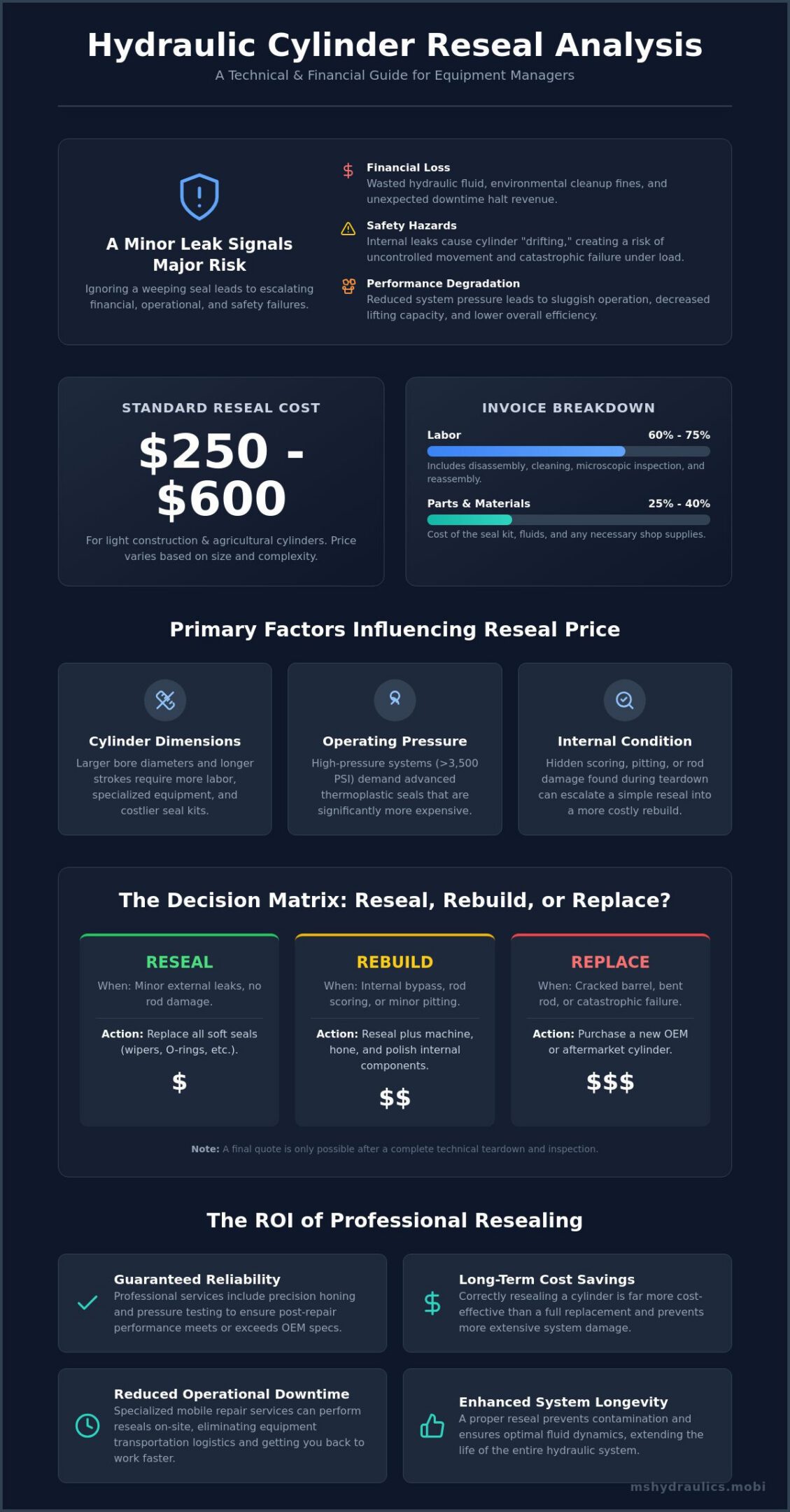
A hydraulic cylinder functions as a precision engineered component designed to convert fluid power into linear motion. Over time, the internal and external sealing elements degrade due to friction, thermal cycling, and particulate contamination. A cylinder reseal is the technical process of replacing these elastomeric and thermoplastic components to restore the unit’s ability to hold pressure. While a simple reseal focuses on soft components, it remains distinct from a comprehensive heavy equipment cylinder rebuild in Texas, which involves structural remediation of the metal rod or barrel. Industry data for standard agricultural or light construction cylinders indicates that the price to reseal hydraulic cylinder units often ranges between $250 and $600, depending on the unit’s complexity and size.
The integrity of a cylinder depends on a specific hierarchy of seals. A standard seal kit includes wipers to prevent external debris from entering the system, rod seals to contain high-pressure fluid during the stroke, and piston seals to prevent fluid from bypassing the piston internally. Wear bands and O-rings provide additional stability and static sealing. If any of these components fail, the system’s volumetric efficiency drops, leading to sluggish performance or complete mechanical failure.
The Economic Impact of a Leaking Cylinder
Fluid loss represents a significant operational expense that extends beyond the cost of replacement oil. In high-pressure systems, even a minor leak can waste dozens of gallons of hydraulic fluid over a single project cycle. On North Texas job sites, the environmental remediation costs for hydraulic spills can be substantial, often resulting in heavy fines from local regulatory authorities. Beyond financial loss, leaking seals create severe safety risks. Internal seal bypass leads to “drifting,” where a cylinder cannot maintain its position under load. In heavy lifting applications, this lack of control can cause catastrophic equipment failure or injury to ground personnel.
Basic Pricing Benchmarks for 2026
The total price to reseal hydraulic cylinder components is typically dictated by a ratio of labor hours to material costs. In a professional shop environment, labor usually accounts for 60% to 75% of the invoice. This reflects the time required for a controlled teardown, chemical degreasing, and a microscopic inspection of the bore and rod. Emergency or “rush” services, which prioritize a specific repair to minimize downtime, can add a surcharge of 15% to 40% to the standard base price. It’s vital to recognize that a final price cannot be confirmed until a technician performs a formal teardown. Internal scoring or pitting on the chrome rod, which is often invisible during an external inspection, can necessitate additional machining that moves the project from a simple reseal into a full rebuild category.
Factors Influencing Hydraulic Cylinder Resealing Prices
Calculating the price to reseal hydraulic cylinder components requires an analysis of specific mechanical parameters. The physical dimensions of the unit, particularly the bore diameter and stroke length, serve as the primary drivers of cost. Larger cylinders require higher-volume seal kits and increased labor hours for disassembly and reassembly. A high-tonnage cylinder found on a large excavator involves significantly more technical labor and specialized torque equipment than a standard 3-inch bore unit used in light agricultural applications. Furthermore, the operating pressure of the system dictates the grade of seal materials required. High-pressure systems operating above 3,500 PSI necessitate advanced thermoplastic materials or reinforced elastomers that can withstand extreme extrusion forces without failing.
The application environment also influences the final invoice. Construction equipment operating in abrasive North Texas soil requires heavy-duty wiper seals and secondary buffers to prevent contamination. In contrast, industrial manufacturing cylinders may prioritize thermal resistance or high-cycle longevity. Adhering to a protocol of Comprehensive Maintenance ensures that these material selections align with the specific stresses of the job site, preventing premature seal degradation.
Cylinder Design and Technical Complexity
Technical architecture significantly impacts the price to reseal hydraulic cylinder units. Single-acting cylinders, which utilize gravity or spring force for retraction, are the most cost-effective to service. Double-acting cylinders require a more complex internal sealing arrangement to manage pressure on both sides of the piston. Telescopic cylinders represent the highest level of complexity; they contain multiple stages that each require independent sealing and rigorous alignment. If a cylinder features integrated valve blocks or specialized internal cushioning, the labor premium increases due to the precision required during the teardown and testing phases. Custom or obsolete cylinders often require custom-machined seals when standard kits are no longer available from the manufacturer, adding both material cost and lead time to the project.
Mobile Service vs. Shop-Based Repair
For fleet managers in the Cleburne area, the logistical approach to repair is a critical cost factor. Utilizing on-site diagnostic services allows for immediate assessment without the expense of transporting heavy machinery. Mobile repair services involve travel fees and on-site labor rates, yet they often provide the lowest total cost of ownership by eliminating the downtime associated with equipment transport. While a shop environment offers maximum control for complex rebuilds, mobile service is highly efficient for standard resealing tasks on excavators, dozers, and drill rigs. If your equipment is immobilized on a job site, contacting a mobile hydraulic specialist is often the most direct path to restoring operational capacity.
The Cost-Benefit Analysis: Reseal, Rebuild, or Replace?
Deciding whether to proceed with a basic repair or a full replacement requires a rigorous technical assessment. While the initial price to reseal hydraulic cylinder units is lower than a full rebuild, structural damage to the rod or barrel often dictates a more extensive intervention. The “point of no return” occurs when the base metal of the cylinder rod is compromised through deep scoring or pitting. In these instances, installing new seals without addressing the underlying surface defects results in immediate seal failure and wasted labor. Professional rebuilds typically represent a 40% to 60% savings compared to the cost of a new OEM cylinder, making restoration a financially superior strategy for most heavy equipment operators.
Evaluating Rod and Barrel Integrity
The surface finish of the cylinder rod is measured in micro-inches. Any deviation from these specifications acts as a cutting edge against the new elastomeric seals. Pitting, often caused by chemical corrosion or impact damage, creates microscopic pockets that trap contaminants and tear seal lips during the stroke. While light surface oxidation can be addressed through precision polishing, deep gouges require full re-chroming. This process involves stripping the old chrome, grinding the rod to a uniform undersize, and electroplating it back to original manufacturer specifications. Similarly, the internal barrel must be inspected for scoring. Barrel honing can restore the cross-hatch pattern necessary for lubrication, but if the score marks exceed the technical limits of the wall thickness, the barrel requires replacement to maintain safety factors.
Long-Term ROI of Professional Rebuilds
A comprehensive ROI analysis considers the cost per hour of operation. A new OEM cylinder carries a high capital cost and, in the current market, often involves significant lead time delays that exacerbate machine downtime. Professional repair shops mitigate these issues by restoring units to original performance standards with faster turnaround times. Many reputable facilities provide warranties on their rebuild work, offering a level of verification that matches or exceeds new part guarantees. Implementing a rigorous program of heavy equipment maintenance is the most effective way to extend the intervals between these major repairs. By monitoring fluid cleanliness and addressing weeping seals early, operators can ensure the price to reseal hydraulic cylinder components remains a manageable maintenance expense rather than a catastrophic repair bill.
Estimating Labor and Parts for North Texas Equipment
The price to reseal hydraulic cylinder assemblies in the North Texas market depends heavily on the technical infrastructure of the repair facility. Professional restoration requires more than just a new seal kit; it demands specialized tooling such as high-capacity torque multipliers for gland nuts and precision honing equipment for the barrel. After the assembly is complete, a dedicated hydraulic test bench is necessary to verify the unit’s performance under full operating pressure. While some operators consider high-quality aftermarket seal kits to reduce material costs, OEM kits remain the standard for maintaining manufacturer warranties on newer machinery. The variance in kit pricing is often negligible compared to the cost of a secondary failure caused by inferior materials. For an engineering-grade assessment that ensures long-term reliability, utilizing mobile hydraulic repair services eliminates these technical risks.
Labor Benchmarks for Cleburne and DFW
In the Cleburne and DFW regions, labor rates for certified technicians typically align with industry standards, ranging from $75 to $150 per hour. For common equipment like skid steer loaders, a standard 2.5-inch or 3-inch bore cylinder reseal generally requires three to five hours of billable labor. This time includes a controlled teardown, chemical degreasing to remove oxidized fluid, and a microscopic inspection of the piston and gland. Technicians must verify that the internal components haven’t suffered from “dieseling” or thermal degradation, which can indicate broader system issues. Most professional facilities charge a diagnostic fee or “bench fee” to cover this initial technical assessment, which is often applied toward the total repair bill if the service proceeds.
The Hidden Costs of DIY Resealing
Attempting a DIY reseal in field conditions introduces significant risks that can lead to premature failure. Field environments lack the cleanliness required for high-pressure systems; even a single grain of North Texas dust can score a new seal or piston during the first cycle. Most owner-operators lack the specialty tools required for a professional result, such as seal expanders, resizing tools, or heavy-duty snap ring pliers. If a gland nut is tightened with an impact wrench rather than a torque multiplier, the threads can become stretched or galling can occur, leading to structural instability. Improper seal orientation or incorrect gland nut torque often results in immediate leaks, necessitating a “redo” that doubles the parts cost and extends machine downtime. When you calculate the total price to reseal hydraulic cylinder units yourself, you must account for the high probability of rework without professional-grade verification tools. Precision is the primary differentiator between a temporary fix and a permanent repair.
This commitment to precision is a hallmark of all professional mechanical trades; for instance, while this guide focuses on hydraulics, HVAC specialists like Air Services Mechanical apply similar rigorous standards to ensure the longevity of complex climate control systems in other regions.
Why Professional Resealing Saves Money for Cleburne Fleets
Professional restoration serves as a critical safeguard for the operational integrity of high-pressure hydraulic systems. While the initial price to reseal hydraulic cylinder units covers the labor and parts for a specific component, the value of professional service lies in its holistic diagnostic approach. A technician doesn’t simply replace elastomeric materials; they perform a comprehensive audit of the unit’s mechanical performance. This includes verifying the concentricity of the rod and the structural stability of the gland nut threads. Utilizing expert mobile hydraulic repair services in the Cleburne area further optimizes this process by eliminating the logistical complexities and transport costs associated with heavy equipment maintenance.
Pressure testing remains the definitive standard for verifying repair integrity. Before a cylinder is re-installed on an excavator or drill rig, it must be subjected to static and dynamic pressure tests that exceed its rated operating capacity. This verification process ensures that the new seal orientation is correct and that no internal bypass exists. Without this level of industrial-grade testing, operators risk immediate component failure upon re-introduction to the field, leading to secondary damage and doubled labor expenses. Professional shops provide the engineering expertise required to ensure that every repair meets or exceeds original equipment specifications.
Precision Diagnostics and Root Cause Analysis
Seal failure is frequently a secondary symptom of a deeper systemic issue. Professional technicians utilize precision diagnostics to identify root causes such as excessive fluid heat, particulate contamination, or side-loading from worn bushings. If a cylinder is subjected to side-loading, the internal wear bands will show uneven degradation, indicating that the mechanical alignment of the machine is compromised. Replacing seals without addressing these underlying factors ensures that the price to reseal hydraulic cylinder assemblies will become a recurring, unnecessary expense. By resolving the primary mechanical fault, technicians secure the long-term reliability of the component and the safety of the entire lifting or digging operation.
Minimizing Downtime on North Texas Job Sites
For fleets operating in the DFW corridor, the speed of local intervention is a primary driver of profitability. Shipping hydraulic components to out-of-state facilities or distant metropolitan hubs often adds days of unproductive downtime to a project timeline. Local mobile repair provides a strategic advantage, allowing for on-site teardowns and rapid component restoration. Having a dependable partner in Cleburne ensures that emergency failures are addressed with technical precision rather than stop-gap measures. If your machinery is currently showing signs of decreased cycle times or external leakage, requesting a technical consultation for your fleet can prevent a minor seal issue from escalating into a total system failure.
Just as heavy equipment requires specialized care to prevent system failures, your facility’s infrastructure also benefits from the attention of seasoned professionals; you can discover Garrett’s Plumbing for expert support with residential or commercial plumbing challenges in the region, backed by four generations of trade experience.
Optimizing Your Hydraulic Maintenance Strategy
Precision resealing is more than a simple parts replacement; it’s a technical verification of your system’s operational integrity. By addressing seal wear through professional diagnostics, you avoid the compounding costs of rod damage and environmental remediation. The price to reseal hydraulic cylinder components remains a cost-effective investment when performed by technicians who understand the specific mechanical stresses of North Texas job sites. Ms. Hydraulics provides on-site mobile diagnostics and specialized repair for a wide range of machinery, from standard excavators to complex drill rigs. Our focus remains on minimizing downtime through technical excellence and rigorous performance testing. To protect your equipment and ensure engineering-grade performance, Request a Professional Cylinder Repair Quote from Ms. Hydraulics today. Technical excellence is the most direct path to sustained operational stability.
Frequently Asked Questions
How much does it typically cost to reseal a hydraulic cylinder in 2026?
The total price to reseal hydraulic cylinder units is primarily determined by the physical dimensions of the cylinder and the complexity of its internal architecture. Industry benchmarks suggest that costs vary based on whether the unit is a standard single-stage design or a complex multi-stage telescopic cylinder. Final invoices typically reflect the cost of a precision seal kit combined with several hours of specialized labor for teardown and testing. A technical inspection is required to identify any secondary damage that might influence the final service fee.
What is the difference between resealing and rebuilding a cylinder?
The primary difference lies in the scope of work performed on the metal components of the cylinder. A reseal is a maintenance procedure focused on replacing the soft elastomeric and thermoplastic seals to restore pressure containment. A rebuild is a more extensive engineering process that includes structural remediation, such as honing the barrel or re-chroming the rod. While a reseal fixes leaks, a rebuild restores the unit to its original manufacturer performance specifications.
Can I reseal a hydraulic cylinder myself to save on labor costs?
While it’s possible to attempt a DIY reseal, it isn’t recommended for high-pressure systems due to the precision required for a reliable repair. Most owner-operators lack the specialized tooling, such as torque multipliers and seal expanders, needed to install seals without causing microscopic damage. Cleanliness is another major factor; field conditions often lack the controlled environment required to prevent contamination. Professional repairs include pressure testing on a dedicated bench to verify the integrity of the work before re-installation.
How long does a professional hydraulic cylinder reseal usually take?
A standard professional reseal for a 3-inch bore cylinder typically requires between three and five hours of billable labor. This time includes the critical phases of controlled disassembly, chemical cleaning, and a microscopic inspection of all internal surfaces. Total turnaround times depend on the current shop production schedule and the availability of specific OEM or high-quality aftermarket seal kits. Mobile services can often expedite this process by performing the repair on-site, eliminating the time lost to equipment transportation.
Why did my hydraulic cylinder seals fail so quickly after the last repair?
Quick seal failure usually happens because the technician didn’t identify the root cause of the initial leak, which can drive up the total price to reseal hydraulic cylinder components over the life of the machine. Factors such as hydraulic fluid contamination, excessive system heat, or side-loading from worn pins and bushings can degrade new seals rapidly. If the cylinder rod has microscopic scoring or pitting, it will act as a cutting edge against the new seal material during each stroke.
Is it cheaper to repair or replace a leaking hydraulic cylinder?
Restoring a leaking cylinder is generally the most cost-effective path, often saving 40% to 60% compared to the cost of a new OEM component. Fleet managers typically follow a standard rule where repair is prioritized unless the estimated costs exceed 50% of the value of a new aftermarket unit. This calculation should also consider the availability of new parts, as supply chain lead times can make a professional rebuild the faster option for returning machinery to service.
Does Ms. Hydraulics offer mobile resealing services in the Dallas-Fort Worth area?
Ms. Hydraulics provides both mobile and shop-based hydraulic repair services throughout the Cleburne area and the broader Dallas-Fort Worth region. Our mobile units are equipped with the specialized tooling necessary to perform on-site diagnostics and cylinder resealing for heavy equipment. This localized service model is designed to minimize machine downtime for construction and agricultural operations across North Texas. By bringing the repair facility to the job site, we eliminate the logistical challenges of moving large-scale machinery.
What information do I need to provide to get an accurate repair quote?
To provide an accurate repair quote, technicians require the cylinder’s bore diameter, rod diameter, and stroke length. Providing the make and model of the heavy equipment, along with any relevant serial numbers, ensures the correct seal kit is sourced for the repair. It’s helpful to describe the specific symptoms observed, such as external fluid weeping or the cylinder drifting under load. This information allows for a more precise estimate of the labor hours required for a successful restoration.