Custom Hydraulic Hose Fabrication in Cleburne, TX: A Technical Guide
A single hydraulic hose failure is rarely just a component issue. It’s a systemic failure that can cost an operation thousands of dollars per hour in lost productivity. Most heavy equipment operators in North Texas accept this downtime as an inevitable burden, particularly when job sites are located far from physical repair facilities. However, settling for a “close enough” fit often leads to the recurring leaks and pressure drops that compromise machinery longevity. Utilizing expert custom hydraulic hose fabrication Cleburne services ensures that replacements meet exact mechanical parameters rather than just approximate lengths.
You’ll learn how precision engineering and mobile fabrication units solve the logistical challenges of remote sites while ensuring zero-leak performance that matches original equipment manufacturer (OEM) specifications. This guide examines the technical requirements of the ISO 1436:2026 standard for wire-braid-reinforced assemblies. We’ll also explain how on-site diagnostics ensure your high-pressure systems maintain peak operational efficiency without the need for costly equipment transport.
Key Takeaways
- Apply the STAMPED methodology to verify that replacement components meet exact requirements for size, temperature, application, material, pressure, ends, and delivery.
- Eliminate the logistical costs of equipment transport by utilizing mobile custom hydraulic hose fabrication Cleburne services that bring factory-grade crimping technology directly to your job site.
- Identify how precision routing and accurate crimp diameters prevent the leading causes of hydraulic failure, such as external abrasion and catastrophic coupling detachment.
- Ensure long-term system reliability by matching original equipment manufacturer (OEM) specifications to achieve zero-leak performance in high-pressure construction and oilfield environments.
- Integrate on-site diagnostic services with hose fabrication to identify underlying hydraulic system issues, prioritizing machinery efficiency over temporary retail solutions.
The Role of Custom Hydraulic Hose Fabrication in Cleburne’s Industrial Sector
Custom hydraulic hose fabrication Cleburne is the engineering process of creating bespoke fluid power lines tailored to specific mechanical requirements. This isn’t a simple retail transaction. It’s a technical service that accounts for precise pressure ratings, fluid temperatures, and exact dimensional tolerances. For the industrial sectors in Cleburne, particularly construction and oilfield operations, these custom assemblies are vital. They replace the “one size fits all” approach that often leads to premature component failure and unsafe working conditions.
The distinction between generic hoses and application-specific assemblies is found in the material science and assembly precision. Off-the-shelf options rarely account for the specific environmental stressors found in North Texas. The region’s intense summer heat can cause standard rubber compounds to become brittle, while the abrasive, rocky soil of the DFW metroplex quickly wears down unprotected outer covers. Professional custom hydraulic hose fabrication Cleburne services utilize advanced thermoplastics or wire-reinforced materials to ensure that every assembly can withstand these localized challenges. To learn more about the manufacturing of specialized thermoplastic components, you can discover Abbey Extrusions and their high-performance tubing options.
Supporting Johnson County’s Heavy Equipment
The machinery driving Johnson County’s infrastructure, such as excavators, skid steers, and industrial drill rigs, requires high-integrity components to remain operational. When a hose fails on a job site in Alvarado or Cleburne, the resulting downtime ripples through the entire project schedule. Ms. Hydraulics LLC provides mobile hydraulic repair to mitigate these losses. By bringing fabrication capabilities directly to the equipment, the company ensures that fleet integrity is maintained without the logistical burden of transporting heavy machinery to a physical shop.
Standard vs. Custom Assemblies
Achieving an “exact fit” is a primary objective of custom fabrication. Standard hoses often require excessive looping or the use of multiple adapters, both of which increase the risk of leaks and mechanical interference. In complex hydraulic machinery, even a minor misalignment can lead to catastrophic failure under high pressure. Custom fabrication allows for:
- Direct Fitting Integration: Matching OEM specifications exactly to eliminate leak-prone adapters.
- Enhanced Abrasion Resistance: Adding specific guards or sleeves where routing passes near moving parts.
- Precise Length Control: Reducing hose slack that could otherwise snag on debris or chassis components.
This methodical approach ensures that modified or aging equipment remains compliant with modern safety and operational standards.
Technical Specifications: Engineering Hoses for High-Pressure Performance
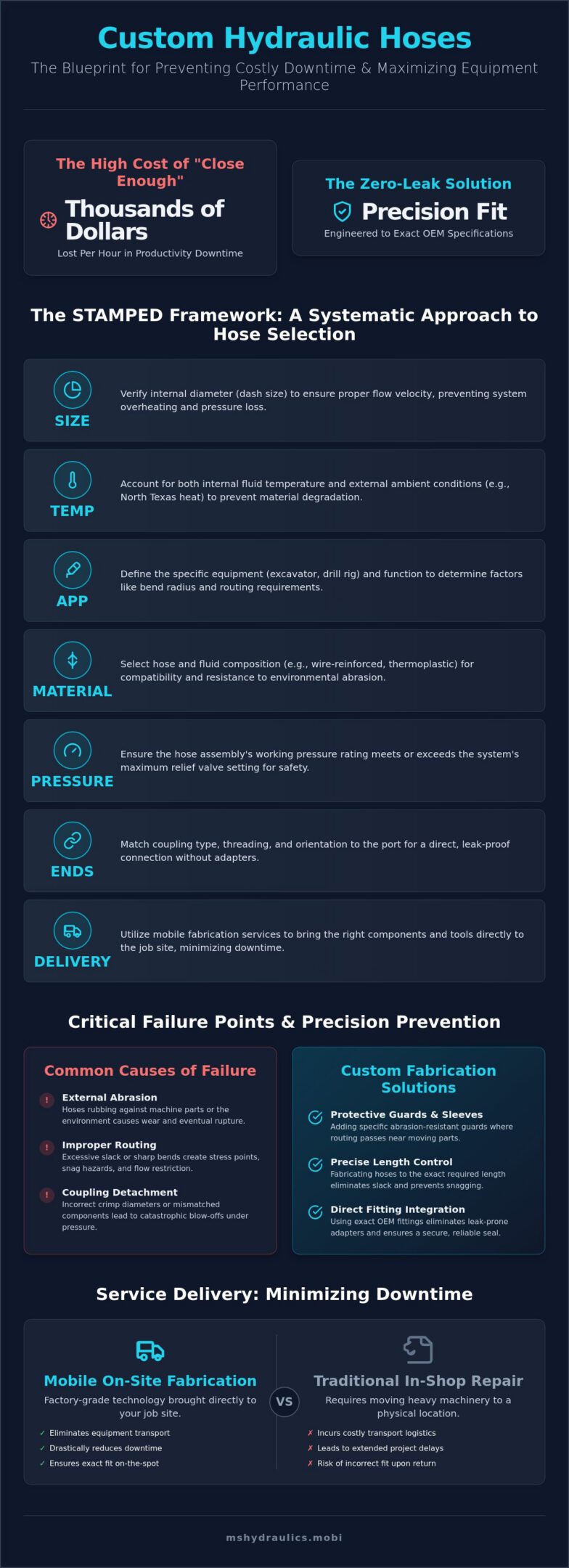
The engineering of high-performance hydraulic assemblies relies on the STAMPED methodology. This acronym represents Size, Temperature, Application, Material, Pressure, Ends, and Delivery. In the context of custom hydraulic hose fabrication Cleburne, this systematic approach prevents the common errors associated with generic replacements. Size must account for the dash size (measured in 1/16th inch increments) to maintain proper flow velocity and prevent heat generation. Temperature considerations include both the hydraulic fluid and the external North Texas environment, which can fluctuate significantly between seasons.
Adherence to SAE J517 standards is non-negotiable for system safety. These standards define the construction, dimensional, and performance requirements for hydraulic hoses. Organizations like the International Fluid Power Society emphasize that matching these specifications ensures the assembly can handle the dynamic loads of modern machinery. Pressure rating verification is the final technical hurdle. Every fabricated line must be rated to meet or exceed the system’s maximum relief pressure to prevent catastrophic failure during peak operation.
Material selection is a critical engineering decision. Wire braid reinforcement offers flexibility for medium-pressure applications, while spiral wire reinforcement is necessary for extreme pressure and high-impulse environments. Modern excavators and drill rigs often require spiral construction to resist the fatigue caused by constant pressure spikes. Selecting the wrong reinforcement type often results in a shortened service life and increased risk of downtime.
Pressure Ratings and Safety Factors
Working pressure is the maximum pressure at which a system is designed to operate continuously. Burst pressure is the point of physical failure. For industrial applications, the safety factor ratio is typically 4:1, meaning the burst pressure must be four times the maximum working pressure. Modern high-flow systems often necessitate 4-wire or 6-wire spiral hoses to maintain these ratios under extreme loads. Verifying these parameters is a fundamental part of our on-site diagnostic services.
Fitting and Connector Precision
Precision in fitting selection is as vital as the hose itself. Common interfaces include JIC (Joint Industry Council) 37-degree flares, ORFS (O-Ring Face Seal), NPT (National Pipe Thread), and BSPP (British Standard Parallel Pipe). High-integrity crimping is the final safeguard against coupling blowouts. This process requires calibrated equipment to achieve the specific crimp diameter mandated by the manufacturer. In Texas field conditions, fittings must also meet stringent corrosion resistance requirements to prevent premature oxidation and seal failure.
Mobile vs. In-Shop Fabrication: Minimising Downtime on the Job Site
In-shop fabrication often involves “hose running,” a practice that introduces significant hidden costs. These include the fuel and labor required for transit, but the primary expense is the halted production of the machinery. While some local competitors require customers to bring failed components to their facilities during fixed business hours, custom hydraulic hose fabrication Cleburne services provided by mobile units eliminate these logistical barriers. Bringing factory-grade crimping technology directly to the field allows technicians to maintain the same assembly standards found in a controlled shop environment without the associated delay. It’s a more efficient model for high-stakes industrial environments.
A critical advantage of on-site fabrication is the ability to conduct diagnostics before installation. Simply replacing a ruptured line without identifying the root cause often leads to repeat failures. Technicians evaluate the system for pressure spikes, contaminated fluid, or mechanical interference. This “point-of-failure” routing allows for adjustments to the new hose’s path. It ensures the assembly avoids abrasive contact points or heat sources that may have compromised the original component. You don’t get this level of integration when you buy a hose from a retail counter.
The Mobile Advantage for Cleburne Projects
For projects throughout Johnson County, mobile service reduces repair windows from half-days to mere hours. This efficiency is enhanced by the ability to perform real-time testing under actual operating conditions. Once the assembly is complete, the machine is cycled to verify the integrity of the new line and its connections. This process is often integrated into broader mobile hydraulic repair, ensuring the entire fluid power system is optimized for performance before the technician leaves the site.
Eliminating Measurement Errors
Measuring a failed hose in the field prevents common errors such as “too short” assemblies or excessive slack that can snag on debris. Precision is especially critical when matching the exact clocking and orientation of elbow fittings. If an elbow is misaligned by even a few degrees, it can stress the hose carcass or prevent proper seating. Technicians also ensure the assembly adheres to the minimum bend radii specified by SAE standards. This prevents premature fatigue and internal wire breakage, which are common in poorly measured lines.
Critical Failure Points and How Precision Fabrication Prevents Them
Precision is the primary defense against systemic hydraulic failure. While many operators view hose replacement as a routine task, custom hydraulic hose fabrication Cleburne involves addressing the mechanical vulnerabilities that lead to downtime. Improper routing remains the leading cause of hose degradation; it causes the hose to rub against chassis components or other hydraulic lines. This constant friction compromises the outer cover and eventually exposes the wire reinforcement to moisture and oxidation. Precision fabrication accounts for these clearance issues by adjusting the hose length and fitting angles to ensure a path that avoids all contact points, a process that can be further enhanced by precision-fabricated shields from Velocity Sheet Metal for added protection.
Coupling detachment is another catastrophic failure point that often results from a failure to adhere to specific crimp specifications. If the crimp diameter is even slightly outside the manufacturer’s tolerance, the fitting can blow off under high-pressure spikes. This isn’t just a maintenance issue; it’s a significant safety hazard. Substandard hoses are also prone to pinhole leaks, which can lead to fluid injection injuries. These injuries occur when high-pressure hydraulic fluid penetrates the skin, necessitating immediate and specialized medical intervention. High-integrity fabrication minimizes these risks by utilizing calibrated crimping equipment and verified components.
Contamination control is a technical step that many retail shops overlook. The process of cutting a wire-reinforced hose generates metal shards and rubber dust that enter the bore. If these particles aren’t removed post-fabrication, they travel through the system and damage sensitive hydraulic valves and pumps. Professional fabrication includes cleaning the interior of every assembly to ensure that the fluid power system remains free of abrasive debris. If your equipment shows signs of external wear or pressure loss, contact our technical team for a field evaluation.
Preventing Abrasion and External Damage
Technicians mitigate external damage by installing protective sleeves and guards in high-friction areas. These components provide an additional layer of defense against the abrasive soil conditions common in North Texas. Securing custom lines with the correct clamps and brackets prevents the vibration-induced fatigue that often leads to premature failure. Identifying these wear patterns is a core component of our on-site diagnostic services, allowing for proactive routing adjustments before a rupture occurs.
Integrity Verification and Testing
Visual inspection protocols are the first step in verifying assembly quality. Technicians examine the crimp for signs of “tailing” or uneven compression and check the fitting alignment against the machine’s interface. Once installed, system pressure testing confirms that the assembly performs under actual operating loads without weeping or vibration. Every assembly’s specifications are documented, creating a technical record that simplifies future preventative maintenance and ensures that subsequent replacements meet the same rigorous standards.
Partnering with Ms. Hydraulics for Custom Fabrication and Field Service
Ms. Hydraulics LLC operates as a disciplined industrial veteran focused on high-integrity fluid power solutions. Our approach to custom hydraulic hose fabrication Cleburne prioritizes technical accuracy and long-standing machinery efficiency over the rapid retail sales models common in the industry. We maintain a comprehensive service area that includes Cleburne, Alvarado, and Grandbury, as well as the wider DFW metroplex. This regional presence allows us to serve as a dependable partner for construction and industrial operations requiring rapid, expert intervention. We value reliability and performance, positioning ourselves as a serious partner for major regional players.
Integrity in fluid power requires a holistic view of the machine’s architecture. We support the entire hydraulic system, offering services like cylinder rebuilds to ensure all actuators meet original performance specifications. This methodology prevents the “band-aid” repair cycle that often plagues heavy equipment fleets. Working with an independent local specialist ensures that your technical data and operational requirements are the primary drivers of the service process. We’re proud of our heritage but remain focused on modern efficiency and rigorous assembly standards.
Our Field Service Capabilities
Our mobile units function as mobile engineering hubs. They’re equipped with factory-grade crimping technology and a diverse inventory of high-pressure hoses and fittings. Technicians are trained to identify the subtle signs of pump cavitation or valve bypass that often manifest as hose failures. By integrating custom hydraulic hose fabrication Cleburne with deep-system diagnostics, we provide a level of verification that shop-based competitors cannot match. Our field service includes:
- Rapid response mobile units serving Johnson County and the DFW area.
- Diagnostics for complex pump, valve, and motor issues.
- Customized preventative maintenance plans tailored to specific machinery duty cycles.
Requesting a Custom Fabrication Quote
Obtaining a quote for custom assemblies is a structured process. You can provide specific mechanical parameters for pre-fabrication or schedule an on-site evaluation to ensure correct routing and orientation. Our engineering-first approach to heavy equipment maintenance is designed to minimize your total cost of ownership by extending component life. We don’t use hyperbolic language because our technical data and the scale of our operations serve as the primary evidence of capability. Contact Ms. Hydraulics today to discuss your fleet’s specific hydraulic requirements and secure a dependable, expert partner for your operation.
Optimizing Fluid Power Reliability in North Texas
Engineering excellence in hydraulic systems requires a transition from reactive parts replacement to proactive field engineering. Adhering to international standards and utilizing the STAMPED methodology allows operators to eliminate the recurring leaks and pressure losses that compromise heavy equipment. Professional custom hydraulic hose fabrication Cleburne services provide the technical precision needed to match OEM specifications while accounting for the specific environmental stressors of the DFW metroplex. This systematic approach ensures that every assembly is a permanent solution rather than a temporary fix.
Ms. Hydraulics LLC has served the Cleburne and North Texas region since 2021 with a focus on technical integrity. Our fully equipped mobile service units provide on-site fabrication and include expert diagnostics with every repair to identify underlying system vulnerabilities. This methodical process ensures your machinery returns to peak operational efficiency without the logistical delays of equipment transport. Request Custom Hose Fabrication or Mobile Repair to secure your fleet’s performance and minimize operational downtime. We’re ready to support your industrial operations with disciplined fluid power expertise.
Frequently Asked Questions
How long does it take to make a custom hydraulic hose on-site?
On-site fabrication typically requires 30 to 60 minutes per assembly once the technician accesses the machinery. This timeframe includes the removal of the failed line, precise measurement, and factory-grade crimping. Complex routing or restricted access to the machine’s chassis may extend this duration. Our mobile units are fully equipped to handle these variables without requiring the machine to leave the job site.
What information do I need to provide for a custom hose assembly?
Providing the STAMPED parameters is the most effective way to ensure an accurate assembly. You should identify the internal diameter, operating temperature, fluid type, and maximum system pressure. Specifying the fitting ends, such as JIC or ORFS, is also critical. Utilizing these technical specifications during custom hydraulic hose fabrication Cleburne ensures the new component matches or exceeds original equipment manufacturer standards.
Can you repair a hydraulic hose or does it always need to be replaced?
Hydraulic hoses cannot be safely repaired and must be replaced in their entirety. Industry safety standards prohibit re-crimping used fittings or splicing damaged hose sections because the structural integrity of the wire reinforcement is compromised once a failure occurs. A new, high-integrity assembly is the only method to guarantee system safety and prevent catastrophic fluid injection injuries or mechanical failure under high-pressure loads.
What is the maximum pressure rating for your custom fabricated hoses?
We fabricate hoses rated for extreme pressures, often reaching up to 6,000 PSI for standard 4-wire spiral assemblies and higher for specialized applications. The specific rating depends on the reinforcement layer, such as wire braid or spiral wire. Every assembly is verified to ensure its working pressure meets a 4:1 safety factor relative to its burst pressure, as mandated by SAE J517 industrial standards.
Do you provide 24/7 emergency hydraulic hose repair in Cleburne?
Ms. Hydraulics provides rapid mobile hydraulic repair throughout Cleburne and Johnson County during our standard operational hours. While we prioritize urgent field failures to minimize your downtime, you should contact our technical team directly to verify current technician availability. Our focus remains on delivering high-integrity repairs that solve the root cause of the failure rather than providing a temporary retail fix.
How do I know if my hydraulic hose fittings are JIC or NPT?
JIC fittings are identified by a 37-degree seating surface or flare on the end of the connector. In contrast, NPT fittings utilize tapered threads that create a seal as they are tightened into a port. Distinguishing between these requires a visual inspection or the use of a thread gauge. Accurate identification is vital during fabrication to prevent cross-threading and ensure a zero-leak connection at the interface.
What areas around Cleburne do your mobile fabrication units cover?
Our mobile fabrication units serve a broad radius centered in Cleburne, including Alvarado, Grandbury, and the wider DFW metroplex. We specialize in reaching remote job sites where traditional hose shops are inaccessible. This coverage ensures that construction and oilfield operations in Johnson County have access to factory-grade assembly technology without the logistical burden of transporting heavy machinery to a physical facility for repair.
Why did my hydraulic hose fail so quickly after installation?
Premature failure is usually the result of improper routing, external abrasion, or exceeding the hose’s rated bend radius. If a hose is too short, it experiences excessive tension during machine cycles, which weakens the coupling interface. Our on-site diagnostic services identify these mechanical stressors. We then adjust the custom hydraulic hose fabrication Cleburne process to include protective sleeves or revised routing paths that prevent a recurrence of the failure.