Mobile Diagnostic Services in Cedar Hill for Heavy Equipment & Hydraulics
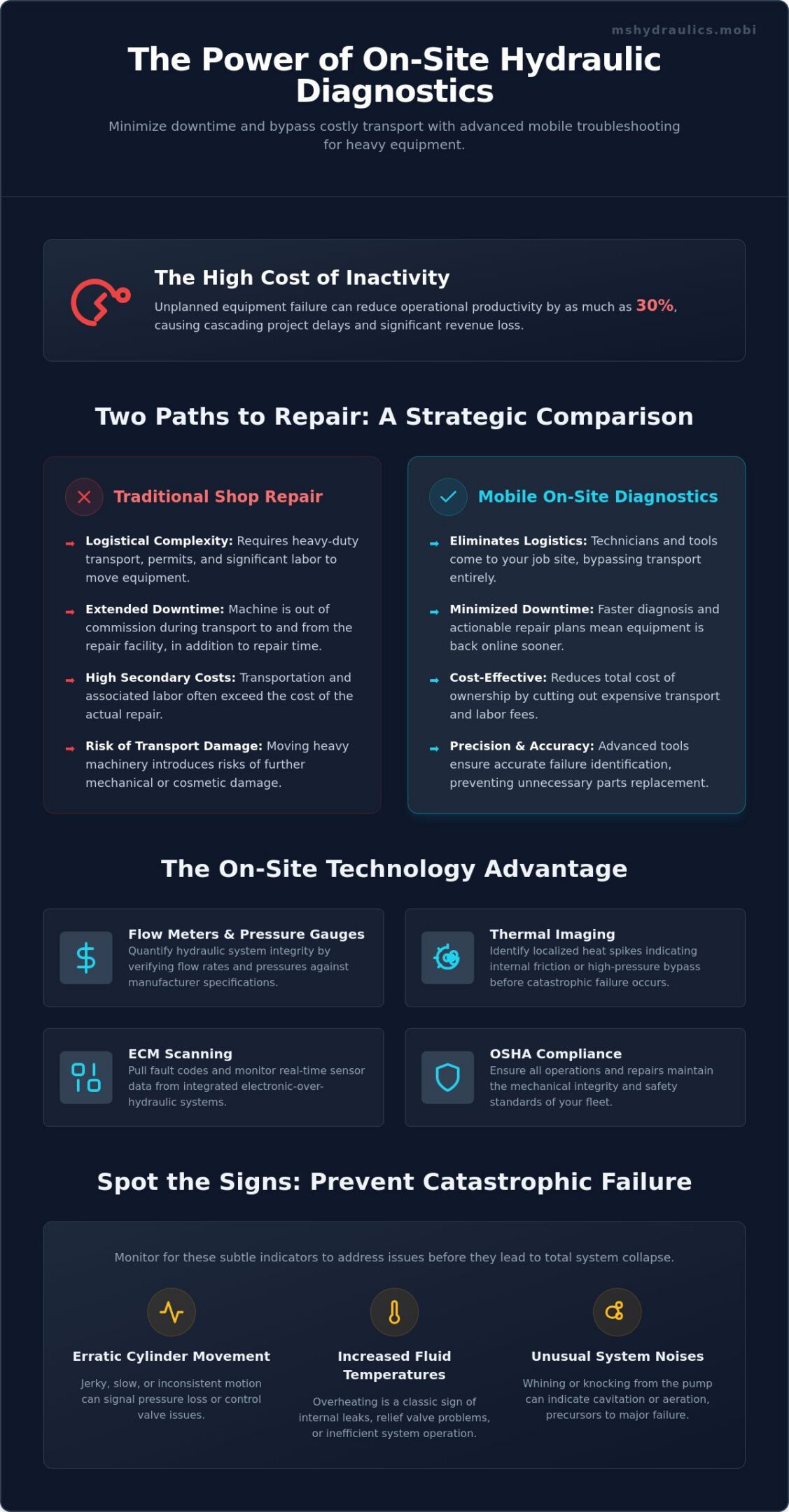
Unplanned equipment failure can reduce operational productivity by as much as 30 percent, yet many industrial operators still rely on reactive, off-site repair models. When a hydraulic system fails on a job site, the logistical burden of transporting heavy machinery often exceeds the cost of the repair itself. Utilizing professional mobile diagnostic services Cedar Hill allows project managers to bypass these transport logistics while ensuring technical precision. By bringing advanced diagnostic tools directly to the equipment, operators can identify mechanical failures with a level of accuracy that general mechanics often lack.
We understand that every hour of equipment inactivity represents a measurable loss in revenue and project momentum. This article demonstrates how specialized on-site diagnostics minimize industrial downtime and restore peak hydraulic performance for Cedar Hill job sites. We’ll analyze the methodologies used to generate actionable repair plans and discuss how mobile-first field service management contributes to documented productivity gains across the heavy equipment sector. This approach ensures that all operations remain compliant with federal OSHA standards while maintaining the mechanical integrity of your fleet.
Key Takeaways
- Understand how on-site troubleshooting eliminates the logistical costs and mechanical risks associated with transporting disabled heavy machinery to a repair facility.
- Identify why professional mobile diagnostic services Cedar Hill utilize precision instrumentation, such as flow meters and thermal imaging, to verify hydraulic system integrity.
- Compare the total cost of ownership between field diagnostics and traditional shop repairs to determine the most efficient path for equipment restoration.
- Learn the essential steps for preparing a job site and machinery data to ensure a technician can perform a comprehensive and safe diagnostic evaluation.
- Discover how specialized mechanical expertise in hydraulic valves, pumps, and motors ensures accurate failure identification for complex industrial fleets.
The Necessity of Mobile Diagnostic Services in Cedar Hill Job Sites
Mobile industrial diagnostics represent a specialized engineering discipline focused on the real-time evaluation of heavy equipment performance. Unlike basic mechanical inspections, these services involve the systematic verification of hydraulic pressures, flow rates, and electrical control signals. For operators in North Texas, the implementation of mobile diagnostic services Cedar Hill provides a critical advantage by identifying system failures at the point of operation. This technical intervention is essential for complex Hydraulic machinery where internal component wear isn’t always visible to the naked eye. Accurate diagnostics require more than just a cursory glance; they demand a methodical approach to system analysis that separates general mechanical checks from high-precision hydraulic troubleshooting.
The financial consequences of equipment failure in the Cedar Hill construction and agricultural sectors are substantial. When a primary asset like a bulldozer or harvester becomes stationary, the resulting project delay cascades through the entire supply chain. Industry data suggests that predictive maintenance and rapid diagnostics can reduce unplanned downtime by up to 30 percent. In Cedar Hill, where large-scale infrastructure projects are common, the ability to troubleshoot on-site ensures that a single mechanical fault doesn’t derail a multi-million dollar timeline. Rapid identification of a failing valve or a compromised pump allows for targeted repairs, preventing the unnecessary replacement of functional components.
Reducing Operational Friction in North Texas
Moving a disabled 40-ton excavator from a job site to a specialized shop involves significant logistical complexity. It requires heavy-duty transport permits, specialized trailers, and substantial labor hours just to move the asset. Utilizing mobile diagnostic services Cedar Hill eliminates these secondary costs. Field-based technicians arrive with the necessary instrumentation to perform high-level analysis, allowing for an actionable repair plan without the machine ever leaving the site. This level of efficiency is vital for maintaining the continuity of local contracting operations, especially when working in tight urban environments or remote agricultural fields.
When to Call for Professional Diagnostic Support
Early detection of system degradation is the most effective way to prevent catastrophic mechanical failure. Operators should monitor for subtle indicators such as erratic cylinder movement, increased fluid temperatures, or unusual cavitation noises in the hydraulic pump. These symptoms often precede a total system collapse. Integrating professional diagnostics into your standard heavy equipment maintenance protocol ensures that small pressure drops are addressed before they compromise the safety and performance of the entire unit. Immediate inspection is the only way to verify if a noise is a simple loose fitting or a precursor to an expensive motor failure.
Technical Parameters of Industrial Mobile Diagnostic Procedures
Industrial field diagnostics demand a disciplined application of engineering logic. Technicians don’t simply look for leaks; they utilize calibrated instrumentation to verify the physical parameters of the hydraulic circuit. This methodical approach ensures that mobile diagnostic services Cedar Hill deliver the same level of verification found in a permanent facility. The process involves deploying specialized tools like digital pressure gauges, flow meters, and thermal imaging cameras to quantify performance. Thermal imaging is particularly effective for identifying localized heat spikes, which often indicate internal friction or high-pressure bypass within a valve stack before a total failure occurs.
The use of thermal imaging and pressure analysis is not limited to hydraulics; these diagnostic tools are also essential for maintaining residential systems, where HVAC Inspections Los Angeles applies similar engineering principles to evaluate the efficiency and safety of home heating and cooling units.
This technical oversight is also critical for electrical infrastructure; those who need to ensure their property’s wiring is up to code can discover Electrical Repair 4U for specialized repair and rewiring services.
Modern heavy equipment relies heavily on integrated electronic-over-hydraulic systems. Therefore, Electronic Control Module (ECM) scanning is a foundational step in the diagnostic sequence. Technicians use diagnostic software to pull fault codes and monitor real-time sensor data, such as pump swashplate angles and solenoid current. By correlating these electronic signals with physical mechanical symptoms, a technician can isolate whether a performance issue is a software calibration error or a physical component failure. This systematic isolation follows established hydraulic fault detection principles, ensuring that no component is replaced without empirical evidence of its failure.
Hydraulic Pressure and Flow Analysis
System efficiency is measured through the precise intersection of Pounds per Square Inch (PSI) and Gallons per Minute (GPM). A drop in PSI often indicates a worn relief valve or a failing pump, while low GPM suggests internal bypass or intake aeration. Field technicians use digital flow meters to measure these parameters under operational load. This allows for the identification of internal leakages in cylinders and control valves without the need for invasive disassembly. Flow testing distinguishes between a failing pump that cannot generate volume and a valve bypass where volume is lost to the reservoir through internal wear.
Field-Based Fluid and Contamination Testing
Hydraulic fluid serves as both a power transmission medium and a diagnostic record. Analyzing this fluid in the field reveals the presence of metallic particulates, water ingress, or fluid oxidation, which are direct indicators of component wear. Adhering to ISO 4406 cleanliness standards is critical, as even microscopic debris can lead to catastrophic system failure. Professionals providing on-site diagnostic services extract samples to verify if the fluid remains within its operational specifications. This proactive analysis predicts component wear and prevents the premature failure of expensive pumps and motors, maintaining the mechanical integrity of the fleet.
Strategic Comparison: Mobile Field Diagnostics vs. Traditional Shop Repair
Strategic asset management requires evaluating the logistical friction inherent in traditional repair models. Transporting a disabled bulldozer or drill rig to a centralized shop involves more than just a simple towing fee; it includes the cost of oversize permits, labor hours for securement, and the total loss of revenue during the transit period. Utilizing mobile diagnostic services Cedar Hill mitigates these factors by initiating the technical evaluation immediately at the point of failure. This shift from a centralized shop model to a field-based approach reduces the time-to-repair metrics significantly. Instead of waiting for a transport slot and shop availability, technicians begin critical flow and pressure testing within hours of the initial call, ensuring that the machine stays on the job site where it’s needed most.
Cost-Benefit Analysis for Cedar Hill Operators
Evaluating the total cost of ownership reveals that travel fees for field technicians are often negligible compared to the significant financial outlay required for heavy-haul freight. More importantly, on-site diagnostic services provide critical environmental context that a static shop environment cannot replicate. Intermittent hydraulic failures, such as those triggered by thermal expansion or specific ground-load resistances, are notoriously difficult to isolate once a machine is removed from its working conditions. When a technician observes a system stall or a pressure drop under actual job site parameters, the resulting data is far more accurate for precision troubleshooting. This localized approach also minimizes the environmental risk of fluid spills during the loading process of a compromised machine.
Data-Driven Decision Making
Field diagnostics foster a transparent, data-driven relationship between the service provider and the fleet owner. Watching a technician perform thermal imaging or ECM scanning on-site provides immediate, verifiable evidence of component degradation. This real-time visibility allows project managers to make informed decisions regarding component repair versus total replacement without the delays of off-site reporting. It effectively eliminates the “wait-and-see” mentality that frequently results in secondary damage to expensive hydraulic pumps or control valves. By obtaining a definitive diagnosis on-site, companies can order specific parts immediately, further compressing the repair window and maintaining strict adherence to project timelines. This methodological approach ensures that every repair action is backed by empirical field data.
Preparing Your Cedar Hill Job Site for a Mobile Diagnostic Call
Efficiency in field diagnostics depends on the preparatory actions taken by the site supervisor before the technician’s arrival. Organizing the site environment ensures that mobile diagnostic services Cedar Hill can proceed without logistical delays. The machine should be positioned on stable, level ground to facilitate accurate pressure readings and safe access to hydraulic manifolds. Technicians require a clear perimeter to deploy diagnostic carts and specialized testing leads. Providing the machine’s hour-meter data and a concise history of recent mechanical symptoms allows the specialist to correlate physical data with expected wear cycles.
Clear communication regarding the specific conditions of failure is equally vital. Site operators should document whether the hydraulic lag occurs only under full load or if it’s persistent regardless of the duty cycle. Noting the temperature of the fluid when the failure occurs provides a technical baseline for the diagnostic specialist. This preliminary data allows mobile diagnostic services Cedar Hill to bypass broad system checks and focus immediately on the most likely failure points within the hydraulic circuit. Having this information ready prevents the need for repetitive testing and speeds up the generation of an actionable repair plan.
Safety Protocols and Site Access
Industrial safety standards require rigorous adherence to Lock-out/tag-out (LOTO) procedures during hydraulic system evaluations. Before testing begins, all non-essential personnel must be cleared from the immediate radius to mitigate risks associated with high-pressure fluid injection or mechanical failure during load testing. Proper site preparation includes:
- Verified LOTO status of all primary and secondary power sources to prevent accidental engagement.
- Unobstructed accessibility to all hydraulic service ports and ECM diagnostic interfaces.
- Availability of comprehensive maintenance logs and previous repair documentation for technical review.
Environmental Considerations in North Texas
The local climate and terrain in Cedar Hill necessitate specific environmental precautions. High-precision diagnostics involve opening hydraulic circuits, which introduces the risk of fluid discharge. Site managers should have spill containment kits ready to maintain compliance with local environmental regulations and protect the job site. Additionally, adequate lighting is mandatory for inspecting internal component wear and reading digital flow meters accurately. If the machinery is located in a high-traffic or dusty area, temporary shielding may be required to prevent particulate ingress during the diagnostic process, as maintaining ISO 4406 cleanliness standards is paramount for system longevity.
If your fleet requires immediate technical evaluation to minimize operational disruption, you can schedule professional Mobile Hydraulic Repair to restore your equipment’s performance on-site.
Ms. Hydraulics LLC: Expert Diagnostics for Cedar Hill Fleet Owners
Ms. Hydraulics LLC maintains a reputation for technical excellence within the North Texas industrial sector. We provide the authoritative mobile diagnostic services Cedar Hill operators utilize to maintain fleet availability and mechanical integrity. Our technicians possess extensive experience with critical assets, including excavators, skid steers, drill rigs, and heavy industrial machinery. By integrating advanced diagnostic instrumentation with a deep understanding of complex hydraulic systems, we deliver a comprehensive evaluation of every machine’s mechanical state. This systematic approach ensures that we identify the root cause of failures rather than simply addressing superficial symptoms. We understand that precision in the diagnostic phase is the only way to ensure a reliable repair.
Our methodology aligns with the rigorous standards required by major international players. We don’t guess; we verify. Each diagnostic call involves a structured sequence of tests designed to measure physical and mechanical parameters accurately. This data-driven strategy allows us to provide fleet owners with a clear, actionable path toward restoration. By combining our diagnostic capabilities with mobile hydraulic repair, we offer a seamless transition from failure identification to field-based recovery. This integration minimizes the administrative and logistical burden on project managers, allowing them to focus on site productivity.
Precision Equipment and Veteran Expertise
Our diagnostic process is characterized by a disciplined adherence to international industry standards. We utilize calibrated flow meters, digital pressure gauges, and thermal imaging to ensure that every measurement is factually accurate. This level of technical rigor is essential for verifying the performance of high-pressure hydraulic valves and pumps. As a locally owned entity, we provide a responsive service model that understands the specific operational pressures of the Cedar Hill market. Our veteran technicians bring decades of industrial experience to every job site, providing the quiet confidence that comes from a legacy of successful mechanical restorations and verified engineering expertise.
From Diagnosis to Restoration
The transition from a technical diagnostic report to a physical repair is where operational efficiency is truly realized. Findings from an on-site evaluation often lead directly to a specialized heavy equipment cylinder rebuild or a precision valve adjustment. We use the data gathered during the diagnostic phase to develop customized maintenance plans that address the unique wear patterns of your specific machinery. This proactive strategy extends the life of hydraulic components and prevents the recurrence of catastrophic failures. For fleet owners in Cedar Hill and the surrounding North Texas areas, contacting Ms. Hydraulics LLC ensures a rapid, expert response that prioritizes mechanical reliability and project continuity.
Optimizing Fleet Reliability Through Technical Precision
Achieving sustained operational uptime requires a transition from reactive transport models to disciplined field-based analysis. By utilizing precision instrumentation to monitor physical parameters, industrial operators can bypass the logistical complexities of heavy-haul freight while ensuring mechanical accuracy. The integration of electronic scanning with physical load testing provides a definitive understanding of system health, allowing for targeted repairs that prevent secondary component failure. Professional mobile diagnostic services Cedar Hill offer the most efficient pathway to restoring high-pressure hydraulic integrity without compromising project timelines or safety standards.
Ms. Hydraulics LLC was founded in 2021 to provide specialized expertise in high-pressure hydraulic systems for Cedar Hill and the broader DFW Metroplex. Our methodology emphasizes engineering excellence and factual verification for every asset in your fleet. Whether you manage excavators or complex drill rigs, our mobile response team delivers authoritative technical support directly to your job site. You can Request Precision On-Site Diagnostics from Ms. Hydraulics LLC to ensure your machinery continues to perform at its design specifications. We’re committed to maintaining the mechanical performance of your heavy equipment.
Frequently Asked Questions
What is included in a mobile diagnostic service for heavy equipment?
A comprehensive diagnostic service includes a systematic evaluation of the machine’s hydraulic and electrical circuits. Technicians utilize digital pressure gauges, flow meters, and thermal imaging to quantify system performance. The process involves monitoring physical parameters under load and performing electronic control module (ECM) scanning to isolate the root cause of mechanical degradation.
How much does a mobile hydraulic diagnostic call cost in Cedar Hill?
The cost of an on-site diagnostic call depends on the complexity of the machinery and the specific instrumentation required for the inspection. Fleet owners should verify current labor rates and any applicable travel fees for the North Texas area. We recommend contacting a service provider directly to obtain a quote based on your machine’s symptoms and job site location.
Can you diagnose electronic failures on modern excavators and skid steers?
Yes, modern mobile diagnostic services Cedar Hill include full integration with electronic-over-hydraulic systems. Technicians use specialized diagnostic software to interface with the machine’s ECM to pull fault codes and monitor real-time sensor data. This capability is essential for calibrating solenoid currents and identifying harness failures that directly impact hydraulic performance.
How long does a typical on-site diagnostic inspection take?
A standard field-based diagnostic inspection generally requires between two and four hours to complete. While simple pressure checks on a single circuit are relatively quick, troubleshooting intermittent failures in complex multi-pump systems requires a more methodical approach. This ensures that all data points are verified before a final repair plan is generated.
Do I need to move my equipment to a paved area for diagnostics?
Machinery doesn’t need to be on a paved surface for a successful diagnostic evaluation. However, the asset must be positioned on stable, level ground to ensure safety during high-pressure testing and to facilitate accurate fluid measurements. Technicians require a clear perimeter around the machine to safely deploy diagnostic carts and specialized testing leads.
What happens if the diagnostic service identifies a major hydraulic failure?
If a major failure is identified, the technician provides an actionable repair plan that outlines the necessary steps for mechanical restoration. This may include on-site hydraulic hose fabrication or a recommendation for a specialized component rebuild. The diagnostic report serves as a technical foundation for deciding between immediate repair or total component replacement.
Are mobile diagnostics as accurate as shop-based inspections?
Field diagnostics are as accurate as shop inspections and often provide superior data by testing equipment under actual operational load. Observing a system fail in its working environment allows technicians to account for variables such as thermal expansion or ground-load resistance. Calibrated digital instrumentation ensures that all field measurements meet rigorous international engineering standards.
How quickly can Ms. Hydraulics respond to a diagnostic request in Cedar Hill?
Response times for mobile diagnostic services Cedar Hill depend on the current service schedule and the urgency of the equipment failure. Ms. Hydraulics prioritizes the restoration of operational productivity for fleet owners throughout the DFW Metroplex. You should contact the service desk directly to verify the earliest available dispatch time for a technical specialist.