Expert Hydraulic Cylinder Repair in Arlington: Restoring Heavy Equipment Performance
For heavy equipment operators, a single failed seal does not just halt a machine; it can result in operational losses exceeding thousands of dollars per hour. Maintaining peak hydraulic performance is a constant challenge in the demanding North Texas environment. You understand that equipment failure often occurs at the most critical point of a project, leaving you with the logistical burden of transporting oversized components or facing environmental hazards from fluid leaks. Securing reliable hydraulic cylinder repair in Arlington is essential to maintaining project timelines and ensuring the safety of your job site.
This article details the engineering precision required for high-standard hydraulic cylinder rebuilds. It focuses on how technical verification and mobile diagnostics can restore your system pressure while significantly extending component lifespan. We’ll examine the mechanical parameters of professional repairs and the specific methodologies used to minimize downtime through on-site intervention. By prioritizing rigorous standards and mechanical accuracy, operators can transition from reactive maintenance to a state of sustained equipment reliability and performance.
Key Takeaways
- Understand the engineering requirements for restoring hydraulic cylinders to OEM specifications using high-grade seal kits and precision machining.
- Utilize a technical framework to determine when hydraulic cylinder repair Arlington is more cost-effective than purchasing new components.
- Learn how on-site diagnostic services detect internal bypass and drifting issues directly on the job site to prevent unnecessary equipment transport.
- Identify the specific mechanical parameters that indicate a cylinder is beyond economical repair due to catastrophic barrel damage.
- Discover how rapid mobile response units facilitate immediate failure assessment to maintain project timelines for major infrastructure works.
The Critical Role of Hydraulic Cylinder Repair in Arlington Industries
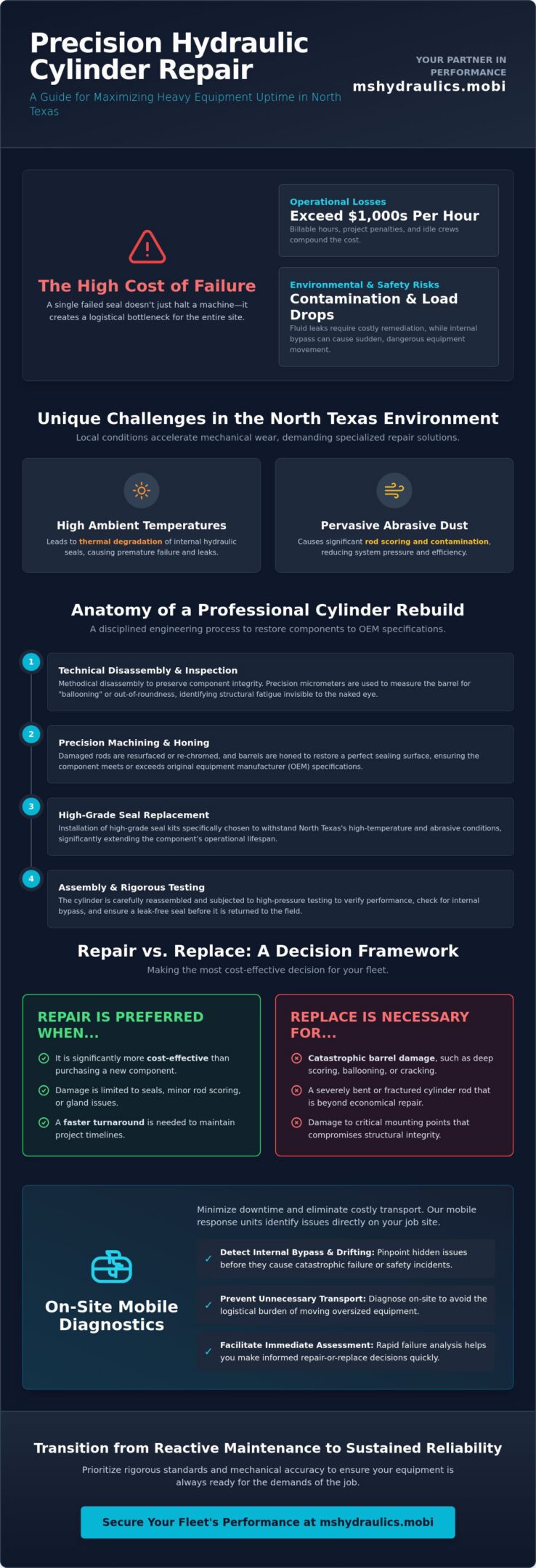
A Hydraulic cylinder functions as the critical actuator for heavy machinery, converting fluid pressure into the linear force required for excavation, lifting, and grading. In the industrial context of North Texas, hydraulic cylinder repair Arlington is categorized as a restorative engineering discipline. This process requires returning a component to its original equipment manufacturer (OEM) specifications through precise machining and material verification. For major infrastructure projects along the I-30 and Highway 360 corridors, the reliability of these actuators dictates the success of tight construction schedules. A cylinder failure on a high-capacity excavator doesn’t just stop that unit; it creates a logistical bottleneck for the entire site.
Environmental conditions in Arlington accelerate mechanical wear in ways that standard maintenance schedules often fail to predict. High ambient temperatures lead to thermal degradation of internal seals. Simultaneously, the pervasive abrasive dust characteristic of North Texas soil causes significant rod scoring. These factors create a cycle of internal leakage and reduced system pressure. Localized repair strategies focus on utilizing high-grade seal kits that withstand these specific thermal and abrasive parameters, ensuring the component’s longevity in the field.
Relying on local expertise for hydraulic cylinder repair Arlington also removes the burden of complex logistics. Hauling oversized equipment to distant dealerships is a costly and time-consuming endeavor that increases project overhead. By utilizing regional services, fleet managers keep their assets within the North Texas area. This facilitates faster turnaround times and reduces the overall cost of ownership for heavy machinery fleets.
Arlington’s High-Stakes Construction and Industrial Sectors
The ongoing development within the Arlington Entertainment District and the expansion of local manufacturing hubs require high-performance hydraulics. These sectors operate with minimal margins for error. Whether it’s a large-scale commercial build, a logistics center operation, or a professional renovation project like those managed by HMJ Contracting, hydraulic integrity is paramount. Additionally, agricultural equipment in Tarrant and Johnson County relies on these systems to manage heavy workloads during critical seasonal windows, where equipment availability is non-negotiable.
The Hidden Costs of Cylinder Failure
Total cost of failure includes more than just the repair bill. It encompasses the loss of billable hours and the potential for project penalties. Environmental risks are also significant. A single seal failure can lead to hydraulic fluid contamination on a job site, triggering strict remediation requirements. Safety remains the highest priority. Internal seal bypass can lead to drifting or sudden load drops, presenting a direct threat to ground crews. Utilizing On-Site Diagnostic Services helps identify these risks before they result in a catastrophic failure. It’s often more efficient to rebuild a cylinder proactively than to respond to an emergency breakdown.
The Anatomy of a Professional Hydraulic Cylinder Rebuild
A professional rebuild is a disciplined engineering process that transcends basic component replacement. It represents a comprehensive restoration of the actuator to its original equipment manufacturer (OEM) specifications. Achieving this level of precision requires a combination of specialized tooling, high-grade materials, and a deep understanding of hydraulic dynamics. When performing hydraulic cylinder repair Arlington, technicians must account for the high-pressure environments where these machines operate, ensuring that every seal and surface meets rigorous performance metrics.
Step 1: Technical Disassembly and Inspection
Disassembly must be methodical to preserve the integrity of the remaining components. Technicians carefully remove the head, piston, and rod assembly, ensuring the internal barrel surface remains unmarred. Once the unit is open, a detailed technical inspection follows. Using precision micrometers, technicians measure the barrel for “ballooning” or out-of-roundness. These deviations often indicate structural fatigue that a visual inspection would miss. Diagnosing the root cause of failure is also essential. Whether the issue stemmed from particulate contamination, side-loading, or hydraulic fluid overheating, understanding the “why” allows for corrective measures that prevent future downtime.
Step 2: Component Restoration and Machining
Component restoration focuses on the mechanical interfaces that dictate seal life. The chrome rod is polished to eliminate nicks and burrs that cause seal tearing. If the rod is bent, it’s straightened or replaced to prevent side-loading. The cylinder barrel undergoes honing to restore a specific cross-hatch pattern. This pattern isn’t just for aesthetics; it retains a microscopic film of oil that lubricates the seals during the stroke. In cases where original components are worn beyond acceptable tolerances, custom fabrication of bushings or pins ensures the entire assembly functions as a cohesive unit. This level of mechanical precision is what separates a temporary fix from a long-term hydraulic cylinder repair Arlington solution.
Step 3: Precision Reassembly and Testing
Reassembly is conducted in a clean-room environment to mitigate the risk of particulate ingress. Technicians install new seal kits, wear rings, and wipers designed to withstand modern hydraulic pressures and temperatures. Every fastener, including the piston nut, is torqued to precise manufacturer specifications. The process concludes with rigorous verification. Static and dynamic pressure testing confirms that the cylinder maintains zero-leak performance and bypass integrity under full load. For organizations seeking reliable Hydraulic Cylinder Rebuilds, this systematic approach provides the necessary assurance of mechanical reliability and operational safety.
Repair vs. Replace: A Decision Framework for Arlington Fleet Managers
Decisions regarding hydraulic cylinder repair Arlington must be based on objective mechanical data and logistical constraints. Fleet managers often face the dilemma of choosing between a technical rebuild and a full component replacement. While a new unit offers the perceived benefit of a factory-fresh start, the associated lead times and procurement costs often make restoration the more viable path for maintaining fleet availability. A disciplined evaluation of the component’s structural integrity is the first step in this decision-making process.
A cylinder is technically classified as “Beyond Economical Repair” (BER) when the cost of restoration exceeds approximately 70% to 80% of the price of a new unit. This condition typically occurs following catastrophic barrel failure, such as deep internal gouging or structural deformation that machining cannot correct. However, for the majority of wear-related failures, rebuilding provides a significant life-cycle advantage. Rebuilding also serves as a sustainable industrial practice, as it recycles the heavy steel mass of the barrel and rod while only replacing the wear components.
Factors Influencing the Rebuild Decision
Several variables dictate whether a rebuild is the optimal path:
- Machine Obsolescence: For older machinery where OEM parts are discontinued, a custom rebuild is often the only method to return the asset to service.
- Rod Condition: Minor surface scoring is easily corrected through precision polishing. If the rod is severely pitted or bent, the cost of a new rod must be integrated into the rebuild estimate to determine if it remains cost-effective.
- Lead Time Requirements: Procurement of a new OEM cylinder can take weeks, especially for specialized equipment. A professional rebuild can typically be completed in a fraction of that time, directly reducing the cost of idle machinery.
Cost Comparison Table: Rebuild vs. New
The following table outlines the typical parameters considered during a fleet assessment in Arlington. These figures represent industry averages and illustrate the value of a heavy equipment cylinder rebuild Texas service.
| Metric | Professional Rebuild | New OEM Replacement |
|---|---|---|
| Direct Procurement Cost | 40% – 60% of new cost | 100% of list price |
| Average Lead Time | 2 – 5 Business Days | 2 – 4 Weeks (standard) |
| Environmental Impact | High Sustainability | High Raw Material Usage |
| Performance Life | Equivalent to OEM | OEM Standard |
By prioritizing hydraulic cylinder repair Arlington, organizations maintain better control over their maintenance budgets and equipment schedules. The transition from reactive replacement to technical restoration ensures that components are utilized to their full engineered potential, maximizing the return on investment for every piece of heavy equipment in the fleet.
Mobile Diagnostics: Identifying Cylinder Issues on the Job Site
Mobile diagnostics provide a significant technical advantage by allowing for immediate failure assessment where the machine sits. This approach eliminates the logistical delay of transporting equipment for a preliminary evaluation. Through On-Site Diagnostic Services, technicians utilize non-invasive methods to determine if a component requires a full rebuild or if the issue lies elsewhere in the hydraulic circuit. One primary technique involves detecting internal bypass, also known as drifting. By isolating the cylinder and monitoring rod movement under load, technicians confirm seal integrity without removing the unit from the machine.
Thermal imaging provides another layer of verification. By scanning the cylinder barrel during operation, technicians identify friction-related heat signatures. Excessive heat at specific points often indicates internal scoring or a damaged piston seal bypassing fluid. This data-driven approach ensures that hydraulic cylinder repair Arlington is only initiated when mechanical evidence warrants it, preventing unnecessary teardowns. When removal is required, preparing the machine involves securing the load and depressurizing the system to ensure field safety. This methodical preparation prevents fluid injection injuries and secondary mechanical damage.
Field Troubleshooting for Operators
Operators managing hydraulic cylinder repair Arlington requirements can perform preliminary checks to assist in the diagnostic process. Visual inspections should focus on external leaks at the rod seal or gland nut, which often signal the initial stages of seal failure. If the machine exhibits “spongy” operation, it typically indicates air aeration or cavitation within the fluid, which can lead to rapid component degradation. Additionally, measuring cycle times against factory specifications helps differentiate between cylinder bypass and potential flow issues in the pump or control valves.
Ensuring Cleanliness During Field Service
The North Texas environment poses specific challenges for field repairs. Abrasive dust and high winds can introduce contaminants into the hydraulic circuit during hose disconnection. Maintaining a clean work area is critical to long-term reliability. Technicians use dedicated caps and plugs to seal all open ports immediately, protecting the sensitive internal components of the machine. Proactive Heavy Equipment Maintenance strategies prioritize these cleanliness standards to prevent premature cylinder failure. If your machinery is showing signs of performance loss, contact us for expert Mobile Hydraulic Repair to resolve the issue before it leads to a catastrophic breakdown.
Ms. Hydraulics LLC: Precision Cylinder Solutions for Arlington
Ms. Hydraulics LLC operates as a strategic partner for industrial entities requiring high-precision actuator restoration. We integrate advanced mobile hydraulic repair Cleburne TX capabilities with the technical infrastructure required for complex shop-based rebuilds. This dual approach ensures that every hydraulic cylinder repair Arlington project begins with an accurate, data-driven assessment of the mechanical failure mode. By applying rigorous engineering integrity to every restoration, Ms. Hydraulics LLC provides a reliable alternative to the excessive costs and extended lead times typically associated with OEM component replacements. Our focus remains on returning equipment to service with verified performance metrics that match or exceed original specifications.
The Ms. Hydraulics LLC advantage lies in our ability to bridge the gap between field diagnostics and high-tier machining. We don’t just replace seals; we analyze the physical and mechanical parameters that led to the failure. This level of technical scrutiny allows us to identify underlying issues such as rod misalignment or fluid contamination before they cause secondary damage. By combining this analytical depth with a rapid response model, we help fleet managers maintain a state of modern efficiency across their entire inventory of heavy machinery.
Our Arlington and DFW Service Area
Our logistics network effectively covers the primary industrial corridors of Arlington, Mansfield, and Crowley. We recognize that unplanned equipment stoppage represents a significant financial liability for large-scale operations. To mitigate this, we maintain the specialized logistical capacity for a 24-hour emergency response, specifically designed to address critical system failures. Our technicians possess extensive specialized knowledge across all major equipment brands, including Caterpillar, Komatsu, and John Deere. This cross-brand expertise allows us to maintain strict adherence to specific internal nomenclature and original manufacturer tolerances, ensuring a seamless fit and function once the component is reinstalled.
Partnering for Operational Efficiency
Operational efficiency is achieved through a highly structured and transparent service workflow. The process initiates with a comprehensive on-site diagnostic verification to identify internal bypass or structural fatigue. Following the precision rebuild, every unit undergoes a final dynamic pressure test to confirm zero-leak performance under maximum load conditions. We provide comprehensive documentation for every repair, which serves as an essential component of your internal fleet maintenance records. This methodical approach ensures that stakeholders have a verifiable account of the restoration process and the mechanical status of the asset. For organizations prioritizing technical excellence and long-term reliability, Contact Ms. Hydraulics LLC for Expert Cylinder Repair to secure the operational integrity of your heavy machinery fleet.
Advancing Equipment Reliability Through Technical Restoration
Maintaining peak performance in heavy machinery requires a transition from reactive replacement to a disciplined engineering approach. Technical restoration, supported by precision machining and rigorous honing, allows components to return to service at original specifications without the lead times of new procurement. Utilizing on-site field diagnostics ensures that hydraulic cylinder repair Arlington is executed with maximum efficiency, addressing the root cause of mechanical failure rather than just the symptoms. This strategy preserves project timelines and maximizes the return on investment for every asset in your fleet.
Ms. Hydraulics LLC has established a legacy of technical excellence in North Texas since 2021, focusing on the mechanical parameters that dictate long-term durability. Our commitment to engineering integrity and transparent documentation provides the assurance that your equipment remains operational and safe. To optimize your machinery’s lifecycle and restore system pressure, Request an Expert Cylinder Repair Quote from Ms. Hydraulics LLC. Implementing these rigorous standards ensures your machinery continues to perform at its engineered potential.
Frequently Asked Questions
How do I know if my hydraulic cylinder needs a rebuild or just a new seal?
The requirement for a rebuild is determined through a detailed internal inspection of the mechanical surfaces. While a new seal addresses external leakage, a full rebuild is necessary if there is evidence of internal bypass, rod scoring, or barrel deformation. If the cylinder exhibits drifting or a loss of system pressure under load, the internal components likely require machining to restore OEM tolerances and ensure long-term reliability.
How long does a typical hydraulic cylinder repair take in Arlington?
A standard hydraulic cylinder repair Arlington typically requires two to five business days for completion. This duration accounts for technical disassembly, precision machining, and the installation of high-grade seal kits. Turnaround times can vary based on the extent of component damage and the procurement of specialized parts. Mobile diagnostic assessments are often performed within 24 hours to initiate the restoration process and minimize machine downtime.
Can you repair a scored hydraulic rod on-site?
Minor surface abrasions can sometimes be addressed through on-site polishing, but significant rod scoring requires shop-grade equipment. Deep gouges or pits in the chrome plating necessitate precision machining to prevent the immediate destruction of new seals. Technicians evaluate the depth of the scoring during the initial diagnostic phase to determine if the rod can be restored or if a full replacement is technically required.
What causes a hydraulic cylinder to ‘drift’ or lose position?
Cylinder drifting is primarily caused by internal bypass at the piston seal, allowing fluid to move between the high-pressure and low-pressure sides of the barrel. This mechanical failure prevents the actuator from maintaining a static position under load. Other contributing factors include worn control valve spools or thermal expansion of the hydraulic fluid, which can compromise the volumetric efficiency of the entire hydraulic circuit.
Do you provide pick-up and delivery for large cylinders in the Arlington area?
Logistical support for oversized and heavy components is a standard feature of our industrial service. We facilitate the secure transport of large cylinders across the Arlington and DFW industrial corridors to our specialized repair facility. This service removes the burden of equipment transport from the fleet manager, allowing for a more streamlined maintenance workflow and faster return-to-service intervals for critical machinery.
Is it cheaper to rebuild a cylinder or buy a new one?
Performing a hydraulic cylinder repair Arlington is generally the more cost-effective strategy, with costs typically ranging between 40% and 60% of a new OEM replacement. Rebuilding is especially advantageous for obsolete equipment where new parts are no longer manufactured. A cylinder is only classified as beyond economical repair if the structural integrity of the barrel or rod is compromised beyond the limits of safe machining.
What information do I need to provide for a cylinder repair quote?
To generate an accurate technical quote, provide the machine make and model, the cylinder’s serial number, and a detailed description of the failure symptoms. Including measurements of the rod diameter and stroke length helps in identifying the correct seal configurations. Digital photographs of any visible external leaks or rod damage also assist technicians in providing a more precise preliminary assessment of the required restoration work.
How do you test a cylinder after it has been rebuilt?
Every rebuilt unit undergoes rigorous static and dynamic pressure testing to verify zero-leak performance under maximum load. This process involves cycling the cylinder through its full stroke to ensure the seals are properly seated and that no internal bypass occurs. Testing to original manufacturer specifications provides the final engineering verification required to guarantee the component’s mechanical reliability and safety before it is reinstalled on the machine.