Forklift Hydraulic Repair in Arlington: Minimizing Warehouse Downtime
How much does a single hour of idle time truly cost your logistics operation when a mast cylinder fails mid-shift? You likely recognize that every minute a forklift remains inactive, your facility’s throughput drops and operational overhead climbs. The logistical burden of transporting heavy equipment to a distant shop often worsens this loss, turning a standard mechanical issue into a multi-day disruption. When general mechanics lack the specialized expertise required to handle high-pressure systems, the risk of recurring failure increases.
This technical guide provides a rigorous framework for diagnosing and resolving hydraulic failures directly on-site to restore operational efficiency. By prioritizing professional forklift hydraulic repair Arlington, you can eliminate the need for expensive equipment transport while ensuring your fleet meets the safety requirements of OSHA 29 CFR 1910.178. We’ll examine precision diagnostics for mast and tilt cylinders, the necessity of high-spec hose fabrication, and the methodical steps required for a full hydraulic system restoration that ensures long-term reliability for your warehouse fleet.
Key Takeaways
- Identify specific technical indicators such as internal seal bypass and pump cavitation to address hydraulic failures before they compromise safety.
- Reduce warehouse downtime through on-site forklift hydraulic repair Arlington, allowing for diagnostics and testing under actual operational load conditions.
- Quantify the true economic impact of equipment failure by analyzing the hidden costs of shop transport and logistical bottlenecks.
- Establish a disciplined maintenance protocol centered on monthly fluid analysis to detect metallic particulates and water ingress early.
- Master the parameters of high-precision cylinder restoration, ensuring long-term reliability through professional honing and high-spec seal integration.
The Critical Role of Hydraulics in Arlington Material Handling
The operational efficiency of a logistics facility in North Texas depends on the mechanical integrity of its lifting systems. Within these machines, the hydraulic circuit serves as the primary mechanism for force transmission. Forklift hydraulic systems are engineered to handle extreme pressure, yet they remain the most frequent point of failure in high-intensity environments. For facilities operating near the TX-360 and I-20 corridors, maintaining constant readiness is a requirement to meet global supply chain demands. This high-cycle usage places immense strain on both internal combustion and electric units. While electric forklifts often utilize a separate motor for hydraulic functions, both types rely on the same physical principles of fluid power. This makes specialized forklift hydraulic repair Arlington a critical component of professional fleet management.
Arlington’s Industrial Landscape and Equipment Stress
Warehouses in the Arlington area operate under unique environmental pressures. The heavy-duty cycles common in regional distribution centers lead to rapid thermal buildup in hydraulic fluid. When ambient Texas temperatures exceed 100 degrees Fahrenheit, the fluid’s viscosity can drop below the manufacturer’s recommended parameters. This thinning reduces lubricating properties and accelerates seal wear. Additionally, the prevalence of environmental dust in North Texas contributes to valve contamination. Even microscopic particulates can score cylinder walls or clog fine orifices in control valves, leading to erratic performance and eventual system collapse.
Identifying High-Risk Hydraulic Components
Several specific components are particularly vulnerable to these stresses. Mast lift cylinders represent the backbone of vertical movement, bearing the full weight of the load. They are prone to internal bypass, where fluid leaks past the piston seal, causing the carriage to drift downward. Tilt and side-shift cylinders are precision components that often experience external leaks due to their exposed nature and frequent movement. Finally, the control valves and pumps act as the brain and heart of the circuit. A loss of volumetric efficiency in the pump or a sticking spool in the valve bank will render the entire machine non-functional. Professional forklift hydraulic repair Arlington ensures these high-risk components are diagnosed with the technical precision required to prevent catastrophic failure.
Common Forklift Hydraulic Failures and Technical Indicators
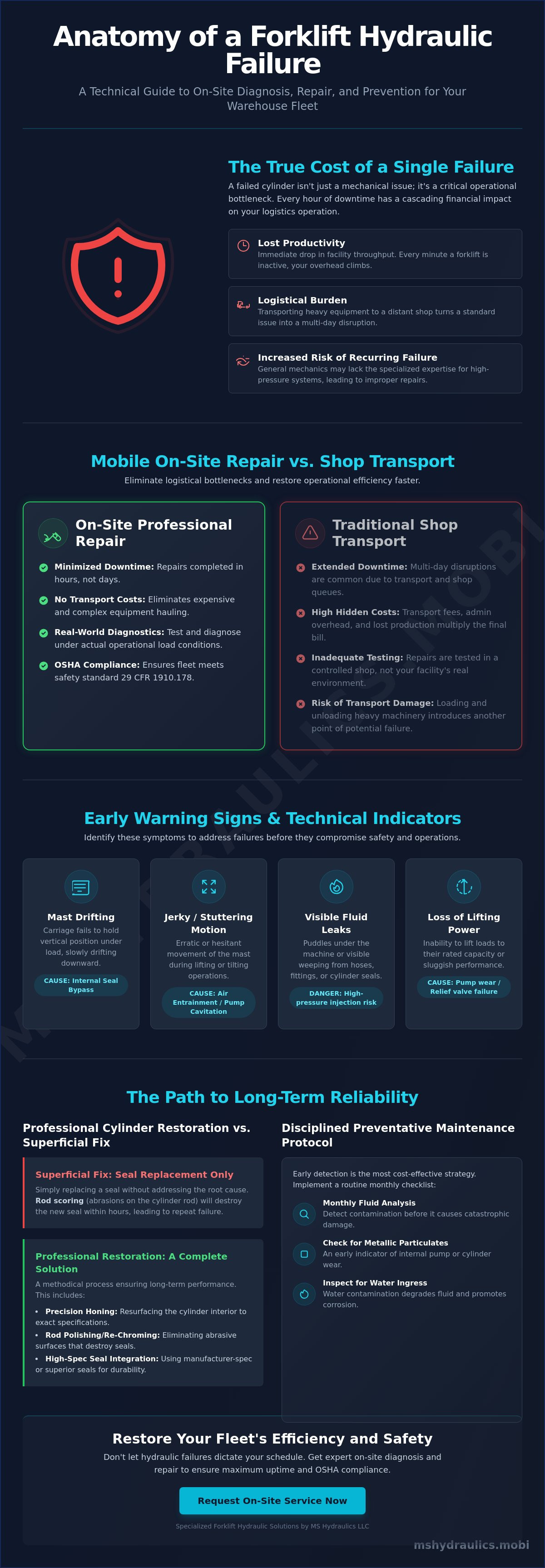
Detecting the early mechanical signatures of a failing system is essential for timely forklift hydraulic repair Arlington. Mast drifting occurs when the carriage fails to maintain its vertical position while under load. This is typically a symptom of internal seal bypass within the lift cylinders. This bypass allows pressurized fluid to escape past the piston seal, resulting in a gradual, unintended loss of elevation. When operators report jerky or stuttering mast movement, the issue often stems from air entrainment or pump cavitation. Adhering to OSHA safety standards requires that any machine exhibiting these erratic behaviors be removed from service immediately to prevent workplace accidents.
Fluid leaks represent a more visible but equally dangerous failure mode. Pinhole leaks in high-pressure lines can be difficult to spot, yet they present a significant risk of hydraulic injection injuries. If a machine experiences a systemic loss of lifting power, the diagnostic focus shifts to the pressure relief valves and the hydraulic pump. A decline in the pump’s volumetric efficiency means it can no longer generate the flow necessary to overcome the load. Accurate forklift hydraulic repair Arlington involves more than just swapping parts; it requires an engineering-level understanding of these failure modes. Engaging professional on-site diagnostic services allows for the precise identification of these failures under real-world warehouse conditions.
The Science of Hydraulic Cylinder Failure
Rod scoring is a primary driver of seal degradation in material handling equipment. When the chrome surface of a cylinder rod is compromised by environmental debris, it creates an abrasive interface that destroys new seals within hours of operation. Simply replacing the seal is a superficial fix that doesn’t address the root cause. A proper Heavy equipment cylinder rebuild Texas requires precision honing of the barrel and polishing of the rod to restore original equipment manufacturer (OEM) specifications. This methodical approach ensures the restored component can withstand the high-pressure cycles required in North Texas shipping hubs.
Hydraulic Hose Vulnerabilities on Forklifts
Hoses on a forklift mast endure unique mechanical stressors that aren’t present in stationary industrial equipment. They’re subject to constant flexing and high-speed travel over pulleys, which leads to outer cover abrasion and reinforcement wire fatigue. These stressors are compounded by the high-frequency pressure spikes that occur during rapid lifting and lowering sequences. For safety compliance, Class 4 forklift hydraulic hoses must maintain a burst pressure rating of at least four times their maximum operating pressure to prevent catastrophic failure during heavy load maneuvers.
Mobile On-Site Repair vs. Shop Transport in Arlington
Analyzing the total economic impact of equipment failure reveals that transport fees are only a small fraction of the total cost. When a forklift is removed from the facility for service, the operation loses the machine’s throughput for the duration of the transport and the subsequent 3-5 day lead time typical of regional dealership service departments. Choosing professional forklift hydraulic repair Arlington eliminates these delays by bringing diagnostic and repair capabilities directly to the warehouse floor. This approach ensures that the machine is returned to service hours, rather than days, after the initial failure.
Performing diagnostics on-site provides a significant technical advantage. Technicians can evaluate the hydraulic system under real-world load conditions and duty cycles specific to your facility’s requirements. This allows for the identification of pressure fluctuations or thermal issues that may remain hidden in a static shop environment. Mobile service units also utilize specialized containment systems and high-capacity spill kits to manage fluid recovery during component removal. These measures prevent floor contamination and ensure adherence to facility safety protocols while maintaining environmental compliance during the repair process.
The Logistics of Forklift Transport
Moving a non-operational forklift within busy Arlington industrial zones presents significant logistical challenges. The process requires specialized heavy-duty flatbeds and experienced rigging to ensure the machine is secured without damaging the mast or steering linkage. There is always a risk of secondary damage during the loading and unloading process, particularly when winching a unit with a locked hydraulic system. The model for Expert Mobile Hydraulic Repair in Cleburne, TX demonstrates how on-site intervention bypasses these risks, a strategy that is equally effective for Arlington-based logistics hubs where space for loading is often restricted.
Immediate Response: On-Site Hose Fabrication
Mobile repair units function as fully equipped workshops. Rather than relying on pre-made hose kits that may not account for slight variations in routing or previous equipment modifications, technicians perform custom forklift hydraulic repair Arlington through on-site hose fabrication. This ensures perfect fitting alignment and optimal hose length, which are critical for preventing premature failure due to hose torque or abrasion against the mast pulleys. Every fabricated assembly undergoes rigorous inspection to verify it meets the required pressure ratings before installation. Modern mobile units feature integrated pressure testing equipment, allowing for the verification of hose integrity at full working pressure before the machine is cleared for operation.
Preventative Maintenance Checklist for Arlington Fleet Managers
Fleet managers in North Texas must move beyond reactive maintenance to preserve operational uptime and equipment longevity. A structured protocol addresses the environmental stressors discussed previously, such as high-cycle thermal loads and particulate contamination. Implementing a rigorous inspection schedule ensures that minor technical deviations don’t escalate into systemic failures. This methodical approach reduces the frequency of emergency forklift hydraulic repair Arlington by identifying component fatigue before it compromises safety or throughput.
- Daily Visual Inspections: Operators must examine mast chains and hydraulic line routing for signs of abrasion or misalignment. Misrouted lines often catch on pulleys, leading to immediate pressure loss.
- Monthly Fluid Analysis: Extracting fluid samples allows for the detection of metallic particulates or water ingress. These contaminants act as abrasives within the pump and valve spool interfaces.
- Annual Relief Valve Calibration: Pressure relief valves require annual verification to prevent system over-pressurization. Over-pressurization is a leading cause of catastrophic seal failure and cylinder wall scoring.
- Proactive Seal Replacement: Tilt cylinders experience constant oscillation under load. Establishing a replacement schedule for these seals every 2,000 operating hours prevents the drifting issues that hamper precision loading.
Hydraulic Fluid Management
Arlington’s extreme temperature swings, ranging from sub-freezing winter mornings to triple-digit summer afternoons, necessitate precise fluid viscosity management. Selecting the incorrect ISO grade for these conditions leads to pump cavitation or excessive thinning, which reduces the lubricating film strength. Regular filter replacement intervals are equally critical in industrial environments to prevent the recirculation of contaminants. For a broader perspective on fleet-wide standards, consult our guide on Heavy Equipment Maintenance in Cleburne & North Texas.
Structural and Mechanical Synergy
Hydraulic performance is inextricably linked to the mechanical condition of the forklift mast. Worn mast rollers introduce lateral stress on lift cylinders, causing the internal piston to exert uneven pressure on the barrel walls. This mechanical misalignment often manifests as hydraulic “sweating” at the control valve spools long before a visible leak appears. A 10% drop in hydraulic pressure can reduce lifting capacity by up to 25%. Maintaining the structural integrity of the mast assembly is therefore essential to preserving hydraulic efficiency. Secure your fleet’s reliability by scheduling Heavy Equipment Maintenance to implement these technical standards today.
Specialized Forklift Hydraulic Solutions by Ms. Hydraulics LLC
Ms. Hydraulics LLC provides a technically rigorous approach to forklift hydraulic repair Arlington, positioning our mobile service units as fully capable field workshops. This operational model eliminates the systemic inefficiencies of traditional shop-based repair cycles. We specialize in precision hydraulic cylinder rebuilds, a process that involves complete disassembly, technical honing of the barrel, and the installation of high-specification seals. By restoring components to their original mechanical parameters, we ensure that the system’s volumetric efficiency is fully recovered. This level of precision is required to maintain the load-bearing integrity of modern material handling equipment.
Our diagnostic protocol focuses on identifying the root cause of hydraulic instability rather than merely addressing visible symptoms. Whether the issue involves a malfunctioning control valve or a failing pump, our technicians utilize calibrated pressure-testing equipment to verify performance. This integrity-driven approach prevents the recurrence of failure and minimizes long-term operational costs. Custom hose fabrication is performed on-site, allowing for immediate resolution of line failures across all forklift makes and models. Every assembly is verified against high-pressure standards to ensure it withstands the rigors of high-cycle warehouse operations.
Expertise Across Major Forklift Brands
Different manufacturers employ distinct hydraulic architectures that require specialized knowledge. Toyota units often require specific attention to mast controller integration, while Hyster and Yale equipment may feature unique valve configurations. Crown’s electric-drive systems involve specialized motor-pump interfaces that demand precise calibration. Our team maintains deep technical familiarity with these nuances. For complex failures requiring advanced troubleshooting, we provide On-Site Diagnostic Services that align with the most recent 2026 industrial safety and performance standards. This ensures that every forklift hydraulic repair Arlington meets rigorous verification criteria before a machine returns to the line.
Securing Your Arlington Operations
Maintaining fleet readiness in a high-demand logistics hub requires a predictable service partner. Facility managers can schedule emergency hydraulic service calls to address immediate failures or establish custom maintenance contracts for large-scale warehouse fleets. These contracts provide a structured framework for the preventative protocols discussed in this guide, ensuring that every unit in the fleet operates at peak efficiency. Establishing a proactive partnership reduces the likelihood of catastrophic system failure and stabilizes maintenance budgets. Contact Ms. Hydraulics LLC for On-Site Forklift Repair to secure the technical integrity and long-term reliability of your material handling equipment.
Optimizing Fleet Reliability Through Technical Precision
Operational stability in the North Texas logistics corridor requires a transition from reactive maintenance to disciplined engineering standards. By prioritizing on-site intervention, facilities eliminate the logistical bottlenecks and secondary damage risks associated with equipment transport. Technical diagnostics performed under real-world load conditions provide the accuracy necessary to identify root-cause failures in mast and tilt cylinders. This methodical approach ensures that every forklift hydraulic repair Arlington restores a machine to its original performance parameters while adhering to federal safety regulations.
Since 2021, our focus has remained on providing engineering excellence through on-site hydraulic hose fabrication and comprehensive cylinder diagnostics across Arlington, Mansfield, and Fort Worth. Maintaining the integrity of your hydraulic circuits is the most effective strategy for minimizing downtime and securing long-term equipment ROI. Request Expert Mobile Forklift Repair in Arlington from Ms. Hydraulics LLC today to restore your facility’s throughput and ensure your fleet remains mission-ready.
Frequently Asked Questions
How much does it cost to repair a forklift hydraulic leak in Arlington?
Repair costs depend on the leak’s specific location, the components involved, and the labor hours required for technical disassembly. Factors such as the complexity of the hydraulic circuit and the necessity for specialized seal kits influence the final assessment. A precise quote requires an initial diagnostic evaluation to determine if the issue is a simple fitting failure or a more complex internal cylinder leak.
Can you rebuild a forklift lift cylinder on-site at my warehouse?
Yes, we perform on-site forklift hydraulic repair Arlington by rebuilding lift cylinders directly at your facility. This technical process involves the controlled disassembly of the unit, inspection of the rod for scoring, and the installation of high-specification seals. Executing these rebuilds on-site eliminates the logistical delays and secondary damage risks associated with transporting heavy equipment to an external shop.
How long does a typical mobile forklift hydraulic hose repair take?
A typical mobile hydraulic hose repair is completed in approximately one to two hours, depending on the hose’s accessibility within the mast assembly. This timeframe includes the on-site fabrication of a custom hose to exact specifications and the subsequent pressure testing of the circuit. On-site fabrication ensures that the replacement assembly matches the original routing parameters, which prevents future abrasion and premature failure.
What are the signs that my forklift hydraulic pump is failing?
Technical indicators of hydraulic pump failure include increased operational noise, such as whining or cavitation, and a noticeable decrease in lifting speed. You might also observe fluid aeration, which appears as a milky substance in the reservoir and suggests the pump is pulling air into the system. These symptoms indicate a loss of volumetric efficiency that requires immediate diagnostic intervention to prevent total system collapse.
Do you provide emergency 24/7 hydraulic repair in Arlington, TX?
We provide mobile hydraulic repair and on-site diagnostic services during operational hours to restore equipment functionality as quickly as possible. For facilities requiring urgent assistance, it’s advisable to verify current availability and response times directly with our dispatch office. Our priority is executing high-precision repairs that ensure the long-term reliability of your material handling fleet through methodical engineering standards.
Is it better to repair or replace a leaking forklift cylinder?
Repairing a cylinder is often the most cost-effective and technically sound option if the barrel and rod remain within OEM tolerances. Rebuilding involves honing the internal surfaces and replacing the seal group, which restores the component’s original performance. Replacement is typically reserved for instances where the rod is severely bent or the barrel exhibits deep scoring that cannot be remediated through standard machining.
Do you service all brands of forklifts, including electric and propane models?
We provide specialized forklift hydraulic repair Arlington for all major brands, including Toyota, Hyster, Yale, and Crown, regardless of their power source. While electric and propane models utilize different drive systems, their hydraulic lifting and tilting mechanisms operate on identical physical principles. Our technicians are trained to handle the specific nuances of both high-voltage electric units and internal combustion equipment.
What is the most common cause of forklift hydraulic failure in North Texas?
The most common cause of hydraulic failure in North Texas is fluid degradation resulting from extreme thermal cycles and environmental contamination. High ambient temperatures in Arlington accelerate the oxidation of hydraulic fluid, which reduces lubricating properties and leads to seal hardening. Additionally, the prevalence of industrial dust contributes to valve spool abrasion, causing the internal leaks and erratic behavior discussed in this guide.